Gran Vía guide: Madrid's grand boulevard between spectacle and shopping
Madrid: City Sightseeing Hop On Hop Off
What is Gran Vía and is it worth a visit?
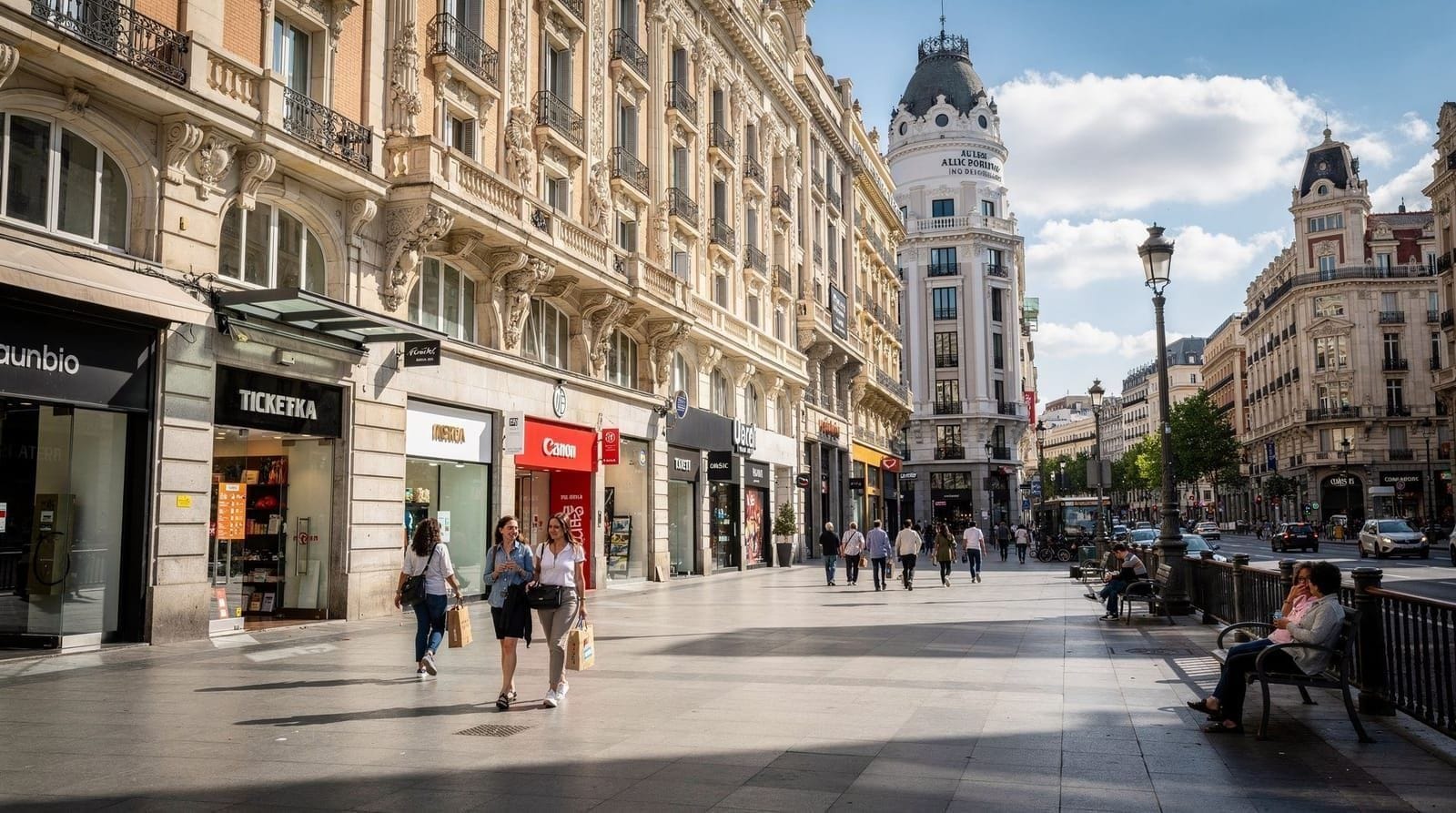
Gran Vía is Madrid's most architecturally spectacular street — 1.3 km of early 20th-century Beaux-Arts, Modernisme, and Art Deco buildings built between 1910 and 1932 as Spain's answer to the Champs-Élysées. Worth walking once for the architecture and the energy. It is also Madrid's theatre district, and several of the musicals playing here (in Spanish) are genuinely good.
In brief: Gran Vía is Madrid’s most theatrical street — a 1.3 km of turn-of-the-century architectural ambition, now functioning as a shopping boulevard and theatre district. Walk it once for the buildings (especially the Metrópolis corner at dusk); come back in the evening if you want Madrid’s version of Broadway.
| Where | Central Madrid, from Calle de Alcalá to Plaza de España |
| Cost | Free to walk; museums/shows extra (musicals from around €30–70) |
| Time needed | 45 min viewing walk, or 2 hours with shopping/food |
| Getting there | Metro Banco de España, Gran Vía, Callao or Plaza de España |
| Best time | Late afternoon (17:00–19:00) or after 22:00 for illuminated facades |
Built to modernise a city that was falling behind
Gran Vía did not exist before 1910. Madrid’s medieval street pattern — dense, irregular, organic — was still largely intact in the centre of the city when the Restoration-era government decided that the capital needed a modern boulevard comparable to Haussmann’s Paris or Vienna’s Ringstrasse.
The construction required demolishing 14 complete streets and 315 buildings in the oldest part of the city, displacing thousands of residents. The project took 22 years — from 1910 to 1932 — divided into three sections that reflect the architectural fashions of each decade.
Section 1 (Alcalá to Red de San Luis, 1910–1924): Beaux-Arts and Historicist. The Metrópolis building (1911) establishes the visual register of the first stretch — ornate stone facades, elaborate corner treatments, allegories in carved stone.
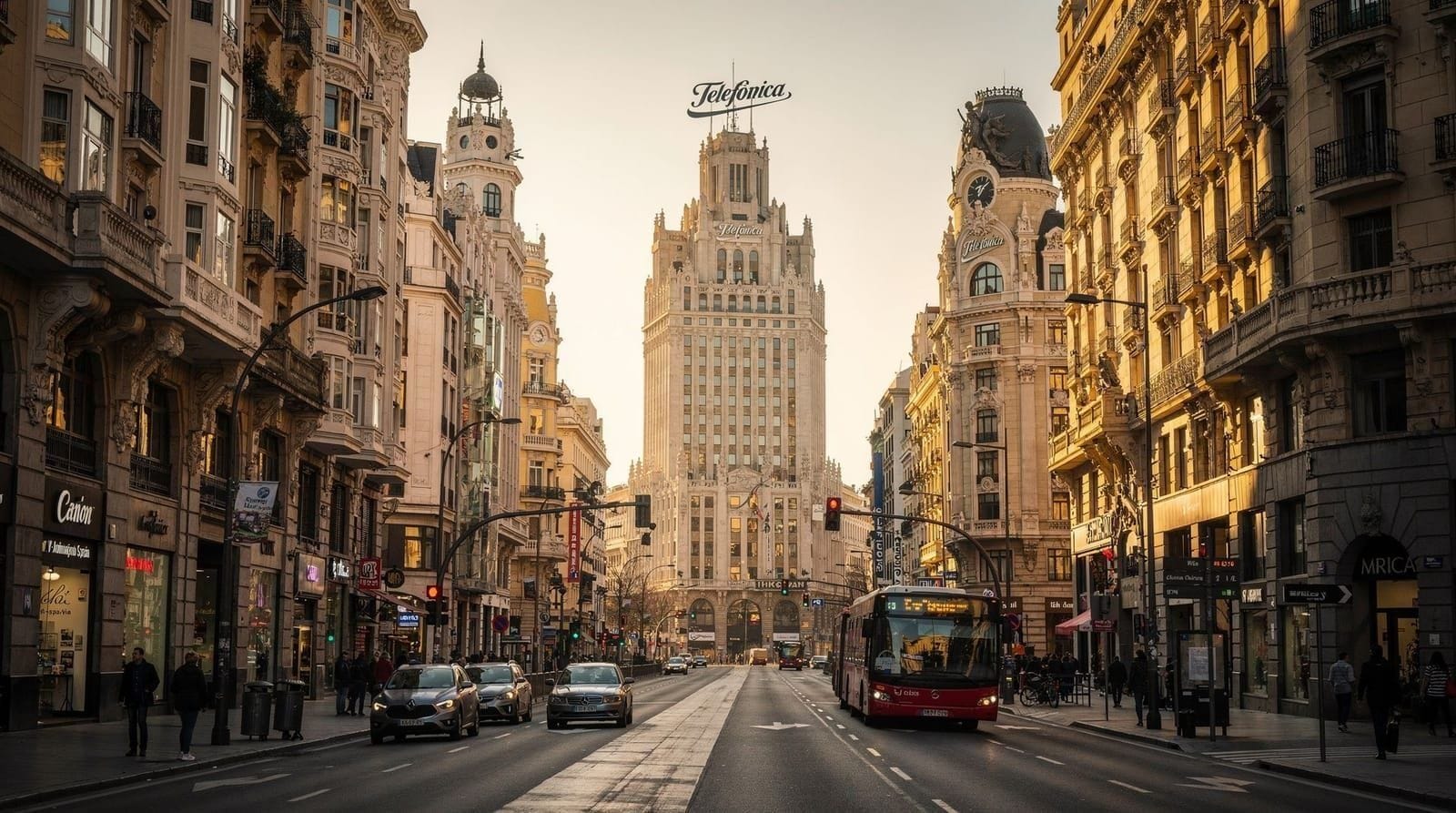
Section 2 (Red de San Luis to Callao, 1917–1928): More eclectic, mixing Modernisme elements with rationalist influences. The Telefónica Building (1929) — in section 2, just north of the red de San Luis intersection — breaks with the ornate neighbours in its stripped-back American-influenced rationalism.
Section 3 (Callao to Plaza de España, 1925–1932): The most overtly cinematic section, influenced by American movie-palace architecture. The Capitol Building (1933), the Carrión/Palacio de la Prensa building, and several former cinemas with curved facades and vertical signage.
The buildings worth stopping for
Edificio Metrópolis (Calle de Alcalá 39): The starting point if you approach from Sol. Built in 1905–1911 by the Parisian firm of Jules and Raymond Février for a French insurance company, the building has a circular corner tower topped by a zinc-covered dome and, since 1975, an allegorical winged Victory statue (the original winged Phoenix was removed when the original client sold the building). The building is best photographed from the Gran Vía–Alcalá intersection looking west at dusk, when the facade catches the low western light.
Edificio Telefónica (Gran Vía 28): Built 1926–1929 by American architect Louis Weeks for the International Telephone and Telegraph Corporation, this was the tallest building in Europe at its 1929 opening (89 metres). The design is New York in Madrid — brick and terracotta in the manner of 1920s American commercial architecture, with minimal European ornament. The building served as a Republican observation post during the Siege of Madrid in the Civil War; Franco’s forces shelled it without bringing it down, which is why it remains (the shelling scars were repaired). Today it houses a Telefónica store and cultural space at ground level.
Edificio Capitol/Carrión (Gran Vía 41): A 1933 Art Deco building with a curved facade and setback upper floors — the clearest American Art Deco influence on the whole street. Originally housed the Capitol cinema and apartments; it now houses the NH Collection Hotel at the top (with a rooftop bar that has excellent views) and a cinema at ground level.
Casa Matesanz (Gran Vía 27): A 1923 Modernisme building with typical Catalan-influenced decorative programme — tile work, organic stone ornament, elaborate ironwork. A reminder that the Barcelona Modernisme style had significant influence in Madrid during this period.
Gran Vía as a theatre and cinema district
Madrid does not have the West End or Broadway — it has Gran Vía. The major theatres are clustered around the middle and western sections:
Teatro Lara (Corredera Baja de San Pablo 15, just north): One of Madrid’s oldest functioning theatres (1880), programming quality Spanish-language drama and comedy.
Teatro Rialto (Calle de Valverde 9): Housed in a former cinema, currently staging major musicals.
Teatro Nuevo Apolo (Tirso de Molina area): Commercial musicals and large-scale productions.
El Rey León has been a fixture of the Gran Vía musical scene for years; productions rotate every 6–18 months. For English-language speakers, most productions are in Spanish — the experience is still enjoyable for non-speakers if the production is visually strong (El Rey León, Mamma Mia). For current listings: entradas.com, ticketmaster.es, or the individual theatre websites.
Film: Several surviving original cinema buildings still function as cinemas. The most interesting is the Cine Callao (Plaza Callao 3), opened in 1926 and one of the few surviving Art Deco cinema interiors in Spain, now hosting both films and concerts.
If you’d rather have the architecture and history narrated than research it yourself, a hop-on-hop-off route runs the length of Gran Vía with commentary and lets you get off at Callao or Plaza de España to continue on foot:
Madrid hop-on-hop-off sightseeing busShopping: the honest picture
Gran Vía functions primarily as Madrid’s main shopping boulevard for the mass market. You will find:
- Zara (several branches, including a flagship at Calle Preciados connecting to Sol)
- H&M, Mango, Bershka, Pull&Bear: Standard fast-fashion chains at European prices
- El Corte Inglés at Callao: Spain’s major department store, genuinely useful for everything (food hall in basement, pharmacies, electronics, fashion, home goods)
- Camper (Gran Vía 54): Spanish shoe brand with international reputation; Gran Vía has one of the better-stocked stores
For Spanish-specific products: Loewe (luxury leather, Calle Serrano in Salamanca), Camper, Massimo Dutti. The Barrio de Salamanca luxury shopping guide covers the upmarket end.
For affordable and independent: Malasaña (north of Gran Vía, immediately accessible) has vintage shops, Spanish independent designers, and second-hand bookshops. El Rastro (Sunday mornings, La Latina) for flea-market finds.
Sunday hours: Unlike much of Spain, several Gran Vía shops open on Sundays under Madrid’s tourist-zone exemption — El Corte Inglés and most chain stores trade seven days a week here, which is not the case in most Spanish neighbourhoods where Sunday closing is still standard.
Rooftop bars and the Gran Vía skyline
Several buildings on and near Gran Vía have rooftop bars with views of the boulevard skyline:
Circulo de Bellas Artes (Calle de Alcalá 42): The rooftop terrace of the 1926 cultural centre is Madrid’s most accessible quality rooftop view — not technically on Gran Vía but adjacent, with excellent sightlines down the boulevard. Day entry €6 for the rooftop; evenings fill up in summer.
The Principal Madrid Hotel (Marqués de Valdeiglesias 1): Rooftop bar with Gran Vía views; walk-in if there’s space, reservation strongly recommended on weekends.
NH Collection Palacio de Tepa and several other hotels near Gran Vía operate rooftop terraces with varying prices and reservation requirements. The rooftop bars guide covers all options with current pricing.
Gran Vía at night
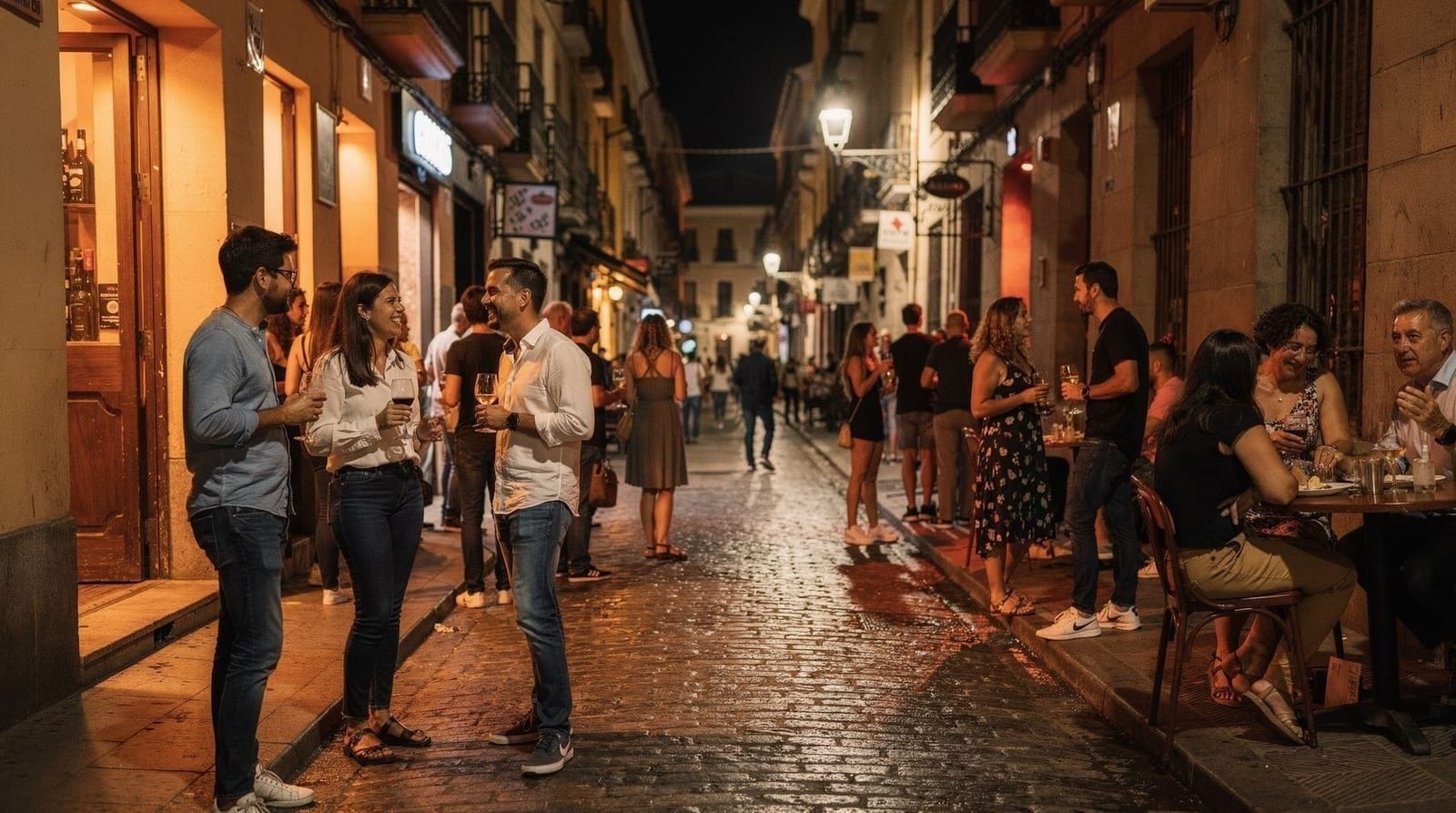
After 22:00 in summer, Gran Vía functions as a major artery of Madrid’s late-night scene. The boulevard itself is busy with people heading to the theatre district shows and late dinners. The side streets north (Chueca, Malasaña) and south are where nightlife actually concentrates.
The Madrid nightlife guide covers Gran Vía as a transit zone rather than a destination — it is where you walk to get to Malasaña bars or Chueca clubs, not where you spend the night.
Practical logistics
Walking the full length: Gran Vía is 1.3 km end to end. Walking at a viewing pace (looking up at architecture, stopping for photos) takes about 45 minutes. Walking at normal pace without stopping: 15 minutes.
Metro access:
- Banco de España (Line 2): Metrópolis/Alcalá end
- Gran Vía (Lines 1/5): Middle section at Red de San Luis
- Callao (Lines 3/5): North mid-section
- Plaza de España (Lines 3/10): Western end
Best time to walk: Late afternoon (17:00–19:00) when the light comes from the west and illuminates the Metrópolis building; or at night after 22:00 when the building illumination is most dramatic.
Photography tip: The Metrópolis building corner is almost always in shadow or direct sun; the best light is at dusk (west-facing facade) or the blue hour just after sunset. Gran Vía looking west from the Alcalá intersection at dusk is the classic Madrid skyline shot.
Accessibility: The boulevard itself is flat and wide with generous pavements since the 2018–2020 pedestrianisation, making it one of the more wheelchair- and stroller-friendly walks in the historic centre. Metro stations along the route have lifts at Callao and Gran Vía, though not at every entrance — check the station-specific accessibility map before relying on it.
Toilets and rest stops: El Corte Inglés at Callao has public toilets on several floors and is the most reliable option along the route. The Círculo de Bellas Artes café also has facilities for paying customers, and doubles as a good sit-down break with a view.
What Gran Vía is not: managing expectations
Visitors sometimes arrive expecting Gran Vía to feel like the historic core of Madrid — narrow lanes, centuries-old tapas bars, a medieval street plan. It is the opposite: a purpose-built, early 20th-century commercial boulevard closer in spirit to the grand avenues of Paris or Buenos Aires than to the Habsburg quarter around Plaza Mayor. That distinction matters for planning — if you want the “old Madrid” experience, spend your time in La Latina or the streets around Puerta del Sol instead, and treat Gran Vía as the modern counterpoint: come here for the architecture-as-spectacle and the theatre district, not for a sense of centuries-old continuity.
How Gran Vía connects to the rest of central Madrid
Gran Vía runs east-west through the geographic centre of Madrid, connecting Puerta del Sol (via Calle Preciados and Alcalá) with Plaza de España (where the Royal Palace is accessible via Calle Bailén). The sol-gran-vía neighborhood guide covers the entire district between the boulevard and Sol.
The streets north of Gran Vía lead directly into Malasaña and Chueca — 5-minute walks from the middle section of the boulevard. This adjacency makes Gran Vía a natural starting point for an afternoon that moves from architecture and shopping to neighborhood bars and restaurants.
Gran Vía’s transformation since 2020
The pedestrianisation of the central section of Gran Vía — begun in 2018 and substantially completed by 2020 — has changed the character of the boulevard significantly. Removing most private car traffic from the central lanes has created more pavement space, reduced noise substantially during the day, and made the architectural walk considerably more pleasant. The kerbside bus and taxi lanes remain, but the dense private car traffic that previously made it difficult to look up at the buildings is gone.
The transformation has also changed the commercial composition. Several department stores and large-format retail businesses have moved out; the surviving restaurants and cafés now have proper outdoor terrace space. The boulevard is more leisurely and more functional as a walking experience than it was a decade ago.
The film and cultural history of Gran Vía
Gran Vía was central to Madrid’s cultural life in the mid-20th century in ways that are worth understanding for architecture enthusiasts. The boulevard was Madrid’s cinema district — in the 1940s and 1950s, major Hollywood releases premiered at the Gran Vía palaces, drawing the city’s film-going public to the elaborate lobbies and double-height auditoria.
The Cine Capitol (1933, still partially operating) and the Gran Vía cinema (1959, now converted) were the two flagship theatres. The architectural ambition of the cinema interiors — Art Deco ornament, illuminated signs, queue lanes with ornate ironwork — was intended to make cinema-going a ceremonial occasion rather than a casual amusement. This tradition is visible in the surviving facades even where the cinemas have been converted.
The period also saw Gran Vía develop as a restaurant and café destination for the Madrid bourgeoisie — establishments like the Café del Círculo de Bellas Artes (now the Círculo de Bellas Artes cultural centre café, still excellent) and several hotel dining rooms on side streets established a social geography of Grand boulevard café culture that partially survives today.
Practical walking route recommendations
Architecture walk (45 minutes, east to west): Start at the Metrópolis building corner (Alcalá/Gran Vía junction). Walk west along the south side of the boulevard for the best facade views. Stop at: Edificio Metropolis (look for the Victory statue from below), Casa Matesanz (no. 27, Modernisme), Edificio Telefónica (no. 28, American Rationalism), Palacio de la Prensa (no. 46, 1924 Eclectic), and Edificio Capitol (no. 41, Art Deco). End at Callao metro for a cross-street view north toward Malasaña.
Shopping and food walk (2 hours): Enter from the Callao end. Check the El Corte Inglés food hall for Spanish products (basement of the Callao branch). Walk east for the main retail offerings. Exit at Gran Vía metro and head north 5 minutes to Malasaña for independent shops and cafés. The Malasaña guide covers specific recommendations.
Evening walk (sunset and night): Gran Vía at sunset is spectacular when the low light catches the western facades between 19:00 and 21:00 in summer. Start at Plaza de España and walk east — you walk toward the light with the facades in front of you. End at the Metrópolis corner for the blue-hour photograph with the illuminated dome.
If you would rather spend the evening with a guide than on your own, the old streets just south of the boulevard suit a storytelling walk after dark, such as an evening walk through the legends and dark history of old Madrid. It pairs well with a late dinner afterwards.
Hotels on and around Gran Vía
Several of Madrid’s most interesting hotels are on or adjacent to the boulevard. The Hotel de las Letras (Gran Vía 11) occupies a 1917 Beaux-Arts building with a rooftop terrace bar. The NH Collection Gran Vía (Gran Vía 21) is in the 1930 Edificio Matesanz. The Hard Rock Hotel (Plaza de España) is the most visible — the former Torre de Madrid skyscraper, converted in 2019.
For visitors who prioritise location over everything, Gran Vía hotels put you at the geographic centre of the city within walking distance of Sol, Malasaña, Chueca, the Prado (25 minutes on foot), and the Royal Palace (20 minutes). The noise level (traffic and nightlife) can be significant; request higher floors and interior-facing rooms for quieter options.
Staying this centrally also makes the big museums an easy half-day from your door. If art is part of your plan, a pass covering the three major art museums saves you queuing at each ticket desk, and the Golden Triangle art walk shows how to link them in a sensible order.
Who should prioritise Gran Vía, and who can skip it
If your interest is Madrid’s grand 20th-century architecture, or you want an evening of theatre without needing fluent Spanish (visually strong musicals like El Rey León or Mamma Mia work fine as spectacle), Gran Vía earns real time on your itinerary. If you’ve come for tapas culture, art, or quieter historic streets, a single 45-minute walk-through — perhaps combined with a rooftop drink — is enough; the boulevard’s retail offer duplicates what you can find in most European capitals, and its nightlife is better experienced by continuing into Malasaña or Chueca rather than lingering on Gran Vía itself. First-time visitors on a tight schedule should treat it as a corridor between Sol and the Royal Palace rather than a standalone destination — see the Sol and Gran Vía district guide for how it fits the wider centre.
Frequently asked questions about Gran Vía guide
What is the most interesting building on Gran Vía?
The Edificio Metrópolis (at the corner of Gran Vía and Calle de Alcalá) is the most photographed — a 1911 Beaux-Arts building with an allegorical winged Victory statue on top, originally built for the La Unión y El Fénix insurance company. The Telefónica Building (1929, at Gran Vía 28) was the tallest building in Europe when built and has a Rationalist design that stands out from the ornate neighbours. The Capitol Building (Gran Vía 41, 1933) is the best Art Deco example.Is Gran Vía good for shopping?
It depends what you're buying. Gran Vía has all the major Spanish and international chains — Zara, H&M, El Corte Inglés at Callao, various sportswear brands. For Spanish-specific shopping (Camper shoes, Loewe, Spanish fashion), these are on Gran Vía or a short detour away. For unique or independent shopping, the Malasaña neighbourhood (immediately north) and the Barrio de Salamanca (east) are better. For affordable vintage and market shopping, El Rastro on Sundays.What musicals are on in Gran Vía in 2026?
Gran Vía is Madrid's West End — El Rey León, Mamma Mia, Wicked, and local Spanish-language productions rotate through the major theatres. Productions change seasonally; check Teatros del Canal, Teatro Lara, and the Teatro Rialto for current listings. Most productions are in Spanish; English-language alternatives are rare but occasionally scheduled.Is Gran Vía safe at night?
Gran Vía itself is safe at night — well-lit, busy until 02:00–03:00, with police presence and a dense crowd of Madrileños heading to or from theatre and nightlife. The side streets toward Malasaña and Chueca are also active and safe. The standard pickpocket caution applies in the crowded areas around Callao and Sol.Where does Gran Vía start and end?
Gran Vía runs 1.3 km from Calle de Alcalá (south/east end, where the Metrópolis building stands) to Plaza de España (west end), passing through three sections with different construction periods. Metro access: Banco de España (Alcalá end), Gran Vía (middle), Callao (north mid-section), and Plaza de España (west end).