Puerta del Sol: Madrid's symbolic centre and what to actually do there
Madrid: Historical Centre Old Town French
What is Puerta del Sol and why is it important in Madrid?
Puerta del Sol (Gate of the Sun) is Madrid's symbolic centre — the Kilometre Zero point from which all road distances in Spain are measured, and the traditional gathering place for New Year's Eve. It is a large semi-oval plaza, always busy, with the iconic Bear and Strawberry Tree statue, the regional government building (Casa de Correos), and Metro lines 1, 2, and 3 converging beneath it.
In brief: Puerta del Sol is Madrid’s central node — Metro hub (Lines 1/2/3), New Year’s Eve landmark, Bear statue photo stop, and Kilometre Zero of the Spanish road network. Worth 15 minutes of your time; not a destination in itself. The interesting streets radiate out from Sol rather than being in it.
| Where | Central Madrid, Metro Sol (Lines 1/2/3) |
| Cost | Free |
| Time needed | 15–20 minutes; longer on 31 December |
| Getting there | Walkable from almost anywhere in the historic centre |
| Best time | Early morning (before 08:00) to photograph the Bear statue without a queue |
A gate that no longer exists
The name “Puerta del Sol” — Gate of the Sun — refers to a medieval city gate demolished in 1570 as Madrid expanded beyond its original walls. The gate faced east, toward the rising sun; the current plaza occupies the approximate position of the space outside that gate.
For most of its history, the Puerta del Sol was a functional market and meeting point rather than a formal plaza. The urban form you see today dates from the 1850s: a controlled demolition and rebuild under the direction of the Madrid city government, which created the current semi-oval shape and the uniform six-storey facades surrounding it. The project removed 400 properties and reshaped the surrounding street grid.
The central building — the Casa de Correos — predates the 1850s redesign. It was built in 1768 as Madrid’s main post office under Charles III, which explains its neoclassical restraint in a plaza that otherwise reflects later 19th-century urban planning. The clock tower on its facade — a 1866 addition — is the one that strikes the 12 midnight chimes on New Year’s Eve. The building now serves as the headquarters of the Comunidad de Madrid (the autonomous regional government).
The Bear and Strawberry Tree: Madrid’s symbol explained
The Oso y el Madroño appears in Madrid’s coat of arms, on the municipal flag, on every taxi and bus, and in dozens of commercial logos across the city. The bear and strawberry tree combination dates to a 13th-century dispute between the Bishop of Segovia and the citizens of Madrid over land rights: the city retained rights to the forests, the bishop to the pastures.
The bear (a common animal in the forests around Madrid at the time) and the madroño (the characteristic tree of those forests) became the civic symbol of the city’s rights.
The statue in the plaza is a bronze casting from 1967, replacing earlier stone versions. It stands 4 metres high with the bear in characteristic pose — upright, front paws gripping the madroño branches, mouth open toward the red fruit. The base is polished smooth by the hands of generations of visitors. Photograph it early morning (before 08:00) to avoid queueing.
The Metro hub
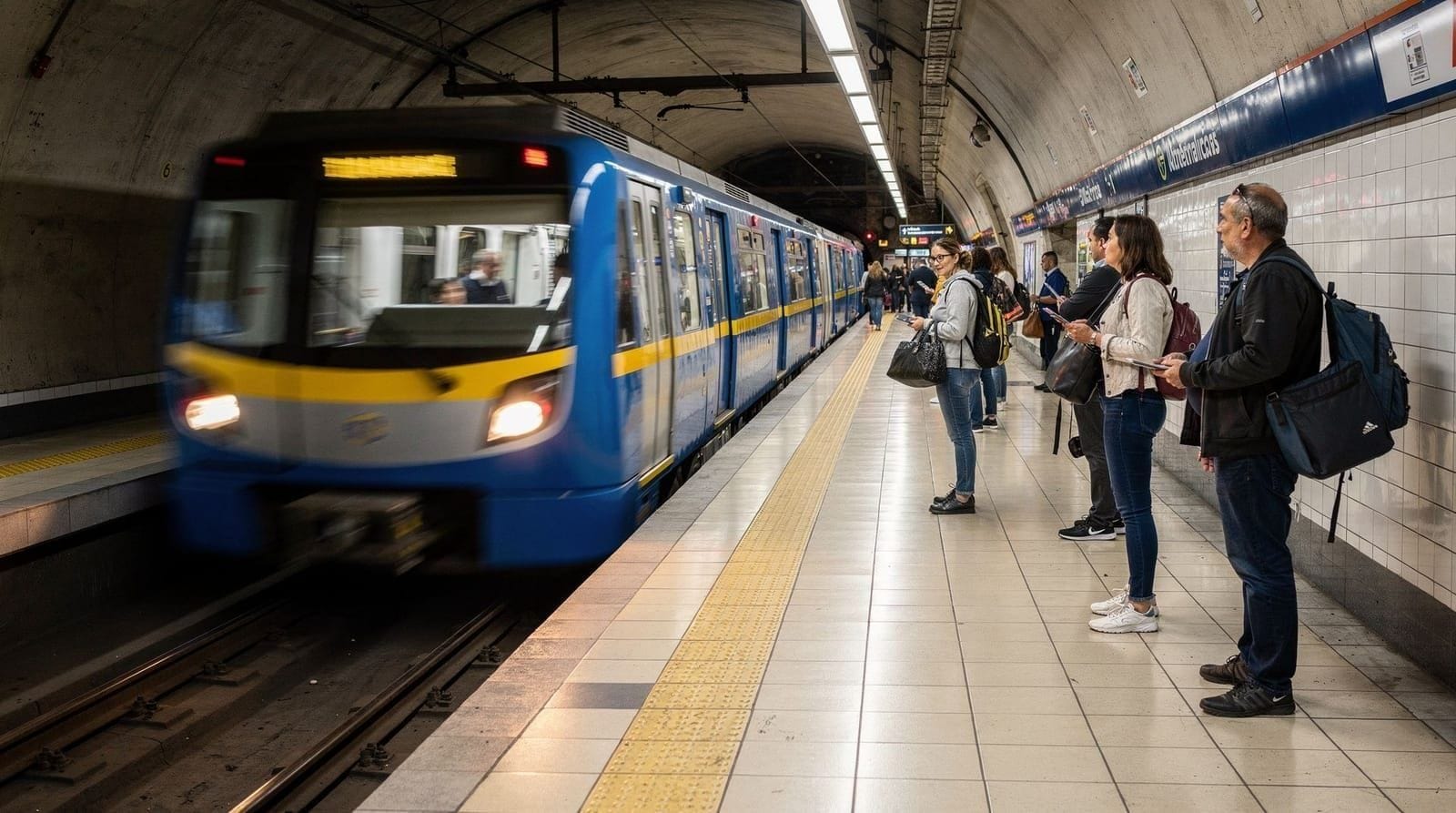
Three Metro lines intersect beneath Puerta del Sol:
- Line 1 (light blue): Runs north-south, connecting Pinar de Chamartín to Valdecarros
- Line 2 (red): Connects Cuatro Caminos with Las Rosas, passing through Banco de España and Opera
- Line 3 (yellow): Connects Moncloa with Villaverde Alto
Sol is the point at which the three major radial Metro lines converge, which makes it the natural interchange point for most city-center journeys. The station is large, well-signposted, and functional — but crowded at peak times (08:00–09:30, 14:00–15:00, 18:00–20:00). The Madrid Metro guide covers the full network.
The Cercanías suburban rail network also connects through the Sol station, with connections to destinations across the metropolitan area.
New Year’s Eve at Sol: what actually happens
The Nochevieja (New Year’s Eve) tradition at Puerta del Sol is one of Spain’s most widely-viewed television events. The ceremony:
At midnight, the bell in the Casa de Correos clock tower strikes 12 times. The tradition — widespread throughout Spain — is to eat one grape per chime: if you eat all 12 grapes in time with the chimes, you will have good luck for the year. In practice, eating 12 grapes in approximately 12 seconds is more difficult than it sounds; the grapes are traditionally seeded Aledo grapes, and seedless alternatives (labeled “grapes for the bells”) are sold everywhere in December.
At Sol on 31 December, 20,000–40,000 people pack into the plaza. The atmosphere is festive and generally good-humoured. Practical considerations:
- Arrive by 22:00 at the latest if you want a plaza position
- Metro runs all night on NYE
- Alcohol is sold freely; the crowd is predominantly Spanish and orderly
- Dress warmly — Madrid in late December is cold (0–8°C, sometimes colder)
- Bag security: the NYE crowd is the most intensively pickpocketed event of the year in Madrid
What to do around Sol
Sol itself is transitory — a place to pass through rather than stay. The interesting streets radiate from it:
East along Calle de Alcalá: Toward the Gran Vía intersection and then the Barrio de las Letras. Some of Madrid’s best café architecture on this stretch.
West along Calle Mayor: Toward Plaza Mayor (5 minutes) and then the Royal Palace (15 minutes). The historical heart of Habsburg Madrid runs along this axis.
South along Carrera de San Jerónimo: Toward the Cortes (Spanish Parliament), the Thyssen Museum, and the Paseo del Prado. The Congress of Deputies building (neoclassical, with bronze lions at the door) is visible from Sol.
North along Calle Preciados: The main pedestrian shopping street, connecting Sol to Callao and the Gran Vía. Department stores, chains, and the El Corte Inglés anchors.
Southwest toward La Latina: Through the streets of the Madrid de los Austrias quarter, reaching the best tapas bars in 10–15 minutes.
If you would rather have someone connect these streets for you than read a map, a guided walk through the historic old town in French starts from this central area and puts the plaza into the longer story of the city. It suits travellers who like context with their sightseeing; if you prefer to wander freely, the directions above are enough.
The protest tradition
Puerta del Sol has a political dimension that tourist guides often omit. The plaza was the scene of the Spanish Velvet Revolution protests against the Bourbon restoration in 1820, of significant 20th-century political demonstrations, and most recently of the 15-M (Indignados) movement in 2011, when thousands of people occupied the plaza for weeks in protest against austerity and corruption. A plaque near the station entrance commemorates this. The plaza’s location at the centre of the capital has always made it the natural gathering point for political expression.
Practical notes
Address: Puerta del Sol s/n, 28013 Madrid. The plaza is at the intersection of 10 streets.
Getting there: Metro Sol (Lines 1/2/3). The central location means Sol is within walking distance (10–20 minutes) of almost everything in the historic center.
Toilets: None in the plaza itself. The nearby department store El Corte Inglés (Calle Preciados, 2 minutes) has public facilities.
Tourist information: The City of Madrid tourist office operates in the Casa de la Panadería on Plaza Mayor, 5 minutes on foot. The regional tourist office is in the Torre de Madrid building on Plaza de España.
The Madrid first weekend itinerary and the one-day Madrid itinerary both use Sol as the start point for the morning walking circuit — it is the natural place to orient yourself on arrival before heading to the specific sights that are the purpose of the trip.
Transport orientation at Puerta del Sol
For visitors arriving at Sol for the first time and trying to understand their position relative to Madrid’s geography, a few reference points help:
The Prado Museum: 20 minutes on foot southeast along Carrera de San Jerónimo and into the Paseo del Prado. Or Metro Line 1 to Atocha (2 stops, 5 minutes).
The Royal Palace: 15 minutes on foot west along Calle Mayor, through Plaza Mayor, continuing west via Calle Bailén.
Retiro Park: 15 minutes southeast on foot along Carrera de San Jerónimo or Calle de Alfonso XII.
Malasaña: 15 minutes north via Gran Vía and then north.
La Latina: 10 minutes southwest via Calle Toledo or through Plaza Mayor.
If the Prado is on your list, the entrance queue is the part most worth planning around; a guided Prado visit with skip-the-line entry removes that wait and gives you a route through the collection. For modern art, a skip-the-line ticket for the Reina Sofía does the same job. Both are optional; the museums can also be visited independently, and the Prado guide and Reina Sofía guide explain how.
Metro Lines 1, 2, and 3 at Sol give direct access to virtually every Madrid destination without a change. This centrality is why arriving at Sol, taking 5 minutes to orientate with the map, and then choosing your direction is genuinely useful.
The clock on the Casa de Correos
The clock tower on the Casa de Correos facade is a 1866 addition to the original 1768 building, designed by the watchmaker Ramón Losada. It strikes the hours and quarters with a bell that, at night in the surrounding streets, is audible for several blocks.
The clock runs on Central European Time (CET/CEST) — Spain is in the same time zone as France and Germany, which is one hour ahead of the UK despite being geographically further west. This means Madrid’s summer sunsets (22:00–22:30 in July) are among the latest in Western Europe at comparable latitude — a consequence of the time zone alignment chosen under Franco in the 1940s.
The clock is also significant as one of the few mechanical tower clocks in central Madrid still in original operation. The restoration in the early 2000s preserved the original movement.
Common scams to watch for around Sol
Beyond pickpocketing, Puerta del Sol has a consistent set of confidence tricks:
The human statues: Not a scam, but worth understanding — some performers expect payment if you photograph them. A coin is appreciated; refusing after photographing is rude in local terms. Have €0.50–1 ready if you want the photo.
The three-cup game (three-card monte): Illegal street gambling using shells or cups. The participant always loses. Madrid police regularly break up these operations; they reconvene minutes later. Simply do not engage.
The “friendship bracelet”: Someone approaches, starts tying a bracelet on your wrist, then demands payment. Politely but firmly decline before the bracelet is attached. Once on your wrist, the social dynamic shifts uncomfortably.
The petition signers: People with clipboards “collecting signatures” for charitable causes who then ask for cash donations. The causes are typically fictitious. Walk past without stopping.
Fake police: In tourist areas, people occasionally approach claiming to be plain-clothes police asking to “check your wallet for counterfeit notes.” Real police in Spain do not operate this way. Do not hand over your wallet.
None of these require anxiety — Sol is safe. They require awareness and the ability to decline without extended interaction.
The Christmas Eve and New Year celebrations
Nochebuena (24 December): Madrid’s Christmas Eve is primarily a family celebration. By 20:00, the city centre empties as people gather for family dinners. Sol is quiet by 21:00 in a way it rarely is. This is actually one of the best times to photograph the Christmas lights without crowds.
31 December: The full New Year’s Eve countdown described above. Grapes, clock, champagne, crowds. The metro runs all night; taxis are scarce after midnight. Allow extra time to return to your accommodation.
5 January (Cabalgata de Reyes): The Three Kings parade — one of Spain’s most important traditional celebrations, far more culturally significant than Father Christmas in Madrid. The parade passes through central Madrid including the Sol area, with elaborate floats and the three kings distributing sweets (caramelos) to the crowd. Arrive 2+ hours before the parade for a good viewing position.
Sol as a pedestrian experience
The plaza itself was pedestrianised in 2014, removing the through-traffic that previously made it difficult to cross and stand. The 2014 renovation also added underground public toilets and reorganised the bus stops to the perimeter. The result is a more functional public space — though the sheer volume of pedestrian traffic means it never feels empty.
In summer, the Sol area is busiest 10:00–21:00 and then again after midnight when bars and restaurants on the surrounding streets are in full operation. The two hours after midnight on weekends are when Madrileños use Sol as a transition point between early bars and later nightlife options in Malasaña, Chueca, and La Latina.
Sol as a photography subject
Puerta del Sol is one of Madrid’s most-photographed spaces, but almost all published photographs show the same view: the Casa de Correos clock tower from across the semicircular plaza, preferably at blue hour or at night with the illuminated facade.
More unusual perspectives:
- Looking east from the western entrance (Calle del Arenal side): The semicircular plaza opens up with the Casa de Correos as the backdrop. Best with a wide-angle lens at the 16mm end.
- The Bear and Madroño statue from the south: Approaching from Calle Preciados, the statue is framed against the plaza’s activity rather than against a static background. Morning, before 08:30, when the queue for selfies hasn’t formed.
- The Metro ventilation shafts: Multiple vents emerge from the Metro station and the Cercanías interchange — functional industrial elements in an ornate civic space. The contrast photographs interestingly if you’re looking for something less familiar.
- Night crowds from the elevated arcade of the Fnac building (northwest corner): Looking down on the plaza from the second-floor windows during peak evening hours shows the crowd density and the illuminated facade simultaneously.
The Kilometre Zero marker in context
The Kilómetro Cero embedded in the pavement south of the Casa de Correos entrance is easy to miss. It is a plaque approximately 30cm in diameter, flush with the surrounding paving, marked with a compass rose and the text indicating its status as the origin point of Spain’s road network.
The concept of Kilometre Zero is 18th-century: as the Spanish road system was rationalised and standardised under the Bourbons, a central reference point was established for measuring road distances. Sol was chosen because it was already the geographic heart of the city and the natural starting point of the radial roads leaving Madrid.
Finding the marker has become a minor tourist activity — look for the small group of people staring at the ground south of the main entrance doors. The marker is surrounded by footmarks from visitors who have stood on it for photographs.
Sol in five minutes: the orientation exercise
A practical orientation exercise for first-time visitors arriving at Sol:
- Stand at the Bear statue and identify your compass directions — the clock tower faces east; the morning sun rises behind it.
- Identify the three metro exits (Calle Preciados north, Calle del Carmen north, east and south exits).
- Locate the tourist information signs: the Casa de Correos/regional government building (facing south) has the tourist office signs. The main City of Madrid tourist office is on Plaza Mayor, 5 minutes west.
- Choose your direction: west for Plaza Mayor and La Latina (tapas, Royal Palace); north for Gran Vía and Malasaña; east for Barrio de las Letras and the Prado; southeast for Cibeles and the Paseo del Prado.
This 5-minute exercise at Sol provides more practical orientation than a map study session back at the hotel. The plaza’s function as a hub is most legible when you experience it physically.
Where Sol fits in the broader Madrid narrative
Puerta del Sol’s history runs parallel to Madrid’s transformation from a medieval market town to a modern European capital. The gate was demolished in 1570 when the city first started growing; the current square was created in the 1850s when the government demolished 400 properties in one of the first major urban renewal projects in Spain; the metro arrived in 1919 as part of the 20th-century modernisation.
Each of these transformations reflects the politics of its moment: the 16th-century expansion under Habsburg imperial ambition; the 19th-century urban renewal under constitutional monarchy; the 20th-century infrastructure under the pressures of industrialisation and growing population; the 21st-century pedestrianisation under democratic urban planning. The plaza is a record of the city’s successive layers of ambition and reform.
For visitors interested in Madrid’s urban history, the Madrid habsburg-bourbon history guide covers the political and architectural narrative from the 1560s to the present, with Sol as one of its recurring reference points.
Is Puerta del Sol worth building a visit around?
Honestly, no — and this guide has said so from the start. Sol is a transit hub and a photo stop, not a destination that rewards lingering. The value is entirely in what it connects to: Plaza Mayor and the Royal Palace to the west, Gran Vía to the north, the Prado and Barrio de las Letras to the southeast, La Latina to the southwest.
Treat Sol as a 15-minute waypoint — Bear statue photo, Kilometre Zero marker, orientation — rather than a stop that deserves a dedicated slot on your itinerary.
The one exception is 31 December, when Sol becomes the genuine focal point of the entire city for a few hours.
Frequently asked questions about Puerta del Sol
What is the Bear and Strawberry Tree statue at Puerta del Sol?
The Oso y el Madroño (Bear and Strawberry Tree) is Madrid's civic symbol — a bronze bear standing on its hind legs eating the red fruit of a madroño (strawberry tree). The current statue was installed in 1967 and is a reproduction of a medieval heraldic symbol of Madrid. It is the most photographed object in the city; queues form for selfies throughout the day.What happens at Puerta del Sol on New Year's Eve?
Madrid's main NYE celebration takes place at Puerta del Sol. The tradition is to eat one grape per chime as the clock on the Casa de Correos strikes midnight — 12 grapes in 12 seconds. Around 20,000–40,000 people pack the plaza. The live broadcast from Sol goes out nationally. Arrive by 22:00 for a position; metro services run all night. Champagne and grapes are sold by street vendors.What is Kilometre Zero at Puerta del Sol?
The Kilómetro Cero marker is embedded in the pavement on the south side of the plaza, in front of the Casa de Correos. It is the point from which all road distances in Spain are officially measured — a plaque marks the spot. Almost invisible unless you know where to look; a crowd usually indicates its location as visitors stop to photograph it.Is Puerta del Sol a good place to eat or drink?
The immediate surroundings (Carrera de San Jerónimo, Calle Preciados) have a high concentration of tourist-trap cafés and chain restaurants. For genuine Madrid eating, walk 5 minutes in any direction: east along Calle de Alcalá toward Barrio de las Letras, south along Calle Huertas, or west toward Plaza Mayor and La Latina. Avoid the menus-del-día offered by street hawkers outside Sol.Is Sol safe? I've heard about pickpockets.
Sol is safe in the sense that violent crime is rare. It is however one of Madrid's principal pickpocket hotspots — the volume of tourist traffic and the crowding around Metro entrances and the Bear statue make it a prime working area. Keep bags closed in front of you, phones out of back pockets, and be attentive near the Metro escalators. This is standard city-center vigilance, not cause for anxiety.