Habsburg and Bourbon Madrid: 500 years of royal history in stone
El Escorial: Royal Site Entrance Ticket
What is the Habsburg and Bourbon history of Madrid and where do you see it?
Madrid became Spain's capital in 1561 when Philip II moved the Habsburg court here from Toledo. The Austrias (Habsburg) dynasty built the Palacio Real de El Escorial, the Plaza Mayor, and the old city grid of Madrid de los Austrias. The Bourbon dynasty (from 1700) rebuilt the Royal Palace after a fire, created the Paseo del Prado boulevard, and built the pleasure palaces of Aranjuez and La Granja. Today this history is visible in the Austrias district, the Royal Palace, the Prado (a Bourbon creation), and in day-trip sites like El Escorial and Aranjuez.
| Where | Austrias quarter + Royal Palace (central Madrid); El Escorial and Aranjuez (day trips) |
| Cost | Royal Palace around €18, El Escorial around €13, Aranjuez varies |
| Time needed | Half a day centrally; a full day for either day trip |
| Getting there | Cercanías C-8/C-3 to El Escorial (1hr) or Aranjuez (45min) from Atocha |
| Best time | Weekday mornings; Aranjuez gardens best April–June |
Before Madrid: why a village became an empire’s capital
In 1561, Madrid was a modest Castilian town of perhaps 30,000 people with no cathedral, no university, no history of political importance. Toledo was the historical capital. Valladolid was where the court had most recently resided. Seville controlled the America trade. So why did Philip II choose Madrid?
The reasons were pragmatic rather than symbolic: Madrid sat at the geographic centre of the Iberian Peninsula, on a plateau high enough to be defensible and cool enough to be tolerable for royal administration, close to the hunting grounds of El Pardo and the Guadarrama mountains, and distant from the factional politics of older cities. Moving the court here allowed the Habsburg monarchy to build a new administrative centre from scratch, shaped to its needs.
Within 50 years, Madrid had grown to over 100,000 people. Within a century, it was one of Europe’s largest cities, capital of an empire spanning the Americas, the Philippines, parts of Italy, the Low Countries, and portions of Germany and Africa. The physical traces of that explosive growth remain visible in the centre of the city today.
The Habsburg layer: Madrid de los Austrias
The oldest layer of Madrid’s built heritage is the quarter known as Madrid de los Austrias — the Austrias being the Spanish name for the Habsburg dynasty. This district, centred on the Plaza Mayor and its surroundings, dates primarily from the reigns of Philip II (1556–1598), Philip III (1598–1621), and Philip IV (1621–1665).
What defines Habsburg Madrid:
- Narrow, irregular medieval street grid inherited from the Moorish town and adapted by successive generations
- Brick and granite construction (the local combination known as “Madrileño style” or estilo herreriano after architect Juan de Herrera)
- Square towers, slate roofs, and austere facades typical of northern European Catholic architecture
- A network of convents and churches that occupied a significant fraction of the city’s land area (many survived; some were demolished in the 19th century)
The key Habsburg buildings:
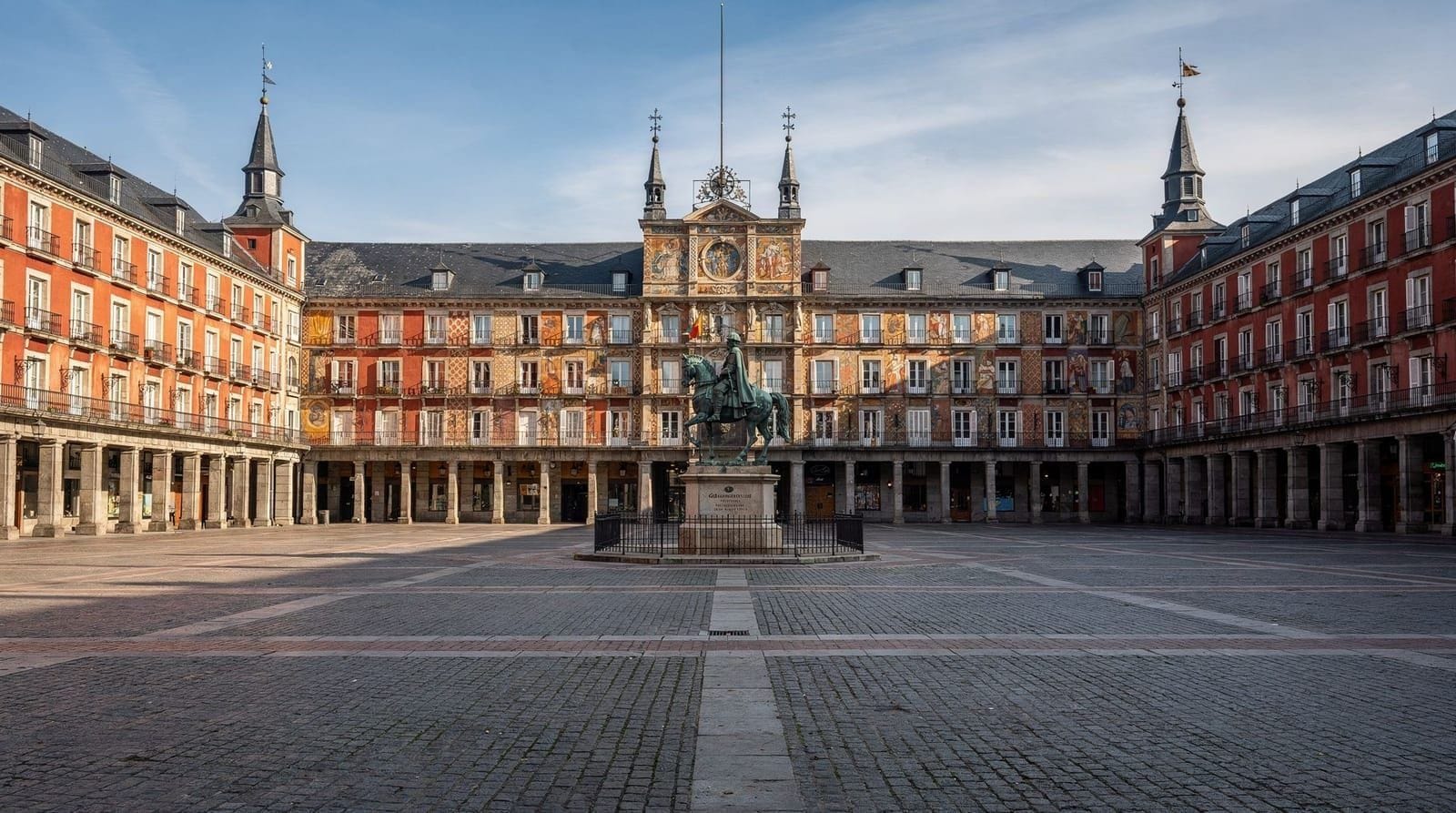
Plaza Mayor (1619) — Commissioned by Philip III, designed by Juan Gómez de Mora. The plaza was built to provide a formal, enclosed public space for royal ceremonies, bullfights, and public executions (auto-da-fé). The bronze equestrian statue of Philip III at the centre was cast in Italy in 1616. The current appearance reflects an 18th-century rebuilding after a fire; the nine identical gateways and the uniform arcade date from this period. The frescoed facades of the Casa de la Panadería (the royal bakehouse) were added later.
Casa de la Villa (old city hall) — On Plaza de la Villa, the 17th-century city hall (now used for public events) with its characteristic Madrileño tower.
Convento de las Descalzas Reales — A royal convent founded in 1559 by Juana of Austria, daughter of Emperor Charles V and sister of Philip II. The interior — visible on guided tours — contains an extraordinary collection of Flemish tapestries, royal portraits, and devotional objects accumulated across four centuries. One of Madrid’s genuinely undervisited treasures; entry €6.
The Palacio Real (Alcázar predecessor) — The original Habsburg palace on the high ground above the Manzanares river burned down in 1734. Philip II had significantly expanded it; its site is now occupied by the Bourbon Royal Palace, but the topography and the relationship to the city below remains the same.
El Escorial: the Habsburg monument
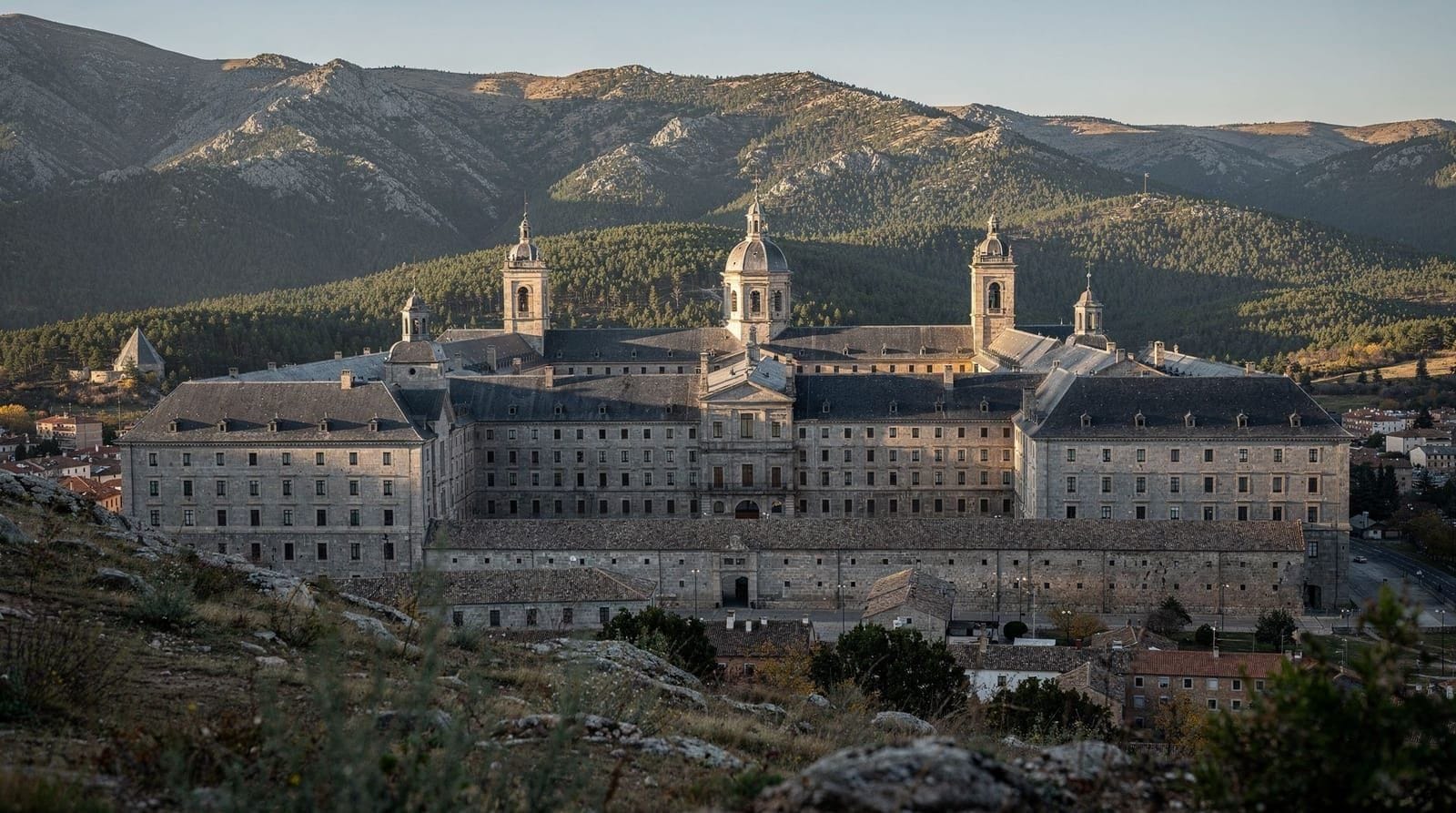
Thirty kilometres northwest of Madrid, the Real Monasterio de El Escorial is the most complete expression of Habsburg ideology in architecture. Philip II commissioned Juan de Herrera to design and build a combined monastery, royal palace, library, and mausoleum on the slopes of the Guadarrama mountains, completed in 1584.
The building’s scale is extraordinary — 16 courts, 86 staircases, 300 cells, 15 cloisters, and a basilica whose interior volume rivals St Peter’s in Rome. The aesthetic is austere, unornamented, and imposing — a deliberate rejection of Renaissance ornament in favour of power communicated through geometry and scale.
What to see:
- The Pantheon of Kings — the circular underground crypt where all Spanish monarchs from Charles I to Alfonso XIII (with exceptions) are buried. Marble, gilt bronze, and absolute silence.
- The Library — 40,000 volumes and one of the most beautiful Baroque library spaces in Europe, with ceiling frescoes by Pellegrino Tibaldi.
- The royal apartments of Philip II — a series of small, austere rooms with tile floors and religious paintings; famously, Philip II’s bedroom was arranged so that he could see the high altar from his bed.
El Escorial is 1 hour from Madrid by Cercanías train (C-8 from Atocha or Príncipe Pío). Entry to the monastery €13, €7 reduced.
El Escorial royal monastery entrance ticket covers skip-the-line access if you’d rather not risk queueing on a day-trip schedule with a fixed return train.
The Bourbon turn: a new dynasty and a new city
In 1700, the last Habsburg king of Spain, Charles II, died without a direct heir. The War of Spanish Succession (1701–1714) ended with the Bourbon grandson of Louis XIV of France — Philip V — on the Spanish throne. The Bourbons brought French aesthetic values and a different vision of royal representation.
The shift is visible in Madrid’s architecture:
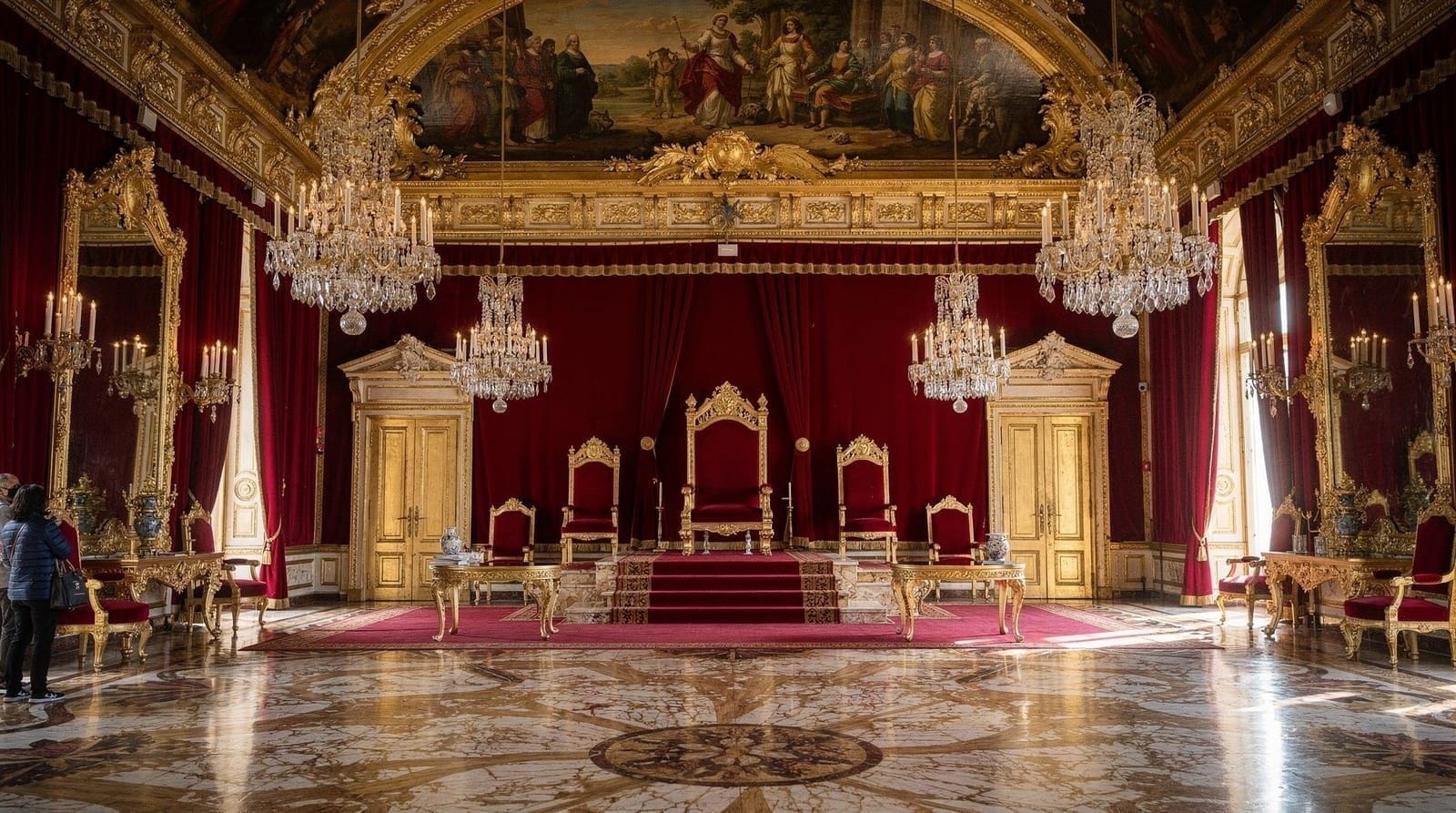
The Palacio Real — In 1734, the original Habsburg Alcázar burned in a catastrophic fire on Christmas Eve. Philip V commissioned an entirely new palace in the French-Italian Baroque style from Italian architect Filippo Juvara (and after his death, Giovanni Battista Sacchetti). Completed under Charles III in 1764, the Royal Palace replaced the austere Habsburg structure with a building of 3,418 rooms in white granite and limestone, designed to demonstrate Bourbon authority on a European scale.
The palace is the largest royal palace in Western Europe by floor area. It is still the official residence of the Spanish royal family (who do not live there — they live at Zarzuela Palace outside Madrid, which is not open to the public). The Royal Palace is used for state ceremonies and is open to visitors daily.
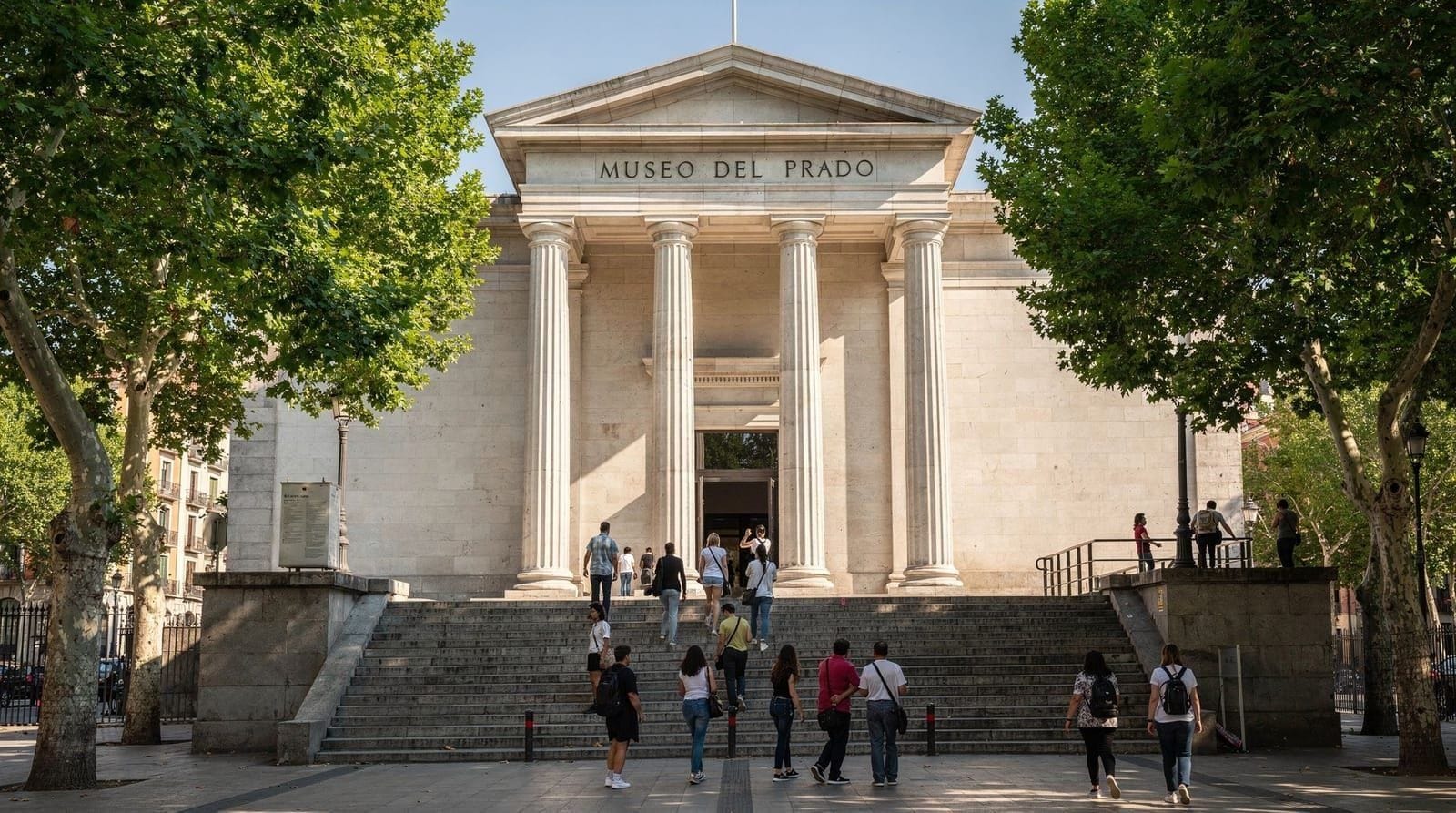
The Paseo del Prado — Charles III (1759–1788) was Madrid’s great urban reformer, responsible for the transformation of the city from a medieval accretion to something resembling a planned European capital. His most lasting achievement was the Paseo del Prado — a tree-lined boulevard with fountains (Cibeles, Neptune, Apollo) built to provide a formal promenade for the court and citizens. The same project included the construction of the Prado building (originally a natural history museum) and the Real Jardín Botánico. The Bourbon vision was Enlightenment urbanism: rational, public, designed for circulation rather than enclosure.
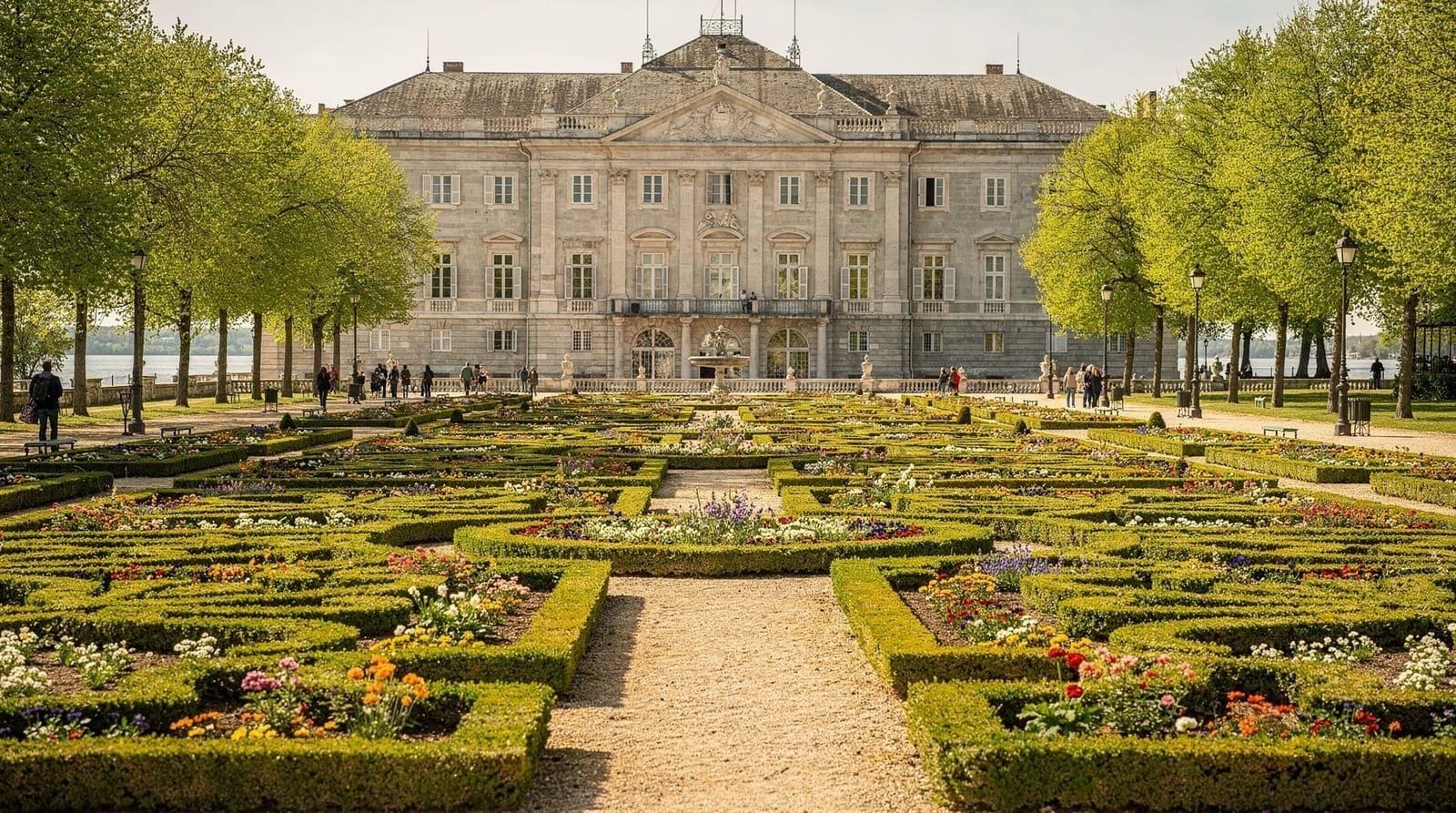
Aranjuez — The royal palace and gardens at Aranjuez, 45 minutes south of Madrid by Cercanías, are a Bourbon creation — the 18th-century remodelling of an earlier royal property into a French-style palace with formal gardens on the banks of the Tagus and Jarama rivers. The UNESCO designation of Aranjuez’s cultural landscape recognises the completeness of this Bourbon vision: palace, gardens, fountains, royal canal, and the surrounding cultivated landscape as an integrated composition.
The Bourbon art collection: the Prado’s origins
The Prado opened as a public museum in 1819, but its collection was assembled by Spanish monarchs from the Habsburg period onward. Philip II had acquired Flemish and Italian works on an imperial scale; Philip IV was a patron of Velázquez and collected more than 2,000 paintings. Charles III began organising the royal collections.
Ferdinand VII — the Bourbon king who opened the Prado — made available to the public a royal collection of unparalleled quality that had been accumulating for 300 years. The museum building itself was designed under Charles III by Juan de Villanueva in neoclassical style.
This is why the Prado’s old master collection has no parallel: it reflects 300 years of Spanish royal collecting, including works that arrived as gifts from other European courts, war spoils, diplomatic presents, and direct commissions. The Velázquez portraits were painted for the Habsburg court; the Flemish works were acquired through Habsburg family connections to the Low Countries; the Italian Renaissance works came through Spain’s political control of Naples and Milan.
Walking the Habsburg-Bourbon trail in central Madrid
A 2-hour walking itinerary covering both dynasties in central Madrid:
- Start: Puerta del Sol — the geographic centre of Spain and the 0 km marker for all national highways. The current neoclassical building dates from Bourbon urban reform.
- Walk west on Calle Mayor — passing the Habsburg street grid, the 17th-century Convento de las Descalzas Reales on your right.
- Plaza Mayor — the Habsburg centrepiece. Note the gates, the arcade, the bronze Philip III.
- Continue west to Plaza de la Villa — the 16th–17th century city hall complex (Habsburg civic architecture).
- Descend to Plaza de la Armería (Armory Square) — the forecourt of the Royal Palace, with views toward the Campo del Moro gardens.
- Royal Palace — the Bourbon replacement for the Habsburg Alcázar. Entry €18; the state rooms and the Pantheon of Infantas are the highlights.
- Almudena Cathedral — built 1883–1993, finally consecrated by Pope John Paul II, in a neo-Gothic style that attempts to align with the Royal Palace’s neoclassical exterior. Free entry.
- Return east via the Cuesta de San Vicente to the Paseo del Prado — the Bourbon boulevard, ending at the Prado.
Total: 5–6 km on foot, mostly flat or slight downhill westward, returning east.
Timing this walk: Start by 09:30–10:00 to reach the Royal Palace before the mid-morning tour-group surge, and check the palace’s ceremonial calendar in advance — the Cambio de la Guardia (changing of the guard, first Wednesday of the month at 12:00, except January, July and August) is worth timing for if it fits, but it also draws crowds that make the forecourt harder to move through. Allow the full afternoon for the Royal Palace and Almudena Cathedral together rather than rushing both before lunch; the state rooms alone justify 90 minutes to two hours.
Day trips for the Habsburg-Bourbon history arc
El Escorial (1 hour by Cercanías C-8): The apex of Habsburg royal architecture. Combine with a lunch stop in San Lorenzo de El Escorial town (the monastery is the visit; the town has decent restaurants).
Aranjuez (45 min by Cercanías C-3): Bourbon palace and gardens. Spring is best — the royal gardens are at their most impressive April–June. The Museo de Falúas Reales (royal pleasure boats) is unusual. The strawberries of Aranjuez are the local gastronomic claim; they appear in markets from May, and the small train that runs from Madrid seasonally (the Tren de la Fresa, “strawberry train”) makes a themed day of the trip if it’s running during your visit.
Toledo (33 min by AVE from Atocha): The pre-Madrid Habsburg capital, where Charles V held court and El Greco worked for 40 years. The Cathedral is one of the finest Gothic buildings in Spain; the Alcázar was rebuilt as a military museum after the Civil War. The city’s position above the Tagus river is visually dramatic. See the Toledo from Madrid guide.
Of the three, El Escorial is the essential single day trip for this specific historical thread — it is the one site that cannot be substituted by anything in central Madrid, whereas the Royal Palace already gives you a strong dose of Bourbon architecture without leaving the city.
Fitting Habsburg-Bourbon history into a Madrid itinerary
The history arc works best as a 2–3 day overlay on any Madrid trip:
- Day 1: Morning in Madrid de los Austrias (Plaza Mayor, Descalzas Reales), afternoon Royal Palace + Almudena Cathedral
- Day 2: Prado (Bourbon collection, Habsburg portraits) + Paseo del Prado
- Day 3 (day trip): El Escorial or Aranjuez (or Toledo for the pre-Habsburg context)
For the 3-day Madrid itinerary, the Habsburg-Bourbon thread provides a unifying historical narrative across the museums, the Austrias quarter, and the Paseo del Prado boulevard.
See Madrid in one day if time is limited — the priorities are the Royal Palace (Bourbon exterior, Habsburg atmosphere) and the Prado (Habsburg collection, Bourbon institution).
The transition between dynasties: what changed
The Habsburg-to-Bourbon transition of 1700 was not just a change of royal family. It represented a fundamental shift in how the Spanish monarchy understood itself and how it chose to represent power.
Habsburg aesthetic: Austere, northern European in character (the dynasty was German-Burgundian in origin), driven by Catholic religious devotion and a military conception of sovereignty. El Escorial is the perfect expression: a palace where the king’s bedroom faces the high altar of the basilica, where the architecture is deliberately stripped of ornament, where power is communicated through geometry and scale rather than display.
Bourbon aesthetic: French and Italian Baroque — theatrical, exuberant, emphasising the king’s magnificence rather than his piety. The Royal Palace in Madrid, the palaces at La Granja (near Segovia) and Aranjuez, the Paseo del Prado boulevard — all show a different political sensibility: the king as arbiter of taste and beauty, the city as a stage for royal display.
Practical consequences for Madrid: The Bourbons were city builders and institution founders. Charles III (1759–1788, known as “Madrid’s best mayor”) built or commissioned the Prado (initially a natural history museum), the Royal Botanic Garden, the fountains of the Paseo del Prado, the Puerta de Alcalá (triumphal arch, 1778), the customs building (now the Prado’s annex), and extensive street paving and public lighting. The Madrid that international visitors experience is largely a Bourbon creation laid over a Habsburg city.
Why this distinction matters for visitors: Understanding which dynasty built what changes how you read the city. The tight, defensive street pattern around Plaza Mayor and the Descalzas Reales reflects Habsburg-era Madrid, built organically without an overarching plan beyond royal ceremony and religious life. The wide, formal boulevards — the Paseo del Prado, the Puerta de Alcalá’s triumphal arch, the grid pattern around the Retiro — reflect the Bourbon rationalist vision of a capital designed for circulation, commerce, and public display. Walking from one to the other, as the itinerary above does, makes the shift in political philosophy physically legible in a way that reading about it in isolation does not.
The later dynasties and what they added
The 19th and 20th centuries added additional layers to Madrid’s royal and republican history:
Ferdinand VII (1813–1833): Opened the Prado as a public museum (1819), one of the most significant cultural acts of any Spanish monarch. Also responsible for brutal political repression — the Goya Black Paintings were created during this period.
Isabella II (1833–1868): Commissioned the Teatro Real (1850) and the Almudena Cathedral (began 1883, under her symbolic patronage). Her reign ended with the 1868 revolution that opened the Retiro park to the public.
Alfonso XII (1874–1885): The equestrian monument on the Retiro lake bears his name. Short reign but significant: stabilised the constitutional monarchy after the instability of 1868–1873.
Alfonso XIII (1886–1931): Reigned until the proclamation of the Second Republic forced him into exile. The transition from monarchy to republic is marked in Madrid by the opening of the Casa de Campo (formerly royal, given to the public in 1931) and the political events of the 1930s that led to the Civil War.
Key museums for the Habsburg-Bourbon story
Museo del Prado: The Habsburg collection (Velázquez court portraits, Flemish acquisitions, Italian Renaissance paintings) and the Bourbon context (the building, the institutional vision).
Palacio Real (Royal Palace): The Bourbon replacement for the Habsburg Alcázar. The Armería Real (Royal Armory) within the palace complex holds one of the finest collections of royal armour in Europe — Habsburg armour from Charles V onward.
Convento de las Descalzas Reales: Founded by Juana of Austria (Habsburg, daughter of Charles V); the Flemish tapestry collection reflects the Habsburg Low Countries connection. Entry €9; guided visits only.
El Escorial (day trip): The definitive Habsburg monument. Entry to the monastery complex €13.
Aranjuez (day trip): The definitive Bourbon pleasure palace. Royal apartments, gardens, the Casita del Príncipe. See Aranjuez from Madrid for day-trip logistics.
For the visual art produced during these dynasties — the portraits, the religious commissions, the court paintings — the golden triangle art walk provides the curatorial framework.
Aranjuez royal palace and gardens private day trip pairs well with this history arc if you want the Bourbon pleasure-palace counterpart to El Escorial’s Habsburg austerity in a single guided day.
Who this history arc suits, and who should simplify
This is a dense, multi-site narrative, and it rewards visitors who genuinely enjoy connecting architecture to political history across centuries. If that’s not your travel style, you don’t need to abandon the theme entirely — the Royal Palace and Plaza Mayor alone, covered in an afternoon, give you the essential Habsburg-to-Bourbon contrast without the day-trip commitment. Families with young children, or anyone with only a single full day in Madrid, should treat El Escorial and Aranjuez as optional extensions for a return trip rather than must-do additions, since both require the better part of a day including travel. For a first, tightly-scheduled visit, prioritise the central Madrid sites in the walking itinerary above and save the day trips for when you have more time to spend on this specific thread.