Toledo from Madrid: the complete day-trip guide
From Madrid: Toledo Tour with Cathedral and 7 Monuments
How do you get from Madrid to Toledo, and how long does it take?
The AVANT high-speed train from Madrid Puerta de Atocha takes ~33 minutes to Toledo. Several trains run daily (see Renfe); the single fare is €12–16 (return €24–32). Buses from Plaza Elíptica, Avenida de América and Estación Sur also serve Toledo in 50 minutes to 1.5 hours from about €6.55 each way but the train is much faster and nearly as cheap. Toledo is a full-day destination — arrive by 09:30 and stay until at least 17:00 to see the cathedral, Alcázar, El Greco museum, and the old town.
| Where | 70 km southwest of Madrid |
| Cost | ~€50–64/person DIY (train + wristband + lunch) |
| Time needed | Full day recommended, 4–5 hrs minimum |
| Getting there | AVANT train, ~33 min from Atocha |
| Best time | Arrive by 09:30, before cathedral queues form |
What makes Toledo exceptional
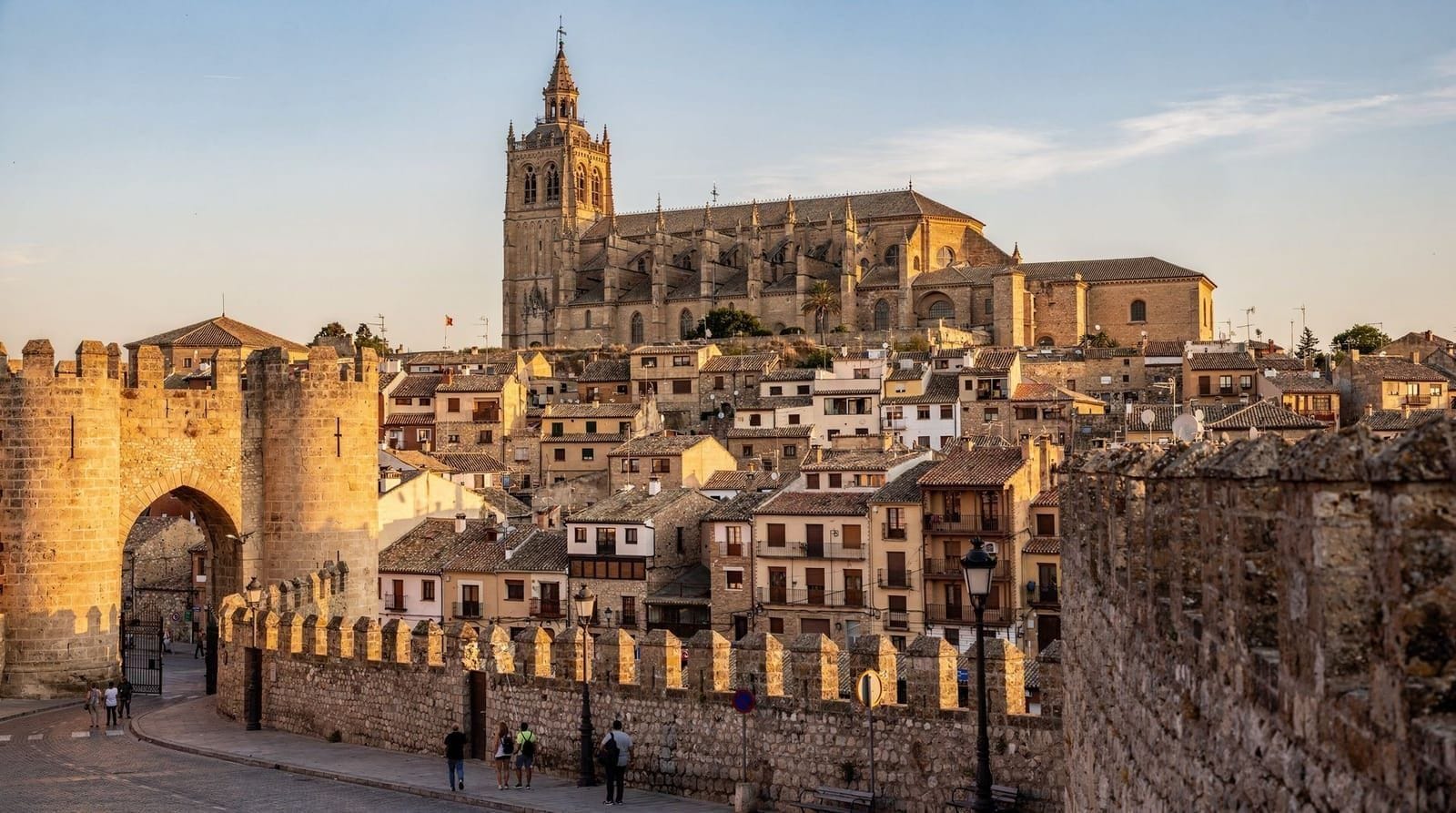
Toledo is the city that would require a week in Italy and half a week in Morocco to replicate. In a single walled hilltop, you get a Gothic cathedral that took 250 years to build, a Moorish palace (the Alcázar), active medieval synagogues, the largest mosque converted to a church in Spain, and a tradition of sword-making and damascene metalwork that predates the Reconquista. El Greco chose to live here rather than Madrid, and his paintings still hang in the churches and museum where he intended them.
All of this is 33 minutes from Madrid by AVANT high-speed train.
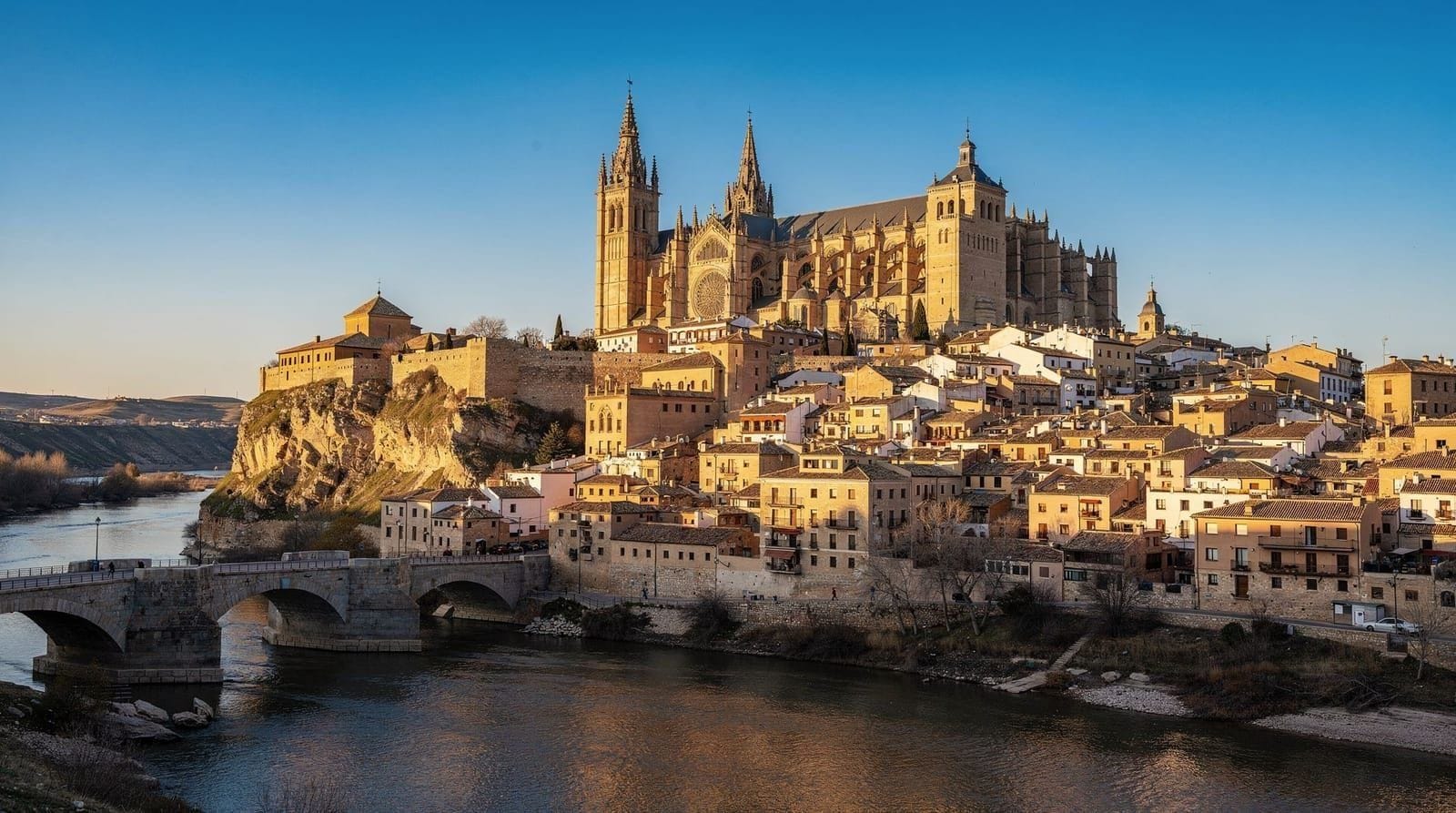
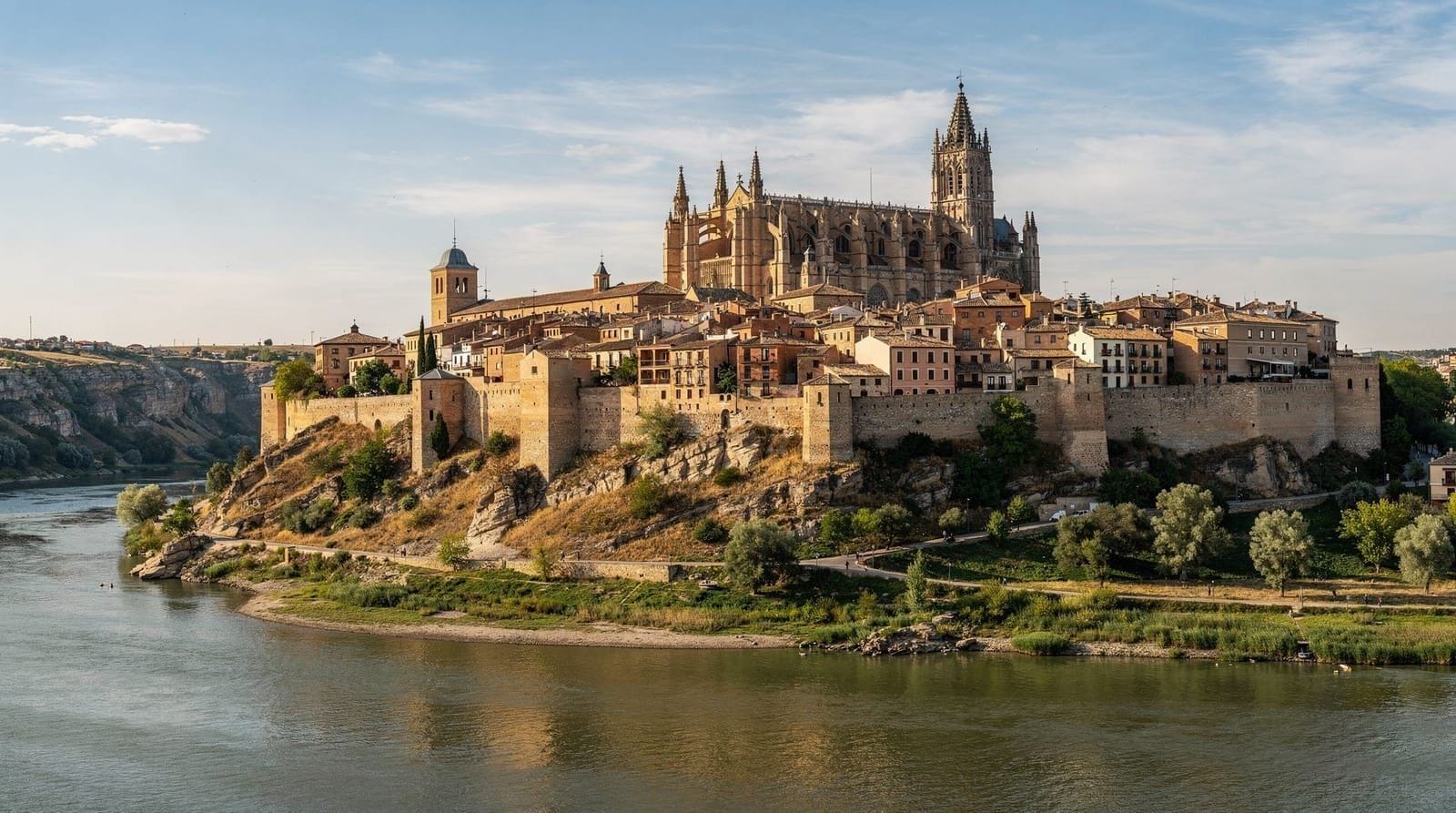
The city sits on a granite hill almost entirely encircled by a loop of the River Tajo — a natural moat that explains why every empire wanted to control it and why the medieval layout has survived. You enter through the Puerta de Bisagra (16th century imperial gate) and immediately step into streets that require almost no imagination to picture in any century from the 7th to the 17th.
Getting to Toledo from Madrid
By AVANT high-speed train (recommended)
The simplest and fastest option. AVANT trains (Spain’s regional high-speed service) depart Madrid Puerta de Atocha and arrive in Toledo in approximately 33 minutes.
- Departure station: Madrid Puerta de Atocha (Metro: Atocha Renfe, Line 1)
- Arrival station: Toledo — a fine Mudéjar-style station building, 1.5 km from the old town
- Frequency: Several trains a day, first departure around 06:45 (see Renfe)
- Fare: €12–16 each way (€24–32 return), depending on time of day and booking window
- Booking: Renfe.com or the Renfe app; Tourist Travel Pass NOT valid (requires separate ticket)
- Pro tip: The return journey is free-seating on AVANT; pick your return train with flexibility
By bus (budget option)
ALSA buses depart from Plaza Elíptica, Avenida de América and Madrid Estación Sur (Metro: Méndez Álvaro, Line 6), arriving at Toledo’s bus station in 50 minutes (direct) to 1.5 hours. Single fares start at about €6.55. The bus station is closer to the old town than the train station but the longer journey time makes this worth it only if you’re on a tight budget.
By guided tour
Full-day Toledo tour from Madrid with optional cathedral entry — bus transfer, guided walking tour, and optional tickets. Good for those who want everything arranged.
Toledo guided day trip by bus — a slightly shorter format, morning departure from Madrid.
Toledo private day trip by train — private guide meets you in Toledo; you travel by AVANT independently.
How to get from the Toledo station to the old town
The Renfe station is 1.5 km northeast of the Puerta de Bisagra, the main gate to the walled city.
Bus 5: Line 5 runs from the station to Plaza de Zocodover (the main square inside the walls). Most reliable option if you have luggage or it’s hot.
Escalators: Free public escalators rise from the Paseo de Recaredo (outside the walls) to near the Alcázar and Zocodover — useful when you’re already inside the walls and heading uphill.
Taxi: ~€5 from the station. Worth it for groups of 3–4.
Walking: 20–25 minutes uphill following signs. Manageable but steep in places.
What to see in Toledo: a practical circuit
Toledo’s old town is compact — roughly 1.5 km across — but densely packed. A full day allows you to see everything; a half-day means choosing priorities.
The Cathedral of Toledo
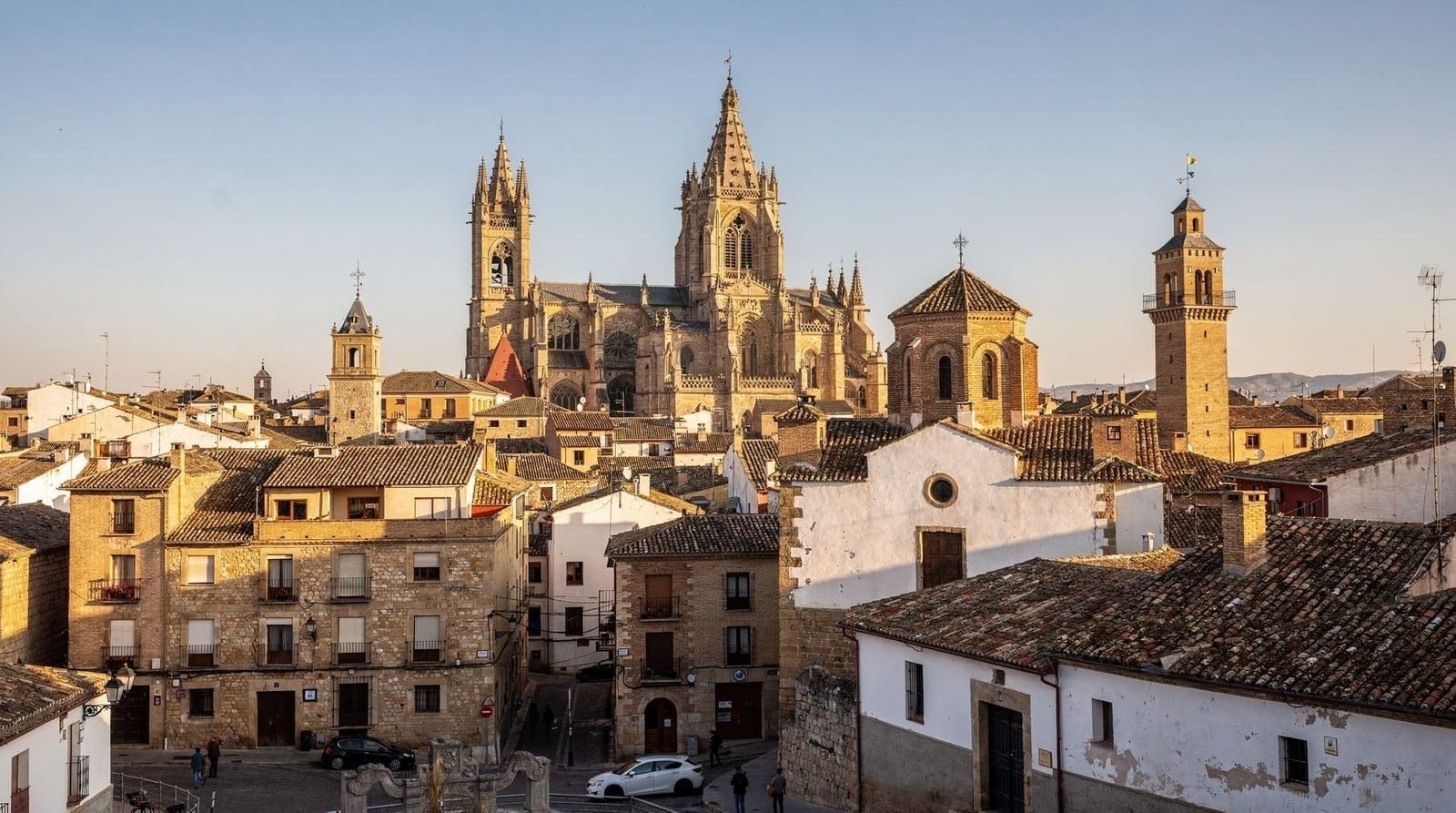
Spain’s most impressive Gothic cathedral. Construction began in 1226 and the main structure was completed by 1493, though the Transparente (a baroque chandelier of marble figures pouring through a hole punched in the ceiling) was added in 1732. Inside: 88 side chapels, a treasury with El Greco’s “The Disrobing of Christ” and Goya altarpiece paintings, medieval choir stalls, and 750 stained glass windows.
Practical: admission €12, open Monday–Saturday 10:00–18:30, Sunday 14:00–18:30. Buy online or at the cathedral shop; queues form from ~10:30. Budget 90 minutes minimum.
Alcázar de Toledo
The fortress-palace on Toledo’s highest point, now the Castillo-Alcázar military museum. The exterior — four symmetrical towers — is the silhouette that defines Toledo. Inside: an extensive military history museum (heavily focused on the 1936 Civil War siege in which Nationalist forces held the Alcázar for 70 days) and views over the surrounding plateau. Admission: €5.
El Greco museum (Museo del Greco)
Housed near where El Greco actually lived and worked, this museum displays his paintings in context — the rooms recreated to approximate the domestic and studio spaces of a 16th-century Greek-born painter in Imperial Spain. The “Apostolado” series (12 portraits of the apostles) is the centrepiece. Admission: €3 (free on Saturday from 14:00 and on Sunday).
Sinagoga del Tránsito and Santa María la Blanca
Two medieval synagogues in the Judería (Jewish quarter), built before the 1492 expulsion of Spanish Jews. The Tránsito (now the Sephardic Museum) has extraordinary Mudéjar plasterwork decoration. Santa María la Blanca has been converted to a church but retains its Islamic-style horseshoe arches. Santa María la Blanca is included in the tourist wristband; the Tránsito is not.
San Juan de los Reyes
A Franciscan monastery built by Ferdinand and Isabella to commemorate the Battle of Toro (1476). The cloisters are the most ornate Gothic stonework in Toledo. From the terrace: chains of Christian slaves freed from Moorish captivity were hung on the exterior walls as an act of devotion. Wristband entry.
Mirador del Valle
Outside the city walls, 1.5 km south across the Tajo river: the viewpoint that gives you the classic panorama of Toledo on its granite hill. Best in early morning or late afternoon when light is low. Take a taxi (~€5) or walk the 25-minute circuit via the Puente de San Martín and back via Puente de Alcántara.
Where to eat in Toledo
Eating near Plaza de Zocodover or the Cathedral means paying tourist prices for mediocre food. Move one or two streets away for significantly better value.
Cervecería Gambrinus (Calle Armas, near Zocodover): Reliable, busy, large portions, menú del día ~€14. Not exciting but consistently solid.
La Flor de la Esquina (Calle Santo Tomé): Near the El Greco church; good carcamusas (pork stew) and traditional Castilian dishes. Budget ~€18–25 per person.
For mazapán: Santo Tomé shop on Calle Santo Tomé is the historic producer; their mazapán figures and paste are made to traditional recipes. Queue is fast; eat as you walk.
Menú del día tip: Most restaurants serve a €12–15 three-course set lunch weekdays, including bread, wine or water, and dessert. Order this over à la carte at lunch.
Toledo in your Madrid itinerary
See the Madrid and Toledo 2-day itinerary for a structured plan that combines Toledo as a day trip or overnight from Madrid. The Madrid week with day trips itinerary places Toledo on Day 3 after establishing Madrid orientation.
Can’t decide between Toledo and Segovia? See the Toledo vs Segovia comparison guide.
For other day trips from the capital, see best day trips from Madrid.
Toledo’s historical layers in context
Toledo was the capital of Visigoth Spain from the late 6th century — the city where the Visigoths converted from Arian Christianity to Catholicism in 587 AD, setting the template for the Christian church that would shape Spain for the following millennium. When the Moors arrived in 711, Toledo became a frontier city under Islamic rule but retained a substantial Christian (Mozarab) population alongside the incoming Arab and Berber settlers.
The Jewish community — present in Toledo since at least the 5th century — grew under Muslim rule and reached its peak under the early Christian kings (11th–13th centuries) who used Jewish administrators, translators, and financiers to run the newly reconquered kingdom. Toledo’s synagogues — Santa María la Blanca (12th century) and El Tránsito (14th century) — are the visible legacy of one of medieval Europe’s most significant Jewish communities, before the 1391 pogroms and the 1492 expulsion.
The “School of Translators of Toledo” — active from the 12th to 13th centuries — is where Arab and Hebrew scientific, mathematical, and philosophical texts were translated into Latin and made available to European scholarship. Greek philosophy, Arabic astronomy, Islamic medicine, Aristotle and Averroes — all passed through Toledo into European intellectual life.
El Greco arrived in 1577, failed to get a royal commission from Philip II, and stayed in Toledo for the rest of his life. His mannerist style — elongated figures, phosphorescent colours, compressed space — found its natural home in this intense, layered city. The Burial of the Count of Orgaz (1586) in the church of Santo Tomé is still in the position El Greco painted it for, and it is arguably the greatest painting in Spain that isn’t in a major national museum.
This is the depth that makes Toledo more than a picturesque medieval city.
A practical Toledo itinerary
Half-day (4–5 hours on-site)
09:00 — Arrive, take bus 5 to Zocodover. 09:15 — Walk to the Cathedral (queue is minimal this early). 09:30–11:00 — Cathedral (allow 90 minutes minimum). 11:15 — Walk to El Greco Museum (€3, 45 minutes). 12:15 — San Juan de los Reyes cloisters (15 minutes, wristband entry). 12:45 — Lunch on Calle Armas or near Zocodover. 14:30 — Return to station, train back to Madrid by 15:30.
What you miss: The Alcázar, the synagogues, the Mirador del Valle, the full Judería quarter walk.
Full day (7–8 hours on-site)
Follow the half-day itinerary above, then from 14:30: walk the Judería quarter (sinagoga del Tránsito, Santa María la Blanca), taxi to Mirador del Valle for the panoramic view (17:00 is ideal), return to town for mazapán shopping, train home 18:30–19:30.
Seasonal tips for visiting Toledo
Spring (April–May): Best weather, manageable crowds on weekdays, the Corpus Christi procession in June is spectacular. Book trains ahead for holiday weekends.
Summer (June–August): The city bakes (35–38°C routinely). Take the earliest train (before 08:00 arrival), spend 12:30–16:00 in air-conditioned museums or a cool restaurant, resume in the late afternoon. The evening after 18:00, when the buses leave, is extraordinary.
Autumn (September–October): Ideal. The tourist pressure drops after the school holidays. October light on the stone is warm and photogenic. Weekend trains still need advance booking.
Winter (November–March): The quietest period. Occasional fog in the valley creates dramatic approaching views of the city on its hill. Cold (5–12°C) but manageable. The free museum hours (Prado Monday–Saturday 18:00–20:00, Reina Sofía Monday 19:00–21:00) are irrelevant here — focus Toledo’s shorter winter daylight on outdoor exploration and use the extended mid-afternoon.
DIY by train vs guided tour: the honest verdict
DIY wins in almost every scenario. The AVANT train is fast, cheap, and drops you near an excellent bus connection into the old town. Toledo’s monuments are clearly signed and you don’t need a guide to understand what you’re looking at (the museum labels are in English throughout).
A guided tour adds value if: you want extensive historical context during your walk (an informed local guide genuinely enriches Toledo), you prefer not to plan logistics, or you’re visiting with a group and want seamless arrangements.
Cost comparison: DIY (train return + wristband + cathedral entry + lunch) = ~€62–76 per person. Guided bus tour with tickets: €50–70. The financial difference is marginal; the flexibility difference is large. If you value context over logistics, consider Toledo with cathedral and 7 monuments guided which includes expert commentary throughout.
Money-saving tips for a Toledo day trip
Book the AVANT train ahead: Fares increase closer to travel time on the higher-demand slots (early morning departures, weekend returns). Booking a few days ahead on renfe.com typically secures the lower fare bracket.
Skip the wristband if you’re selective: If you only want the Cathedral, El Greco Museum (€3), and one or two synagogues, buying individual tickets can work out similar to or cheaper than the full 7-monument wristband — do the math against your actual itinerary rather than assuming the bundle is always the better deal.
Eat where locals eat: The menú del día two streets from Zocodover costs half what a similar meal costs on the square itself, for equal or better quality — this single habit is the biggest lunch-budget lever on the day.
Toledo vs Madrid’s other day trips
If you’re weighing Toledo against other options, it’s worth knowing where it sits: Toledo has the highest monument density of any day trip within reach of Madrid, ahead of Alcalá de Henares (more compact, Cervantes-focused, a half-day trip) and comparable in scale to Segovia (see the direct Toledo vs Segovia comparison if you’re deciding between the two). For the full range of options and how they compare on time and transport, see best day trips from Madrid, day trips by train, and — if you don’t want to rely on driving — day trips without a car, all of which rank Toledo among the top two or three choices from the capital.
Toledo with limited mobility or a stroller
Toledo’s old town is genuinely hilly and largely cobbled, which makes it one of the more physically demanding day trips from Madrid. The free public escalators on the northwest side (rising from Paseo de Recaredo toward the Alcázar and Zocodover) are the single most useful accessibility feature — they eliminate the steepest climb from the lower town.
Within the walls, though, narrow medieval streets and stepped sections are unavoidable in places; a standard stroller is manageable on the main routes (Calle del Comercio, the areas around Zocodover) but expect to lift it over occasional steps near the cathedral and the Judería quarter. Wheelchair users should expect a more limited but still worthwhile visit focused on the Cathedral (which has step-free access to the main nave), the escalators, and the Mirador del Valle (reachable by taxi, flat viewing area) — the Alcázar and the narrower old-town streets are more difficult.
Frequently asked questions about Toledo from Madrid
Is Toledo worth a day trip from Madrid?
Yes — easily one of the best day trips in Spain. UNESCO-listed, medieval walled, layered with Roman, Moorish, Jewish, and Christian history. The cathedral alone takes 1.5 hours. Toledo ranks among the best-preserved historic city centres in Europe and is a 33-minute train ride away.What time should I arrive in Toledo?
Take the first or second morning train (depart Atocha ~08:00–09:00, arrive Toledo ~08:30–09:30). The cathedral and Alcázar queue noticeably by 10:30. Arriving early also means you reach the Mirador del Valle viewpoint before bus tour groups. Leave Toledo by 18:00–19:00 to be back in Madrid for a late dinner.How much does a day trip to Toledo cost?
DIY: AVANT return ~€24–32 + Toledo tourist wristband (7 monuments) €14 + lunch ~€12–18 = around €50–64 per person. Guided bus tour from Madrid: €40–65 per person (includes transport, guide, some entry tickets). The cost difference is small; DIY wins on flexibility.What is the Toledo tourist wristband?
The Toledo Pulsera Turística (tourist bracelet) covers entry to 7 monuments including the Mosque of Cristo de la Luz, San Juan de los Reyes, the Sinagoga de Santa María la Blanca, and others. Costs €14. Available at the tourist office and at monument entrances. Note: the Cathedral charges a separate admission (€12) and is NOT included.Do I need to book the Toledo cathedral in advance?
The cathedral does not require advance booking, but queues form from 10:30 onward. Buy your ticket online or at the cathedral shop (€12); arrive before 10:00 for a near-empty experience. The Cathedral Treasury (El Transparente, El Greco paintings) is inside and worth 90 minutes minimum.How do I get from the Toledo train station to the old town?
The Renfe station is 1.5 km northeast of the old town walls. Bus 5 drops you at Plaza de Zocodover in the old town. Taxi costs ~€5. Or walk uphill (~20 min) — signposted and scenic. Escalators on the northwest side of town lift you from the Puerta de Bisagra area up the hill, free.Is Toledo suitable for families with children?
Yes — the Alcázar military museum has interactive exhibits children like, the Mirador del Valle view is dramatic without any walking difficulty, and the sword-making shops along Calle del Comercio are genuinely impressive. The old town's hills involve a lot of walking; bring a carrier for toddlers.What should I eat in Toledo?
Mazapán (marzipan) is Toledo's famous confection — the Santo Tomé brand is the traditional producer with shops throughout the old town. Carcamusas (pork and tomato stew) and venison (caza) are the local dishes in sit-down restaurants. For a quick lunch, head away from the Zocodover square to streets like Calle Armas or Calle Reyes Católicos where the menú del día (€12–15) represents excellent value.Is Toledo accessible for wheelchair users or strollers?
Partially. The free public escalators help with the steepest climb from the lower town, and the Cathedral has step-free access to the main nave. But the old town's narrow, cobbled, hilly streets make it one of the more physically demanding day trips from Madrid — a standard stroller manages the main routes but may need lifting over steps near the cathedral and Judería quarter.How does Toledo compare to Alcalá de Henares as a day trip?
Toledo has far greater monument density and requires a full day; Alcalá de Henares is more compact, centred on Cervantes' birthplace and university heritage, and works well as a half-day trip. If you only have half a day free, Alcalá is the better fit; for a full day of layered history, Toledo wins.
Top experiences
Bookable activities with verified prices and instant confirmation on GetYourGuide.