Toledo
Toledo is 33 minutes from Madrid by AVANT train. UNESCO walled city with a cathedral, El Greco, and 3,000 years of Christian, Muslim and Jewish heritage.
From Madrid: Toledo Tour with Cathedral and 7 Monuments
Quick facts
- Train from Madrid (Atocha)
- ~33 min (AVANT)
- Train fare
- ~€12–€16 each way
- UNESCO status
- Historic city since 1986
- Population
- ~85,000
- Altitude
- 529 m (Tagus gorge setting)
- Day trip or overnight
- Full day; overnight worthwhile
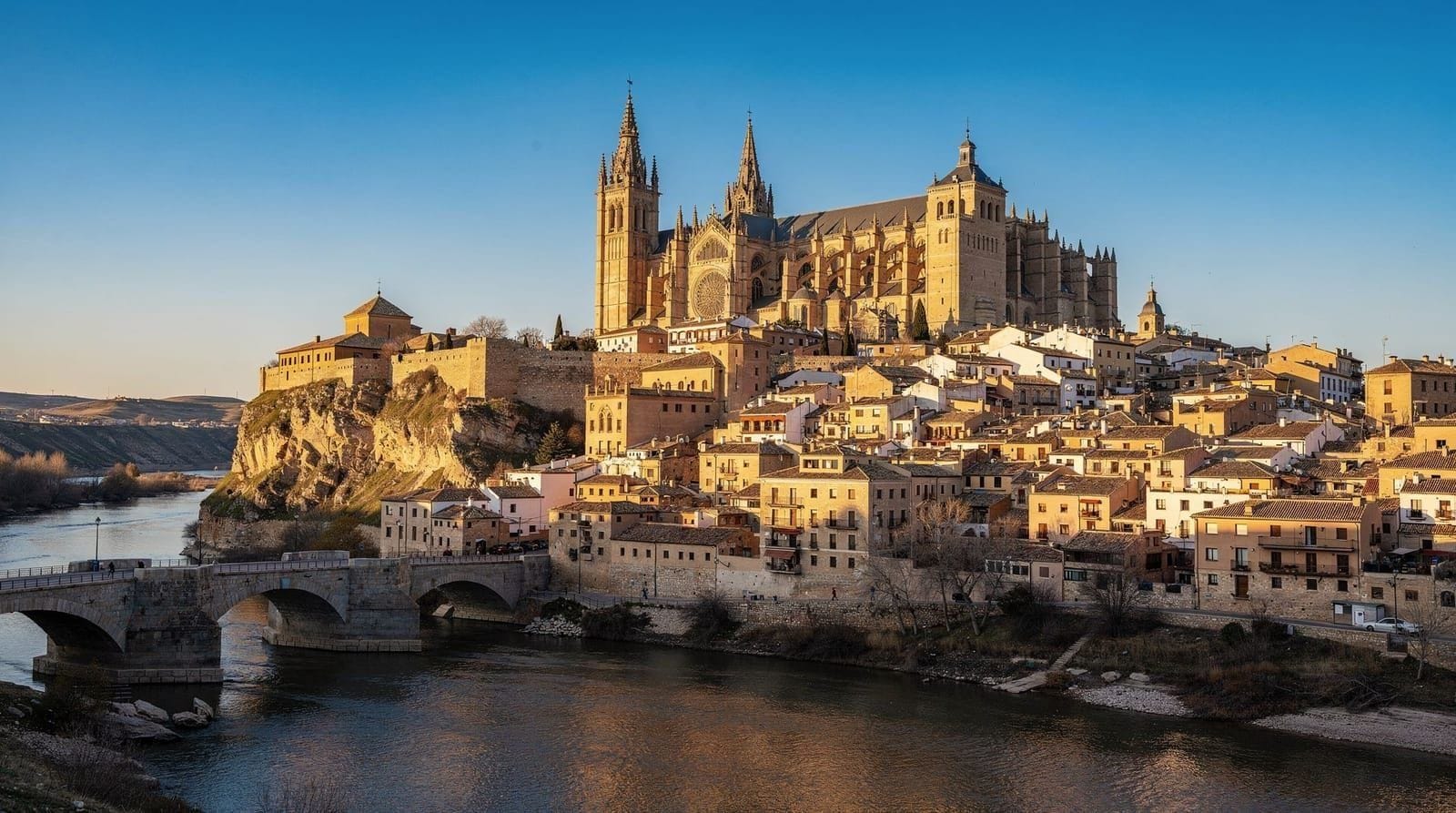
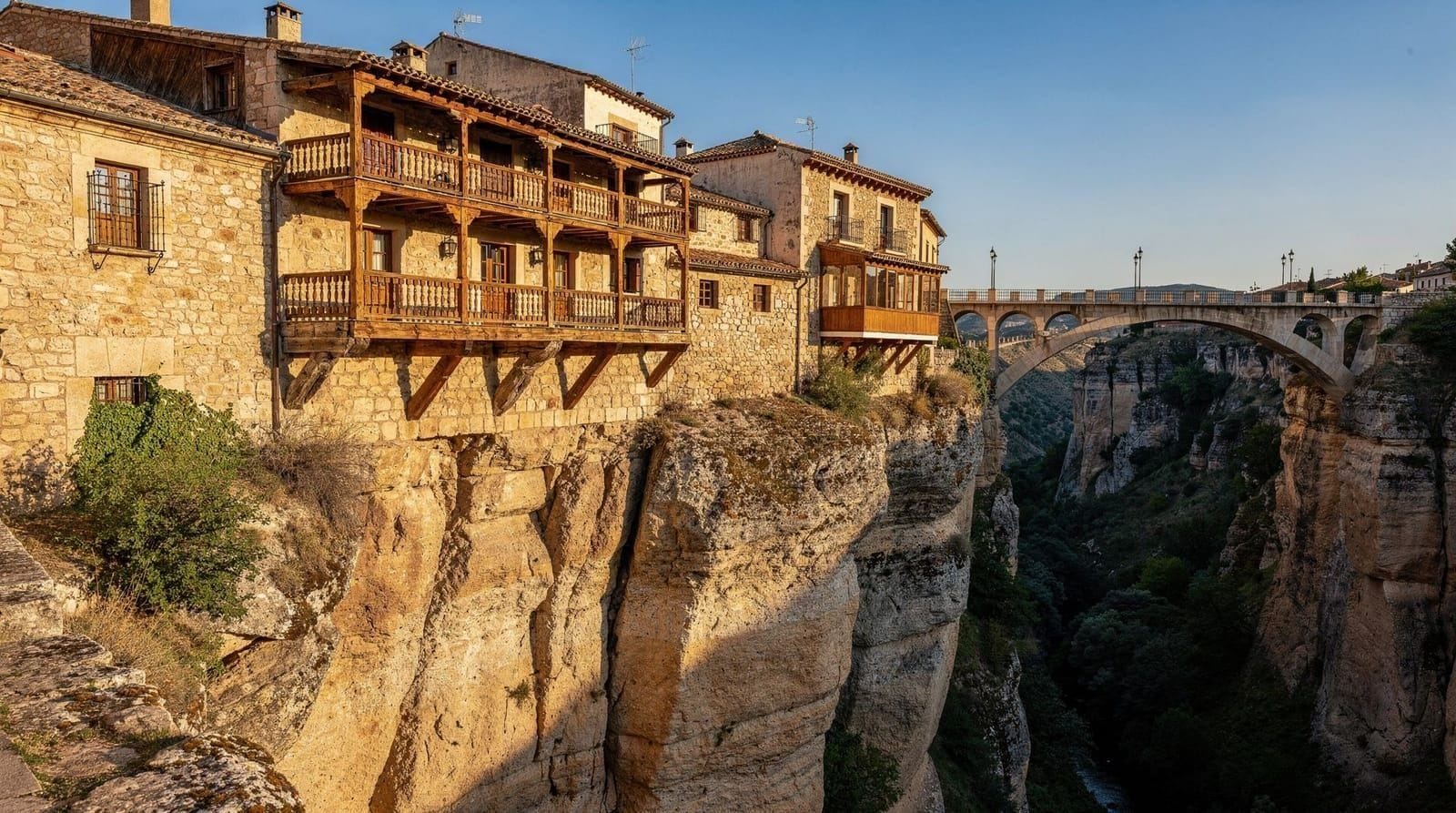
Toledo earns its reputation as the single best day trip from Madrid. In 33 minutes on the AVANT high-speed train from Atocha, you arrive at a walled city perched on a granite outcrop surrounded on three sides by the River Tagus — a city that was Roman, Visigothic, Moorish, and Castilian in sequence, and that still carries all four layers in its streets, churches, mosques, and synagogues. No other city in Spain compresses quite this much history into a walkable core.
The UNESCO designation (1986) recognised what visitors sense immediately: Toledo is not a museum piece kept artificially alive for tourism, but a working provincial capital whose medieval fabric survived because the city’s commercial importance declined after the court moved to Madrid in 1561. That decline was Toledo’s architectural salvation. Philip II’s decision to establish his court in Madrid froze Toledo’s development, leaving the Gothic cathedral, the Moorish mosque-turned-church, the two surviving synagogues, and the Renaissance palaces essentially intact while the rest of Spain modernised.
| Where | Toledo old town, ~70 km south of Madrid, Castile-La Mancha |
| Cost | Around €12–€16 train fare + €12 cathedral + €14 monument bracelet |
| Time needed | Full day (8–9 hrs); overnight for empty-streets mornings |
| Getting there | AVANT from Atocha, ~33 min |
| Best time | Weekday, first morning train, before coach tours arrive |
Getting to Toledo from Madrid
The easiest and fastest way is the AVANT high-speed train from Atocha station, taking approximately 33 minutes. Several trains run each day (see the Renfe website); the first departure is around 06:45. Tickets cost around €12–€16 each way depending on the train; book in advance on Renfe’s website or the app. The Toledo station is modern and about 20 minutes’ walk from the old city centre — taxis queue outside (€4–€6) or you can take the uphill escalators that deposit you near the Bisagra Gate.
Bus alternative: ALSA buses from Plaza Elíptica, Avenida de América or Estación Sur run to Toledo in 50 minutes (direct) to 1 hour 30 minutes and cost from around €6.55 one way. This makes sense if you miss a train, but the AVANT is faster and the price difference is not dramatic.
Organised tour: guided day trips from Madrid by bus are also widely available, including entrance tickets to the cathedral, Alcázar, and other monuments bundled in. These cost €40–€80 per person depending on what’s included. Useful if you want narrated context; the downside is fixed timing and large groups.
Guided day trip to Toledo from Madrid by bus with cathedral entryWhat to see: the essential sights
Toledo Cathedral
The Catedral Primada is the supreme Gothic cathedral of Spain and one of the finest in Europe. Construction began in 1226 and continued for 250 years; the result is a layered accumulation of Gothic structural engineering, Renaissance embellishment (the choir stalls, the chapter house ceiling), and Baroque excess (the Transparente, a 1732 altarpiece that tears a hole in the ceiling vault to let natural light illuminate the tabernacle — theatrical, technically audacious, and either magnificent or absurd depending on your tolerance for Baroque). Entry costs €12; an audio guide is worth it.
The Treasury holds El Greco’s portrait of a cardinal and an extraordinary Monstrance by Enrique de Arfe (1517), 183 kg of gilded silver used in the Corpus Christi procession. The sacristy contains sixteen El Greco paintings including his masterpiece El Expolio (The Disrobing of Christ, 1577–79).
The Alcázar
The square fortress on Toledo’s highest point was destroyed and rebuilt several times; the current structure was rebuilt after its destruction in the 1936 siege. It now houses the Army Museum (Museo del Ejército), one of Spain’s best military museums with exhibits spanning three millennia of Spanish military history. The siege of 1936 itself — where Nationalist forces held out for 69 days against Republican bombardment — is documented in clinical detail, with no attempt to sanitise. Admission €5; free on Wednesdays (permanent collection); closed on Mondays.
El Greco’s Toledo
Doménikos Theotokópoulos — El Greco — came to Toledo from Rome in 1577 expecting a royal commission from Philip II. The commission never materialised, but Toledo became his permanent home until his death in 1614. The city features in his paintings as a moody, elongated, almost supernatural landscape.
The Casa-Museo del Greco (€3; free on Saturday from 14:00 and on Sunday) occupies the street where El Greco likely lived, though not his actual house. The collection includes Vista de Toledo (a reproduction — the original is in the Metropolitan Museum in New York) and several genuine works. More important is the Museo de Santa Cruz, a 16th-century hospital housing Toledo’s largest El Greco collection including El Apostolado (the twelve apostles).
The church of Santo Tomé contains El Greco’s most celebrated work, El entierro del conde de Orgaz (The Burial of the Count of Orgaz, 1586–88). Entry €4; the church is small and gets crowded. Go early.
The synagogues
Toledo had one of the largest Jewish communities in medieval Spain before the 1492 expulsion. Two synagogues survive.
Santa María la Blanca (12th century) is architecturally Moorish — built by Muslim craftsmen for Jewish worship — with white horseshoe arches and pine-cone capitals. It was later used as a church, a military barracks, and eventually returned to its current state as a museum. Entry €4.
El Tránsito (14th century, built for Samuel Halevi, treasurer to Peter I) has the most complete surviving Mudéjar interior in Toledo: Hebrew inscriptions, stucco arabesque decoration, and an artesonado ceiling. It houses the Sephardic Museum tracing the history of Spain’s Jewish communities. Entry €3; free on Saturday from 14:00 and on Sunday.
The Mosque of Cristo de la Luz
A small 10th-century mosque — one of the oldest surviving Islamic buildings in Spain — converted to a Christian chapel after the Christian reconquest of Toledo in 1085. The interior still shows the original Moorish brickwork and the nine different vault designs, each unique, covering the nine bays. Entry €4. Often bypassed by tours focusing on the cathedral; worth ten minutes.
Where to eat in Toledo
Toledo’s food identity is built on two things: game and Castilian roasts, and marzipan. The restaurants near the Cathedral and in the tourist lanes are overpriced for what they offer. Better options are a few streets in.
Restaurante Adolfo (Calle Granada 6): Toledo’s most celebrated kitchen, in a 15th-century building. Chef Adolfo Muñoz uses local game (partridge, venison, wild boar) and the signature dish is perdiz estofada a la toledana — stewed red-legged partridge in the local style with wine and herbs. Mains €24–€38. Reserve in advance.
La Abadía (Plaza San Nicolás 3): reliable mid-range in a converted cellar, good carcamusas (Toledo’s classic pork and vegetable stew), local wine list. Mains €14–€22.
Bar Ludeña (Plaza de la Magdalena 13): local institution for bocadillos and tapas. The carcamusas here are the benchmark for the dish and cost €4 as a tapa. Lunch only, closes early.
For marzipan, Toledo’s mazapán has IGP (Protected Geographical Indication) status. Santo Tomé (Calle Santo Tomé 3) is the most established shop; Casa Telesforo near the Cathedral is smaller and less touristy. Marzipan figures, rolls filled with sweet potato or pine nut, and marzipan coated in chocolate are the main products. A box of 12 pieces costs €8–€14.
The Jewish quarter, the Moorish quarter, and the urban palimpsest
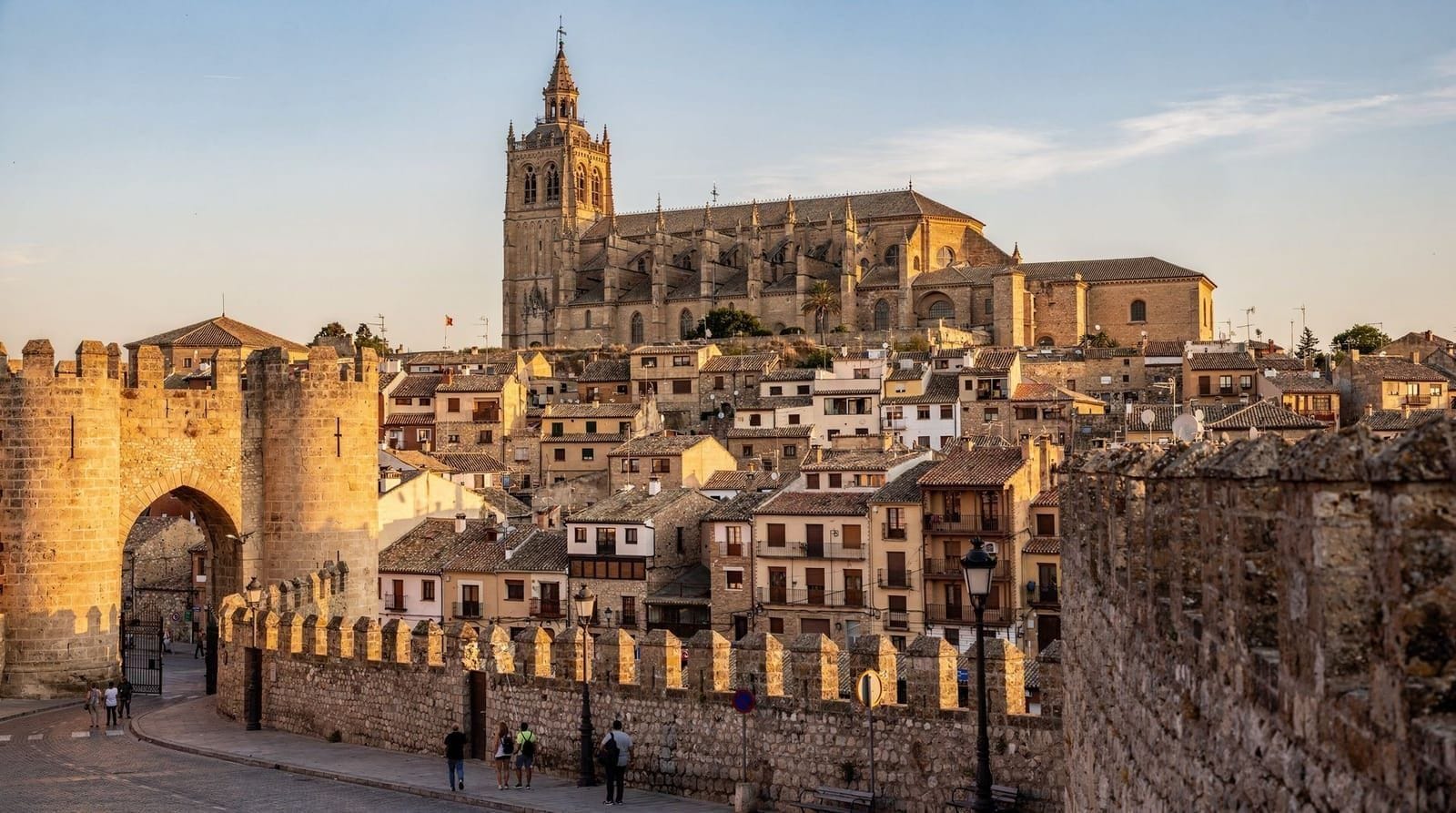
Toledo’s historic centre is small enough to walk in two hours, but its layering is what rewards slower exploration. The Judería (Jewish quarter) centres on the two synagogues and the narrow streets around Calle San Juan de Dios. The Medina (Moorish quarter) is less clearly defined but includes the mosque, the former souk around Calle Comercio, and the layout of streets that follows the Islamic city plan rather than the later Christian grid. The Christian city radiates from the Cathedral and the central Plaza del Ayuntamiento.
The Puerta del Sol (15th century, not the Madrid square) is the best-preserved of Toledo’s historic gates: a Mudéjar arch combining Christian and Islamic decorative motifs, built under Christian rule by craftsmen trained in the Moorish tradition. Toledo’s entire Mudéjar architecture — Christian religious buildings decorated and constructed in Islamic style — is what makes the city’s aesthetic distinct from Castilian cities that rebuilt more thoroughly after the reconquest.
The Tagus gorge and the city walls
Walking the city walls is possible on the south side, where the Paseo de Recaredo follows the medieval perimeter and gives views over the Tagus gorge below. The most photographed view of Toledo — the silhouette of the walled city against the sky — is from the Carretera de Circunvalación on the opposite (south) bank of the Tagus, a 15-minute walk from the city via the San Martín bridge. Early morning or golden hour: the light here is what El Greco painted.
The Puente de Alcántara (Roman foundations, rebuilt 1257) and Puente de San Martín (1390) are the two historic bridges. The San Martín bridge has a legend: the architect’s wife reportedly set fire to his original calculations the night before opening, allowing him to recalculate and discover a fatal flaw before the bridge was tested.
Full-day Toledo tour with optional Cathedral entrance from MadridPractical information
When to arrive: Trains from Madrid fill up on weekends. The first morning train (around 06:45) arrives before the bus-tour crowds. Toledo’s lanes are dramatically emptier before 10:00.
Toledo Tourist Bracelet: the Pulsera Turística is a wristband giving access to seven monuments (excluding the Cathedral, the Alcázar, El Tránsito and the El Greco Museum, which each have their own ticket) for €14. Good value if you plan to see San Juan de los Reyes, Santo Tomé, Santa María la Blanca, Cristo de la Luz, and others (€4 each separately). Sold at participating monuments.
How long do you need: a rushed half-day covers the Cathedral, Santo Tomé, and a wander. A full day (8–9 hours) allows comfortable visits to all the main sights plus lunch. An overnight stay adds the empty-streets magic of early morning before the day-trippers arrive — Toledo’s hotels inside the walls are expensive (€100–€200+) but the experience of the city at night is genuinely different.
Getting around in Toledo: the old city is entirely walkable — it is also entirely hilly. The tourist train (Tren Turístico) runs a 45-minute loop of the perimeter if your legs need a break.
Accessibility: Toledo’s stone streets and steep inclines make it challenging for mobility-impaired visitors. The Cathedral, Alcázar, and some museums have lifts or accessible routes; the synagogues and Cristo de la Luz mosque have steps.
Toledo’s swordmaking and other lesser-known crafts
Toledo steel was, for centuries, the benchmark against which European sword-making measured itself — the phrase “a Toledo blade” carried the same weight in the medieval and early modern world that a Swiss watch carries today. The craft traces to Roman-era metalworking in the region and was refined under successive Muslim and Christian rule, reaching its peak in the 16th century when Toledo swords armed conquistadors and European nobility alike. Several espadería (swordsmith) workshops in the old town still produce blades using traditional damascening techniques — inlaying gold and silver wire into blackened steel in intricate patterns.
Genuine damascened pieces (letter openers, decorative swords, jewellery) are sold in shops along Calle Comercio and near the Alcázar; prices range from a few euros for small souvenir pieces to several hundred for a full ceremonial blade. As with any tourist-district craft shop, quality varies significantly — the workshops attached to the Museo de la Fábrica de Armas (the old royal armaments factory, now partly a university campus and museum) give a more reliable sense of the authentic technique than the cheapest souvenir stalls.
Toledo at night and on a quieter morning
Toledo empties dramatically once the last day-trip trains and buses leave, typically by early evening. The transformation is one of the best reasons to consider the overnight option mentioned in the practical section: the floodlit cathedral and Alcázar against the night sky, the narrow lanes without the day’s crowds, and a dinner at a proper pace rather than one eye on the return train.
The Mirador del Valle, across the Tagus gorge on the same viewpoint road mentioned above, is dramatically different after dark — the illuminated city reflected in the river is one of the more memorable urban views in Spain, and worth a taxi trip (€8–€12 each way from the old town) even on a day-trip itinerary if the timing allows a late train back. Early morning (before 09:00) gives a similar but quieter effect: mist over the gorge in cooler months, empty lanes, and shops not yet open — a genuinely different Toledo from the one most day-trippers experience.
How to fit Toledo into a Madrid trip
Toledo works perfectly as a full-day excursion from a 3–7 day Madrid stay. From Atocha, take the morning AVANT, spend the day in the old city, and return on the early evening train in time for Madrid’s late dinner culture.
For a focused history itinerary, see Madrid and Toledo itinerary, which pairs a day in Toledo with the city’s Habsburg quarter, the Royal Palace, and the Prado. If you are choosing between Toledo and Segovia for a single day trip, the guide Toledo vs Segovia compares them honestly — they are complementary rather than interchangeable, but Toledo is the stronger choice for first-time visitors.
For those interested in the wider day-trip options, best day trips from Madrid ranks all the options with honest travel-time information, and day trips by train covers the train-only options.
Before you book anything, it helps to settle the practical side of the journey. The Toledo from Madrid guide goes through the transport choices step by step, and Atocha vs Chamartín explains which station you will be using and how to find your platform. If you prefer to let someone else handle the logistics, day trips without a car lays out the alternatives, and guided vs self-guided helps you decide whether a narrated visit is worth it for a city this layered.
Toledo also pairs naturally with the other historic cities in the region. Segovia and Ávila are the obvious companions for a longer stay in Madrid, and the Madrid week with day trips itinerary shows how to space them out so that each city gets its own day. Back in the capital, the Habsburg and Bourbon history guide gives useful context for why the court left Toledo in the first place.
Frequently asked questions about Toledo
How long does it take to get from Madrid to Toledo?
The AVANT high-speed train from Atocha takes approximately 33 minutes and costs around €12–€16 each way depending on the service. Alsa buses take from 50 minutes (direct) to 1 hour 30 minutes and cost from around €6.55. The train is faster but requires a booking; buses run without booking but take longer.
Is Toledo worth a day trip from Madrid?
Yes — Toledo is the single strongest day trip from Madrid, combining a walled medieval city, the finest Gothic cathedral in Spain, El Greco paintings in situ, surviving synagogues and a Moorish mosque, and excellent Castilian food within a 90-minute round trip. One full day is enough for the main sights; an overnight stay is better if you want to see the city before the day-trip crowds arrive.
What is Toledo famous for?
Three things above all: its role as the city of three cultures (Christian, Muslim, and Jewish communities coexisting in the medieval period), El Greco (who lived and worked here from 1577 until his death in 1614), and its marzipan (mazapán toledano, with IGP status). Historically, Toledo was also the centre of Spain’s sword-making industry; Toledo steel blades were exported across Europe.
What is the Toledo Tourist Bracelet?
The Pulsera Turística is a combined-entry wristband giving access to seven monuments including San Juan de los Reyes, Santo Tomé (El Greco’s Burial of the Count of Orgaz), Santa María la Blanca synagogue, Cristo de la Luz mosque, and others, for €14. It does not include the Cathedral (€12), the Alcázar/Army Museum, the El Tránsito synagogue or the El Greco Museum, which each require a separate ticket.
Where should I eat in Toledo without getting ripped off?
Avoid the restaurants immediately adjacent to the Cathedral and in the most obvious tourist lanes — they are overpriced. Bar Ludeña in Plaza de la Magdalena serves authentic carcamusas (pork stew) for €4 as a tapa. La Abadía in Plaza San Nicolás is a reliable mid-range option. Restaurante Adolfo is the serious choice for local game dishes. For food context, see eat like a local.
Can I do Toledo and Segovia in the same day?
Technically possible but not recommended — both cities deserve at least four hours each and the travel between them requires returning to Madrid. A combined day trip typically rushes both. The tour Segovia & Toledo full-day tour from Madrid covers both with transport included, but it is a long day. If you have a week in Madrid, give each its own day.
What is Toledo’s relationship to El Greco?
El Greco (Doménikos Theotokópoulos, born in Crete 1541) arrived in Toledo in 1577 seeking a royal commission from Philip II. The commission failed, but Toledo became his permanent home until his death in 1614. He painted Toledo’s landscape obsessively — the elongated spires, the grey-green light, the dramatic ridgeline — and his works are scattered across the city’s churches and museums. The church of Santo Tomé houses his masterpiece; the Sephardic Museum has a fine collection; the Museo de Santa Cruz has the largest single holding.
Top experiences
Bookable activities with verified prices and instant confirmation on GetYourGuide.