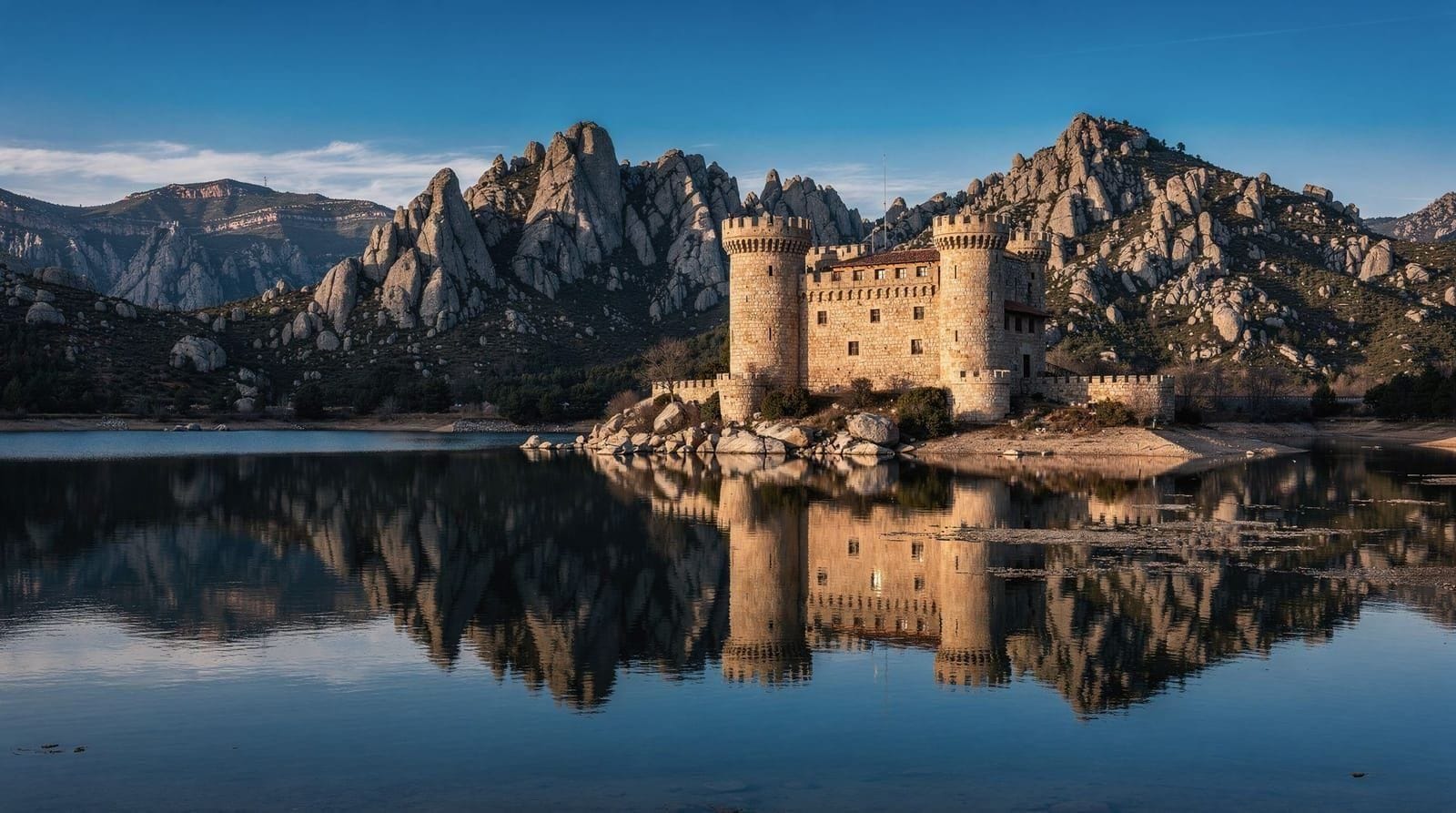
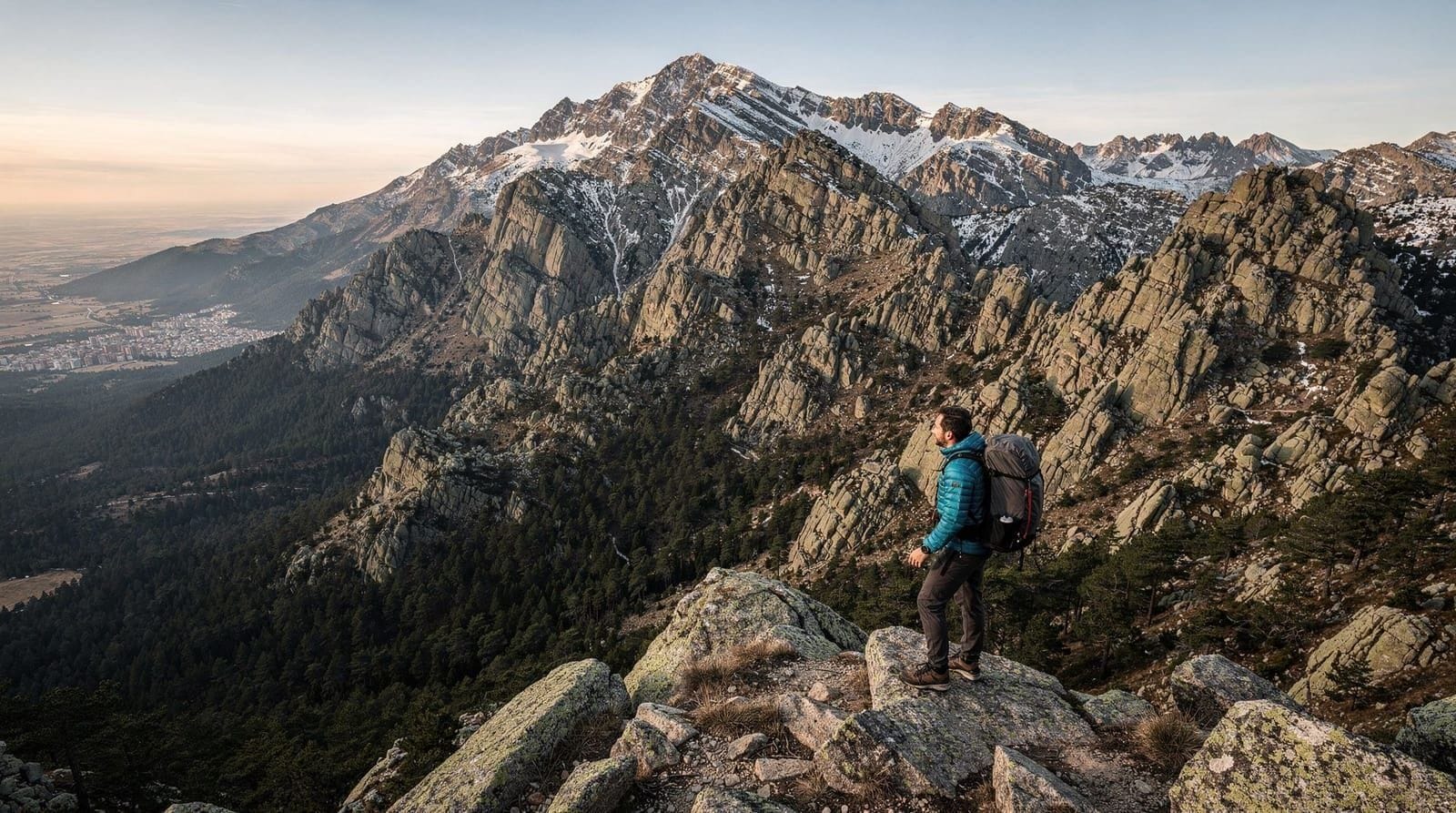
Segovia
Segovia is 28 minutes from Madrid by AVE. Roman aqueduct, fairy-tale Alcázar, Gothic cathedral, and the best cochinillo (roast suckling pig) in Castile.
Segovia: Guided Walking Cathedral Alcázar
Quick facts
- Train from Madrid (Chamartín)
- ~28–30 min (AVE/Avant)
- Train fare
- Variable fare, see the Renfe website
- UNESCO status
- Old town & aqueduct since 1985
- Population
- ~52,000
- Altitude
- 1,000 m — noticeably cooler than Madrid
- Day trip or overnight
- Half day possible; full day recommended
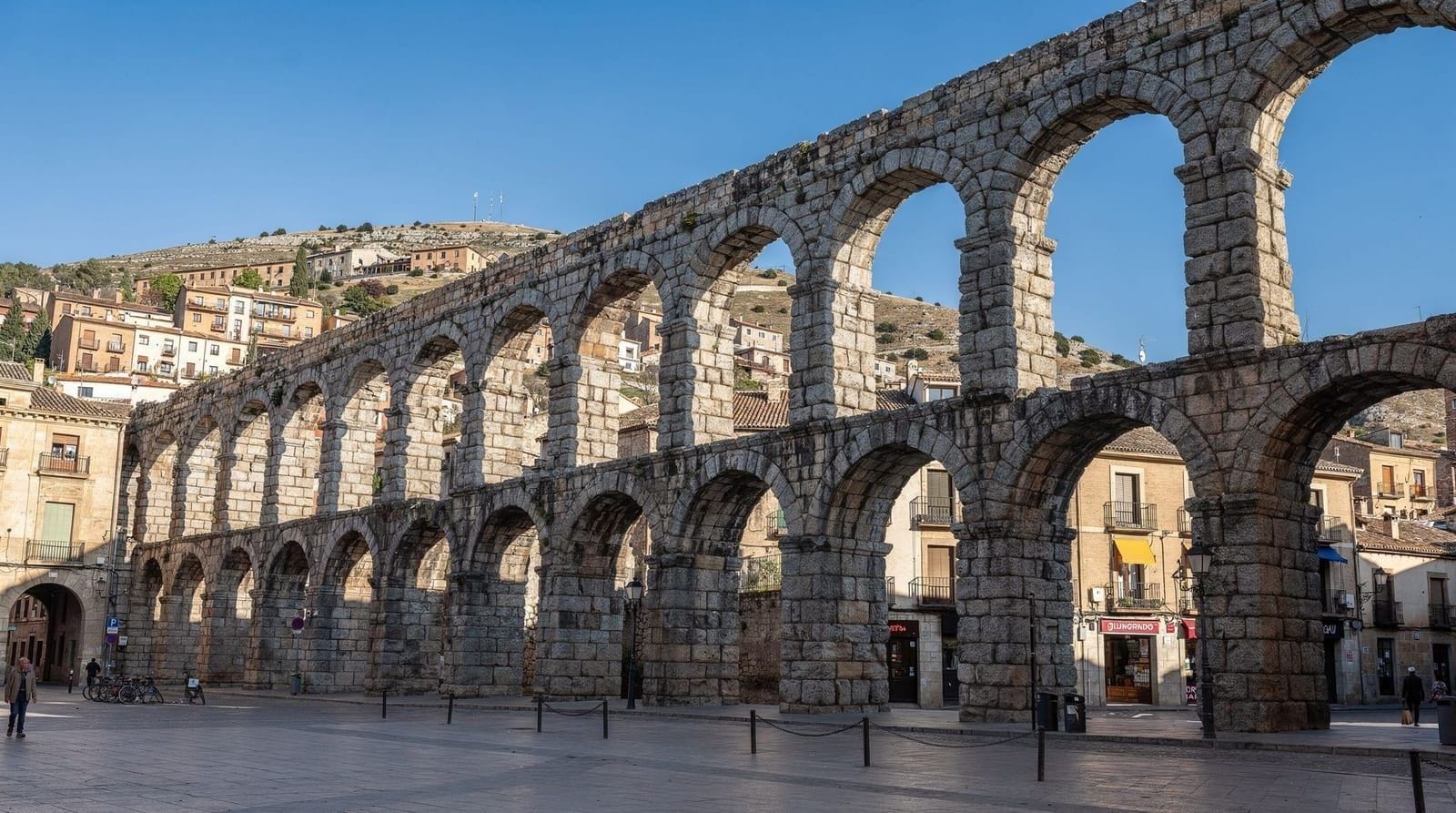
Segovia takes less than half an hour from Madrid and arrives at something that feels impossible: a working Roman aqueduct in the middle of a provincial city, used continuously for nearly 2,000 years until 1973, standing without mortar between its 20,400 granite blocks. The aqueduct alone justifies the trip. The fairy-tale Alcázar, the Gothic cathedral, and the cochinillo asado — roast suckling pig that defines the regional cuisine — make Segovia one of the most rewarding half-days within reach of the Spanish capital.
At 1,000 metres above sea level, Segovia sits noticeably higher than Madrid (650 m) and runs 3–5°C cooler in summer. On a July day when Madrid is at 36°C, Segovia is 31°C — which matters when you are walking cobblestone streets. This makes Segovia a practical refuge in summer that most Madrid visitors overlook.
| Where | Segovia old town, ~90 km northwest of Madrid, Castile-Leon |
| Cost | Train fare (variable, see the Renfe website) + €10 Alcázar + €4 cathedral + €22–€32 cochinillo lunch |
| Time needed | Half day (3–4 hrs) for the essentials; full day (6–8 hrs) with lunch |
| Getting there | AVE/Avant from Chamartín, ~28–30 min |
| Best time | Weekday mornings on the first AVE, before coach tours arrive |
Getting to Segovia from Madrid
The AVE/Avant high-speed train from Chamartín station reaches the Segovia-Guiomar station in 28–30 minutes. Several trains run daily; fares vary (see the Renfe website). Important: the high-speed station (Segovia-Guiomar) is about 5 km from the old city. A connecting bus (line 11) runs to the centre for €2.25 per ticket, or taxis cost €8–€10.
Alternative — regional train from Chamartín: a slower regional train (Cercanías C-8 via El Espinar) takes about 1 hour 45 minutes, arriving at the more centrally located Segovia Renfe station (Paseo Obispo Quesada), a 15-minute walk from the aqueduct. This works well if you miss the AVE or prefer flexibility without online booking.
By bus: Avanza (La Sepulvedana) buses run from Moncloa bus station in Madrid to Segovia in about 1 hour 15 minutes. They drop you near the aqueduct. No booking required.
Organised day trips: guided tours from Madrid including the Alcázar, cathedral, and sometimes Ávila are available for €40–€75. Practical if you want narrated context; the constraint is fixed timing.
Guided walking tour of Segovia with Alcázar and Cathedral entryThe Roman aqueduct
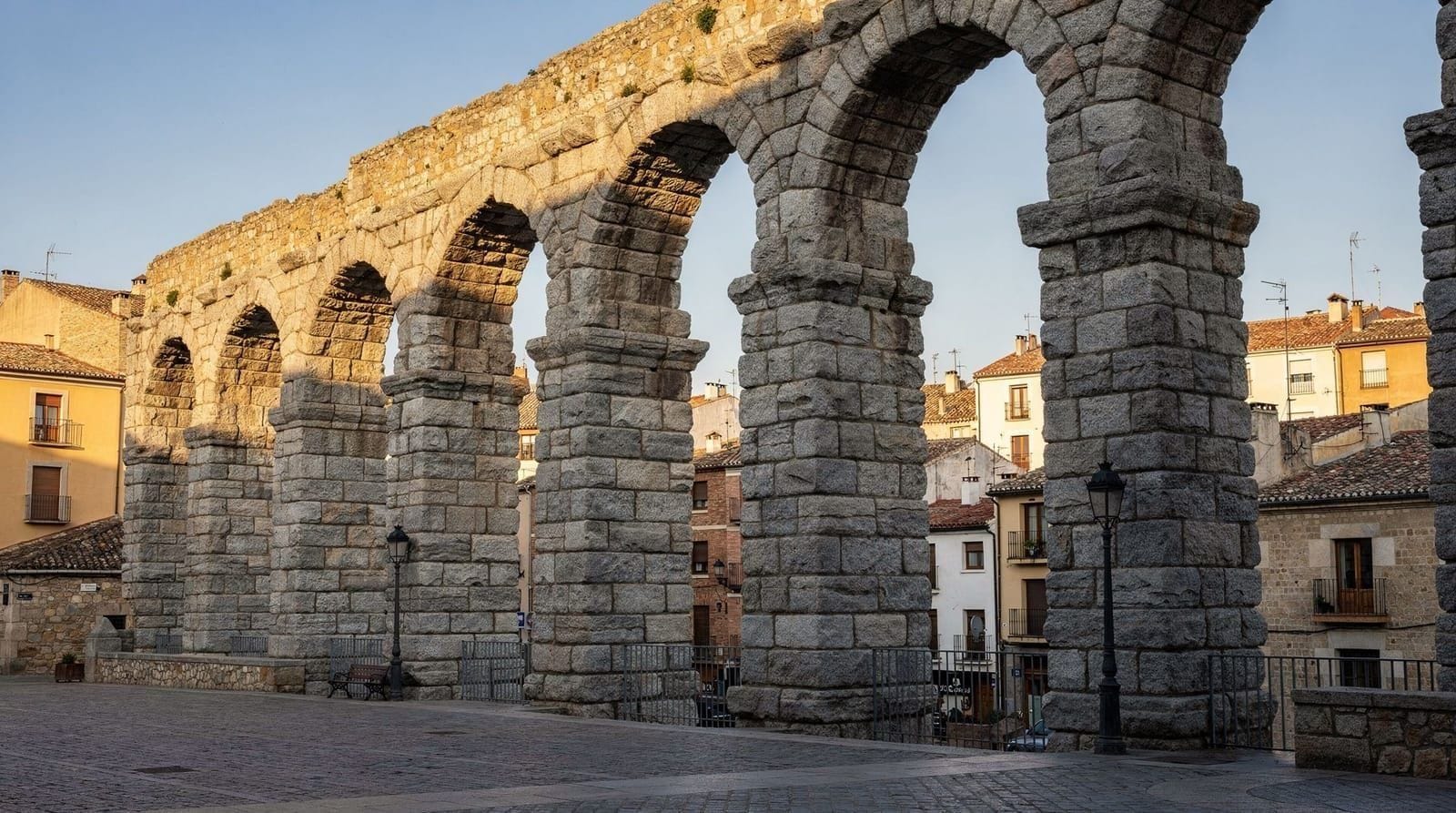
Segovia’s aqueduct is the centrepiece of Plaza del Azoguejo and, arguably, the most impressive piece of Roman civil engineering surviving in western Europe outside Rome and Pont du Gard. Its statistics communicate the scale: 728 metres long, 28.5 metres at maximum height (above the Plaza del Azoguejo), 167 arches in a double-tier arrangement, built using approximately 20,400 granite blocks with no mortar or metal clamps — the entire structure is held by precise fitting and compression alone.
The date of construction is debated (estimates range from 50 BCE to 100 CE); no dedicatory inscription survives. What is not in dispute is its function: the aqueduct carried water from the Frío river in the Sierra de Guadarrama mountains to the Roman city, a distance of 17 km including the visible section. It continued to operate until 1973, when modern pipes replaced it — nearly 2,000 years of continuous use.
The best viewing point is from the base of the Plaza del Azoguejo, looking up at the full height of the double arches. A staircase allows you to climb to a platform at the level of the upper arcade for a closer look. Entry to the base and walk up is free; the viewpoint platform is also free.
The aqueduct was briefly damaged in a Moorish raid in the 11th century (24 arches reportedly destroyed) and repaired under Isabella I of Castile using stone carved with Christian symbols — you can spot the medieval repair section slightly east of the plaza by the different weathering of the stone.
The Alcázar
Segovia’s Alcázar is the castle that allegedly inspired Walt Disney’s Cinderella castle, a claim that Segovians dispute (the actual inspiration is more likely Neuschwanstein in Bavaria) but that captures the visual effect: a ship-prow fortress on a cliff above the confluence of two rivers, with narrow turrets, a round keep, and a moat cut from living rock.
The building’s history is more violent than its fairy-tale appearance suggests. It served as a royal palace (Isabella I was proclaimed Queen of Castile here in 1474), a state prison, a military college (destroyed by fire in 1862 and rebuilt), and currently a museum. The interior includes the Throne Room with an artesonado ceiling, the royal chambers, and a weapons room with a collection of armour and historical firearms. The Torre de Juan II (keep) can be climbed for panoramic views over both gorges and the city — 152 steps, the views are worth it. Entry €7 for the palace and artillery museum, €10 with the tower.
The Cathedral
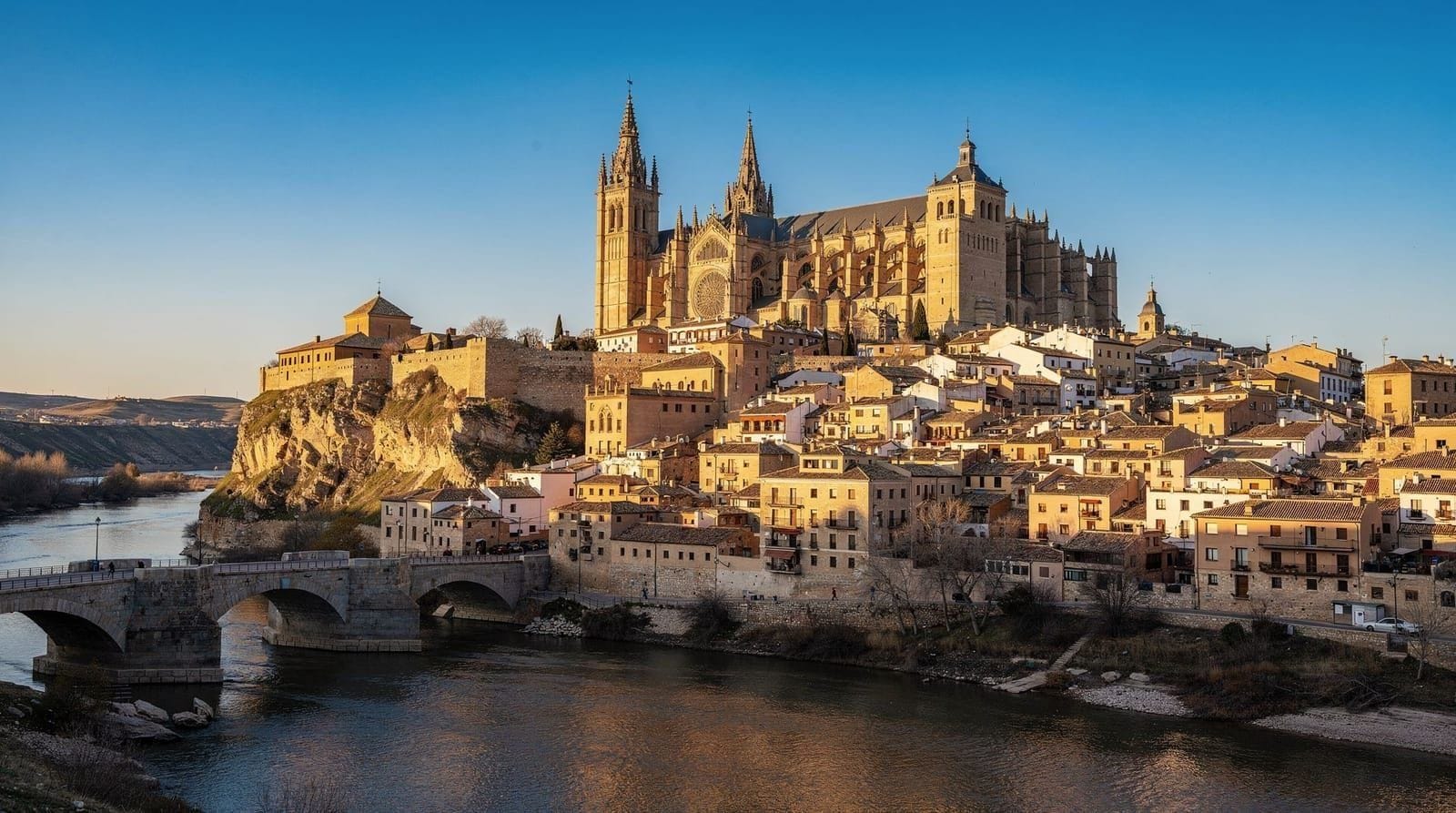
Segovia’s cathedral (1525–1577) is the last Gothic cathedral built in Spain, completed just as the Renaissance was transforming Spanish church architecture. It is sometimes called La Dama de las Catedrales (“the Lady of the Cathedrals”) for its elegant proportions. The interior is lighter and more coherent than Toledo’s cathedral — finished in one sustained campaign rather than over three centuries — and the 16th-century tapestries in the chapter house (Aubusson and Brussels manufacture, 17 pieces) are exceptional. Entry €4; on Sundays the cathedral opens to visitors at 13:30.
Cochinillo asado: the real reason
Segovia’s cochinillo asado — roast suckling pig — is probably the most famous dish in Castile. The dish requires a pig no older than 21 days, weighing 4–6 kg, fed only on mother’s milk. The pig is seasoned with lard, salt, and herbs, then roasted in a clay oven (horno de leña) at low temperature for 2–3 hours until the skin is lacquer-crisp and the meat falls apart. The theatrical presentation at Segovia’s traditional restaurants involves cutting the pig with a ceramic plate (to demonstrate the meat’s tenderness) and smashing the plate on the floor for luck.
Restaurante José María (Calle Cronista Lecea 11): the most serious operation in the city, with their own pig-breeding farm supplying animals raised to strict specifications. A full portion (ración) costs €22–€28. The ceramic-plate cutting ceremony is performed here with evident pride. Book in advance.
Mesón de Cándido (Plaza del Azoguejo 5): the most famous cochinillo restaurant in Spain, in a 15th-century building directly beneath the aqueduct. Opened in 1931, it has served every Spanish king since Alfonso XIII. Quality is high, prices correspond (€26–€32 for a portion), and the tables with aqueduct views command a premium. Also excellent for judiones de La Granja — large white beans slow-cooked with blood sausage and pork. Book in advance; lunch only.
Mesón Duque (Calle Cervantes 12): good mid-range alternative. Similar cochinillo quality at slightly lower prices; less ceremony.
For budget eats, the bars around Plaza Mayor serve tapas at Madrid prices — €2–€3 per tapa. Segovian wine (mainly Ribera del Duero and local white wines) is served by the glass from €3.
The old city beyond the main sights
The streets between the aqueduct and the Alcázar are worth wandering without a specific plan. The Iglesia de Vera Cruz (12th century, Templar or Holy Sepulchre church) sits outside the walls above the river gorge — a 12-sided Romanesque church unlike anything else in Castile. The Barrio de la Judería (Jewish quarter) is centred around Calle de Juan Bravo and preserves traces of the medieval community expelled in 1492. The convent of San Antonio el Real has exceptional Mudéjar ceilings and a peaceful cloister; entry by donation.
The Plaza Mayor is Segovia’s social centre, ringed with café terraces and anchored by the cathedral’s south flank. On weekday mornings before the day-trip coaches arrive, it is genuinely atmospheric — locals having coffee, students from the city’s university, the cathedral bells marking the hours.
Segovia from Madrid with Cathedral and Alcázar entrance includedLa Granja de San Ildefonso
Real Sitio de La Granja de San Ildefonso, 11 km south of Segovia, is a royal palace and gardens built by Philip V in the early 18th century as his Spanish answer to Versailles — a Bourbon king nostalgic for his French childhood creating a French formal garden on the slopes of the Sierra de Guadarrama. The result is genuinely impressive: terraced French baroque gardens with 26 monumental fountains, a palace with tapestry collections and state apartments, and a setting (mountains rising immediately behind the gardens, pines on the slopes, the Segovian plain stretching south) that gives the Versailles template a distinctly Spanish wildness.
The fountains operate on Wednesdays, Saturdays, Sundays, and public holidays from May to September (check current schedules at the patronato website; hours have varied with maintenance programmes). On days when the fountains run, the water spectacle — jets reaching 40 metres at the tallest monument (la Fama) — draws crowds from Segovia and Madrid. On non-fountain days, the gardens and palace are quieter and cheaper. Palace entry approximately €10; gardens free except during fountain days (€10–€12).
A local bus connects Segovia’s bus station to La Granja in 25–30 minutes. If you are combining Segovia and La Granja in a single day from Madrid, allow 9–10 hours total (AVE from Madrid, morning in Segovia, lunch, afternoon at La Granja, return bus to Segovia station for the evening AVE).
The Alcázar’s history and the 1862 fire
The Segovia Alcázar that visitors see today is substantially a 19th-century reconstruction. In 1862, a devastating fire destroyed most of the palace’s interior and the original conical towers, which had been built in the 15th century under Henry IV and Ferdinand and Isabella. The fire started in the tapestry workshop that had been occupying the castle since 1817 (the Alcázar was no longer a royal residence by this point). The reconstruction (1882–1896) restored the towers in the Romantic neo-medieval style fashionable at the time — more dramatically pointed than the originals, which is why the Alcázar’s profile looks somewhat theatrical.
The pre-fire interiors — the Throne Room, the Hall of the Galley (so called for its inverted-ship-keel ceiling), the rooms decorated with plaster ceilings and azulejo tiles — were recreated from historical records and descriptions. The current interiors are authentic reconstructions rather than survivals, which matters for those who distinguish between the two, but the spatial experience and the views from the towers are unchanged.
Judería and the medieval city plan
Segovia’s medieval Jewish community occupied the streets around the Calle de la Judería and Calle de Escuderos, adjacent to the Alcázar on the western tip of the promontory. The community was expelled in 1492 with the rest of Spain’s Jews under the Alhambra Decree; the buildings were subsequently converted to other uses (churches, residences, storage) but the street plan remains the layout of the medieval Jewish quarter. The synagogue of Corpus Christi (now a convent) preserves the shell of the 14th-century synagogue building. It is not open for general visits but the exterior is visible from the street.
Combining Segovia with Ávila
Ávila is 1 hour from Segovia by regional bus (line 67, roughly hourly) and is the natural pairing if you have a full day. The day-trip logic: take the AVE from Madrid to Segovia in the morning, visit the aqueduct and Alcázar, have cochinillo lunch, then take the afternoon bus to Ávila for the walls and the old city at golden hour, and return by train to Madrid from Ávila station. This requires 10–11 hours and some planning but covers two of Castile’s three great walled cities. The guide Ávila from Madrid has the logistics.
For the comparison between Segovia and Toledo — the two most popular AVE day trips from Madrid — see Toledo vs Segovia, which gives an honest assessment of which suits different travellers better.
Getting away from the aqueduct crowds
The area immediately around the aqueduct sees the heaviest foot traffic in Segovia, but two easy detours thin the crowds within ten minutes. The Mirador de la Pradera de San Marcos, reached by a footpath below the Alcázar on the north side of the gorge, gives the single best photograph of the castle — the full ship-prow silhouette against the sky, with none of the crowding of the courtyard viewpoints above. It is a 15–20 minute walk from the Alcázar entrance, downhill on the way out and a steadier climb back. The Convento de San Antonio el Real and the streets around the Barrio de la Judería (mentioned above) are similarly quiet even at midday, because most day-trip itineraries never leave the aqueduct-cathedral-Alcázar triangle.
For anyone extending a Madrid stay with more than one Castilian day trip, Segovia pairs naturally with the Sierra de Guadarrama on the way back — several of the mountain access points sit between Segovia and Madrid, and a driver with a car can break the return journey with an hour in the pine forests rather than heading straight back to the city.
Staying overnight instead of a day trip
Most visitors do Segovia as a day trip, but an overnight stay changes the experience noticeably. The coach tours that fill the aqueduct plaza and the Alcázar courtyard by mid-morning are gone by early evening, and the old town after 19:00 — golden light on the aqueduct, the Plaza Mayor terraces filling with locals rather than day-trippers, the Alcázar floodlit against the dark — is a different, quieter place. A one-night stay also removes the pressure of catching a specific return train, which matters if you want an unhurried cochinillo lunch.
Rooms inside the walls run roughly €70–€130 for a mid-range option; book ahead for weekends. If your Madrid trip has room for it, pairing an overnight in Segovia with Ávila the next morning is a good use of the extra day — see the combination notes above. For travellers still deciding when to come, the best time to visit guide covers Madrid-region seasonality in more depth, and day trips by train compares Segovia against Toledo, Ávila and El Escorial for a first-time visitor choosing just one.
Practical information
Beat the crowds: Segovia gets coach-tour traffic on weekend afternoons. Arriving by the first morning AVE (around 07:30–08:00) means you have the Plaza del Azoguejo and the aqueduct essentially to yourself for two hours.
Weather: at 1,000 m, Segovia is significantly cooler than Madrid. In winter (December–February) temperatures can drop to -5°C at night with occasional snow. A fleece or light jacket is advisable even in summer evenings.
Segovia Card: a combined pass for the Alcázar, Cathedral, and Casa de la Moneda (the old royal mint) is available (check the current price before buying). Worthwhile if you plan to visit all three.
How to fit Segovia into a Madrid trip: Segovia works as a half-day from Madrid (morning train, aqueduct + Alcázar, lunch, afternoon return) or a full day if you add the cathedral, Vera Cruz church, and a slow lunch. For a Madrid week with day trips, Segovia is typically day 5 or 6 once the Madrid city highlights have been covered. It pairs particularly well with Sierra de Guadarrama — the mountains are between the two.
Frequently asked questions about Segovia
How do I get from Madrid to Segovia?
The fastest route is the AVE/Avant train from Chamartín station (28–30 minutes; fares vary, see the Renfe website). The high-speed station is 5 km outside the city; bus 11 (€2.25) or a taxi (€8–€10) connects to the old town. A slower regional train (1h45) arrives closer to the centre. Buses from Moncloa take about 1 hour 15 minutes.
What is cochinillo asado and where is the best in Segovia?
Cochinillo asado is roast suckling pig — an animal no older than 21 days, slow-roasted until the skin is paper-crisp. It is Segovia’s signature dish. Mesón de Cándido (beneath the aqueduct) and Restaurante José María are the two most respected addresses; both require advance booking and cost €22–€32 for a portion.
Is the Alcázar related to Disney’s Cinderella castle?
The common claim is that the Segovia Alcázar inspired Walt Disney when designing Sleeping Beauty Castle and Cinderella Castle. Most historians believe the main inspiration was Neuschwanstein Castle in Bavaria (which Disney had visited). The Segovian castle does bear a visual resemblance to the Disney designs, but the direct inspiration claim has no documentary basis.
Can I visit Segovia in half a day?
Yes — the aqueduct, a walk through the old town, and a look at the exterior of the cathedral and Alcázar can be done in 3–4 hours. To see the Alcázar interior, Cathedral interior, and have a proper lunch, allow 6–8 hours.
What is the best time of year to visit Segovia?
April–June and September–October for the best weather and manageable crowds. Summer (July–August) works well here because Segovia at 1,000 m runs 3–5°C cooler than Madrid — a relief if you are combining a Madrid city trip with a day out. Winter is cold but crowd-free; the aqueduct in snow is remarkable.
Is Segovia or Toledo better for a day trip from Madrid?
Both are outstanding but different. Segovia is smaller, faster to reach, more coherent in one day, and better for one specific meal (cochinillo). Toledo is larger, has more total content (cathedral, three cultures, El Greco), and requires a longer day. First-time visitors with one day trip usually prefer Toledo; those with two day trips logically do both. See Toledo vs Segovia for a full comparison.
Top experiences
Bookable activities with verified prices and instant confirmation on GetYourGuide.