Aranjuez
Aranjuez — royal palace, UNESCO gardens, strawberries, and the Tren de la Fresa. Just 15–45 min from Madrid. Honest guide with real prices and logistics.
Aranjuez: Private Royal Palace and Gardens Tour
Quick facts
- Distance from Madrid
- ~48 km south
- By Cercanías train
- ~40–45 min (C-3 from Atocha)
- By Avant fast train
- Check Renfe for times and fares
- UNESCO status
- Cultural Landscape of Aranjuez (2001)
- Royal Palace ticket
- €9 (gardens are free)
- Best season
- April–June (strawberry season, gardens peak)
Aranjuez occupies an unusual position among Madrid’s day trips: it is the closest (15–45 minutes depending on the train type), the most accessible, and — in certain respects — the most underestimated. Most visitors who mention Aranjuez think of strawberries and a palace. Those who have spent a morning in the Jardín de la Isla and the Jardín del Príncipe understand that it is also one of the finest examples of Baroque landscape design in Spain — a fact that UNESCO recognised in 2001 when it inscribed the entire cultural landscape as a World Heritage Site.
The town sits at the confluence of the Tagus and Jarama rivers on the meseta south of Madrid. The rivers historically supplied the abundant water that made the formal gardens possible — an unusual resource in the dry Castilian plain. The Bourbon monarchs from Philip V onward developed Aranjuez as their spring residence across the 18th century, commissioning a series of palaces and formal gardens that transformed a modest hunting lodge into one of the most elaborate royal landscapes in Spain.
| Where | 48 km south of Madrid, on the Tagus |
| Getting there | Cercanías C-3 ~40–45 min |
| Palace ticket | €9 (gardens are free) |
| Best season | April–June (strawberries, gardens at their peak) |
| Time needed | Half day; full day with a proper lunch and all gardens |
The history: from Habsburg hunting lodge to Bourbon summer capital
Aranjuez was a royal hunting ground before it became a residence. The first proper palace was begun under Philip II in the 16th century — evidence of the broader Habsburg investment in the landscape of the Tagus valley, which also explains El Escorial’s location in the sierra above. Philip II recognised the specific quality of the Aranjuez site: protected from the summer heat by the river vegetation, supplied with game by the surrounding hunting grounds, and close enough to Madrid for convenient use.
The current palace is substantially a Bourbon construction. Philip V (the first Bourbon king of Spain, grandson of Louis XIV) found the Habsburg buildings inadequate and commissioned rebuilding in 1715. The palace burned partially in 1748 and was rebuilt again under Ferdinand VI. The final form, completed under Charles III in the 18th century, is the dignified Baroque building visitors see today.
The Bourbon monarchs used Aranjuez as their spring residence (the royal court moved seasonally between different palaces — Aranjuez in spring, San Ildefonso in summer, the Escorial in autumn, Madrid in winter), which gave the town a particular character: it was a functioning royal city for several months each year, with the court, the ministries, and the diplomatic corps all resident. The current town retains traces of this history in its regular street plan, its broad avenues, and the scale of its public spaces.
The Mutiny of Aranjuez (1808): one of the pivotal moments in Spanish history happened here. In March 1808, a mob led by supporters of the future Fernando VII stormed the palace of the Prime Minister Manuel Godoy, effectively ending his influence and forcing King Charles IV to abdicate in favour of his son. This set off the chain of events that led to Napoleon’s intervention in Spain, the installation of Joseph Bonaparte as king, and ultimately the Peninsular War. The event transformed Aranjuez from a royal pleasure ground into a historical landmark.
The Royal Palace interior
Aranjuez makes the most sense when read alongside the other Bourbon and Habsburg residences. The story of how the two dynasties shaped Spanish architecture and court life is told in Habsburg and Bourbon history, and the grander Madrid residence is covered in the Royal Palace guide. Seeing both lets you judge for yourself how the intimate Aranjuez palace differs from its city counterpart.
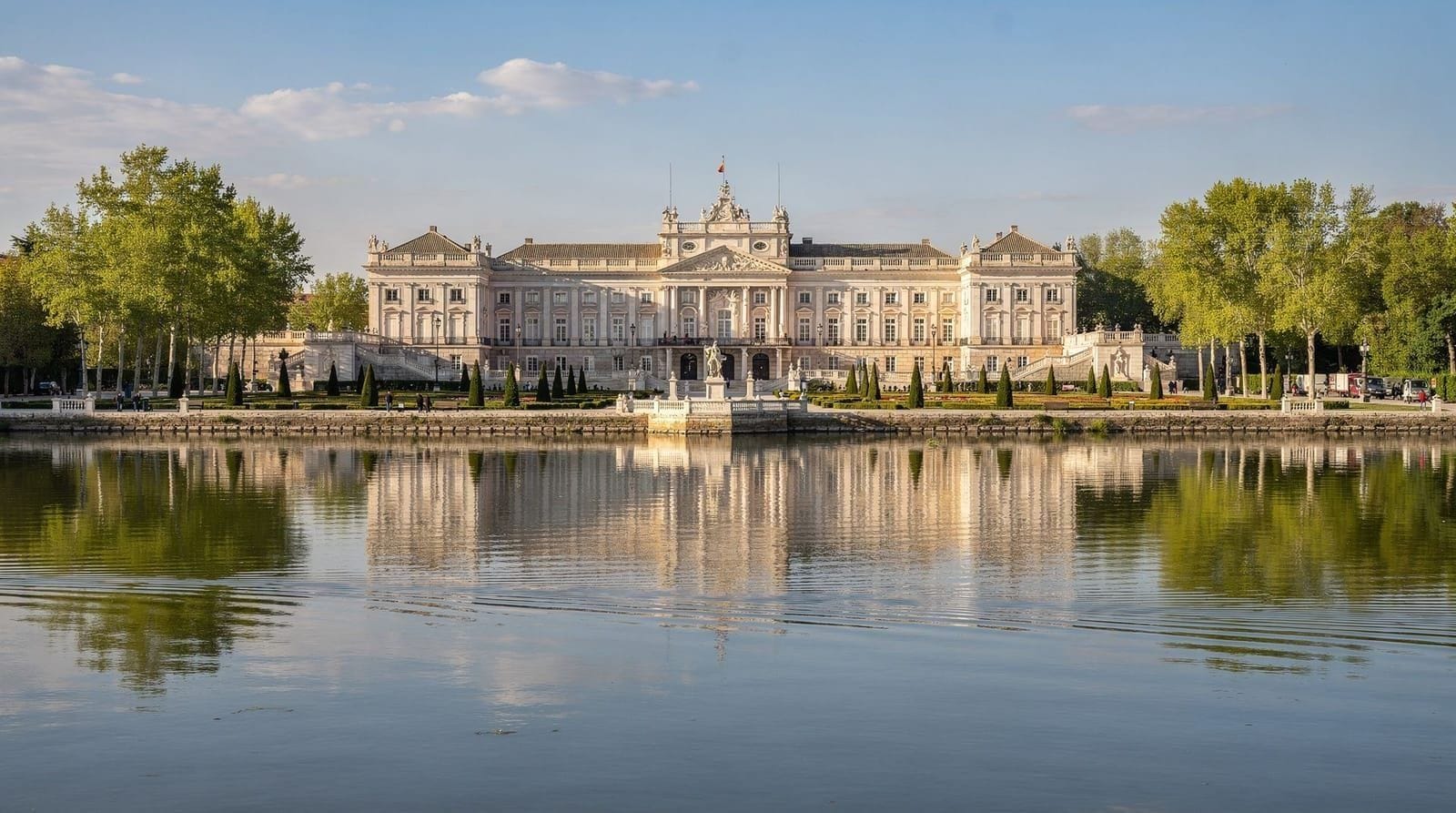
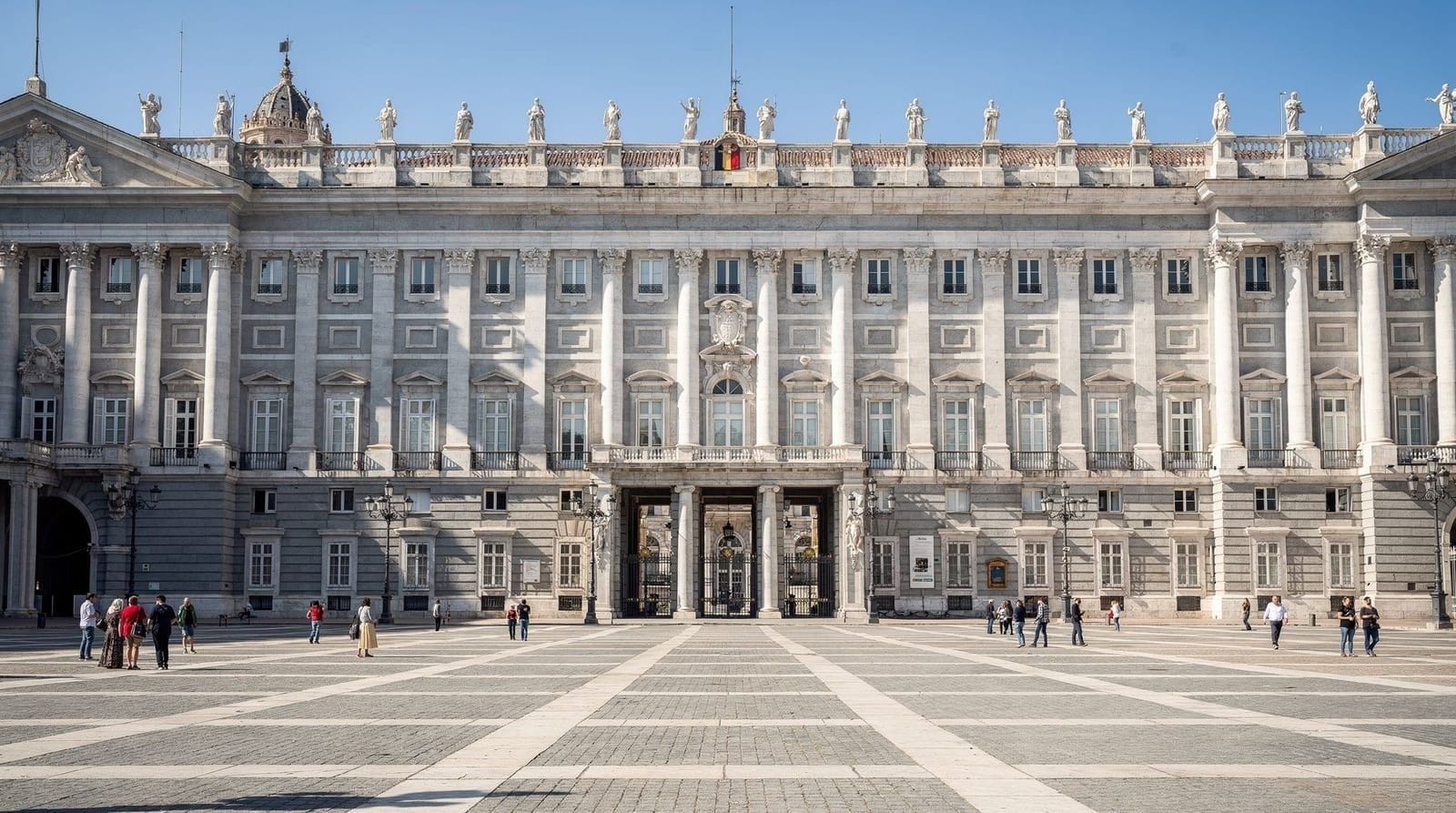
The Palacio Real de Aranjuez (ticket €9; the main gardens are free) was substantially rebuilt in the 18th century under Ferdinand VI and Charles III. The exterior is a long, dignified Baroque facade in warm stone — less imposing than the Madrid Royal Palace but more intimate.
The interior rooms that justify the ticket:
Sala de Porcelana (Porcelain Room): built in 1763 at the royal Buen Retiro porcelain factory, this room is the most extraordinary in the palace — every surface (walls, ceiling, door surrounds) is covered in white-and-green Chinoiserie porcelain tiles and figures. The effect is total immersion in one of the most fashionable decorative styles of the 18th century; nothing else quite like it exists in Spain.
Sala de los Relojes (Clock Room): a collection of European clocks spanning three centuries, including several by the finest clockmakers of their era. For anyone with an interest in precision mechanisms, this is the best single room in the palace.
Sala Árabe (Arab Room): an 1848 neo-Moorish interior inspired by the Alhambra, added by Isabella II’s court. Gilded stucco, coloured tiles, Arabesque ornament — a 19th-century fantasy of medieval Islam that sits oddly but visually impressively alongside the 18th-century Baroque rooms.
Royal Boudoir and Bedchamber: the private apartments used by Queen María Luisa of Parma (wife of Charles IV) in the early 19th century, decorated in the Louis XVI style with painted silks and gilt furniture.
The palace is closed on Mondays. Audio guide available; helps significantly with understanding the historical context of each room.
The gardens: the real attraction
The gardens of Aranjuez cover several distinct areas, all accessible on the standard ticket, and constitute collectively one of the best Baroque landscape experiences in Spain:
Jardín del Parterre (Parterre Garden): the formal French garden immediately in front of the palace — symmetrical, geometric, with boxwood hedges and central fountain. The most photogenic view of the palace is from here, looking back across the parterre toward the main facade. This is the garden that most represents the Bourbon aesthetic of controlled nature.
Jardín de la Isla (Island Garden): a formal Renaissance/Baroque garden on an island formed by a branch of the Tagus river. The oldest garden on the site, developed under Philip II and refined through the 17th–18th centuries. Enclosed box hedges, lime tree allées, a series of stone fountains including the Hercules Fountain (1660s), and the specific atmosphere of a garden designed to be experienced slowly, on foot, through a sequence of views and enclosures. Less maintained-looking than the Parterre but more atmospheric. Allow 45–60 minutes.
Jardín del Príncipe (Prince’s Garden): the largest of the gardens at approximately 150 hectares, conceived in the English landscape style in the late 18th century for the future Charles IV and his architect Isidro González Velázquez. Unlike the formal geometry of the older gardens, the Príncipe has a more naturalistic character — winding paths, woodland sections, the Tagus river forming the northern boundary.
Within the Príncipe:
-
Casa del Labrador (Farmer’s House): a deliberately misnamed royal pavilion — it is not a labrador’s cottage but a refined Neoclassical palace built for Charles IV in 1803. The interior has the most concentrated luxury in the entire Aranjuez complex: platinum and crystal rooms, a Pompeian-style gallery, a mechanical clock of extraordinary complexity. Separate ticket or included in combination tickets; check current availability.
-
Real Casa de Marinos (Royal House of Mariners): a small museum of royal river boats — the decorated barges used by the court for river excursions on the Tagus. An unusual museum type and one that gives a clear sense of how the Spanish royal family actually used the landscape of Aranjuez.
Allow at least 90 minutes for the Jardín del Príncipe including the Casa del Labrador; more if you want to see the full extent of the garden.
Strawberries: the most unexpected highlight
Fresones de Aranjuez are a genuine agricultural product with a specific local reputation. The combination of the Tagus river water (which allows irrigation without well dependence), the alluvial sandy soil of the river banks, and the specific spring microclimate produces strawberries that are distinctively large and intensely flavoured compared to commercially grown equivalents. The season runs from late March to early June, peaking in May.
During the season, strawberry stands appear throughout the town selling fresh berries by the tray (€2–€4), often combined with fresh orange juice. The local serving format — fresones con nata (strawberries with cream) or fresones con zumo (strawberries in freshly squeezed orange juice) — is available at virtually every café and bar near the palace gardens.
The strawberry is not merely marketing: Aranjuez strawberries have been prized since the 18th century, when they were cultivated specially for the royal court. Several Spanish monarchs were documented enthusiasts. The specific combination of local soil and Tagus water cannot be replicated elsewhere, which is why the seasonal product remains genuinely special.
Outside the strawberry season, the gardens are still excellent, but the specific seasonal experience that makes a May visit memorable is absent.
The Tren de la Fresa (Strawberry Train)
A heritage tourist train runs on selected dates, operating from the Madrid Railway Museum to Aranjuez with restored 1920s steam-engine-style carriages and staff in period costume. On arrival, passengers receive a tray of strawberries with cream.
The Tren de la Fresa is a popular experience for families and for visitors who want a nostalgic, curated format. It operates on a limited schedule and sells out quickly — book on the official Tren de la Fresa website well in advance. Note: the ticket price is higher than a standard Cercanías ticket (see the official Tren de la Fresa website for current fares) and the journey takes longer than a regular train. Worth doing once for the experience; not the most efficient option.
Madrid to Aranjuez private day trip: Royal Palace and gardens with guideGetting to Aranjuez
Before choosing a train, it helps to read the dedicated Aranjuez from Madrid guide, which walks through the practical side of the journey in more detail, and the Cercanías guide if you have never used Madrid’s commuter network. Travellers who plan several excursions can compare the options in day trips by train and day trips without a car.
By Cercanías C-3: the standard option. Runs from Atocha (and Chamartín, though less frequent). Journey approximately 40–45 minutes; trains every 30–60 minutes throughout the day. Cost: see the Renfe website for the current fare. The station is about 1.5 km from the Royal Palace — a 20-minute walk through the town or a short taxi (€5–€7).
By Avant: faster train service, journey times and fares are on the Renfe website; check availability as not all fast trains stop at Aranjuez. If you are short on time, this is clearly the better option.
By organised tour: day trips from Madrid often combine Aranjuez with Toledo, Chinchón, or other nearby sites. The combination with Toledo makes a very full day but covers two UNESCO cultural landscapes.
Combining Aranjuez with Chinchón
If you want the fuller picture of the village before deciding, the Chinchón from Madrid guide covers it on its own terms.
Chinchón, a village 15 km east of Aranjuez, has one of Spain’s most beautiful main squares — a circular arcaded plaza that was used as a bullfighting ring until the 1990s and is now lined with restaurants and bars. The village is also known for its anís (aniseed liqueur). Aranjuez and Chinchón combine naturally if you have a private vehicle; by public transport the connection is inconvenient (Chinchón is served by a bus from Madrid, line 337 from Conde de Casal).
Combined day trip from Madrid: Chinchón, Aranjuez, and ToledoThe royal music connection: Rodrigo’s Concierto de Aranjuez
Aranjuez has a specific place in the history of 20th-century music: Joaquín Rodrigo wrote the Concierto de Aranjuez (1939) in tribute to the town’s gardens, specifically to his memories of walking in the Jardín de la Isla with his wife. The concerto — for solo guitar and orchestra, with a slow movement of extraordinary melancholy — became one of the most performed and recorded pieces in 20th-century classical music. Miles Davis’s 1960 album “Sketches of Spain” (arranged by Gil Evans) opened with a jazz interpretation of the Adagio movement that reached entirely new audiences.
The concerto’s title is inseparable from the town. Whether you are visiting in strawberry season or in November, arriving in Aranjuez with the concerto’s slow movement already in your ears changes the experience of the gardens: the specific pacing, the almost-sadness of the Adagio, and the particular quality of the Tagus landscape make sense together. The piece can be heard at the Rodrigo House-Museum in Madrid (Calle de las Fuentes) or, more appropriately, on the train journey from Atocha with headphones.
Rodrigo was blind from age three (following a diphtheria infection) and composed entirely without visual reference — his Aranjuez was built from memory of texture, sound, and the physical experience of walking in the gardens. This gives the concerto a quality of reconstruction rather than description: what the music captures is the feeling of a landscape remembered, not documented.
Eating in Aranjuez
Lunch in Aranjuez is a good moment to apply the habits described in the eat like a local guide: avoid the most obviously touristic terraces when you can, and look for places where the menu is short and the clientele is local. The tourist menu traps guide explains what to watch for on fixed-price boards near the main sights.
The town’s restaurants cluster around the palace and on Calle Stuart and Calle de la Reina. During strawberry season, eating fresones on the terrace of any of the cafés facing the Jardín del Parterre is the specific local ritual.
Casa José (Calle Abastos 32): two Michelin stars — one of the best restaurants in the Madrid region. The menu uses local produce including Aranjuez asparagus (a second local specialty, in season April–May) and strawberries when available. Expensive (€90–€120+ per person for tasting menu) but genuinely exceptional. Book weeks in advance.
For a more accessible lunch: the restaurants on Calle Stuart and Calle Gobernador serve traditional Castilian cooking — roast lamb, grilled meats, fresh fish from the river — at €15–€25 per person.
Aranjuez asparagus
A second seasonal product worth knowing about: espárragos de Aranjuez (white asparagus) are grown in the same alluvial river soil as the strawberries and have DOP (Protected Designation of Origin) status. The season is April–May. Prepared simply — boiled or steamed and served with olive oil and salt, or incorporated into traditional Castilian dishes — they are distinctively tender compared to asparagus grown elsewhere. Casa José’s seasonal asparagus dishes are particularly well-regarded.
Aranjuez by season
Aranjuez rewards different priorities depending on when you go. This is not a one-season destination, but the experience shifts considerably:
| Season | Gardens | Strawberries | Crowds | Notes |
|---|---|---|---|---|
| Spring (Apr–Jun) | Peak bloom | In season, best month May | Busiest, especially weekends | Tren de la Fresa runs on selected weekends |
| Summer (Jul–Aug) | Green but hot | Finished | Moderate | Many local businesses reduce hours in August |
| Autumn (Sep–Nov) | Good colour, mild | Finished | Lighter | Comfortable walking temperatures, quieter gardens |
| Winter (Dec–Mar) | Bare but atmospheric | Finished | Quietest | Palace interiors and Porcelain Room unaffected by season |
For a first visit with flexible dates, late April to late May combines the gardens at their best with the strawberry season and — on selected weekends — the Tren de la Fresa. For travellers who dislike crowds, October offers nearly the same garden quality without the queues at the palace ticket office. The Madrid royal sites itinerary uses Aranjuez as one stop in a broader circuit of Bourbon and Habsburg palaces.
Building Aranjuez into a wider trip
Aranjuez fits easily into a longer stay. The Madrid and Toledo itinerary shows how to pair it with the region’s best-known historic city, while the week with day trips itinerary spreads several excursions across a full week so that no single day feels rushed. If Segovia is also on your list, Toledo vs Segovia helps you decide which to prioritise, and the Madrid destination page gives the wider picture of the capital you will be returning to each evening.
Frequently asked questions about Aranjuez
How long does it take to get from Madrid to Aranjuez?
By Cercanías C-3 from Atocha: approximately 40–45 minutes. By Avant high-speed: check Renfe for the journey time. The station is a 20-minute walk or short taxi from the Royal Palace.
When is strawberry season?
Late March through early June, peaking in May. The strawberries are sold at stands throughout the town and in café format (con nata, con zumo). Outside this window, the gardens are still excellent.
Is Aranjuez better than Toledo for a day trip?
They serve different purposes. Toledo is the grandest historical city in Spain — a full day destination with a medieval cathedral, El Greco’s work, and several distinct historic quarters. Aranjuez is more compact (half day is sufficient), focused on a specific royal landscape experience, and better suited to visitors who have already seen Toledo or want a shorter excursion. The best day trips guide compares all the Madrid day-trip options.
What is included in the standard ticket?
The standard ticket covers the palace interior and the main gardens (Parterre, Jardín de la Isla). The Jardín del Príncipe and the Casa del Labrador may be separate or included in combination tickets — check current pricing at the palace website.
Is Aranjuez worth visiting outside strawberry season?
Yes — the palace and the formal gardens are open year-round (except Mondays) and are attractive in all seasons. The Porcelain Room and the Jardín de la Isla are worthwhile regardless of the time of year. The specific strawberry experience requires an April–June visit.
Can I do Aranjuez as a half-day and still see something else in Madrid the same day?
Yes — this is the most common way visitors use Aranjuez, precisely because it is the closest day trip. Take the 08:00–09:00 Avant or Cercanías, spend 3–4 hours on the palace and main gardens, have lunch, and be back in central Madrid by mid-afternoon with time for the Prado or a walk through Retiro Park.
Is the Tren de la Fresa worth the extra cost?
For families and for a nostalgic, curated experience, yes — the period costumes and the onboard strawberries-and-cream service make it memorable, particularly for children. For value-focused travellers, no: the standard Cercanías or Avant train is faster and considerably cheaper, and the palace and gardens are identical either way.
Top experiences
Bookable activities with verified prices and instant confirmation on GetYourGuide.