Aranjuez from Madrid: royal gardens, palace & day-trip guide
Aranjuez: Private Royal Palace and Gardens Tour
How do I get from Madrid to Aranjuez and how long does it take?
Cercanías C-3 commuter train from Madrid Atocha to Aranjuez takes approximately 35–45 minutes. Fare: ~€3–4 each way (Tourist Travel Pass valid). The Royal Palace is 1.5 km from the station — walkable in 15–20 minutes or by local bus. Aranjuez is best visited in spring (April–June) when the gardens are in full bloom and the famous Aranjuez strawberries are in season.
Aranjuez: Madrid’s royal garden city
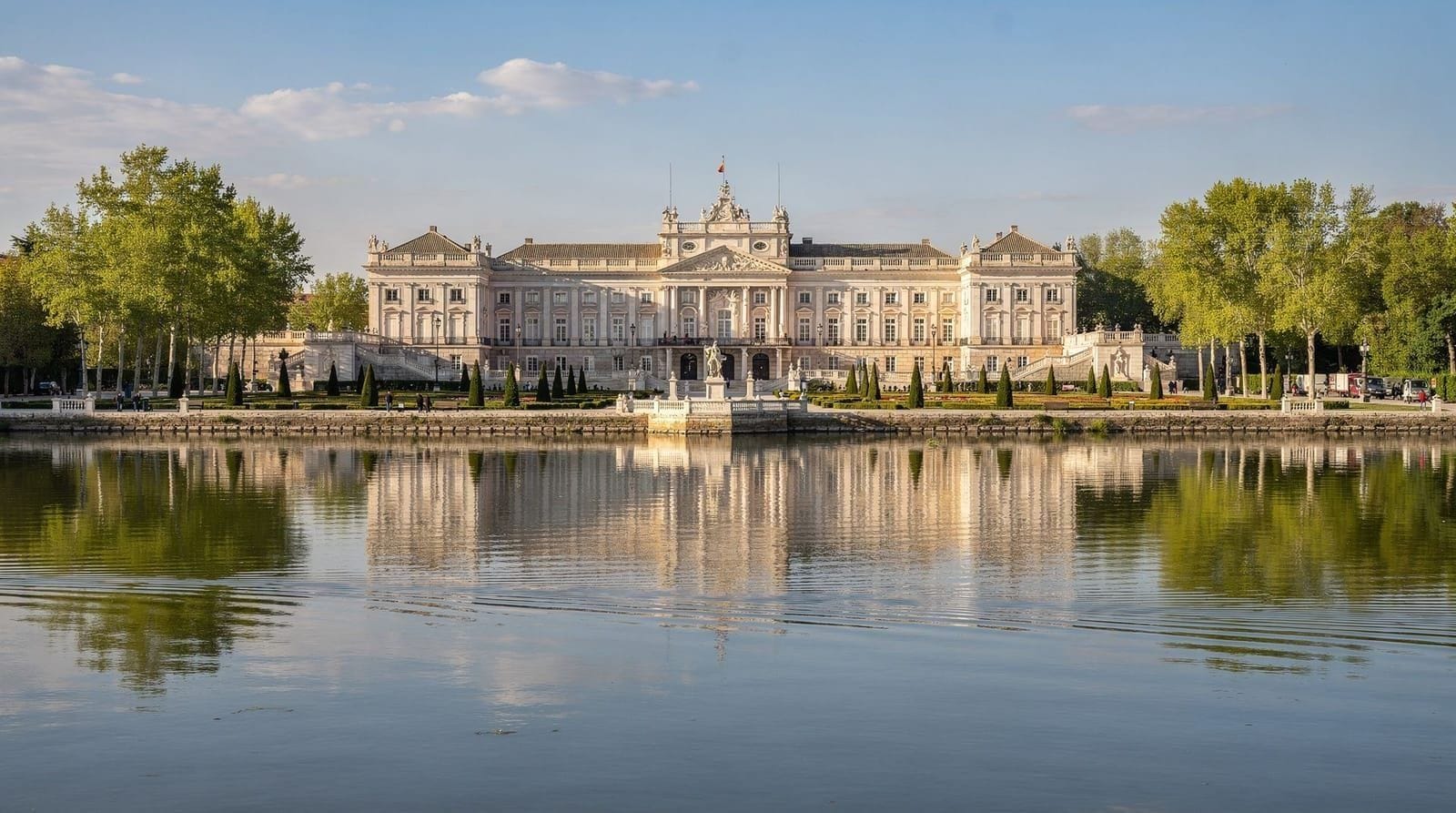
If Toledo and Segovia are about medieval history, Aranjuez is about royal pleasure. The Bourbon dynasty transformed a hunting estate on the banks of the Tagus into one of Spain’s most refined royal landscapes — a combination of formal French gardens, English parkland, a Baroque palace, and a river ecology that sustained the court’s taste for fresh fish, strawberries, and asparagus through the seasons.
The city sits in the valley of the Tagus and Jarama rivers, 47 km south of Madrid — far enough to be lush and green when the Castilian plateau is already baking in May, close enough to return to Madrid for dinner without effort.
The Royal Palace is the main draw, but the free gardens — the Jardín de la Isla and the vast Jardín del Príncipe — are what elevate Aranjuez from a “palace with a royal room” to a day you’ll remember.
| Where | Aranjuez, 47km south of Madrid, Tagus river valley |
| Cost | Around €3–4 each way by train; palace €9, Casa del Labrador €10 |
| Time needed | Half-day (4hrs) covers the palace and Jardín de la Isla; full day adds the Jardín del Príncipe |
| Getting there | Cercanías C-3 from Atocha, 35–45 minutes |
| Best time | April–June, for the gardens in bloom and strawberry season |
Getting to Aranjuez from Madrid
By Cercanías C-3 (recommended)
The simplest and cheapest option. Cercanías C-3 trains depart from Madrid Atocha approximately every 30 minutes throughout the day.
- Departure station: Madrid Atocha (or intermediate stops at Méndez Álvaro, Villaverde Alto, etc.)
- Arrival station: Aranjuez — modern station, 1.5 km from the Royal Palace
- Journey time: 35–45 minutes depending on stops
- Fare: ~€3–4 each way; Tourist Travel Pass valid (check current zone coverage)
- From the station: Walk 15–20 minutes east along Calle de la Estación to the palace, or take local bus (infrequent; walking is easier)
By Tren de la Fresa (seasonal, weekends)
The seasonal tourist train runs from the Madrid Railway Museum to Aranjuez on selected dates, using vintage carriages with costumed staff serving strawberries. Book on the official Tren de la Fresa website. Journey: about 1 hour each way vs the Cercanías 45 minutes. Worth it as a leisure experience with children; not efficient for time-pressed visitors.
By guided tour
Private Aranjuez tour with Royal Palace entry from Madrid — private guide, royal palace entry included.
For a combined Aranjuez and Chinchón day (car required between them): Aranjuez and Chinchón private 8-hour tour.
For a broader day-trip combining Chinchón, Aranjuez, and Toledo: Chinchón, Aranjuez, and Toledo guided day trip.
What to see in Aranjuez
Royal Palace of Aranjuez
The current palace — a Bourbon project begun in the 18th century — is the third building on this site after two earlier structures burned down. The interior contains an exceptional series of royal apartments: the Chinese Porcelain Room (thousands of pieces covering every wall surface), the Smoking Room (a Moorish fantasy decorated in the style of the Alhambra), and the Throne Room.
Admission: €9 (€4 reduced). Open Tuesday–Sunday 10:00–18:00 (19:00 in summer). Free for EU and Ibero-American citizens on Wednesdays and Sundays from 15:00 to 18:00 (19:00 in summer), with ID. Book online for weekends to avoid queues.
Jardín de la Isla
The island garden formed by a channel of the Tagus river directly beside the palace — a formal Baroque garden laid out in the French manner with box hedges, fountains, and paths under ancient plane trees. Free entry. Best in April–May when the water features run and flowers are at peak. 45–60 minutes at a relaxed pace.
Jardín del Príncipe
The larger landscape garden extending eastward from the palace for 150 hectares — this is the English-style parkland, more naturalistic, with century-old trees, lake, and the Casa del Labrador at its far end. Walking the full length takes 1.5–2 hours. Free entry.
Casa del Labrador (“Peasant’s Cottage”): The ironic name — this is a jewel-box neoclassical palace built for Charles IV, richly decorated with silk hangings, marble floors, and a magnificent billiard room. Admission: €10. Guided visit only, about 50 minutes (open Friday–Sunday in winter); genuinely excellent interior.
The town of Aranjuez
Beyond the royal grounds, Aranjuez is a pleasant small city with a historic grid of streets built to house royal court personnel. The Plaza de San Antonio and surrounding streets have good restaurants and bakeries. The market on Saturdays sells local produce including the famous strawberries.
A practical Aranjuez itinerary
Half-day (4 hours)
10:00 — Arrive at Aranjuez station, walk to the Royal Palace (15 min). 10:15 — Royal Palace interior (1.5 hours: the Chinese Porcelain Room, the Smoking Room, the Throne Room). 11:45 — Jardín de la Isla (45 min, free). 12:30 — Walk east to the Jardín del Príncipe entrance. 13:00 — Lunch near the Plaza de San Antonio. 14:30 — Return to station, train back to Madrid.
What you miss: The Casa del Labrador (another 1.5 hours), the full Jardín del Príncipe walk, the riverside path.
Full day (7 hours)
Follow the half-day plan. After lunch (15:00): Continue into the Jardín del Príncipe and walk to the Casa del Labrador (45 min walk each way plus about 50 min guided visit). 17:30 — Return through the Jardín del Príncipe, stopping at the lake and the old boathouse. 18:30 — Walk along the Tagus river promenade. 19:30 — Evening train to Madrid.
The Chinese Porcelain Room: Bourbon excess in context
One of the most striking interiors in Spain. The Gabinete de Porcelana (Chinese Porcelain Room) in the Royal Palace was created between 1760 and 1765 for Charles III. Every surface — floor to ceiling — is covered with interlocking Chinese porcelain pieces, some depicting scenes from daily life in China, others purely decorative. The effect is overwhelming: there is no neutral wall surface, no breathing space. It is simultaneously beautiful and claustrophobic.
This was not aesthetic madness but political symbolism: chinoiserie (the European fascination with Chinese decorative arts) was the height of Bourbon fashion in the 18th century. Louis XV had his Trianon de Porcelaine at Versailles; Charles III answered with this. The pieces were made at the Royal Factory of Buen Retiro in Madrid (now the site of the Retiro park), not imported from China.
The Smoking Room (Salón Árabe) from the 19th century takes the opposite approach — a Moorish fantasy of horseshoe arches, stucco stalactites, and tilework that mirrors the Alhambra in Granada. The room was created for Isabella II in the 1840s when Romanticism made Moorish imagery fashionable throughout Europe.
Aranjuez and the Tagus river ecology
Aranjuez’s position in a river valley — the Tagus and Jarama converging here — gives it a microclimate different from the surrounding Castilian plateau. The valley floor is 10–15°C cooler than the plateau in summer; the rivers support riparian vegetation (poplar groves, willows, reeds) that creates habitat for birds and wildlife absent from the dry land above.
The royal gardens were designed to exploit this: the Jardín de la Isla was created on a river island, enclosed by the Tagus on three sides, with a microclimate that allows tender plants not viable on the plateau. Aranjuez strawberries grow in the same irrigated conditions — the silty Tagus soils, the abundant water, the valley warmth — that made the area productive enough to supply the royal court.
The Tagus river at Aranjuez is clean enough for rowing (historically the royal family rowed here) and the riverside path is pleasant in every season.
When to visit: spring is the answer
Aranjuez in April–May is the optimal visit: the Jardín de la Isla in bloom, the strawberry stalls by the palace gates, asparagus season, comfortable walking weather, and the Tagus still running with spring volume. The gardens remain pleasant in autumn. Summer (July–August) is hot (35°C+) and the gardens less lush; the palace is air-conditioned. Winter is quiet but the gardens lose most of their charm.
| Season | Gardens | Crowds | Notes |
|---|---|---|---|
| Spring (Apr–Jun) | Peak bloom, water features running | Moderate, busiest weekends | Strawberry season; best overall |
| Summer (Jul–Aug) | Green but less lush, 35°C+ heat | Lower on weekdays | Palace is air-conditioned; walk gardens early or late |
| Autumn (Sep–Nov) | Still pleasant, autumn colour in Jardín del Príncipe | Low | Good value alternative to spring |
| Winter (Dec–Mar) | Bare, quiet, some water features off | Lowest | Palace interior remains fully open |
Aranjuez in music: the Concierto de Aranjuez
Rodrigo’s Concierto de Aranjuez (1939) is the most recorded guitar concerto in history and the piece most associated internationally with Spain after flamenco. The second movement’s famous melody — the Adagio — was directly inspired by Rodrigo’s memories of the Aranjuez gardens: the sound of water, the rustle of branches, the quietness of the royal grounds in early morning.
Joaquín Rodrigo was completely blind (from a childhood infection at the age of three) and composed the concerto in Paris before Spain’s Civil War, drawing on his memory of Aranjuez during his formative years in the 1920s. The Adagio theme was later adapted for one of the most famous jazz pieces of the 20th century — Miles Davis’ “Sketches of Spain” (1960).
The connection gives Aranjuez a musical dimension that most visitors don’t know: walking the Jardín de la Isla or the Jardín del Príncipe with the Adagio in mind makes the spaces feel differently weighted. Rodrigo is buried in the town cemetery; his house is occasionally open to visitors.
The Strawberry Train: what it actually is
The Tren de la Fresa (Strawberry Train) is a tourist heritage experience using restored 1920s–1940s Renfe rolling stock, hauled by a vintage steam or diesel locomotive. Period-costumed attendants (dressed as traditional Castilian women) distribute fresh Aranjuez strawberries to passengers during the journey.
The practical reality: The journey takes about 1 hour each way — compared to 40 minutes on the Cercanías. You spend roughly 7 hours in Aranjuez between trains. The train runs on selected dates.
Who it’s for: Families with children who enjoy the theatrical element, train enthusiasts, and visitors who want a distinctive experience rather than an efficient one. The strawberries are genuinely good.
Who should skip it: Anyone who wants maximum time in Aranjuez or who is travelling to the city for the palace and gardens primarily. The Cercanías gives you 7+ hours in Aranjuez for the same or lower cost.
Booking: On the official Tren de la Fresa website. Sells out in advance for popular dates. Fares and dates: see the official Tren de la Fresa website.
The nearby Riofrío palace
18 km west of Aranjuez (car required), the Palacio de Riofrío is a lesser-known Bourbon royal hunting palace — a pink building in a deer park that functions like a smaller, more intimate El Escorial without the religious weight. Built by Isabella Farnese (Philip V’s second wife) in 1752 as a potential retirement residence she never actually lived in.
The deer park surrounding the palace is populated with fallow deer; you drive through the deer as you approach the palace gate. The interior has an unusual hunting-themed decoration — taxidermy, hunting trophy rooms, and painted ceilings depicting hunting scenes — that is genuinely different from the formal royal apartments at Aranjuez or the Escorial.
Entry: €5. Open Tuesday–Sunday. If you have a car and find Aranjuez satisfying but brief, Riofrío adds an excellent second stop 20 minutes away.
Getting around Aranjuez on foot
Aranjuez rewards walking more than most Madrid day trips — the town’s grid layout was built for royal court logistics, so distances between the station, palace, gardens and town centre are consistent and well-signposted. From the train station, it’s a flat 15–20 minute walk to the Royal Palace along Calle de la Estación; a local bus exists but runs infrequently enough that walking is usually faster. Once inside the grounds, the Jardín de la Isla is immediately beside the palace, while reaching the Casa del Labrador at the far end of the Jardín del Príncipe is a genuine 30–40 minute walk each way — factor that into your return train timing rather than estimating loosely. Comfortable shoes matter more here than a fast pace; the paths are flat gravel and paved walkways throughout, with no steep sections.
Packing a picnic instead of a sit-down lunch
Given the scale of the free gardens, a picnic is a genuinely good alternative to a restaurant lunch in Aranjuez, especially with children or in good weather. Buy strawberries, bread, cheese and cold cuts from the Saturday market near Plaza de San Antonio, or from any of the small grocers on the way to the palace, and eat on a bench in the Jardín de la Isla or beside the lake in the Jardín del Príncipe. It saves the 45–60 minutes a sit-down menú del día requires and lets you keep exploring at your own pace — a meaningful advantage on a half-day visit where time in the gardens is the main appeal.
Planning the trip without a car
Aranjuez is one of the easiest royal sites to reach on public transport, which makes it a natural fit for anyone following the day trips without a car approach. If you are comparing it with other rail-friendly escapes, the day trips by train overview and the AVE train day trips guide show how the options differ. Since the Cercanías leaves from Atocha, the Atocha vs Chamartín guide helps you pick the right station, and the Cercanías guide explains how the commuter network works. The Tourist Travel Pass guide is worth a look before you buy single tickets.
Choosing between royal sites
Aranjuez is the garden-led option. For a different mood, El Escorial offers monastic grandeur, while the Royal Palace in Madrid lets you see the Bourbon story in the capital itself. The Habsburg and Bourbon history guide gives useful context for why these palaces look so different from one another. If you are leaning towards a medieval city rather than a royal one, Toledo from Madrid is the obvious comparison.
Aranjuez in your Madrid itinerary
Aranjuez pairs naturally with El Escorial in the Madrid royal sites itinerary — one Habsburg, one Bourbon royal complex. For a full day trip combining Aranjuez and Chinchón (car or guided tour required between them), see the Chinchón from Madrid guide.
The broader context is in the best day trips from Madrid overview and the Madrid week with day trips itinerary.
DIY by Cercanías vs guided tour: the verdict
DIY wins for Aranjuez. The Cercanías C-3 is cheap (often covered by the Tourist Travel Pass), direct, and frequent. The palace and gardens are straightforward to navigate independently. The audio guide available at the palace handles historical context well.
Guided tour makes sense if you want to combine Aranjuez with Chinchón in one day (no public transport between them) or if you prefer the convenience of a round-trip minibus with a guide.
Frequently asked questions about Aranjuez from Madrid
Is Aranjuez worth visiting from Madrid?
Yes, especially in spring. The combination of a Bourbon royal palace, formal gardens, and a UNESCO cultural landscape is unique. Unlike Toledo or Segovia, Aranjuez is less crowded and more relaxed — a genuinely pleasant half-day with good food and a different pace. In autumn and winter the gardens are quieter and still handsome.What is the Strawberry Train (Tren de la Fresa)?
The Tren de la Fresa is a seasonal tourist train running from the Madrid Railway Museum (Museo del Ferrocarril) to Aranjuez on selected dates, pulled by a vintage locomotive with period-costumed attendants serving strawberries during the journey. It's a leisure experience rather than efficient transport — the journey takes about 1 hour each way vs the regular Cercanías 45 minutes. Book on the official Tren de la Fresa website; it sells out. Fun for families, a bit slow for time-conscious visitors.What are the best gardens in Aranjuez?
Two main gardens flank the palace: the Jardín de la Isla (on a river island formed by the Tagus, with baroque fountains) and the Jardín del Príncipe (larger, English-style landscape garden extending east from the palace, 150 hectares). The Jardín del Príncipe also contains the Casa del Labrador, a smaller palace worth seeing. Both are free to enter outside the palace grounds.How much does the Aranjuez Royal Palace cost?
The Royal Palace (Palacio Real de Aranjuez) admission is €9 for adults (€4 reduced), and free for EU and Ibero-American citizens on Wednesdays and Sundays from 3 pm to 6 pm (7 pm in summer) with ID. The Casa del Labrador (small neoclassical palace in the Jardín del Príncipe) is visited by guided tour only, at €10. Both gardens are free. Audio guide: €3–5. Book online to avoid queues.What is Aranjuez's UNESCO designation?
Aranjuez was declared a UNESCO Cultural Landscape in 2001 — recognising the interaction between the royal gardens, the Tagus river, and the historic town as a designed landscape of outstanding value. It is the only UNESCO Cultural Landscape on the Iberian peninsula outside of Sintra (Portugal).What should I eat in Aranjuez?
Aranjuez is famous for its strawberries (fresones de Aranjuez, grown along the Tagus using traditional methods) and asparagus. Spring is the season for both. Buy strawberries from market stalls near the palace gates. For a meal, menú del día restaurants near the main square (Plaza de San Antonio) offer local dishes at €12–15. Asados (roast lamb and suckling pig) are the regional tradition.Is Aranjuez a good day trip if I can only pick one royal site near Madrid?
It depends on your taste. Aranjuez suits visitors who want gardens, river scenery and a relaxed pace alongside the palace interior. El Escorial suits visitors more interested in monastic and dynastic history in a dramatic mountain setting. If gardens and a gentler day matter more than austere grandeur, choose Aranjuez; the El Escorial from Madrid guide covers the alternative in full.Is Aranjuez suitable for a day trip with young children?
Yes, more so than most Madrid day trips. The gardens are flat, spacious and genuinely enjoyable to run around in, the palace visit is relatively short, and the Strawberry Train adds a theatrical element many children love. Combine with a relaxed lunch near Plaza de San Antonio rather than trying to fit in the full Jardín del Príncipe walk with tired legs.
Top experiences
Bookable activities with verified prices and instant confirmation on GetYourGuide.