Almudena Cathedral: Madrid's late-arriving Gothic revival landmark
Madrid: Royal Palace Almudena Small Group
Is the Almudena Cathedral worth visiting and is entry free?
Entry to the main nave is free (a €1 suggested donation is collected at the door). The Cathedral Museum with the dome access costs €8 (€5 reduced). The cathedral itself is architecturally unusual — built in a patchwork of styles over 110 years — but the adjacent view with the Royal Palace is one of Madrid's best public spaces.
In brief: The Almudena Cathedral is Madrid’s only cathedral, completed in 1993 after 110 years of construction. Entry to the nave is free. The rooftop offers good views of the Royal Palace. The real value is the adjacent Plaza de la Armería, where the cathedral and palace face each other across one of Madrid’s finest public squares.
| Where | Calle de Bailén 10, next to the Royal Palace |
| Cost | Free nave (donation welcome); museum with dome €8 |
| Time needed | 30–45 min nave only; 60–75 min with museum and rooftop |
| Getting there | Metro Opera (Lines 2/5), 8-minute walk |
| Best time | Weekday mornings outside Mass hours; quieter than the Palace |
The cathedral that took 110 years to finish
The Almudena is an architectural oddity by any measure. Madrid became Spain’s capital in 1561, but the city did not have a proper cathedral until 1993 — more than 400 years later. The reason is a combination of royal politics, urban planning conflicts, and sheer institutional inertia.
The original 13th-century collegiate church of Santa María la Real de la Almudena served as the de facto cathedral for centuries. Plans for a proper cathedral were drawn up in the 17th century and repeatedly abandoned. The current building was commissioned by Alfonso XII in 1879 as a burial church for his first wife, Mercedes, who died of typhoid aged 18. The plan was revived and the design chosen for the exterior was Neo-Gothic by Francisco de Cubas.
Construction started in 1883. It proceeded in fits and starts through regime changes, wars, the Second Republic, the Civil War, and the Franco dictatorship. By the time it was consecrated by Pope John Paul II in 1993, the architecture reflected multiple different eras: the exterior is Neo-Gothic (late 19th century), the crypt is Romanesque revival, and the interior of the main nave was redesigned in the 1950s in a post-war neoclassical style to match the Royal Palace’s Baroque exterior. The result is a building that tells Madrid’s turbulent 20th-century history through its own aesthetic inconsistencies.
What you actually see inside
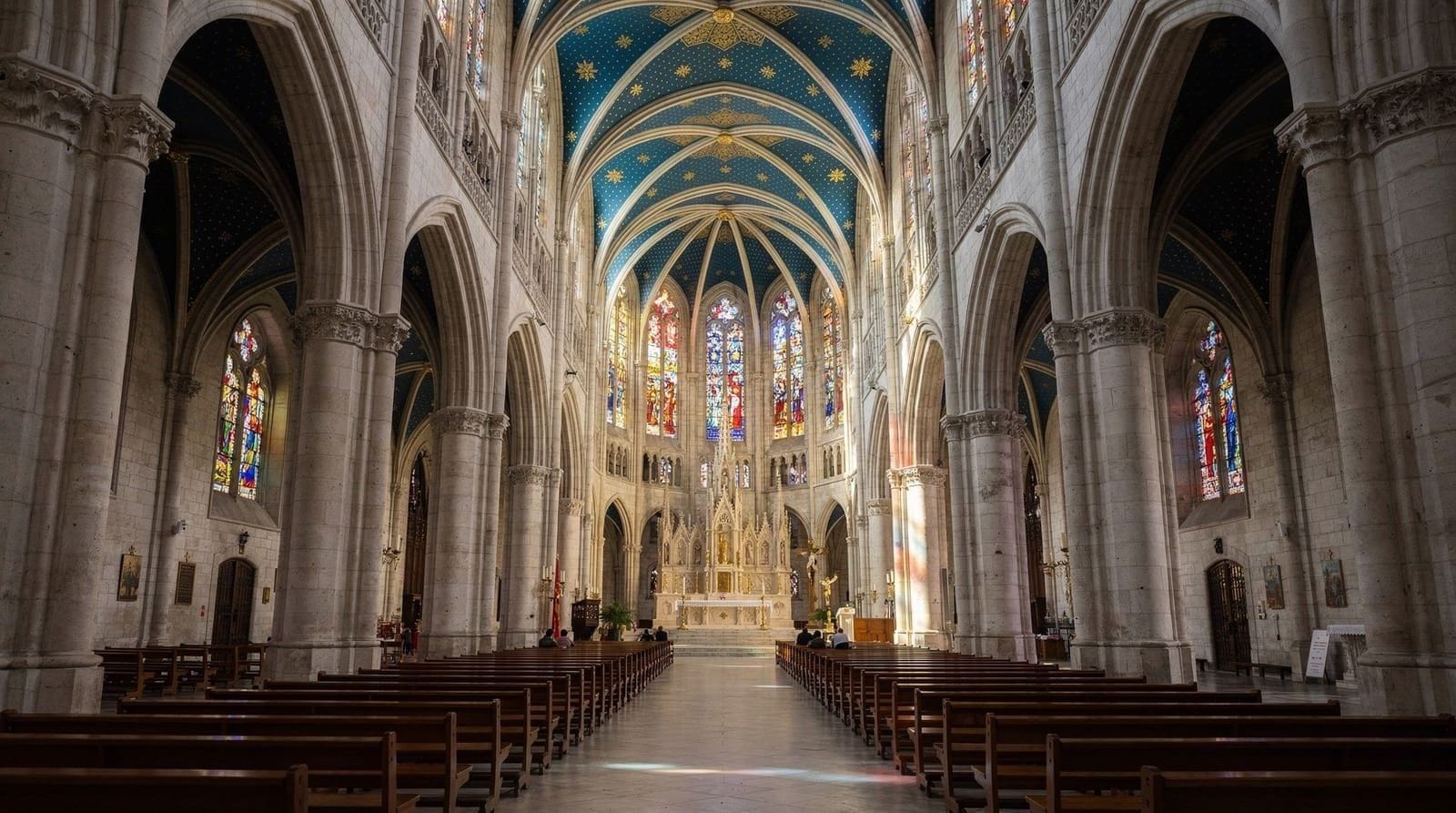
The nave of the main cathedral is large, light, and somewhat cold — the 1950s-era redesign prioritized symmetry over warmth. The windows were filled with modern stained glass rather than Gothic tracery; the result is colourful without being atmospheric in the traditional Gothic sense.
The high altar is significant: the Virgin of Almudena (Virgen de la Almudena), the patroness of Madrid, occupies the central position. The original image has a history stretching back to before the Moorish conquest of the 8th century; the current representation was commissioned in the 20th century for the new cathedral. The feast day of the Virgen de la Almudena (9 November) is Madrid’s other major civic festival alongside San Isidro.
The crypt (access from Calle Bailén below the main church level) is architecturally more coherent than the upper nave — it is properly Romanesque in style and more atmospheric for its relative austerity. The painting and decoration in the crypt are from the 1890s–1910s construction period.
The rooftop and tower views
The Cathedral Museum ticket (€8) includes access to the rooftop walkway around the dome. The views from here are genuinely worthwhile: the Royal Palace fills the northern view, the Manzanares valley and Casa de Campo to the west, and central Madrid to the east. The rooftop is accessible by lift.
This is one of the more underused viewpoints in central Madrid — far fewer visitors than the Círculo de Bellas Artes rooftop or the Faro de Moncloa, and with arguably the best view of the Royal Palace.
The Plaza de la Armería: the real reason to visit
Whatever your interest in the cathedral itself, the public space it creates with the Royal Palace is exceptional. The Plaza de la Armería — the broad esplanade between the two buildings — offers a view that neither building provides on its own: the cathedral’s Neo-Gothic facade faces the palace’s Baroque east facade, with the Manzanares valley visible to the west through the gap between them.
This is a free public space, accessible at all hours. At sunset, with the palace lit and the cathedral silhouette dark against the evening sky, it is one of Madrid’s most photographed vistas. The space is also used for the Royal Changing of the Guard ceremony (first Wednesday of each month, 12:00) and on Spain’s National Day (12 October) for the military parade.
A small-group tour combining the Royal Palace and Almudena Cathedral covers both sites in sequence with a guide who explains the historical relationship between the two buildings.
Getting there and practical details
Address: Calle de Bailén 10, 28013 Madrid. The main entrance faces east, toward the Plaza de la Armería and the Royal Palace.
Metro: Opera (Lines 2/5), 8-minute walk via Calle Mayor. Or walk 10 minutes from Plaza Mayor via Calle Mayor.
Dress code: Shoulders and knees covered, as in any active Catholic place of worship. The requirement is enforced at the entrance.
Masses: In the cathedral, Mass is at 12:00 and 19:00 daily and at 11:00 Monday to Friday; in the crypt at 11:00 and 13:00 daily. During Mass, some side aisles may be restricted and photography is inappropriate.
How to integrate the Almudena into a visit
The natural combination is Royal Palace + Almudena Cathedral + Plaza Mayor as a half-day circuit of the Habsburg quarter. Start at the palace (90 minutes), cross to the cathedral (45 minutes), then walk east along Calle Mayor to Plaza Mayor (10 minutes) and from there to Puerta del Sol.
For architecture enthusiasts, the contrast between the cathedral’s stylistic layering and the palace’s coherent Bourbon Baroque is itself a lesson in how Madrid’s history worked in fits and starts.
The Madrid first weekend itinerary and the Madrid de los Austrias neighborhood guide both build this circuit into a morning programme.
What the Almudena is not
It is not Seville Cathedral, Notre-Dame, or Cologne Cathedral — not a Gothic masterpiece built over centuries with a unified vision. Visitors who come expecting a great Gothic interior will be disappointed. The interest here is historical and contextual rather than purely architectural: what does it mean that Spain’s most Catholic nation-state took 400 years and two attempts to build a cathedral for its capital? The Almudena embodies that question in stone.
For genuinely great religious architecture within day-trip distance, Toledo — 33 minutes by AVE from Atocha — has the Cathedral of Toledo, one of Spain’s finest Gothic monuments, and a dozen other medieval churches in the same compact historic center.
The Virgen de la Almudena: Madrid’s patroness
The Virgen de la Almudena is the patroness of Madrid, and the story of her discovery is one of the city’s founding myths. According to tradition, when Alfonso VI reconquered Madrid from the Moors in 1083, an image of the Virgin — supposedly hidden by Christians before the Moorish conquest in 714 to protect it from destruction — was discovered in a section of the old city wall called the Almudena (from the Arabic al-mudayna, meaning “the small city” or citadel).
The image is venerated in the lower crypt of the cathedral; the feast day of the Virgen de la Almudena is 9 November, one of Madrid’s two principal civic and religious festivals (the other being San Isidro on 15 May). On 9 November, the image is processed through central Madrid in a ceremony attended by the city government and the royal family.
The current carved image dates from the 20th century — the original medieval image was destroyed during the Civil War. The patronal identity has been maintained regardless, and the feast remains an important marker of Madrid’s civic calendar. Understanding the Almudena’s role as patroness helps explain why the cathedral, despite its architectural limitations, holds a central place in Madrileño identity.
Royal weddings: the Almudena in the 21st century
The Cathedral of La Almudena was the venue for the wedding of Crown Prince Felipe (now King Felipe VI) and Letizia Ortiz on 22 May 2004 — the first royal wedding to take place in the cathedral since its consecration. The choice was deliberate: Pope John Paul II had personally consecrated the building in 1993, and the cathedral’s location adjacent to the Royal Palace made it the obvious venue for the first major state ceremony of the new century.
The 2004 royal wedding was watched by 700 million people globally and brought significant international attention to both the cathedral and the Plaza de la Armería setting. The west doors through which the royal couple exited are the same doors facing the Royal Palace plaza that all visitors pass today.
The crypt: Madrid’s underground Romanesque church
The lower crypt of the Almudena is architecturally the most coherent part of the building — a complete Romanesque-style church on the lower level, with vaulted ceilings, carved capitals, and painted decoration from the 1890s–1920s construction period. The crypt is accessed from Calle Bailén (below the level of the main cathedral entrance) and functions as an active parish church.
The crypt’s Romanesque aesthetic is a deliberate choice by the original architects — the stylistic register that best suits the myth of the medieval discovery of the Almudena image. It has a warmth and intimacy that the upper cathedral’s neoclassical nave lacks. Several important figures are buried here, including the Counts of Orgaz (unrelated to the famous El Greco painting, but from the same Toledo family).
For visitors with an interest in the architectural history rather than the devotional context, the crypt is the more architecturally satisfying space and often less busy than the main nave above.
What to expect on arrival
The Almudena is an active church — Masses are celebrated throughout the day, and visitors and worshippers share the space simultaneously. Outside Mass times, the nave is open for tourists; during Mass, lateral movement through the church may be restricted and photography is not appropriate.
The main entrance (east door, facing the Plaza de la Armería) is the principal tourist entrance. The dress code — shoulders and knees covered — is enforced at the entrance. Shawls and wraps are sometimes available for loan at major European churches; this is not consistently offered at the Almudena — come prepared.
The Royal Palace entry is directly across the plaza. The natural circuit — arrive at the palace (10:00), visit 1.5 hours, cross to the cathedral (30–45 minutes), then walk east via Calle Mayor to Plaza Mayor — covers the Habsburg heart of Madrid in a comfortable morning and appears in the Madrid first weekend itinerary.
The architectural style debate
The Almudena’s stylistic incoherence is its most commented-upon characteristic. Critics have been harsh: the exterior Neo-Gothic of Francisco de Cubas, the 1950s-era neoclassical nave redesign, the Romanesque crypt, and the post-Vatican II liturgical furniture all clash without the unity of purpose that makes great ecclesiastical architecture. The architects who worked on the building across 110 years had different briefs, different budgets, different political constraints, and different aesthetic assumptions.
The defenders of the Almudena argue that this layering is itself historically honest — that the cathedral’s confused stylistic identity reflects the confused political identity of Spain in the period it was built. A cathedral begun under Alfonso XII, stalled under the Republic, continued under Franco, and consecrated under Juan Carlos I cannot be architecturally coherent because the Spain that built it was not coherent.
This argument is more interesting than a simple aesthetic judgment. Whether you find it persuasive determines whether the Almudena is a building that disappoints or one that illuminates.
Comparing the Almudena with Toledo Cathedral
For visitors interested in Spanish religious architecture, the comparison with Toledo Cathedral is instructive and worth making deliberately. Toledo Cathedral (begun 1226) is a masterpiece of Spanish Gothic — coherent, unified, built over two centuries by successive generations working within a consistent aesthetic vision. The Gothic nave is one of the finest in Spain; the sacristy (with El Greco paintings), the treasury (the Cisneros monstrance), and the Transparente altarpiece are individually extraordinary.
Toledo is 33 minutes by AVE from Madrid-Atocha. The contrast between the Almudena (1879–1993, architecturally hesitant) and Toledo Cathedral (1226–1492, architecturally confident) is the most concise summary of how Catholic Spain’s relationship with its own ecclesiastical identity changed between the medieval period and modernity.
The Toledo from Madrid guide covers the day trip logistics.
Wedding and christening site: the royal family connection
Beyond the 2004 royal wedding, the Almudena has served as the ceremonial religious venue for the Madrid royal family since its consecration. Princess Leonor — heir to the throne — was christened here in November 2005. Crown Princess Sofia (second in line) was also christened at the Almudena.
The connection is both logistical (the palace is adjacent) and symbolic. The Almudena’s location and its status as the cathedral of Madrid make it the appropriate venue for royal ceremonies in a way that no other Madrid church — however more architecturally distinguished — could be.
Accessibility and visit planning
The Almudena is one of Madrid’s most accessible major buildings. The main entrance is at plaza level with no steps; the interior is entirely flat except for the tower/rooftop access (lift available). The crypt is accessible via a ramp from Calle Bailén.
The museum and rooftop access involves a lift to the dome level. For wheelchair users and visitors with limited mobility, the accessible route covers everything of significance.
Photography: The main nave permits photography outside of Mass. The altar area and the Virgin’s chapel have restrictions during services. The rooftop permits photography freely — the view of the Royal Palace from the dome walkway is the primary reason for the €8 museum ticket.
Visiting with children: The cathedral is a manageable, low-effort stop for families — the nave is quick to see, there are no ticket queues comparable to the Royal Palace next door, and the rooftop walkway (with a lift, not stairs) is a genuine hit with kids who enjoy a “castle view.” Keep visits brief during active Mass and remind children that quiet is expected, as it remains an active place of worship rather than a pure museum.
Mass schedules: Several daily masses; the Sunday 12:00 Mass is the most heavily attended. Arrive 30 minutes before these to claim a seat. The 19:00 weekday Mass is the quietest and most atmospheric.
Near the Almudena: what else to see in the immediate area
Jardines de Sabatini (3 minutes north of the cathedral, free): The formal neoclassical gardens on the north side of the Royal Palace, with geometric box hedges and a reflecting pool. Free entry; good photography position for the palace’s north tower.
Plaza de Oriente (5 minutes north): The formal plaza facing the palace’s east facade, with equestrian statues of Spanish monarchs and the Teatro Real opera house. The Café de Oriente terrace here is the best coffee option in the palace area.
La Latina neighborhood (10 minutes south via Calle de Segovia): Madrid’s best tapas barrio. After the palace-cathedral morning, lunch in La Latina is the standard conclusion to the circuit.
Best time of day to visit
Weekday mornings, right after the 10:00 opening and before the Royal Palace crowds spill across the plaza, are the calmest window — you’ll often have long stretches of the nave to yourself. Midday on weekends is busiest, driven mostly by the Changing of the Guard crowd (first Wednesday of the month, 12:00) rather than cathedral visitors specifically. Late afternoon, an hour or two before the evening closing (20:30, or 21:00 in July and August), is a good second-choice window with softer light for photographing the Plaza de la Armería. Avoid arriving right at Sunday midday Mass times if your priority is sightseeing rather than worship, since movement through parts of the nave is restricted then.
Seasonally, the cathedral makes most sense as a midday indoor option in summer heat (July–August), when the Plaza de la Armería offers little shade and a cool nave is a welcome break between Royal Palace queueing and lunch in La Latina. In winter, the rooftop walkway can be cold and exposed — check conditions before paying for the museum ticket purely for the view.
Almudena vs Royal Palace vs Toledo Cathedral: how to spend limited time
| Time needed | Cost | Best for | |
|---|---|---|---|
| Almudena nave only | 30–45 min | Free | A quick, uncrowded stop between the Palace and Plaza Mayor |
| Almudena + museum/rooftop | 60–75 min | €8 | Royal Palace views and architectural context |
| Royal Palace | 90 min–2 hrs | Ticketed, see Royal Palace guide | State rooms, armoury, and the palace’s Baroque grandeur |
| Toledo Cathedral (day trip) | Half-day incl. travel | Ticketed, see Toledo from Madrid guide | Spain’s finest unified Gothic cathedral interior |
If you only have an hour in the area, the free nave plus the Plaza de la Armería view covers the essentials. If cathedral architecture is a genuine interest rather than a quick stop, save your energy for Toledo instead of expecting the Almudena to deliver a Gothic masterpiece.
Making the Almudena part of a wider royal Madrid day
The cathedral works best as one link in a chain rather than a destination on its own. If you would rather not juggle separate queues, an entry option covering both the cathedral and the palace keeps the morning simple, and you can still decide on the spot how long to linger in each building. Travellers who prefer to keep the palace as the main event and treat the cathedral as an extra can look at a palace visit with the cathedral as an optional add-on.
For the historical thread that connects the two buildings, the Habsburg and Bourbon history guide explains why Madrid’s royal quarter looks the way it does, and the Madrid royal sites itinerary strings the palace, the cathedral and the surrounding streets into a single route. Visitors who want the full palace story first should read the Royal Palace guide before arriving.
After the cathedral: where to go next
The streets around the Almudena lead naturally in several directions, depending on your energy and appetite:
- For art: the Golden Triangle art walk picks up where the royal quarter leaves off, and the Prado Museum guide helps you decide how much of the collection to take on in one visit.
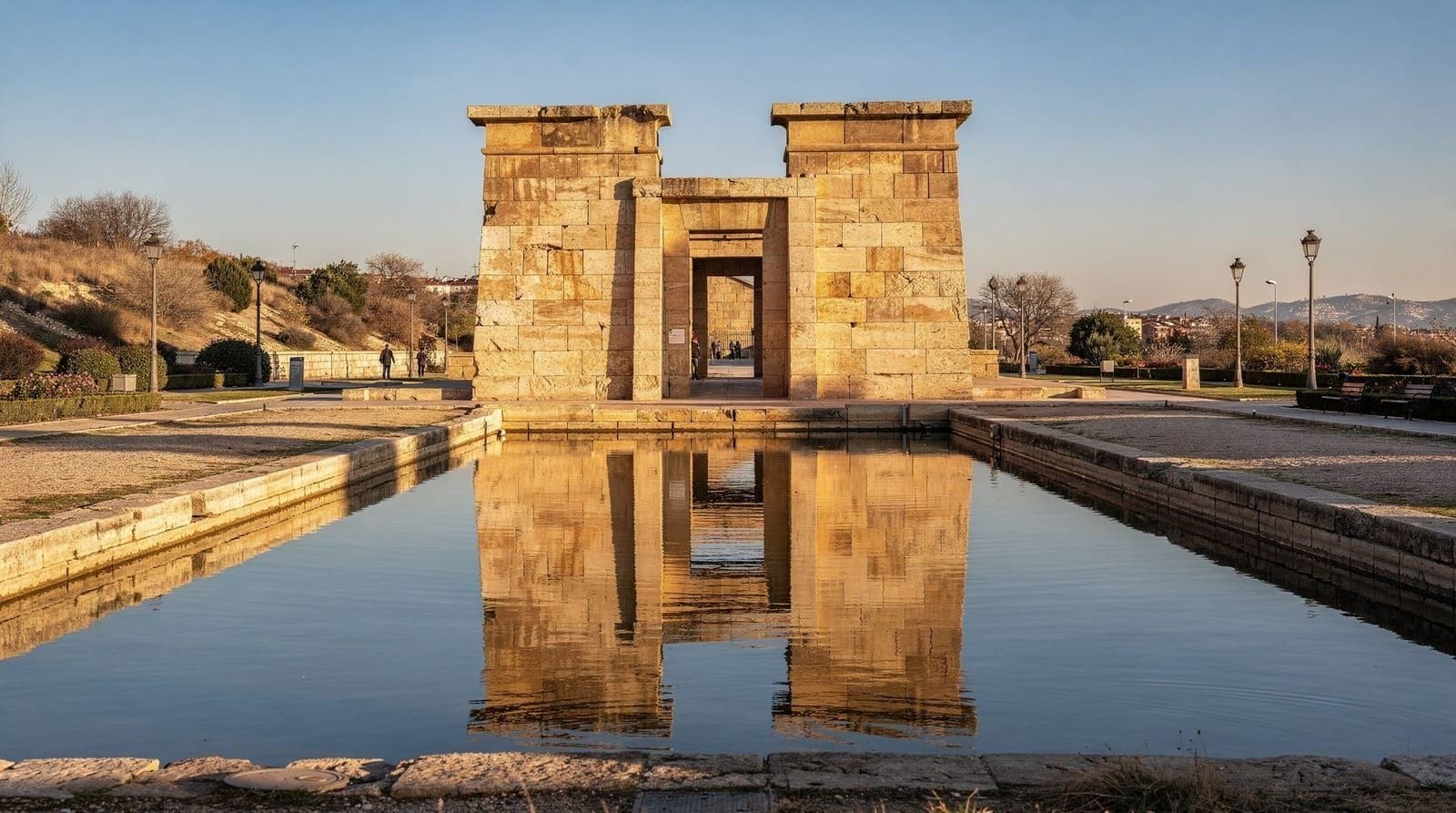
- For a sunset view: the Temple of Debod is a short stroll away and pairs well with the evening light over the Manzanares side of the city.
- For lunch: the where to eat in La Latina guide and the wider La Latina neighbourhood cover the tapas bars that traditionally round off this circuit.
- For culture in the evening: the Teatro Real and zarzuela guide is useful if you want to stay in the royal quarter after dark.
- For free options: the free things to do in Madrid list shows how the cathedral nave, the plaza and the gardens fit into a low-cost day, alongside the Madrid on a budget guide.
Planning the visit around your trip length
How much time the Almudena deserves depends on how long you are in the city. On a short stay, the one day in Madrid itinerary treats the cathedral as a quick stop beside the palace, while the three-day itinerary leaves room to go inside properly and climb to the rooftop. If you are still deciding how many days to give the capital, the how many days in Madrid guide helps you set priorities, and the Madrid de los Austrias neighbourhood is the natural base for exploring on foot.
Getting around is simple: the Madrid metro guide explains the network, and since the royal quarter is compact, most of the day is spent walking rather than riding.
Frequently asked questions about Almudena Cathedral
What are the Almudena Cathedral's opening hours?
The cathedral is open daily 10:00–20:30 from September to June and 10:00–21:00 in July and August. The Cathedral Museum, which includes the dome, is open Monday–Saturday 10:00–14:30 and closed on Sundays and feast days. The cathedral is open for Mass throughout the day, which may limit tourist access to certain areas.How much does it cost to visit the Almudena Cathedral?
Nave: free (€1 donation requested at the entrance). Cathedral Museum with dome access: €8, or €5 reduced. Under-9s are free for the museum. The crypt is visited separately on a guided tour.What is special about the Almudena Cathedral historically?
The Almudena is extraordinarily late for a major European cathedral — construction began in 1879 and was not completed until 1993, when Pope John Paul II consecrated it. Madrid was the only major European capital without a cathedral for most of its history as a capital city; the original cathedral plan was blocked by Carlos III, who considered it unnecessary.Who is buried in the Almudena Cathedral crypt?
The crypt, which opens onto the lower level of the building, contains the tombs of several important figures. It also serves as the parish church for the Cathedral area. The Virgin of Almudena (the patron of Madrid) is venerated here — she is one of the oldest Marian images in Madrid, with a history stretching back to the Moorish period.How much time should I budget for the Almudena Cathedral?
Around 30–45 minutes for the free nave, or 60–75 minutes if you add the museum and dome (€8 ticket). Most visitors pair it with the Royal Palace next door, which needs 90 minutes to 2 hours on its own, so plan a half-day for the combined visit rather than trying to rush both in an hour.Is the Almudena Cathedral crowded like other Madrid landmarks?
No — it's one of the least crowded major sights in central Madrid, even though it sits directly next to the heavily visited Royal Palace. Most visitors to the plaza photograph the exterior and skip going inside, so the nave, crypt and rooftop rarely feel busy outside of Mass times or the royal-family ceremonial dates.
Top experiences
Bookable activities with verified prices and instant confirmation on GetYourGuide.