Royal Palace of Madrid guide: tickets, what to see, and honest tips for 2026
Madrid: Royal Palace Fast Access Ticket
Is the Royal Palace of Madrid worth visiting and do I need to book in advance?
Yes on both counts. The Royal Palace is the largest functioning royal palace in Western Europe by floor space, with genuinely opulent state rooms, a royal armoury, and the Stradivarius string collection. In peak season (April–October), same-day queues can be 30–60 minutes; online skip-the-line tickets are worth the small surcharge.
In brief: The Royal Palace of Madrid is the largest functioning royal palace in the Western world by floor space — 135,000 square metres, 3,418 rooms. Standard entry is €18; free for EU and Ibero-American citizens on weekday late afternoons (Monday–Thursday). Skip-the-line tickets are worth buying online in spring and summer.
| Where | Calle de Bailén s/n, edge of the historic centre |
| Cost | €18 standard; free for EU and Ibero-American citizens Mon–Thu late afternoon |
| Time needed | 1.5–2 hours (palace only), 3–4 hours with Armoury and gardens |
| Getting there | Metro Ópera (Lines 2/5), 5-minute walk |
| Best time | Weekday mornings, Oct–March, to avoid the worst queues |
A palace designed to impress, not to house a family
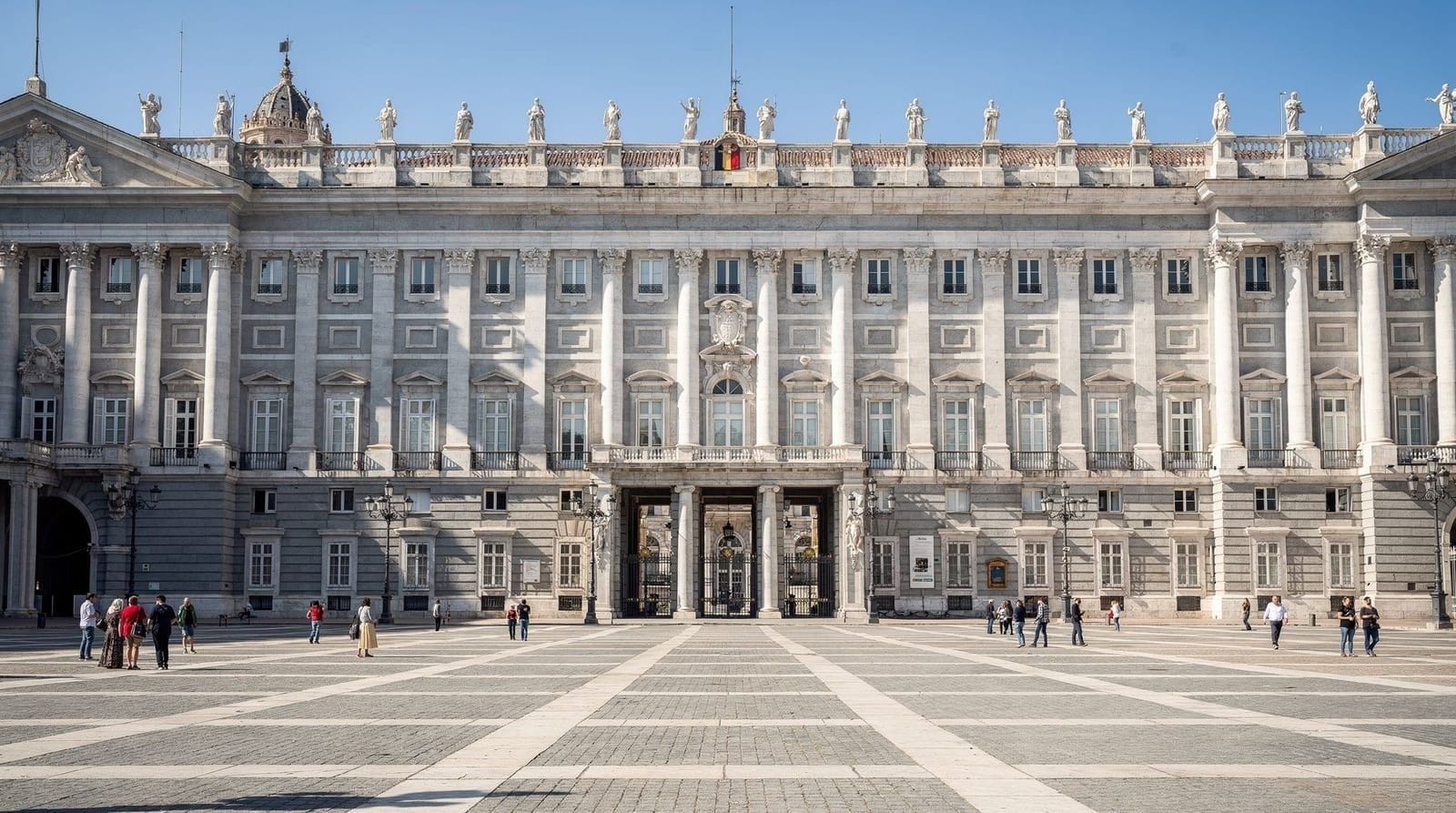
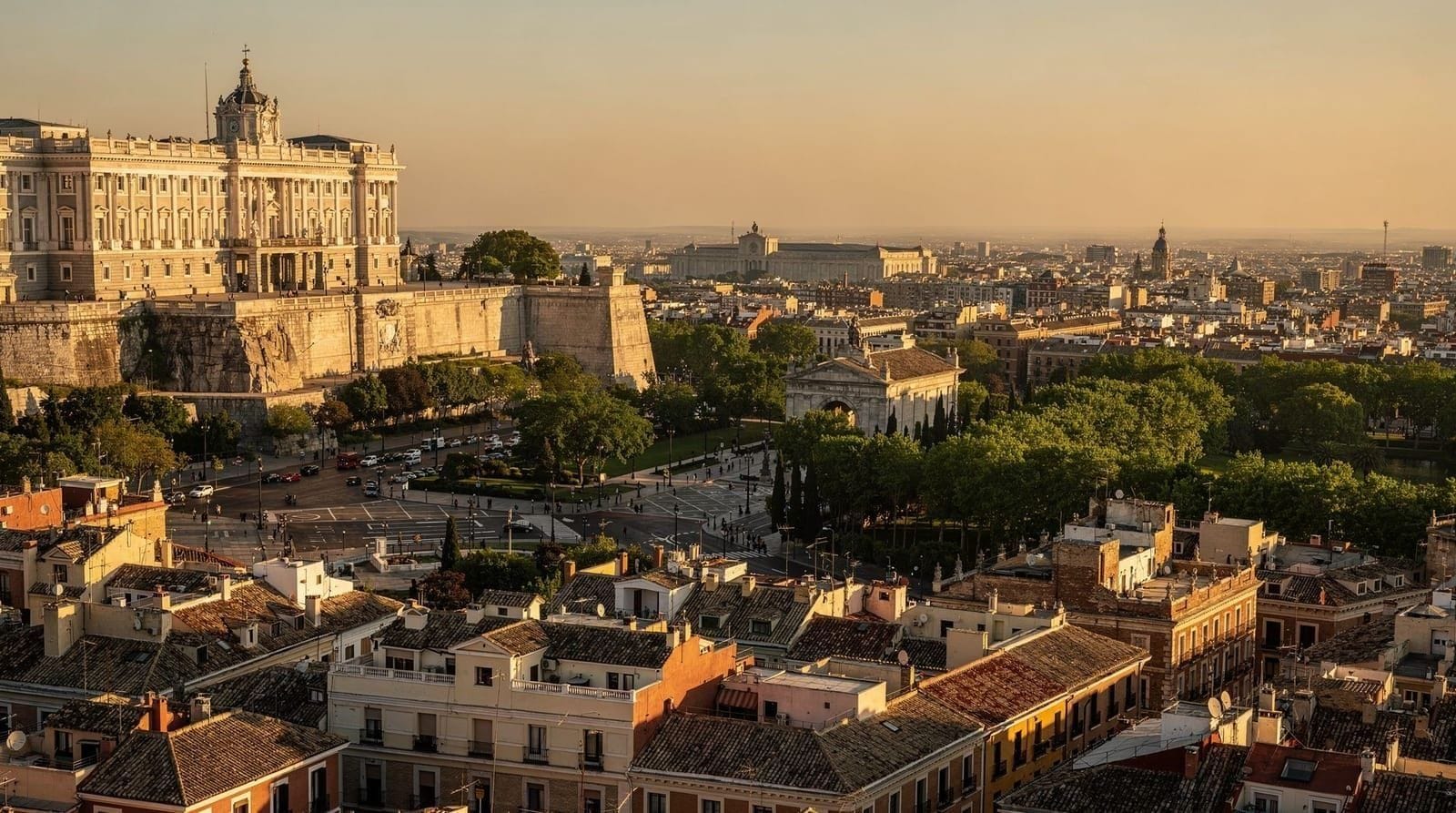
The Royal Palace of Madrid (Palacio Real) was not built to be comfortable. It was built to project power. Philip V ordered its construction after a fire destroyed the original Habsburg Alcázar in 1734, and he commissioned Italian architects — Juvara and then Sachetti — to design something that would rival Versailles. The result is a 140-metre-long limestone and granite cube sitting on a promontory above the Manzanares River valley: visible from far outside Madrid, and deliberately so.
The palace took 26 years to build (1738–1764) and was completed under Charles III, who became the first monarch to actually reside in it. Nine monarchs lived here until Alfonso XIII left in 1931 following the proclamation of the Second Republic. Since then it has been state property maintained by Patrimonio Nacional (National Heritage).
The current king uses it only for formal state functions. For visitors, this is genuinely good news: the state rooms are preserved in full ceremonial condition, not adapted for daily family living.
What you actually see inside
The self-guided route covers 50 rooms on the official tour. The rooms are not uniformly spectacular — some are repetitive formal reception spaces — but the best are genuinely extraordinary.
The Hall of Columns
The first major space after the entrance staircase: a 30-metre hall used for treaty signings, investitures, and state banquets. The ceiling frescoes by Corrado Giaquinto (1762) cover the Triumph of Religion and the Church — ambitious in scale, busy with allegorical figures, and impressive in the way only Baroque excess can be.
The Throne Room (Salón del Trono)
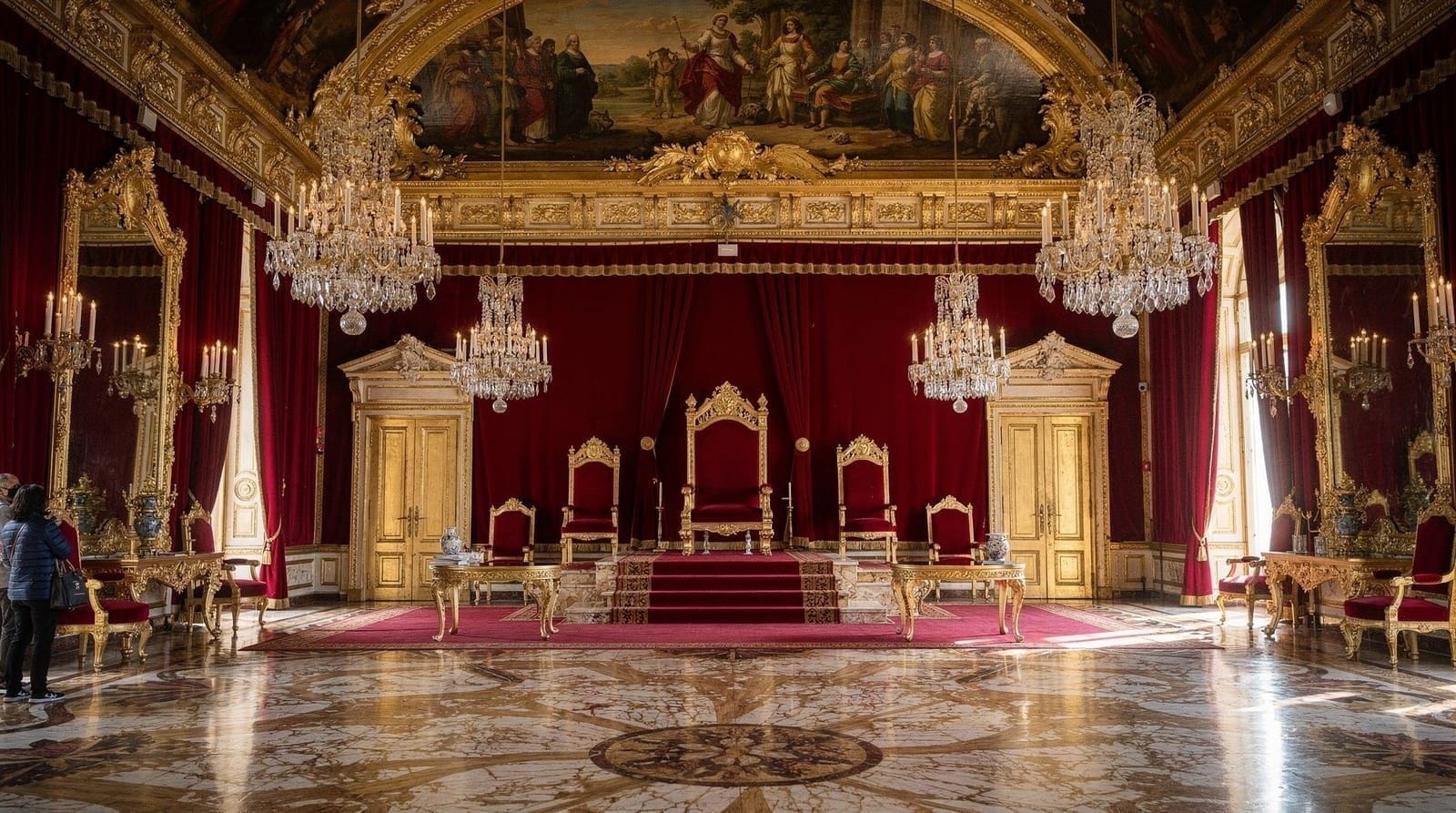
The ceremonial heart of the palace and the most photographed room. The thrones of the current king and queen (installed in 1977) sit under a ceiling fresco by Giambattista Tiepolo — the Allegory of the Magnificence of the Spanish Monarchy — considered one of Tiepolo’s finest works. The walls are hung with crimson velvet and four bronze lions guard the throne. State portraits of Charles III and Charles IV by Anton Raphael Mengs hang on either side.
The Throne Room is still used for the ceremonial accreditation of foreign ambassadors, which means it is occasionally closed on short notice for official functions.
The Gasparini Room
The most elaborate room in the palace and the one most visitors single out as the highlight. Charles III commissioned it as his dressing room; the entire surface — walls, ceiling, floors — is covered with embroidered silk, stucco, and marble in an overripe Rococo style that is either magnificent or oppressive depending on your tolerance for ornamentation. The floor is Chinese marble; the ceiling stucco depicts garlands of flowers with Chinese-influenced motifs.
The State Dining Room
One of the largest dining rooms in any European palace: 36 metres long, capable of seating 140 guests. The table is set for a formal state dinner with the full royal service — porcelain, crystal, gold cutlery. This is the room used for state banquets when heads of government visit.
The Royal Armoury (Armería Real)
A separate building on the south side of the Plaza de la Armería holds one of the three finest royal armour collections in Europe (alongside Vienna and the Tower of London). The highlight is the complete suit of armour made for Charles V by the Milanese workshop of Kolman Helmschmid — the armour the emperor wore at the Battle of Mühlberg (1547), as depicted in Titian’s famous equestrian portrait. The collection of tournament armour, children’s armour, and decorated ceremonial pieces is superb.
Don’t skip the Armoury. Many visitors rush through the palace rooms and overlook it entirely; it is consistently rated as one of the best parts of the visit by those who see it.
A premium skip-the-line Royal Palace ticket includes fast-track entry to both the palace and the Royal Armoury with a guide explaining the historical context of each room.
The Royal Pharmacy (Farmacia Real)
On the north side of the main square: a collection of pharmaceutical equipment, ceramic drug jars, glass vessels, and distillation apparatus used by the royal household from the 18th century. Unexpectedly interesting — the contrast between the precision of the ceramic work and the grimness of what 18th-century medicine actually achieved is striking. Small space; 20–30 minutes.
The Stradivarius string collection
A lesser-known treasure: the Royal Palace holds the only complete Stradivarius orchestra in the world — five violins, two violas, two cellos, and a double bass all made by Antonio Stradivari between 1694 and 1720. The instruments are displayed in one of the music rooms and are still used for occasional concerts. For string enthusiasts, this is as significant as any room in the palace.
The gardens: Jardines de Sabatini and Campo del Moro
Jardines de Sabatini (north side of the palace): A formal neoclassical garden laid out in the 1930s on the site of the royal stables. Free entry; open daily. The garden’s north-facing view looks toward the Palacio de la Zarzuela hills. The geometric box hedges and central pond make for good photography.
Campo del Moro (west side, below the palace): A larger English-style park running down the slope toward the Manzanares River. The palace viewed from below — from this western garden — is the most dramatic single image of the building. Free entry but access is only from the south gate on Paseo de la Virgen del Puerto. Fewer tourists than the Sabatini gardens.
The Plaza de la Armería and the view
The main square in front of the palace’s east facade faces the Almudena Cathedral and offers a clear view south over the Manzanares valley toward the Casa de Campo park. On a clear day, the Sierra de Guadarrama fills the western horizon. This view is one of Madrid’s best free experiences — accessible without a ticket, any time the square is open.
Practical logistics
Address: Calle de Bailén s/n, 28071 Madrid. The main entrance is on the east side, facing the Plaza de la Armería.
Getting there: Metro Opera (Lines 2/5), then walk west along Calle de Arenal and Calle Mayor. Or walk from Plaza Mayor in 10 minutes via Calle Mayor. From Puerta del Sol by foot: 15 minutes via Plaza Mayor.
Best time to visit: Weekday mornings (10:00–12:00) in January–March or October–November for minimum crowds. Avoid weekend afternoons April–October.
Photography: Allowed throughout the self-guided route. The Throne Room and Gasparini Room are the best-photographed spaces.
A small-group Royal Palace and Almudena Cathedral tour covers both adjacent sites with a guide in under three hours.
Combining the Royal Palace with surrounding sights
The Royal Palace anchors the western edge of Madrid’s historic Habsburg quarter. From the palace:
- West: Gardens and the view over the Manzanares valley (free, 30 minutes)
- East: Almudena Cathedral — immediately adjacent, 45–60 minutes
- Southeast: Plaza Mayor — 10-minute walk via Calle Mayor
- East: Puerta del Sol — 15-minute walk
The Madrid de los Austrias walking area connects these sites logically. For a first-time visitor building a one-day circuit of central Madrid, the Royal Palace + Plaza Mayor + Sol route is the classic structure, as laid out in the Madrid first weekend itinerary.
What to skip and what not to miss
Don’t miss: The Throne Room, the Gasparini Room, the Royal Armoury, and the view from the Plaza de la Armería. If the Changing of the Guard coincides with your visit (first Wednesday of the month at 12:00, except January, July and August), plan your arrival accordingly — it requires a plaza viewpoint.
Safely skippable: The upper-floor official portrait galleries (repetitive for non-specialists) and the gift shop if you’re on a budget (expensive, limited selection).
Honest warning: The palace is crowded at all times in peak season. If you are travelling with young children under 8, a 90-minute palace visit is ambitious — the self-guided route offers little to engage children directly. The armoury tends to hold children’s attention better than the decorated rooms. Check the Madrid with kids guide for age-appropriate structuring.
The palace in the broader Habsburg-Bourbon Madrid circuit
The Royal Palace sits at the western end of the “Royal Mile” of Madrid — the axis running from the Prado Museum through the Retiro park, along the Calle de Alcalá past the Cibeles fountain, through Sol, along Calle Mayor through Plaza Mayor, and culminating at the palace. This 2.5 km walk covers most of Madrid’s historical core.
From the palace, the circuit extends outward to the other royal sites within the region:
- Aranjuez: Royal summer palace and French-inspired gardens, 45 minutes south by Cercanías train — a day trip that makes the Madrid palace more legible by comparison
- El Escorial: Philip II’s monastic palace in the Sierra, 1 hour northwest — the austerity of El Escorial makes the Madrid palace’s Bourbon excess more dramatic by contrast
- Palacio de la Zarzuela: The current royal family’s residence, visible from the Sierra roads but not open to visitors
The Madrid Royal Sites itinerary builds these three sites into a two-day programme.
Royal Palace tour options compared
Self-guided (€18): The standard option. Good signage, free audio guide app, room to linger at what interests you. Best for independent visitors who have done pre-visit research.
Guided visit (€26 in total, €17 reduced): A Patrimonio Nacional guide accompanies the group through the standard route. Useful for historical context; groups can be large (15–25 people). Tours in Spanish and English.
Skip-the-line private tour: Booked through operators like GYG, these include priority entry and a private guide for your group. Eliminates queuing entirely; the guide focuses on what your group is interested in. Most cost-effective for families of 3+ people or anyone who values flexibility.
Combined Palace + Prado tours: Several operators offer combined programmes (palace morning, Prado afternoon) in a single day. Ambitious but feasible for visitors who want to cover the two most important paid attractions in Madrid in one day.
Photography at the Royal Palace
Best external shots:
- Plaza de la Armería (east facade) at mid-morning with the cathedral visible behind you
- Campo del Moro (western gardens, below the palace) looking up at the palace facade — best in early morning before the sun is too high
- Jardines de Sabatini (north gardens) for the formal garden geometry with the palace towers
Interior photography: Permitted throughout the self-guided route. No flash in the Throne Room and Gasparini Room. The Throne Room ceiling fresco photographs well with a wide-angle lens; the Gasparini Room’s embroidered walls require good natural light (go on a sunny morning).
Best visiting time for photography: 10:00–11:00 on weekdays — the east-facing Plaza de la Armería facade is in good morning light, crowds are lower, and the garden views are unobstructed.
Children’s programmes and family visit tips
The Royal Palace runs occasional family workshops and children’s guided tours on weekends; check the Patrimonio Nacional website for current scheduling. For a standard family visit:
-
Under 5s: The palace visit is difficult — 90 minutes of decorated rooms with nothing to touch. The Campo del Moro garden (free, open daily) provides outdoor space and the palace-from-below view that younger children often find more impressive than the interior.
-
Ages 6–10: The Royal Armoury is the most engaging section — armour is tangible and visually striking. The children’s armour pieces (Philip II had sets made for his children; the Prado’s equestrian portraits show the results) are particularly engaging.
-
Ages 10+: The full palace route is manageable with some preparatory storytelling about Philip V and the Bourbons. The Madrid with kids guide covers the full family circuit for different ages.
Royal events at the Palace in 2026
The Royal Palace is used for specific state functions throughout the year:
- Changing of the Guard (monthly): First Wednesday of each month at 12:00 in the Plaza de la Armería, except January, July and August
- National Day (12 October): Military parade past the palace
- Easter (Holy Week): The palace may partially close for state religious ceremonies
For specific 2026 dates and any exceptional closures, the Patrimonio Nacional website lists confirmed closures 2–4 weeks in advance. During major state events (investitures, treaty signings), the Throne Room and Hall of Columns are closed to visitors — these closures are typically announced 24–48 hours in advance.
Royal Palace vs Prado: how to split a Madrid day
The Royal Palace and the Prado are Madrid’s two essential paid attractions, but they sit at opposite ends of the historic centre and cannot both be done justice in a single rushed morning. The comparison:
| Royal Palace | Prado | |
|---|---|---|
| Time needed | 1.5–4 hours | 2–4 hours |
| Best morning slot | 10:00 opening, before tour groups arrive | 10:00–13:00 |
| Free window | Mon–Thu 16:00–18:00 (Oct–Mar) or 17:00–19:00 (Apr–Sep), EU and Ibero-American citizens only | Daily evening windows, all nationalities |
| Pairs well with | Almudena Cathedral, Plaza Mayor | Reina Sofía, Retiro Park |
The practical split for a 2-day visit: palace and the western historic quarter on day one, Prado and the Paseo del Prado museums on day two — the geography naturally separates them.
Frequently asked questions about Royal Palace of Madrid guide
How much do Royal Palace tickets cost?
General admission is €18 (€9 reduced for ages 5–16, over-65s and students under 25). The guided visit costs €26 in total (€17 reduced). Entry is free for EU and Ibero-American citizens Monday to Thursday 16:00–18:00 (October–March) or 17:00–19:00 (April–September), self-guided visit only, and for everyone on 18 May and 12 October. Under-5s are free. Book online at the official Patrimonio Nacional website to avoid the ticket queue.What are the Royal Palace opening hours?
April–September: Monday–Saturday 10:00–19:00. October–March: Monday–Saturday 10:00–18:00. Sundays and holidays 10:00–16:00 all year. Last entry 1 hour before closing. The palace sometimes closes partially for official state events — check the website before visiting.How long does the Royal Palace take to visit?
The self-guided route covers 50 rooms and takes 1.5–2 hours at a moderate pace. With the Royal Armoury, Pharmacy, Cathedral, and gardens, allow a full half-day (3–4 hours). Guided tours run approximately 90 minutes.Is there a free entry day at the Royal Palace?
EU and Ibero-American citizens (with proof of nationality or residence) enter free Monday to Thursday 16:00–18:00 (October–March) or 17:00–19:00 (April–September), self-guided visit only. Other nationalities do not qualify for this concession. Entry is also free for everyone on 18 May (International Museum Day) and 12 October (National Day).What is the Royal Changing of the Guard?
The Solemn Changing of the Guard takes place on the first Wednesday of each month at 12:00 (except January, July and August) in the Armería Square, with full cavalry and infantry ceremony. It is free to watch from the plaza.Can I visit the Royal Palace and the Almudena Cathedral together?
Yes, and it makes sense to do so. The Cathedral of La Almudena is immediately adjacent (literally sharing the southern wall of the palace complex). The Cathedral has its own admission: the nave asks for a €1 donation, and the museum with the dome costs €8 (€5 reduced).What metro station is closest to the Royal Palace?
Opera (Metro Lines 2 and 5) is the closest — 5 minutes on foot. Alternatively, the historic walk from Sol through the Plaza Mayor takes about 15 minutes and is one of Madrid's most characterful routes.Does the Royal Family live in the Royal Palace?
No. King Felipe VI and the royal family reside at the Palacio de la Zarzuela, northwest of Madrid. The Royal Palace is used for official state functions (investitures, state dinners, head-of-state meetings) but not as a private residence. This means the state rooms are maintained in full ceremonial condition and open to visitors year-round.
Top experiences
Bookable activities with verified prices and instant confirmation on GetYourGuide.