Retiro Park guide: Madrid's great public park
Madrid: Retiro Park Segway 1 5h
Is Retiro Park free and what are the main things to see?
Yes, Parque del Retiro is entirely free to enter and open daily from sunrise to midnight. The main highlights are the Palacio de Cristal (glass palace, free exhibitions by the Reina Sofía), the artificial rowing lake (Estanque Grande) with boat rentals, the Rosaleda rose garden (spectacular in May–June), and the large 19th-century iron-and-glass Palacio de Velázquez (free exhibitions). The park covers 125 hectares and is a 5-minute walk from the Prado.
| Where | Central Madrid, Metro Retiro (Line 2) or Atocha (Line 1) |
| Cost | Free entry; boat rental €6 on weekdays, €8 on weekends and holidays, per 45 minutes |
| Time needed | 1–3 hours, longer on Sundays |
| Getting there | 5 minutes east of the Prado on foot |
| Best time | Spring (May rose peak) or early morning to beat weekend crowds |
The park Madrid built for itself
The Parque del Retiro did not start as a public park. It started as a royal hunting ground and pleasure garden attached to the Buen Retiro Palace, built for Philip IV in the 1630s. For 200 years it was the private preserve of the Spanish court — the setting for royal performances, naval battles staged on the artificial lake, and the kind of elaborate outdoor entertaining that only absolute monarchy could sustain.
The French invasion and the subsequent decades of political upheaval destroyed the palace (parts of it survived until the late 19th century) and opened the grounds. The park was formally opened to the public in 1868 following the deposition of Isabella II. What Madrileños received was 125 hectares of mature trees, formal gardens, artificial lakes, and an infrastructure of royal leisure that they then made entirely their own.
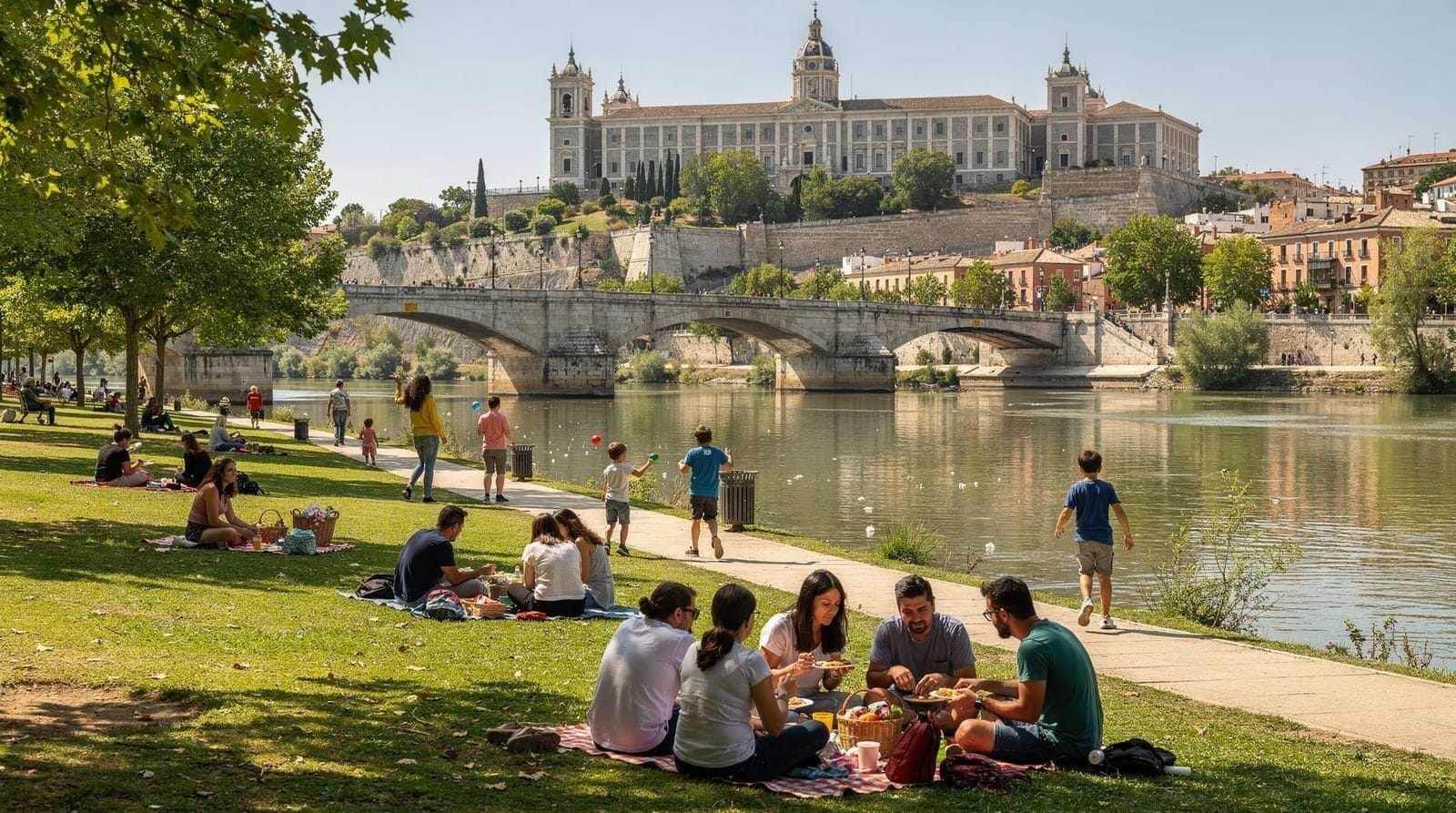
Today the Retiro is one of the best city parks in Europe — not because of any single spectacular feature, but because it genuinely belongs to the city. Sunday afternoons in the Retiro are Madrid at its most itself: families, couples, joggers, chess players, accordion players, and the strange suspension of urban pace that only a real park creates.
The Estanque Grande and boat rental
The large artificial lake — the Estanque Grande del Retiro — was created in the 17th century for theatrical royal entertainments including, famously, staged naval battles with small boats. Today it is the social centre of the park: the monument to Alfonso XII (a semicircular classical colonnade with an equestrian statue of the king) commands the western bank, and the rowing boats cluster at the eastern rental dock.
Boat rental: €6 per boat Monday to Friday and €8 on weekends and public holidays, for 45 minutes. Weekend afternoons in spring and summer involve a wait; arriving before 13:00 significantly reduces queuing time. The experience of rowing on the Estanque with the Alfonso XII monument behind you and ducks swimming alongside is one of Madrid’s more distinctive pleasures — absurd, peaceful, and genuinely enjoyable.
The lake’s edge is one of the prime people-watching spots in Madrid on a sunny Sunday. Bring food from one of the park’s kiosks (scattered throughout the park, selling sandwiches, drinks, and light snacks at reasonable prices — not tourist-trap levels) and find a bench on the southern side with the view across the water.
Palacio de Cristal: the glass palace
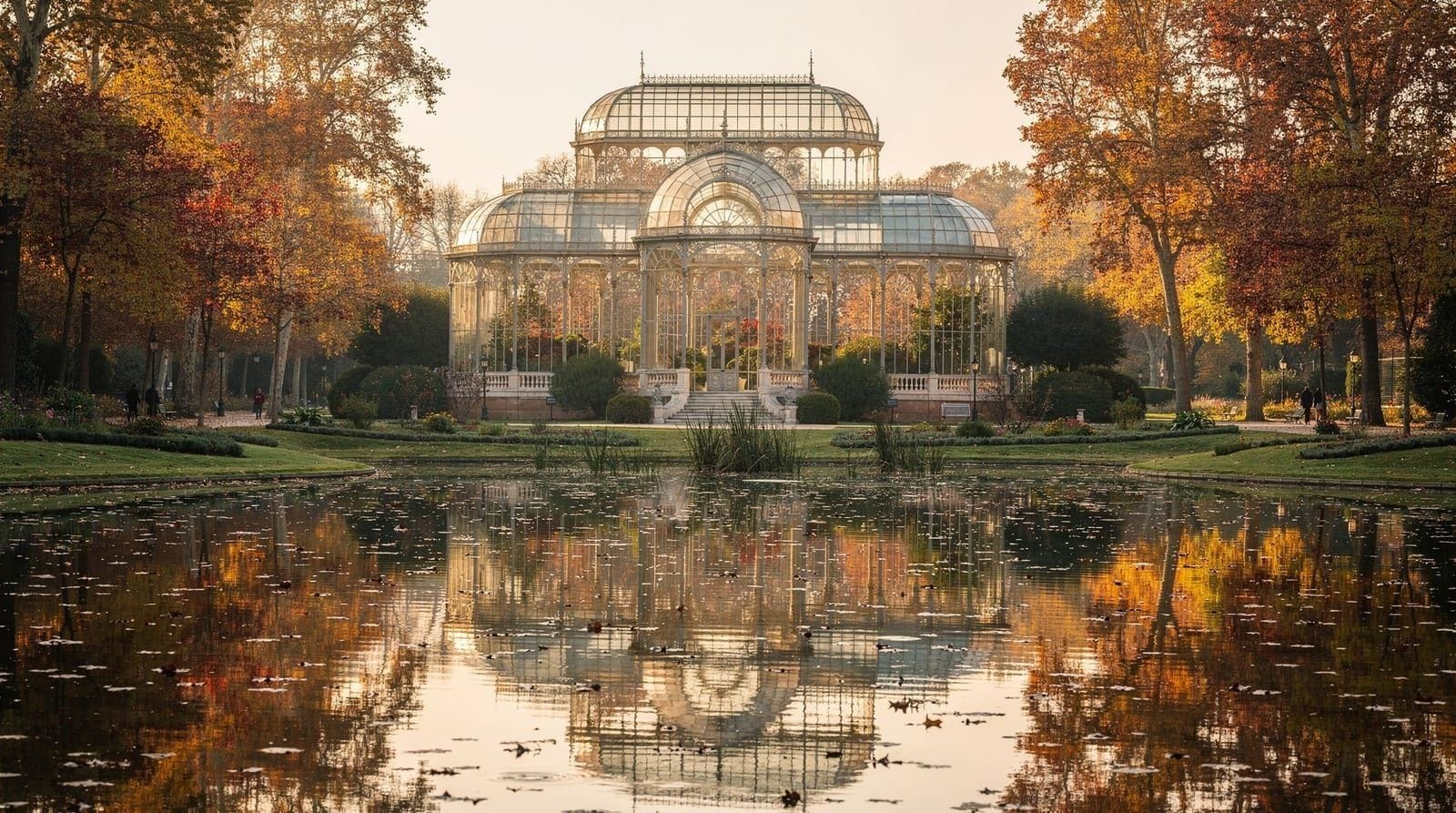
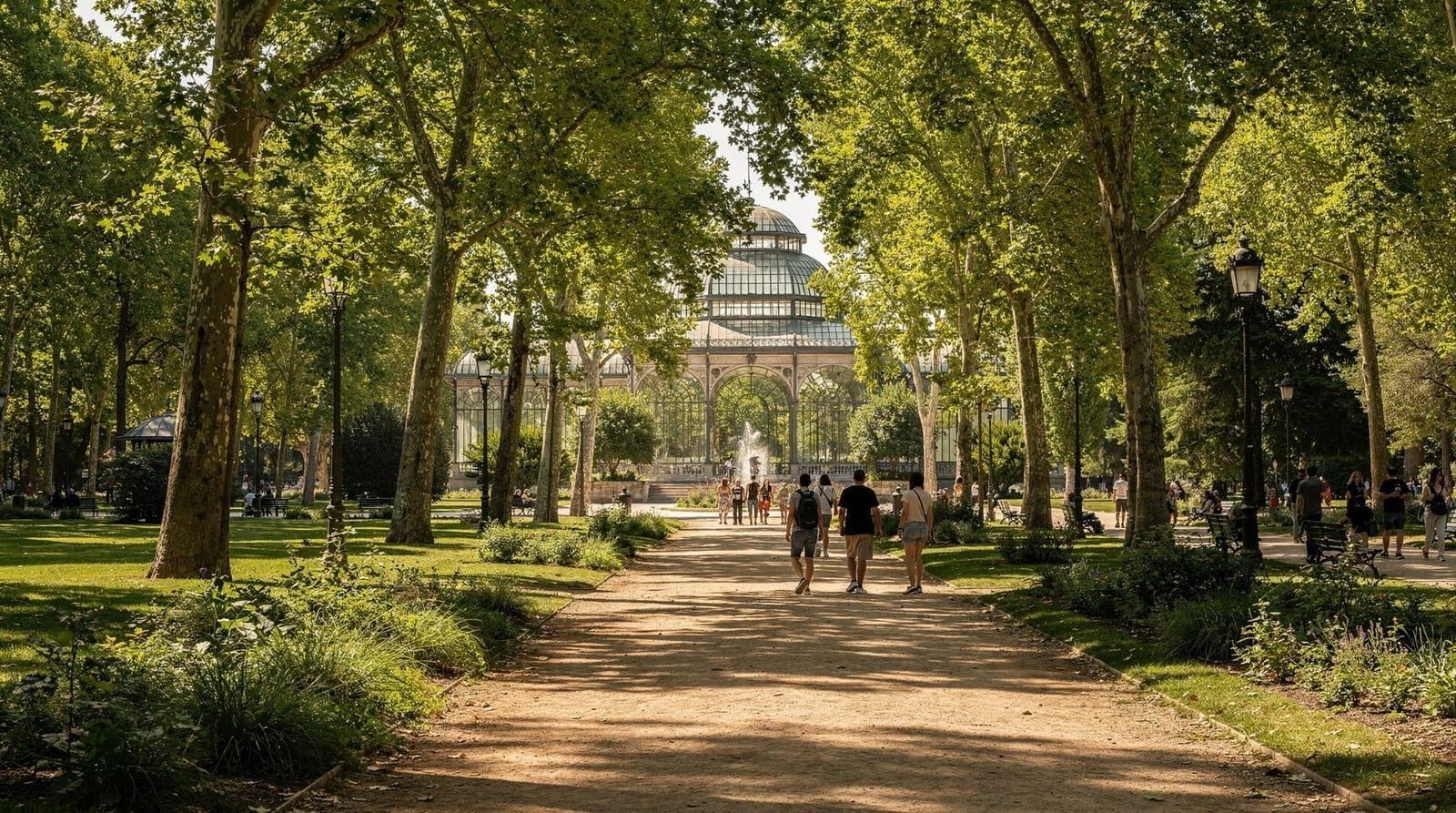
The Crystal Palace in the southern section of the park is architecturally significant and reliably beautiful regardless of what’s inside it. Ricardo Velázquez Bosco built it in 1887 — essentially a large ornamental greenhouse using cast iron and glass on a structural system that gives a large, light-filled interior space with minimal visual obstruction.
Since 1980, the Reina Sofía museum has managed the space as a venue for site-specific contemporary art installations — typically one or two large commissions per year, chosen for how they respond to the specific qualities of the glass-and-iron space. The installations change every 3–6 months; check museoreinasofia.es for the current exhibition.
Entry is always free. The Palacio de Cristal is currently closed for renovation works, until 2027. The building is worth visiting even if the current installation is not to your taste — the light through the glass, the reflection in the adjacent pond, and the historical incongruity of contemporary art in an 1887 exhibition hall are all part of the experience.
Best time for photography: late afternoon (16:00–18:00) when the low sun comes through the southern glass panels, or overcast days when the diffuse light eliminates harsh shadows.
Palacio de Velázquez
100 meters north of the Crystal Palace, the Palacio de Velázquez (also by Ricardo Velázquez Bosco, 1883) is a brick-and-tile building with Moorish-influenced ornamental tilework that serves a similar function — large, high-ceilinged exhibition space managed by the Reina Sofía for rotating contemporary art exhibitions. Also free.
The building is less spectacular architecturally than the Crystal Palace but the exhibition programme is usually more substantial — larger works and longer runs. Check the Reina Sofía website for current shows.
The Rosaleda
In the southwest corner of the park, the Rosaleda (rose garden) is enclosed behind low hedges and visited by almost everyone but considered by almost no one as a destination in its own right. This is a mistake.
The garden has approximately 4,000 rose plants in several hundred varieties, arranged formally around a central fountain. Peak bloom: mid-May to mid-June. The last two weeks of May are the best — an almost overwhelming concentration of colour and scent, with roses from deep red through every shade of pink, orange, yellow, and white.
The annual Madrid Rose Competition (Concurso Internacional de Rosas Nuevas de Madrid) takes place in late May in the Rosaleda, bringing new variety entries from international breeders. It is a public event — free to attend, surprising to encounter.
The Rosaleda is also a useful orientation point: it sits near the park’s southwest corner, on the axis connecting the Real Jardín Botánico and the Atocha area. Walking from the Prado into the park, through the Rosaleda, and across the park to the Crystal Palace takes about 45 minutes and covers the best of what the park offers in a single east–west traverse.
Sunday in the Retiro: the weekly street fair
On Sunday mornings, the area along the Cuesta de Moyano (the book market street on the southeast side of the park, near Atocha) runs the permanent secondhand book market — open every Sunday and on holidays, with roughly 30 stalls selling old books, prints, maps, and periodicals. A good place to find vintage Madrid photography and old Spanish novels, but prices have risen with the neighbourhood’s visibility.
Inside the park on Sunday afternoons, look for:
- The puppet theatre (Títeres del Retiro) near the northern entrance — free performances on weekends and school holidays, quality varies but children love them
- Street musicians at multiple locations throughout the park
- Outdoor dance groups (Latin dances particularly, near the main lake)
- The chess tables at the northern end of the park — serious games, open to challengers
The park in different seasons
Spring (March–May): The best overall season. Cherry and almond trees bloom in March; the rose garden peaks in May. The Book Fair in late May–June brings an additional reason to visit. Temperatures ideal (15–22°C) for extended time outdoors.
Summer (June–August): Hot — 35°C+ in July and August. The park is largely shaded by its mature trees, making the shaded paths and the area around the lake tolerable even in heat. Come in early morning (07:00–10:00) or early evening (18:00–20:00). The Crystal Palace can be unbearably hot inside on sunny summer days.
Autumn (September–October): Second-best season after spring. Temperatures drop to 18–25°C, the trees begin changing colour in October, and the park is quieter than summer. The light in late afternoon through the changing leaves is excellent for photography.
Winter (November–February): Cold (5–12°C) but not prohibitive. The park is almost always quiet in winter — locals come on sunny winter days for a weekend walk, but the summer crowds are entirely absent. The Crystal Palace and Palacio de Velázquez exhibitions are worth checking. Snow falls rarely (perhaps once every few years) but transforms the park dramatically when it does.
The park as a base for the surrounding area
The Retiro and the surrounding Jerónimos district contain several sites within a 15-minute walk of the park’s main entrance:
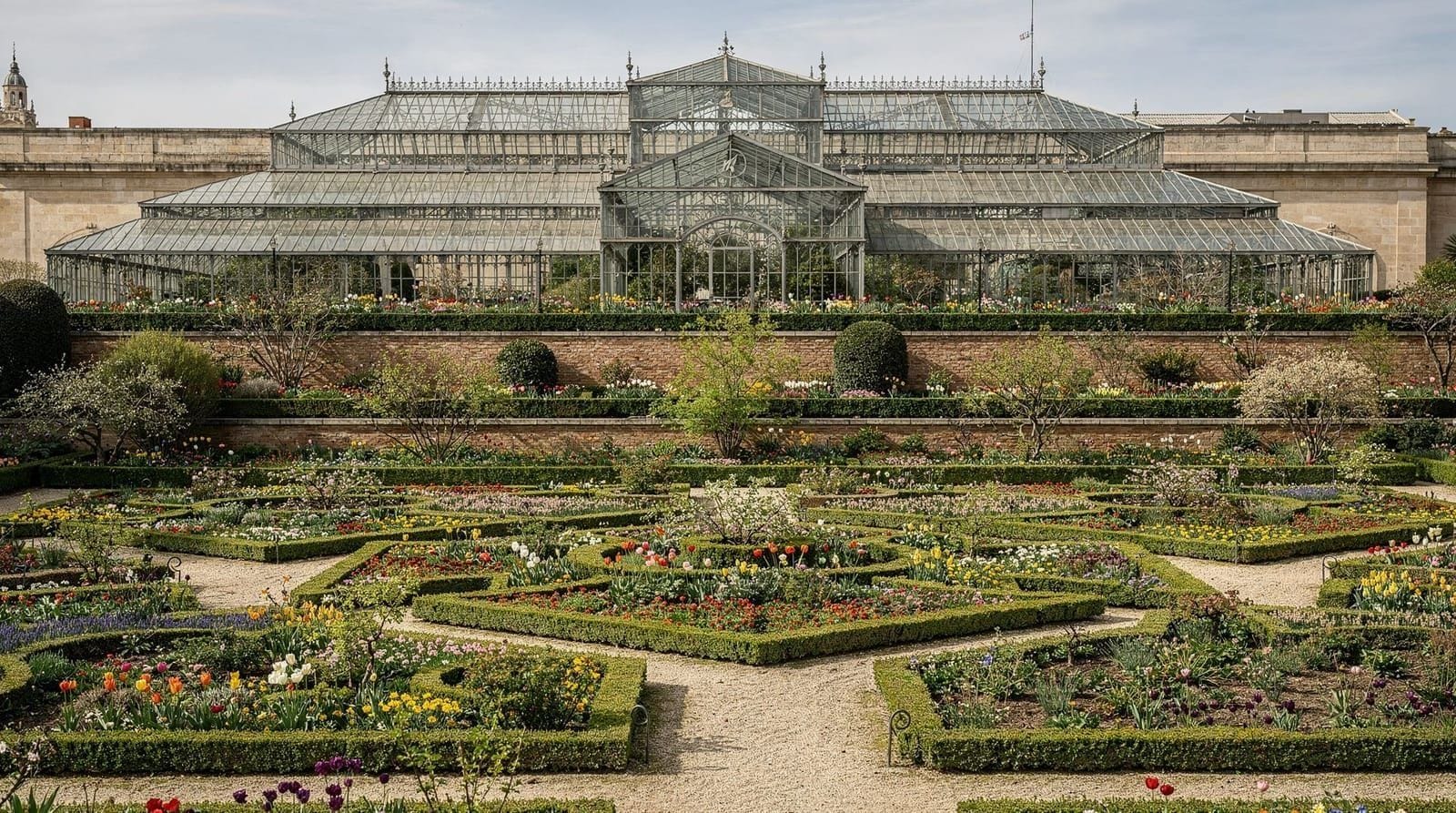
- Real Jardín Botánico (southwest corner, Paseo del Prado 2): Royal Botanic Garden, entry €4, 30,000 plant species
- Prado museum (west, Paseo del Prado): 5 minutes walk
- Reina Sofía (southwest, Atocha): 15 minutes walk
- Calle de Serrano (north): the Salamanca district’s main commercial street, 10 minutes walk
The park is the natural rest stop between a morning at the Prado and an afternoon in the Salamanca district, or between the Thyssen and a late afternoon in the Jerónimos neighbourhood.
For families, see Madrid with kids — the puppet theatre, boat rental, and the free space make the Retiro one of Madrid’s best free family destinations. For couples, the Crystal Palace at sunset and the Rosaleda in May are the standout options.
Seeing the Retiro from a bike or segway
For visitors who want to cover the park’s 125 hectares without walking all of it, a guided e-bike or segway tour through the Retiro and the surrounding boulevards is a genuinely efficient way to see the Estanque, the Rosaleda, and the Crystal Palace in a single loop, with a guide adding context along the way.
A guided segway tour through Retiro Park covers the park’s highlights in about 90 minutes — a good option if your visit is short or you’re combining the park with other central sights the same day.
If you would rather pair the park with royal Madrid, a half-day outing that combines the Royal Palace and the Retiro with a local guide links two of the city’s best-known sights in one relaxed morning or afternoon. It suits travellers who like having the connections between sights explained rather than working them out from a map. For the palace itself, see the Royal Palace guide; for the cathedral next door, the Almudena Cathedral guide.
If you prefer to pedal on your own schedule, the e-bike tours guide and the Madrid by bike guide explain how cycling works in the city, and the Segway in Retiro guide covers what a segway outing in the park is like. Note that the park’s own paths are made for strolling, so ride with care at busy weekend moments.
Planning your Retiro visit around the rest of Madrid
The Retiro works best as a pause rather than a stand-alone mission. Many visitors slot it between two museum visits, and the Prado Museum guide and the Golden Triangle art walk both fit naturally either side of a long bench break under the trees. If your days are packed with art, the park is where your feet and your attention span recover.
Different trip lengths use the park differently:
- One day: in the Madrid in one day itinerary, the park is a short green interlude rather than a full stop. Pick the lake and one palace and move on.
- Three days: the 3 days in Madrid itinerary leaves room for a slower loop with a boat ride and a long lunch nearby.
- Longer stays: with more time, return on a different day or at a different hour. The park at 08:00 and the park on a Sunday afternoon feel like two separate places.
Budget travellers will find that the Retiro is one of the cheapest good days in the city. The free things to do guide and the Madrid on a budget guide both lean on it, and the museum free hours guide helps you combine the park with a free museum window. Runners can find route ideas in the running in Retiro guide, and anyone looking for a calmer green day on the other side of the centre can compare with Madrid Río and the Casa de Campo guide.
A slow half-day route through the park
If you have no fixed plan, this loop uses what the park does best without turning it into a checklist:
- Enter near the main gate and walk straight to the Estanque Grande. Look at the water and the Alfonso XII monument before deciding whether to queue for a boat.
- Follow the paths south toward the Palacio de Velázquez and the Palacio de Cristal. Even if the current exhibitions do not interest you, the buildings and their surroundings reward a slow look.
- Continue to the Rosaleda, especially in late spring, and sit for a while rather than photographing and leaving.
- Finish by leaving through the gate that suits your next stop, whether that is the Botanical Garden, the Prado or a café in the surrounding streets.
The point of the route is the pace. The park is large enough that rushing through it defeats its purpose, and nothing here needs a strict schedule. Take water in hot months, wear comfortable shoes, and treat any bench with a view as part of the itinerary rather than a delay.
Eating and drinking around the park
The kiosks inside the park cover a quick snack, but the streets around it are better for a proper meal. For ideas on what to order and where, the eat like a local guide and the Madrid tapas guide explain how meals are timed in the city, and the tourist menu traps guide helps you avoid the fixed-price places that cluster near big sights. A picnic from a nearby market is also a good plan on a fine day.
Retiro for couples and families
For couples, the quieter corners, a late-afternoon walk and the glass palace in good light are the main draws; the Madrid for couples itinerary builds a day around moments like these. For families, the Madrid with family itinerary and the rainy day with kids guide help you plan around the weather, with the park as the sunny-day option. The best time to visit guide will help you decide which season suits your group.
Retiro by time of day: a quick guide
| Time | Character | Best for |
|---|---|---|
| Early morning (before 09:00) | Quiet, joggers and locals only | Photography, peaceful walking |
| Midday–afternoon | Busy, especially weekends | Boat rental, the Rosaleda, people-watching |
| Sunset (varies by season) | Golden light on the Crystal Palace | Photography, couples |
| After dark | Quiet in the east; less recommended for solo walkers elsewhere | Avoid unless staying near a well-lit path |
Frequently asked questions about Retiro Park guide
What time does Retiro Park open and close?
Retiro Park is open daily. From October to March: 06:00–22:00. From April to September: 06:00–midnight. There are no fences closing the park after hours — the midnight 'closing' is when the gates are formally locked, but pedestrian access via smaller gates continues. It is generally safe throughout the day; the park is less recommended alone at night (after 22:00) though security patrols operate.How do you get to Retiro Park from central Madrid?
Metro: Retiro (Line 2) for the main eastern entrance, Príncipe de Vergara (Lines 9 and 2) for the northern entrance, or Atocha (Line 1) for the southwest entrance near the Botanical Garden and Prado. On foot from the Prado: 5 minutes east. From Puerta del Sol: 20 minutes east on foot, or 3 minutes by Metro (Sol to Retiro). The park's main entrance (Puerta de Alcalá side) is on Calle de Alfonso XII.Can you rent boats on the Retiro lake?
Yes. The Estanque Grande (large pond) has rowing boat rental available daily (10:00–14:00 and from 15:15 until closing, between 17:15 and 20:30 depending on the season; closed 24, 25 and 31 December and 1 January). Rates in 2026: €6 per boat Monday to Friday and €8 on weekends and public holidays, for 45 minutes. Boats hold up to 4 people. Weekend afternoons are the most crowded; arrive before 13:00 or after 16:30 for shorter waits. There is no powered boat rental — only rowing boats and a small number of paddleboats.What is the Crystal Palace in Retiro Park?
The Palacio de Cristal (Crystal Palace) is an iron-and-glass greenhouse built in 1887 by architect Ricardo Velázquez Bosco for the 1887 Philippines Exhibition, which showcased plants and fauna from Spain's Pacific colony. It stands on the banks of a small artificial lake in the southern section of the park. Since 1980 it has been managed by the Museo Reina Sofía as an exhibition space for site-specific contemporary art installations. Entry is free, but the building is currently closed for renovation works until 2027. The building is beautiful in its own right — the light through the glass shifts with the weather and time of day.When is the Rosaleda at its best in Retiro Park?
The Rosaleda (rose garden) in the southwest corner of the park has approximately 4,000 rose plants. Peak bloom is mid-May to mid-June, with the most intense display in the last two weeks of May when the annual Concurso de Rosas (Rose Competition) takes place. By July the first flush is largely over, though some varieties continue blooming through September. The garden is free and beautifully maintained — one of the genuinely underrated spots in the park.Is Retiro Park safe?
During daytime hours, yes — it is one of the city's safest and most pleasant spaces, used by families, joggers, cyclists, and tourists. Pickpocket risk exists in crowded areas (the main lake and puppet theatre on weekends), the same as any major city park. At night (after dark) the central and northern parts of the park are less recommended for solo walkers. The eastern section around the rose garden and the Monument to Alfonso XII on the lake is well lit and frequented later into the evening.What free activities are available in Retiro Park?
Free activities: puppet theatre (Títeres del Retiro, weekends and school holidays), outdoor chess tables near the Estanque, outdoor book fair (late May to late June each year, Madrid Book Fair or Feria del Libro), free contemporary art exhibitions at the Palacio de Cristal and Palacio de Velázquez, Sunday afternoon street performers, and simply walking the 15 km of marked paths. The annual Book Fair in late May–June is one of the largest outdoor book fairs in the world — hundreds of publisher stands, author signings, and genuinely good prices.