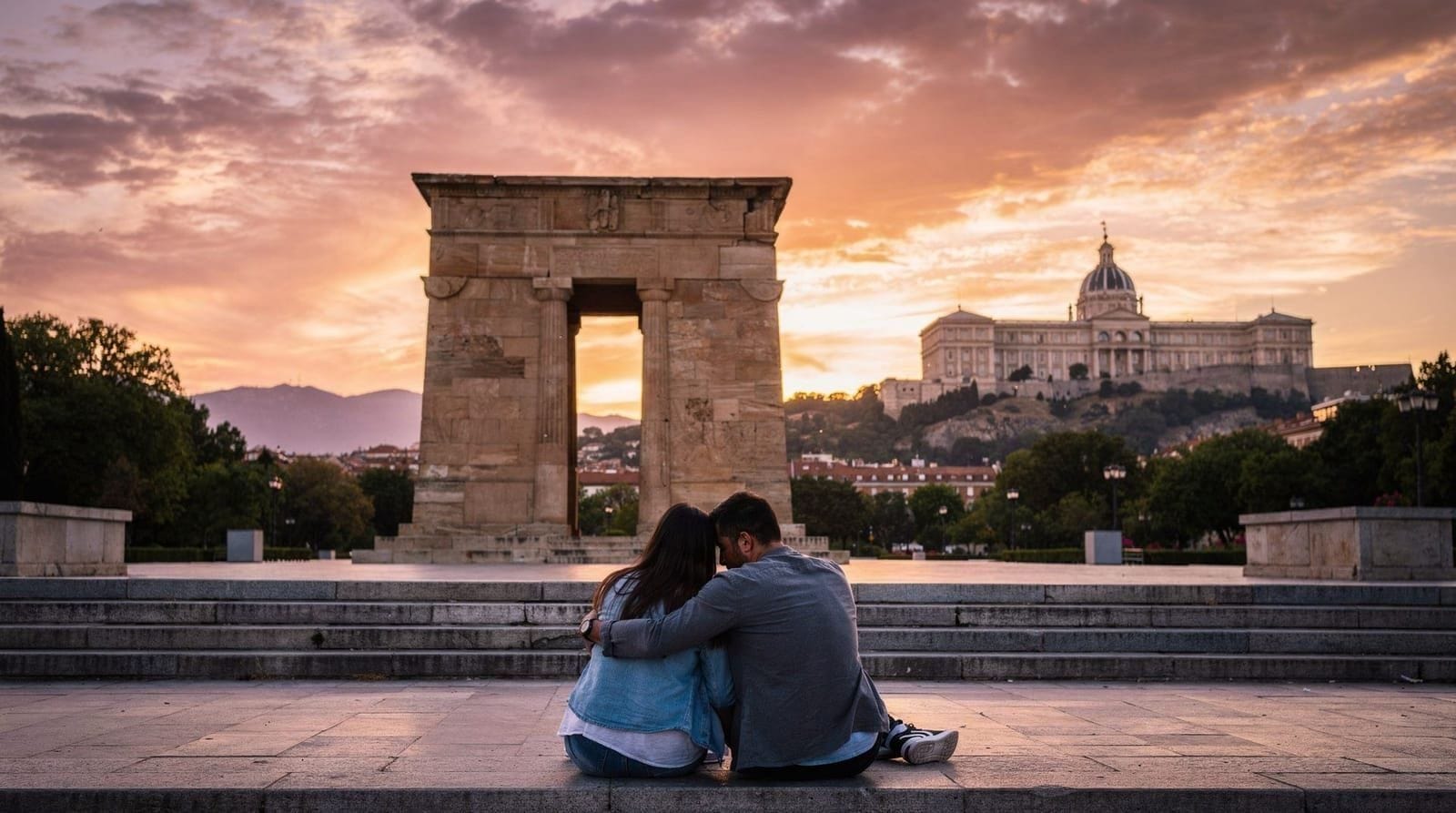
Temple of Debod at sunset: Madrid's Egyptian temple and western skyline
Madrid: Royal Palace Fast Access Ticket
What is the Temple of Debod and is the sunset view worth it?
The Temple of Debod is a 2nd-century BC Egyptian temple, dismantled from its original site above the Nile (which was flooded by the Aswan Dam) and gifted to Spain in 1968 in recognition of Spanish archaeologists' work saving Nubian monuments. It sits in the Parque del Cuartel de la Montaña in Moncloa, overlooking the Manzanares valley and the Casa de Campo. The sunset view from the surrounding terrace — the Royal Palace visible to the south, the Guadarrama mountains (snow-capped October–May) to the west, the Madrid skyline framing everything — is the best free sunset viewpoint in the city. Free to enter the temple interior on timed visits; the park surrounding it is open 24 hours.
An authentic 2nd-century BC Egyptian temple, free to visit, sitting on a Madrid hilltop with what is arguably the city’s best sunset view — this is one of the few Madrid experiences that costs nothing and consistently exceeds expectations.
| Where | Parque del Cuartel de la Montaña, Moncloa |
| Cost | Free (interior visit and exterior/park both free) |
| Time needed | 20–30 min interior, 60–90 min for the sunset experience |
| Getting there | Metro Plaza de España (Lines 3, 10), 10-min walk |
| Best time | 60–90 minutes before sunset; arrive early on weekends |
An Egyptian temple on a Madrid hill
The Temple of Debod was built during the reign of the Pharaoh Adikhalamani (reigned c. 200–180 BC) near the Nile’s first cataract in Nubia, in what is now southern Egypt near the modern Aswan Dam. It was dedicated primarily to the god Amun, with later additions to Isis as the Ptolemaic period developed. For over two thousand years it stood in the Nubian landscape.
In 1960, the Egyptian government began the construction of the Aswan High Dam. The flooding of Lake Nasser that followed threatened dozens of ancient Nubian temples and monuments — the most famous rescue effort being the relocation of Abu Simbel. The government of Egypt, in gratitude for the archaeological assistance provided by the Spanish Archaeological Mission (which had worked to document and save Nubian monuments before the flooding), gifted the Temple of Debod to Spain in 1968.
The temple was dismantled, shipped to Spain, and reassembled in its current location on the hill of the Parque del Cuartel de la Montaña in Moncloa — a site chosen partly for its symbolic resonance (the ancient fortress of the Cuartel de la Montaña barracks stood here, demolished) and partly for its practical quality as an elevated park space with western views.
The result is one of the most improbable things in Madrid: a 2nd-century BC Egyptian temple in a city park, surrounded by water channels that echo the Nile context, and serving as the best sunset viewpoint in the capital.
The sunset view: what you actually see
From the terrace around the Temple of Debod, looking west and southwest:
Immediate foreground: The reconstructed moat and water channels that frame the temple on its plinth. Papyrus plants grow in the water channels during summer.
Middle ground (southwest): The Manzanares river valley, the Madrid Río linear park, and the expanse of Casa de Campo — 1,700 hectares of Mediterranean scrubland stretching westward.
Key landmark (south-southwest): The Palacio Real (Royal Palace) on its promontory, visible from the Debod terrace in its full western facade — the face of the palace that looks out over the Manzanares valley. This is the view point from which the palace makes most architectural sense: the Bourbon building on its high ground, the river valley below, the city behind. This view is not available from within the historic centre; you need to be west of the palace, which is where Debod places you.
Background (west and northwest): The Sierra de Guadarrama mountains, 50–60 km away, visible on clear days. From October to May, the upper summits carry snow — on a clear winter or early spring evening, the juxtaposition of an Egyptian temple, a Bourbon palace, and snow-capped mountains behind a Madrid sunset is genuinely extraordinary.
Best light: The sun sets behind the Guadarrama peaks from October to March, creating a dramatic western horizon. In summer (May–August), the sun sets further north and at a flatter angle — still beautiful, but different in character. The temple stones take on a warm orange light from about 1 hour before sunset; the Royal Palace turns pink-orange in the last 30 minutes.
Visiting the temple interior
The temple interior (the sanctum sanctorum and the gate pylons) is open for free visits, with a limited number of visitors at a time. Hours (source: Ayuntamiento de Madrid and esmadrid.com; check the Ayuntamiento de Madrid website before visiting, as the interior can close temporarily):
- Winter: Tuesday–Sunday and public holidays, 10:00–20:00 (last entry 19:30)
- Summer (15 June–15 September): Tuesday–Sunday and public holidays, 10:00–19:00 (last entry 18:30)
- Closed every Monday, and on 1 and 6 January, 1 May, 24, 25 and 31 December
Interior visits are free but limited to 30 people and 30 minutes; booking a free slot in advance through the Ayuntamiento de Madrid reservation service is recommended.
The interior itself: The temple is small — 8 m wide, 22 m long. What you see is the reconstructed sanctuary building with its decorated chambers, hieroglyphic carvings (some original, some reconstructed), and the gateway pylons. The main pylon of Nektanebo I was separated from the main temple during the reconstruction and stands independently at the western end. The interior visit is interesting as historical curiosity but the exterior and the surrounding view are the primary draw; if the timed entry doesn’t work out, the exterior experience is complete in itself.
Practical logistics for sunset visits
Timing: Sunset times vary significantly by season:
- June: 21:45 (latest)
- September: 20:30
- December: 17:55 (earliest)
- March: 19:30–20:00
Check the precise sunset time for your visit date. The view is best in the 60–90 minutes before sunset, not just at the moment the sun disappears. Arrive 60–90 minutes before sunset.
Crowds: The Debod sunset is one of Madrid’s most Instagrammed moments. Weekend evenings in spring and autumn (April–May, September–October) see significant crowds. On popular evenings, the narrow terrace around the temple can be congested, which limits the experience. Weekday evenings in the same seasons are typically less crowded. Winter sunsets (December–February) are cold but often the most atmospheric — snow on the Guadarrama visible, fewer people, low golden light.
What to bring: A light layer for the evening — the hill catches wind. Camera with a wide lens for the full panorama. If you want to picnic, the park has benches and grass areas around the temple.
Getting to Debod
Metro: Plaza de España (Lines 3 and 10) — 10 minutes walk north through the Parque del Cuartel de la Montaña. Alternatively, Ventura Rodríguez (Line 3) is slightly closer to the park entrance.
On foot from the Royal Palace: 15 minutes north through the Campo del Moro gardens, out the north gate, and up through Parque del Cuartel de la Montaña.
On foot from Gran Vía: 15 minutes west on Calle de la Princesa to the Parque del Cuartel de la Montaña entrance.
By bus: Several EMT bus lines stop at Plaza de España; the temple is a 10-minute walk.
The park and surroundings
The Parque del Cuartel de la Montaña (the park containing Debod) has its own interest beyond the temple:
The site was occupied by the Cuartel de la Montaña (Mountain Barracks) until 1936, when it was stormed by Republican forces at the start of the Civil War — one of the first acts of the Madrid uprising. The barracks were subsequently demolished. The park now has lawns, benches, and the temple as its centerpiece, with views that make it valuable beyond the Egyptian context.
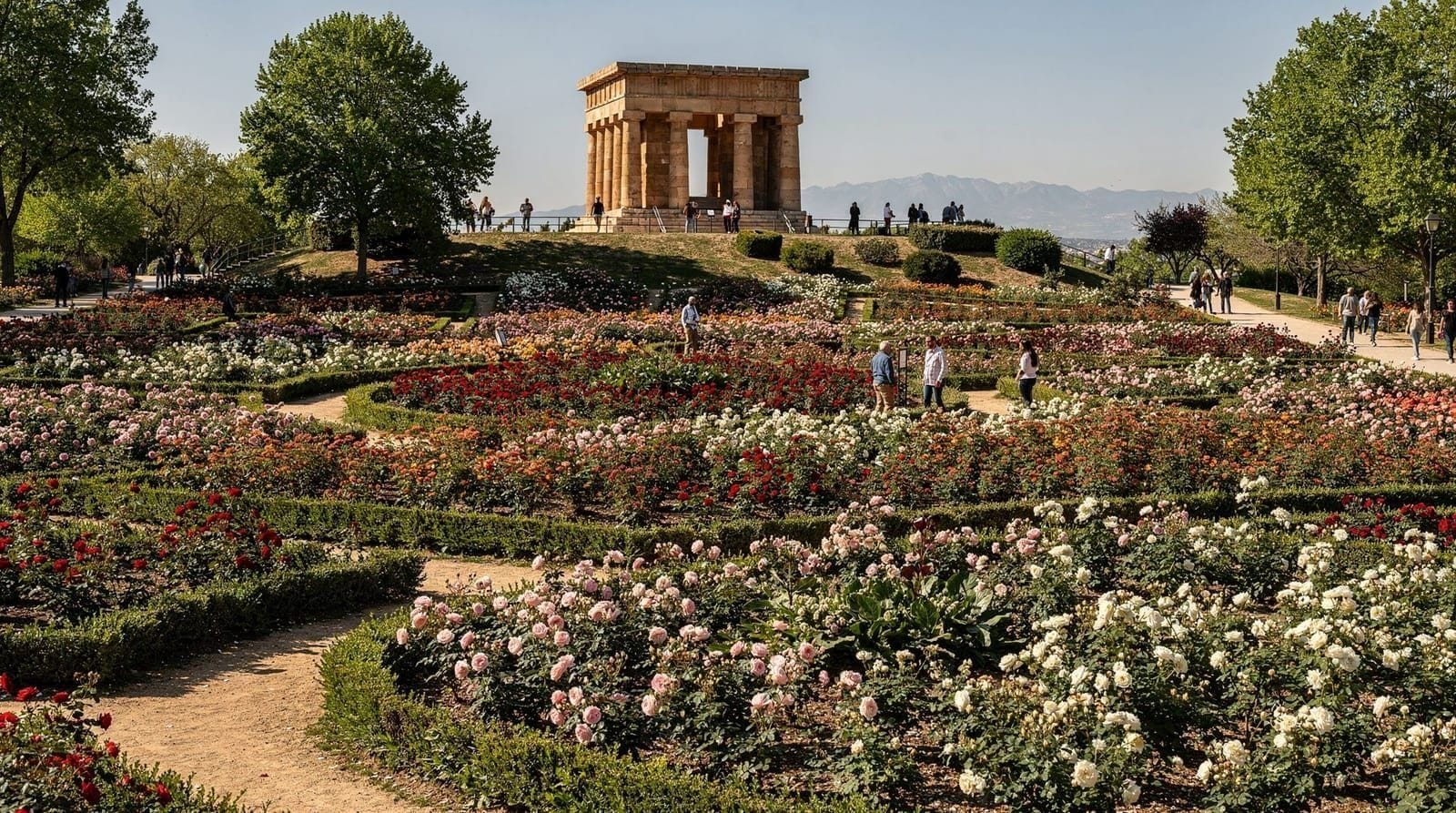
Adjacent parks: Parque del Oeste (150 m north and west from Debod) extends along the hillside above the Manzanares with rose gardens (Rosaleda del Parque del Oeste — a different rose garden from Retiro’s Rosaleda), woodland walks, and the Teleférico (cable car) lower station (the cable car is currently closed for renovation).
Restaurants near Debod: The Malasaña neighbourhood is 15 minutes east (many restaurant options). The Argüelles district immediately adjacent has traditional café options.
Debod in a Madrid itinerary
Best combination: Royal Palace visit in the morning (15 minutes’ walk south from Debod), lunch in the Austrias quarter or Moncloa area, late afternoon at Debod for the sunset. The thematic connection — Egyptian gift, Bourbon palace, Madrid skyline — creates a coherent afternoon even if the geographical connection is not immediately obvious.
If the palace is part of your day, booking a fast-access Royal Palace ticket in advance keeps the morning predictable, so you are not eating into the time you want to keep free for the hilltop. For more on the building itself, see the Royal Palace guide.
Day trips from Debod: The Parque del Oeste (immediately adjacent) leads down to the Teleférico station — a 15-minute descent. The cable car into Casa de Campo is closed for a full renovation, with reopening planned for the first quarter of 2027 (EMT Madrid); check before planning around it. Meanwhile, the Casa de Campo can be reached on foot, by Metro Line 10 or by bus.
For couples: The Debod sunset is the standout romantic viewpoint in Madrid. It consistently appears on lists of the city’s best evening experiences for good reason — free, beautiful, and reliably impressive. See Madrid for couples for a full evening itinerary centred on the sunset.
Why Madrid has an Egyptian temple
The Egyptian gift of Debod to Spain was part of the UNESCO-coordinated rescue of Nubian monuments before the Aswan High Dam flooding. Spain participated through the archaeological mission that worked at various Nubian sites in the 1960s.
The gift was one of several such diplomatic gestures by Egypt in that period — the most famous being the Temple of Dendur, given to the United States and now in the Metropolitan Museum of Art in New York. Spain’s Debod is more unusual in being installed outdoors in a public park, accessible without payment, exposed to weather, and functioning simultaneously as a historical monument, a free museum, and a city viewpoint.
This particular combination — ancient Egyptian temple, free access, best sunset view in a European capital — is not something you plan for. It just happens to be what Madrid got.
Other Madrid viewpoints: how Debod compares
Madrid has several viewpoints worth knowing for different purposes:
Temple of Debod: Best overall sunset panorama, Royal Palace visible, mountain backdrop. Free. Main limitation: crowds on popular evenings, and the narrow terrace gets congested.
Cerro Tío Pío (guide here): 360° panorama from higher elevation in Vallecas (southeast Madrid). Famous swings. No tourists, entirely local crowd. Requires 20 minutes by Metro from the centre.
Faro de Moncloa: A 92m observation tower on the Moncloa hill — panoramic 360° views from an enclosed observation deck. Entry €4. Different perspective than Debod (further north, higher). Good for city overviews rather than the Royal Palace-specific view.
Edificio España rooftop (Gran Vía): A post-Franco modernist tower now a hotel, with a public rooftop bar. Views toward the old city and Gran Vía. Commercial bar prices; reservation needed in peak season.
Círculo de Bellas Artes rooftop (Calle Alcalá 42): The historic arts institution has a rooftop café with 360° views over central Madrid. Entry €6. Good for Gran Vía and city-centre views. Less spectacular for the Royal Palace than Debod.
Each viewpoint has its particular value; the Debod sunset is the most iconic for visitors.
Photography: the best shots of Debod
The Temple of Debod is one of the most photographed subjects in Madrid. Achieving something slightly different from the standard shot requires some planning:
The reflection shot: The temple is surrounded by a shallow water channel. On still days (no wind), the water surface reflects the temple and the sky. The reflection is best in the first hour of morning light (before visitors arrive) or in very calm evening conditions. The best angle is from the south side of the water channel.
The silhouette shot: Shoot from the west side of the temple, with the sun behind the temple, in the last 20 minutes before sunset. The temple becomes a black silhouette against a dramatically coloured sky. Underexpose slightly to maintain the silhouette effect.
The context shot: Shoot from the south, with the temple in the foreground and the Madrid skyline behind — framing the ancient Egyptian stonework against the modern city. The Cuatro Torres skyscrapers are visible in this direction.
The Royal Palace shot: From the temple’s east side, shooting southwest, the Royal Palace dome is visible above the tree line of the Manzanares valley. This requires a longer focal length (85–135mm) to isolate the palace against the valley.
The Cuartel de la Montaña: what stood here before Debod
The park where Debod stands — the Parque del Cuartel de la Montaña — takes its name from the Montana barracks that occupied this hill until 1936. The barracks’ storming at the start of the Spanish Civil War in July 1936 was one of the first major military actions of the conflict.
Rebel officers had barricaded themselves in the barracks on 19–20 July 1936, expecting to be part of the nationalist uprising that would quickly take Madrid. Instead, Republican militias, supported by loyal police and military units, attacked and took the barracks. The rebel officers surrendered; in the chaotic aftermath, a number of the captured officers were killed by the crowd — one of the early examples of the breakdown of order that characterised both sides in the war’s early weeks.
The barracks were subsequently demolished. The site was left as open land for decades before the Temple of Debod’s installation gave it its current form. The Egyptian temple therefore sits on ground that witnessed a pivotal moment in 20th-century Spanish history — a juxtaposition of ancient and modern that Madrid seems to attract.
Debod in a Madrid itinerary
For first-time visitors: The Debod sunset combines well with a morning at the Royal Palace (15 minutes walk south), lunch in the Austrias quarter, and an afternoon at the Plaza Mayor before arriving at Debod for late afternoon and sunset. This covers the monarchical and historical heart of Madrid in one day. Travellers who prefer context with their visit can choose a Royal Palace visit with an audio guide for the morning, then walk to Debod on their own at the end of the afternoon.
For art and culture visitors: Combine the Prado morning (free window 18:00–20:00 alternative), the Botanical Garden afternoon, and Debod sunset — all on the Paseo del Prado / Paseo de la Castellana cultural axis.
For outdoor Madrid: Debod → Parque del Oeste → Casa de Campo (on foot, by Metro Line 10 or by bus; the cable car is closed for renovation, reopening planned for the first quarter of 2027 per EMT Madrid) → Madrid Río → return to centre. This covers the western green belt with the sunset bookended at Debod.
For couples: The Debod sunset is Madrid’s most consistently recommended romantic viewpoint. Arriving 45 minutes before sunset, finding a spot on the south side of the water channel, and watching the Royal Palace turn pink while the Guadarrama mountains catch the last light is a reliable experience regardless of photographic ambition. See Madrid for couples.
Weather and rain contingency
Cloud cover does not necessarily ruin a Debod sunset — partial cloud can actually improve the colour of the sky, catching orange and pink light that a completely clear sky lacks. What does diminish the experience is haze or heavy overcast, which flattens the mountain silhouette and mutes the colour altogether. Light rain earlier in the day often clears the air and produces some of the most vivid sunsets of the year, particularly in spring and autumn — a rain-then-clear forecast is worth watching for rather than avoiding.
Sunset without the crowds: a solo or early-morning alternative
If you would rather experience Debod without a crowd, consider a very early morning visit instead of sunset. The park opens with the general public access hours of a 24-hour park, and an hour after sunrise on a weekday, the reflecting pool is often nearly empty — the water is stillest at this time too, giving the cleanest reflection shot of the temple. The light is cooler and less dramatic than sunset, but the contemplative, uncrowded atmosphere is arguably a better experience for photographers and anyone who prefers solitude to a shared spectacle. This is a genuinely underused option: most visitors default to sunset without considering that Debod is a 24-hour park with a completely different, quieter character at dawn.
Extending the evening: what’s within walking distance
The area around Debod is genuinely useful for building a full evening around the sunset, not just a quick photo stop:
Parque del Oeste and Malasaña: A 10–15 minute walk east leads into Malasaña, Madrid’s alternative-culture neighbourhood with a dense concentration of bars and restaurants — a natural post-sunset dinner destination. Chueca is a further 10 minutes beyond that.
Madrid Río: Downhill and southwest of the temple, the Madrid Río linear park along the Manzanares offers an alternative, flatter evening walk if the crowds at the Debod terrace itself feel like too much.
If Debod’s terrace is too crowded: On the busiest spring and autumn weekend evenings, consider the Parque del Oeste slopes just south of the temple as a less congested alternative vantage point — you lose the temple-and-water-channel framing but keep the mountain and skyline view with more breathing room.
For a fully guided evening that removes the planning altogether, a Madrid sunset walking tour with an optional flamenco add-on covers this part of the city with a local guide and can extend naturally into a flamenco evening for visitors who want to combine the two.