Parque del Oeste: Madrid's western park with roses and mountain views
Madrid: Riverside Casa de Campo e-bike
What is Parque del Oeste and when is it best to visit?
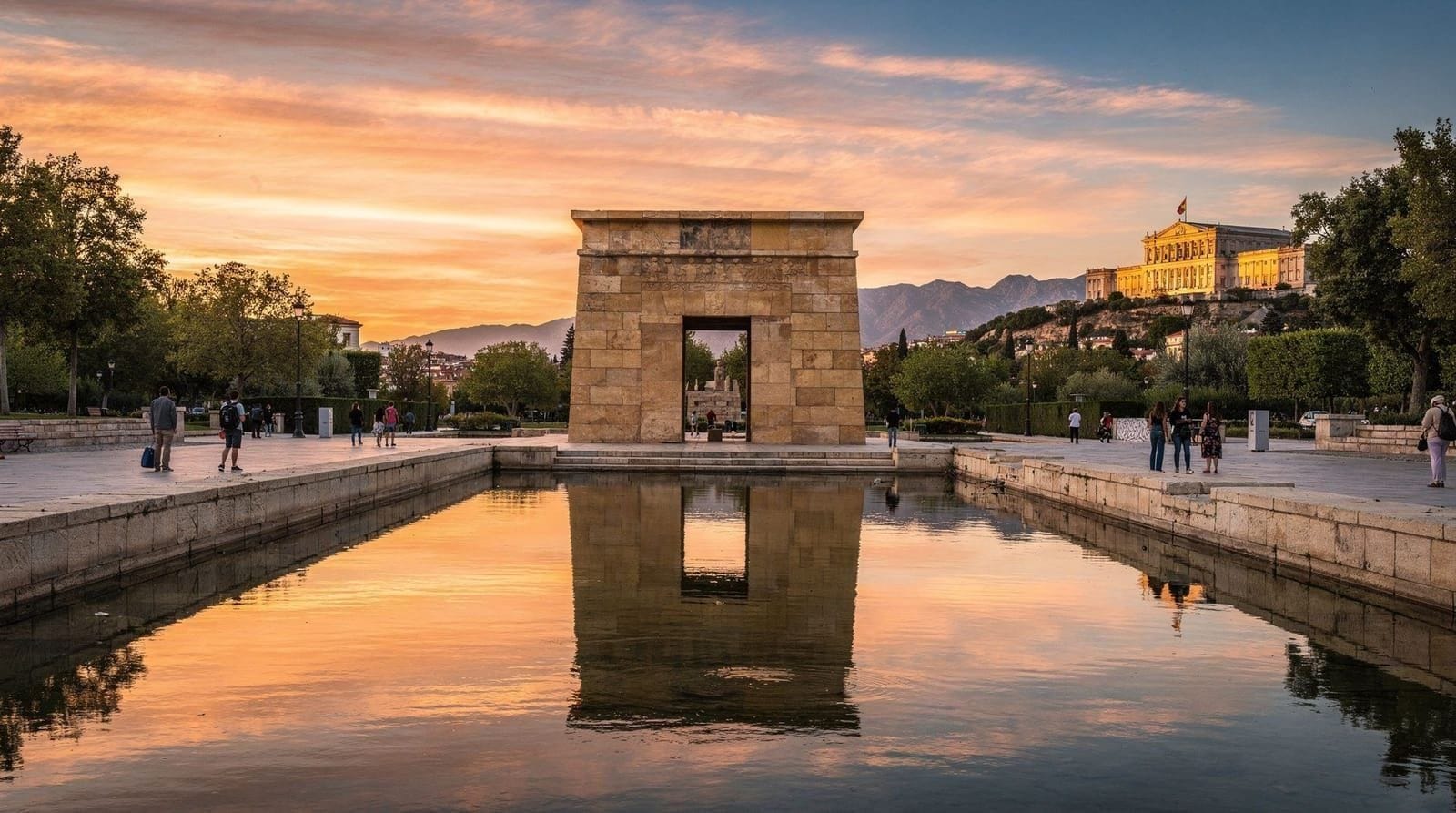
Parque del Oeste is a hillside park on Madrid's western edge, running north–south between Argüelles and Moncloa. It contains the Rosaleda del Parque del Oeste (one of Madrid's best rose gardens, spectacular in May), the lower station of the Teleférico cable car (closed for refurbishment, reopening planned for Q1 2027 according to EMT Madrid), and wide views toward the Guadarrama mountains and the Manzanares valley. Free to enter. Best visited in May for the roses, or on any clear day for the mountain views. Walk from the Temple of Debod south through the park for a natural combination.
| Where | Western Madrid, between Argüelles and Moncloa |
| Cost | Free |
| Time needed | 2–3 hours with the Temple of Debod; add 2–3 hours for Casa de Campo (the Teleférico is currently closed) |
| Getting there | Metro Argüelles or Moncloa (Lines 3, 4, 6), or Ventura Rodríguez (Line 3) |
| Best time | May for the roses; any clear day for the mountain views |
The hillside park above the Manzanares
Parque del Oeste occupies the hillside above the western edge of Madrid — the escarpment that drops from the Moncloa plateau down to the Manzanares river valley and Casa de Campo. It is less famous than the Retiro but more interesting in some respects: the terrain is varied, the views toward the Sierra de Guadarrama are excellent, and the park has a more neighbourhood character (used heavily by residents of Argüelles, Moncloa, and Ciudad Universitaria) without the tourist overlay that the Retiro carries on busy weekends.
The park connects several significant Madrid sites in a single walkable strip: the Temple of Debod to the northeast, the Teleférico cable car station (currently closed) in the middle section, and the Rosaleda rose garden at the northern end near the Ciudad Universitaria.
The Rosaleda del Parque del Oeste
This rose garden is distinct from the Retiro’s Rosaleda — and in the view of many regular visitors, superior. The Rosaleda del Parque del Oeste participates in the Concurso Internacional de Nuevas Rosas (International New Roses Competition), one of the most prestigious rose breeding competitions in Europe. The competition brings entries from international breeders each year; winning varieties are planted in the garden.
The garden has over 20,000 rose plants representing several hundred varieties. Unlike the Retiro Rosaleda (which is flat and enclosed), the Parque del Oeste’s version descends in terraced sections down the hillside, with views through the roses toward the Manzanares valley and the Casa de Campo.
Peak bloom: Mid-May to mid-June. The International Competition is held every May (public voting for the Rosa de Madrid in mid-May, final jury at the end of the month; in 2026 the Rosaleda stayed closed to the public until 16:00 on the final judging day, 22 May); the competition weeks are when the garden is most visited and the variety selection at its most complete.
Outside bloom season: The rose garden is less interesting from July through March, but the structural planting (hedges, pergolas, the competition entry beds) gives the garden some year-round interest.
Entry: Free, no booking required. Hours (Ayuntamiento de Madrid): 1 November to 28 February 10:00–18:00; 1 March to 15 April 10:00–19:00; 16 April to 15 September 10:00–21:00; 16 September to 31 October 10:00–19:00.
The Teleférico: cable car connection
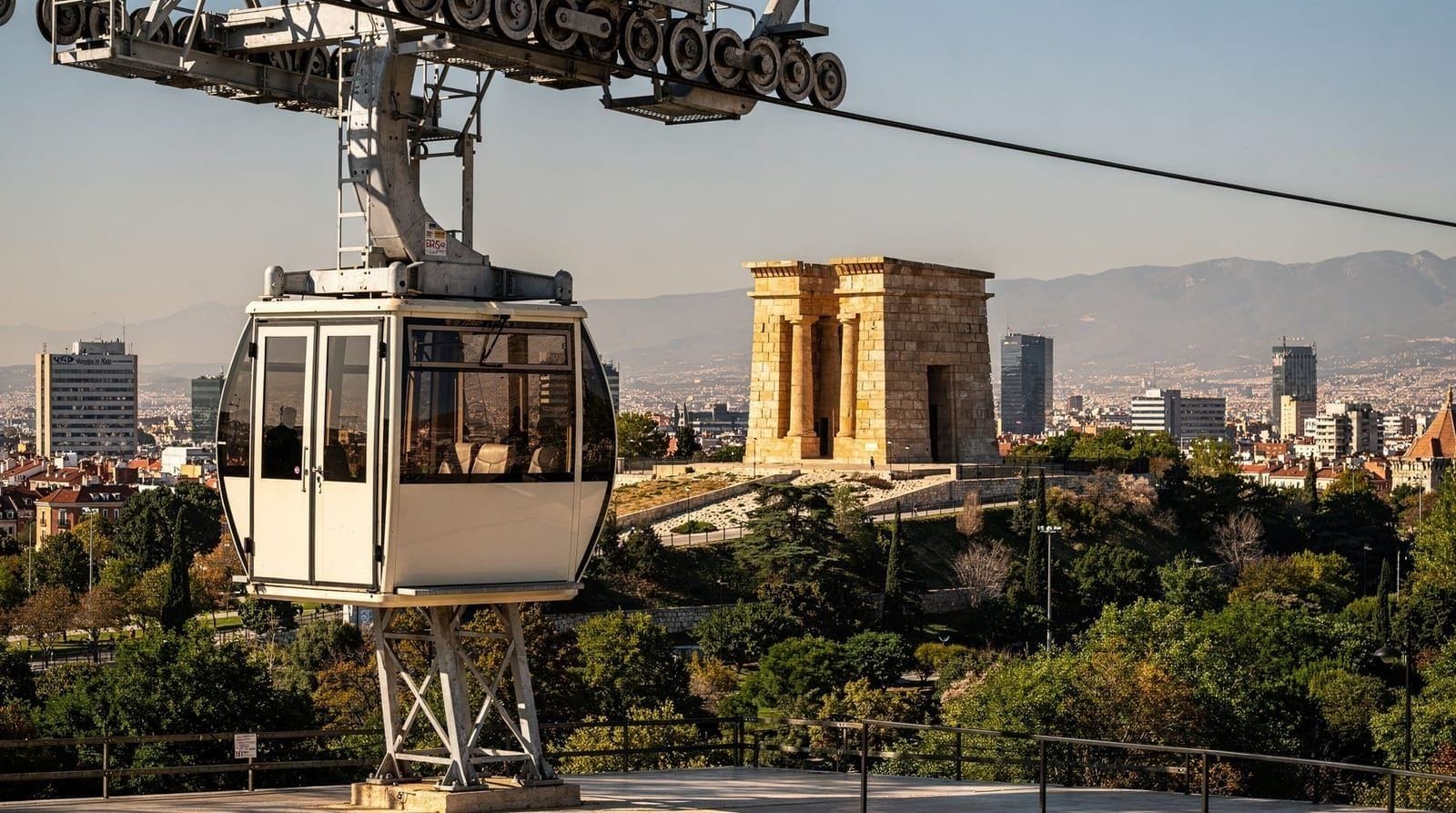
The Teleférico is closed for a full refurbishment; reopening is planned for the first quarter of 2027 (EMT Madrid, the operator). Check before planning around it. The Teleférico de Madrid has its lower station in the middle section of Parque del Oeste, near the Paseo de Rosales (the park’s main terrace walkway). Once reopened, the cable car crosses the Manzanares valley to a station in the northern section of Casa de Campo — an 11-minute journey at roughly 40 metres above the valley floor, with views across the western skyline of Madrid including the Royal Palace.
Teleférico practical: closed for refurbishment, reopening planned for the first quarter of 2027 (EMT Madrid); check the EMT Madrid website for the reopening date, hours and prices. In the meantime, reach Casa de Campo on foot, by Metro Line 10 or by bus, or follow the river on foot along Madrid Río.
For families: Once reopened, the cable car should be a genuinely enjoyable experience for children — the height above the valley floor is thrilling without being scary, and the Casa de Campo end puts you in the park immediately. Return cable car + walk around the lake + return cable car is a 2–3 hour family outing. See the Teleférico Madrid guide for the full ride details.
Once you land on the other side: Casa de Campo is large enough that walking everything is unrealistic. If you would rather cover more ground without tiring out, an e-bike ride along the river and through Casa de Campo is a comfortable way to link the cable car landing with the riverside paths. Our e-bike tours guide compares the options, and the Madrid Río guide shows where the riverside route leads.
Views and walks
Paseo de Rosales: The wide terrace path along the eastern edge of Parque del Oeste is one of Madrid’s best sunset-watching promenades, with views west across the Manzanares valley. A series of bar terraces line the Paseo de Rosales — these are popular local spots for evening drinks in warm months, less touristy than the rooftop bars in the centre.
Mirador del Cuartel de la Montaña: At the northern end of the park, near the Temple of Debod, the viewpoint overlooks the full Manzanares valley with the Guadarrama mountains behind. The view here is similar to the Debod terrace but at a slightly different angle. On clear winter days, the snow on the Guadarrama peaks is framed against the Madrid skyline.
The hillside walks: The park’s internal network of paths drops steeply from the Paseo de Rosales to the lower Manzanares level. These are good for vigorous walking but not accessible for wheelchairs on the steep sections. The park maintenance is good; the paths are clear and waymarked.
Parque del Oeste in the Civil War
Like Casa de Campo, Parque del Oeste was in the front line of the Battle of Madrid (November 1936–March 1937). The hillside park above the Manzanares was heavily fought over; some trees in the park show historic damage from artillery. The Cuartel de la Montaña (mountain barracks) that was stormed at the war’s outbreak stood immediately east of the park; its site is now the Parque del Cuartel de la Montaña where the Temple of Debod stands.
The Faculty of Philosophy and Letters (Universidad Complutense buildings north of the park) was the site of intense fighting and was used by Republican forces as a defensive position — one of the most studied examples of urban warfare in the 20th century (studied by military historians for its techniques of building-by-building defence).
For historical context, the Reina Sofía’s Civil War rooms and Guernica provide the ideological and documentary framework — see the Reina Sofía museum guide for how to plan that visit.
Getting to Parque del Oeste
Metro: Argüelles (Lines 3, 4, 6) — for the central section of the park and the (closed) Teleférico station. Moncloa (Lines 3, 6) — for the northern section. Ventura Rodríguez (Line 3) — for the southern section near the Debod connection.
On foot from Debod: The Temple of Debod is on the southern boundary of Parque del Oeste. Walk south through the Parque del Cuartel de la Montaña for 200m, then connect to the main park. Total: 5 minutes.
On foot from Malasaña: The northern end of Malasaña (around Calle Conde Duque) is a 15-minute walk west to the Paseo de Rosales.
Combining the park with nearby sites
The most natural Parque del Oeste itinerary covers:
- Temple of Debod (sunset, or morning visit to the interior)
- Walk south through the Parque del Cuartel de la Montaña into the main park
- Paseo de Rosales (terrace walk with views, bar stops)
- Rosaleda (in May) or the Teleférico station (closed for refurbishment until Q1 2027)
Total time without Casa de Campo: 2–3 hours. With Casa de Campo (on foot or by Metro Line 10, as the cable car is closed): add 2–3 hours.
If you are planning the Debod end of the walk around the evening light, the Temple of Debod at sunset guide explains how to time it, and the Faro de Moncloa guide covers another high viewpoint close to the northern end of the park. Both pair naturally with a slow walk through the park rather than a rushed one.
For a full day of Madrid’s western parks, the sequence Debod → Parque del Oeste → Casa de Campo → Madrid Río (by cable car once it reopens) covers the full western green belt in one long day (8–10 km of easy walking, most on flat or gentle terrain).
The park in different seasons
Spring (April–May): The prime season. The Rosaleda peaks in May; the trees are in new leaf; temperatures are ideal for extended outdoor time. The International New Roses Competition (May) is worth specifically timing a visit around if you have any interest in roses.
Summer (June–August): The Paseo de Rosales terrace bars are at their most active in summer evenings (from around 19:00), when the temperature drops enough for outdoor sitting. The park’s mature trees provide reasonable shade on the steep hillside paths. Avoid the exposed summit areas in midday July–August heat.
Autumn (September–October): Second best season. The parkland trees change colour in October. The views toward the Guadarrama are sharpest in autumn, when summer haze is gone and the air is clear.
Winter (November–February): Cold and quiet. The Paseo de Rosales terrace bars are largely closed or very quiet. The mountain views are at their most dramatic — snow on the Guadarrama peaks, clear cold light. The park’s Civil War history feels more present in winter’s bare trees.
The surroundings: Argüelles and Moncloa
The residential districts immediately east of the park — Argüelles (around Metro Argüelles) and Moncloa (around Metro Moncloa) — are upper-middle-class Madrid neighbourhoods with good independent restaurants, traditional cafes, and a local rather than tourist character.
For eating near the park: The streets around Calle de Isaac Peral (Argüelles) and Calle de Gaztambide have traditional Spanish restaurants that cater to residents rather than tourists. Prices are 15–20% lower than comparable quality in the Malasaña or Chueca tourist areas.
Café El Viena (Paseo de Rosales) — one of several traditional cafes on the Rosales terrace; a useful base for a pre- or post-park coffee and people-watching.
Staying nearby: The northern edge of Malasaña is within easy reach of the park, so the Malasaña guide is a good companion for an evening that starts with a walk here and ends with dinner in a livelier neighbourhood.
For shopping: The Argüelles area has a mix of chain stores and independent shops along Calle de la Princesa and the streets off it. The El Corte Inglés department store at Argüelles (Calle de la Princesa 56) is one of the city’s major department stores, useful for practical purchases.
History: from royal hunting ground to republican park
Before becoming Parque del Oeste, the hillside was part of the royal properties of El Pardo and the Casa de Campo — hunting and recreational land reserved for royal use. The urban development of the 19th century and the social reforms of the early 20th century gradually made this land available for public use.
The park was formally designed in the early 20th century by the municipal gardener Cecilio Rodríguez, who also designed and maintained the Retiro’s Rosaleda. The Rosaleda del Parque del Oeste was planted as part of this early 20th-century design, explaining why the park has such a well-developed rose collection despite its relatively modest total size.
During the Civil War, the western edge of Parque del Oeste marked the Republican front line — the Manzanares river valley immediately below was the crossing point Franco’s forces attempted to use to take Madrid in November 1936. Some original earthworks from this period are visible in the more remote sections of the park, though most have been absorbed by vegetation over 80+ years.
The park continued in public use under Franco (renamed in the regime’s terminology) and resumed its pre-war name after the transition to democracy.
Practical information
Entry: Free, open-air park with no ticket office; the Rosaleda has its own opening hours (see above)
Facilities: Bar terraces on Paseo de Rosales (open spring–autumn). Limited toilets in the park service buildings. The Teleférico station (closed for refurbishment) has a kiosk.
Getting around: Most of the park’s paths are walkable without special footwear. The steeper hillside descents are better with flat soles; heels are impractical in the western sections.
Dogs: Permitted throughout on leads. Popular dog-walking park for the surrounding Argüelles and Moncloa districts.
Running and exercise: The Paseo de Rosales and the internal paths are popular with local runners, particularly early morning and early evening. The hillside sections give genuine elevation change for anyone wanting more than the flat loops of the Retiro or Madrid Río — a useful option for visitors who run and want to combine exercise with sightseeing rather than treating them as separate activities.
See free things to do in Madrid for the context of this route in a budget Madrid trip.
Parque del Oeste vs other Madrid parks: a quick comparison
Visitors choosing between Madrid’s parks benefit from understanding what each offers:
Retiro vs Parque del Oeste: The Retiro (125 ha) is the signature park — more manicured, more facilities, more famous, more crowded. Parque del Oeste has better mountain views and the best rose garden, a steeper and more varied terrain, and a more neighbourhood character. The two are not in competition; they are on opposite sides of the city and serve different parts of a trip.
Parque del Oeste vs Casa de Campo: Casa de Campo is ten times larger and contains the zoo, the lake, and the swimming pools. Parque del Oeste is the more intimate option — better for a 1–2 hour urban walk than for a full-day excursion. If you have a full day for western Madrid, the sequence Parque del Oeste → Casa de Campo (via the Teleférico once it reopens) covers both.
Parque del Oeste vs Temple of Debod: The Temple of Debod is in the park (technically in the adjacent Parque del Cuartel de la Montaña) — a Debod visit naturally extends into Parque del Oeste. They are the same outing.
A quick comparison of Madrid’s western green spaces:
| Park | Size | Standout feature | Time needed |
|---|---|---|---|
| Parque del Oeste | Small–medium | Rose garden, mountain views | 1–2 hours |
| Casa de Campo | Very large | Zoo, lake, theme park, forest | Half day+ |
| Retiro | Medium | Crystal Palace, boating lake, central location | 1–3 hours |
| Real Jardín Botánico | Small | Formal 18th-century garden, adjacent to Prado | 1 hour |
For a comparable formal garden closer to the museums, see the Real Jardín Botánico guide; for the full-scale forest park across the valley, see Casa de Campo.
If the Retiro is the park you are weighing this one against, the Retiro Park guide lays out what it offers in detail. Visitors who want to see the Retiro in a more active way can also try a guided Segway ride through the Retiro, and runners will find routes in the running in the Retiro guide, a useful contrast with the hillside paths here. Travelling with children? The Madrid with kids guide shows where this park fits into a family trip.
What you might miss: the Ermita de San Antonio de la Florida
On the eastern bank of the Manzanares, at the foot of the Parque del Oeste escarpment, stands the Ermita de San Antonio de la Florida (Paseo de la Florida 5). This small neoclassical chapel, completed in 1798 to designs by Felipe Fontana, contains Goya’s most important surviving fresco cycle — painted directly on the dome and cupola in just a few months in 1798.
The subject (a miracle of Saint Anthony of Padua) is an excuse for Goya to paint a crowded scene of ordinary 18th-century Madrileños watching and reacting to the miracle. The figures are not idealised saints and aristocrats; they are tavern-keepers, washerwomen, soldiers, and citizens — the Madrid of the streets rather than the court. Goya himself is buried in the chapel.
Entry: Free (Tuesday–Sunday 09:30–20:00). No queues. One of Madrid’s most undervisited significant art sites.
Getting there: 5 minutes walk west from Príncipe Pío Metro station (Lines 6 and 10). Or walk down from the (closed) Teleférico station in Parque del Oeste — the path descends to the river and the chapel is on the Paseo de la Florida road at the bottom.
Combining the ermita with a Parque del Oeste walk creates a cultural and natural afternoon: Goya frescoes at the bottom of the hill, Rosaleda, Debod sunset (and the Teleférico once it reopens). A genuinely complete and free afternoon. If you’re timing your visit for the roses, see Madrid in spring for the wider seasonal context of what else is blooming or worth prioritising in April–May.
Frequently asked questions about Parque del Oeste
Is Parque del Oeste worth visiting if I've already seen the Retiro?
Yes, if you have time — the two parks offer different things. The Retiro is more manicured and central, with more facilities and the Crystal Palace. Parque del Oeste has better mountain views, the standout Rosaleda rose garden, a steeper and more varied terrain, and a genuinely local, less touristy atmosphere. Visiting both gives a fuller sense of Madrid's green spaces; if forced to choose one, the Retiro suits a first-time visitor better and Parque del Oeste suits a repeat visitor or anyone with a specific interest in roses.How long should I budget for Parque del Oeste?
A focused walk through the Rosaleda, Paseo de Rosales, and the viewpoints takes about 1–1.5 hours. Combined with the Temple of Debod at one end, budget 2–3 hours. The Teleférico cable car is closed for refurbishment (reopening planned for Q1 2027 according to EMT Madrid); once it reopens, the crossing into Casa de Campo adds another 2–3 hours for the return trip and a walk around the lake there.