Teleférico de Madrid: cable car over the city — worth it or tourist gimmick?
Madrid: Royal Palace Fast Access Ticket
Is the Teleférico de Madrid worth the price?
Conditionally yes, once it reopens. The Teleférico is currently closed for a full overhaul, with reopening expected in the first quarter of 2027 (EMT Madrid, the operator) — check before planning. The ride itself is 11 minutes over the Manzanares River valley and the Casa de Campo park, with good aerial views of the [Royal Palace] and the Guadarrama mountains on clear days. It is a reasonable experience for families with young children and on clear-sky days. On hazy days or in peak summer heat, the value drops sharply.
In brief: Madrid’s cable car crosses 2.5 km over the Manzanares valley in 11 minutes. Once it reopens, it is best on clear spring or autumn days; views of the Royal Palace and the mountains are genuinely good. Not a must-do, but a pleasant optional for families or clear-day visits.
Closed for an overhaul: the Teleférico de Madrid is closed for a full renovation, with reopening expected in the first quarter of 2027 (source: EMT Madrid, the operator). Check its status before planning. Meanwhile, the Faro de Moncloa, the Temple of Debod terrace, the Parque del Oeste, the Casa de Campo on foot or by Metro Line 10 or bus, and Madrid Río are the alternatives. The rest of this guide describes the ride as it will be once the cable car reopens.
| Where | Paseo del Pintor Rosales ↔ Casa de Campo |
| Status | Closed for an overhaul; reopening expected Q1 2027 (EMT Madrid) |
| Time needed | 11 min crossing, ~45 min round trip with stops |
| Getting there | Metro Argüelles (Lines 3/4/6), 10-min walk |
| Best time | Once reopened: clear spring/autumn days; avoid summer midday haze |
What the Teleférico actually is
The Teleférico de Madrid has run since 1969 (it is currently closed for an overhaul), connecting the Parque del Oeste on the east side of the Manzanares with the Casa de Campo on the west. The route crosses the river valley at a height of up to 40 metres above the ground, passing over the wooded hillside of the Parque del Oeste and the Manzanares riverbank.
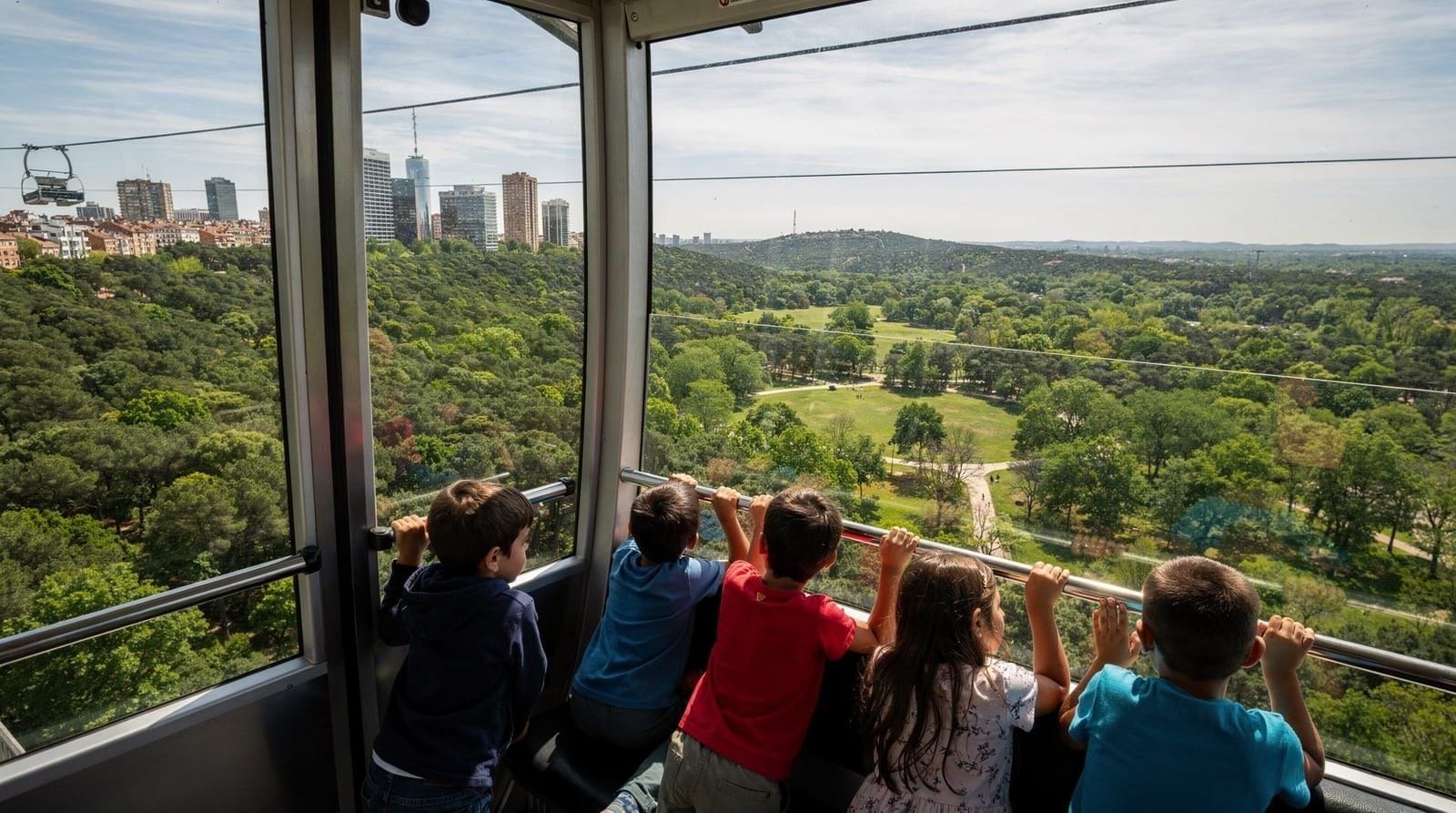
The gondolas are enclosed cabins holding 6–8 passengers. The 11-minute crossing operates in both directions simultaneously — while you cross east-to-west, other cars cross west-to-east. The system has a good safety record across its 50+ years of operation.
This is not a mountain cable car. Madrid sits at approximately 650 metres altitude; there is no significant elevation change between the two stations. The ride is about the view over the valley and the novelty of the aerial crossing, not about accessing otherwise-unreachable terrain.
The views: what you actually see
Departing from Rosales (heading west):
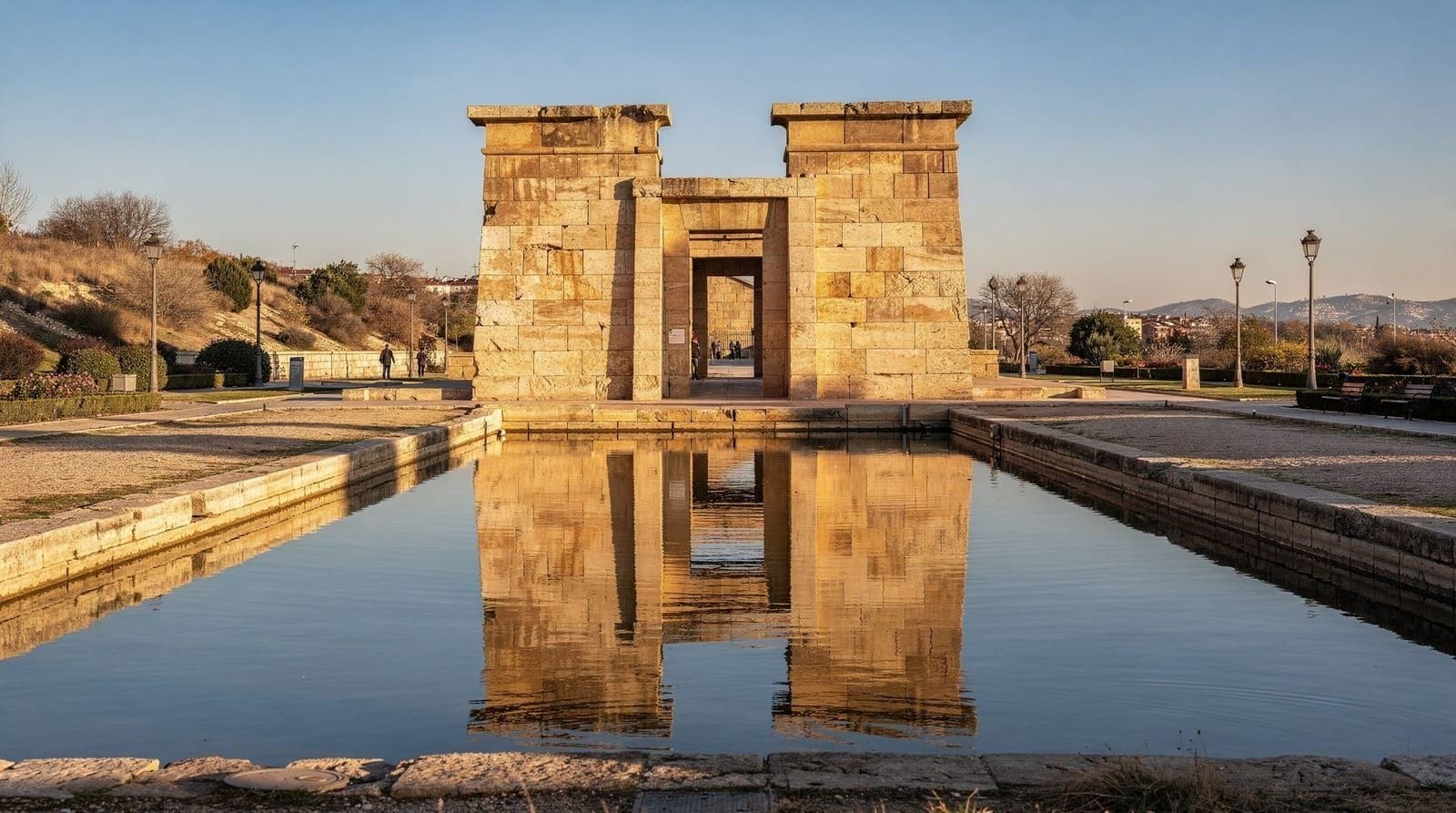
- The Parque del Oeste and the Temple of Debod are visible to the south (you can see the Egyptian temple from the cable car)
- The Royal Palace is visible to the south-southeast on its promontory — this aerial angle shows the scale of the building and the western gardens (Campo del Moro) in a way that ground-level approaches don’t
- The Manzanares riverbank and the Madrid Río park below
- On clear days: the Sierra de Guadarrama mountains filling the western horizon
At the midpoint (clearest views):
- Direct view down into the river valley and tree canopy
- The city skyline looking east — you can see the Cuatro Torres business area skyscrapers in the distance
Arriving at Casa de Campo:
- The lake (Lago de Casa de Campo) is visible to the south
- The Casa de Campo forest extends in all directions
When to go
Best conditions: Spring (April–May) and early autumn (September–October) on a clear day. The mountains are snow-capped in spring; the air is clearest before summer heat haze builds.
Avoid: July and August midday (temperature at the terminus can be 38–40°C, the Casa de Campo is exposed parkland, and the return journey is largely spent in the sun). If you go in summer, take the first morning operating time.
Winter: Check the operator’s winter arrangements once the cable car reopens; it only runs when wind conditions allow. On a cold clear February day with snowy mountains visible, the view is excellent. The cars are heated.
The arrival point: Casa de Campo options
The western terminus in the Casa de Campo is not a tourist infrastructure area — it is the edge of a large urban forest park (1,700 hectares). From the terminus building, you have several options:
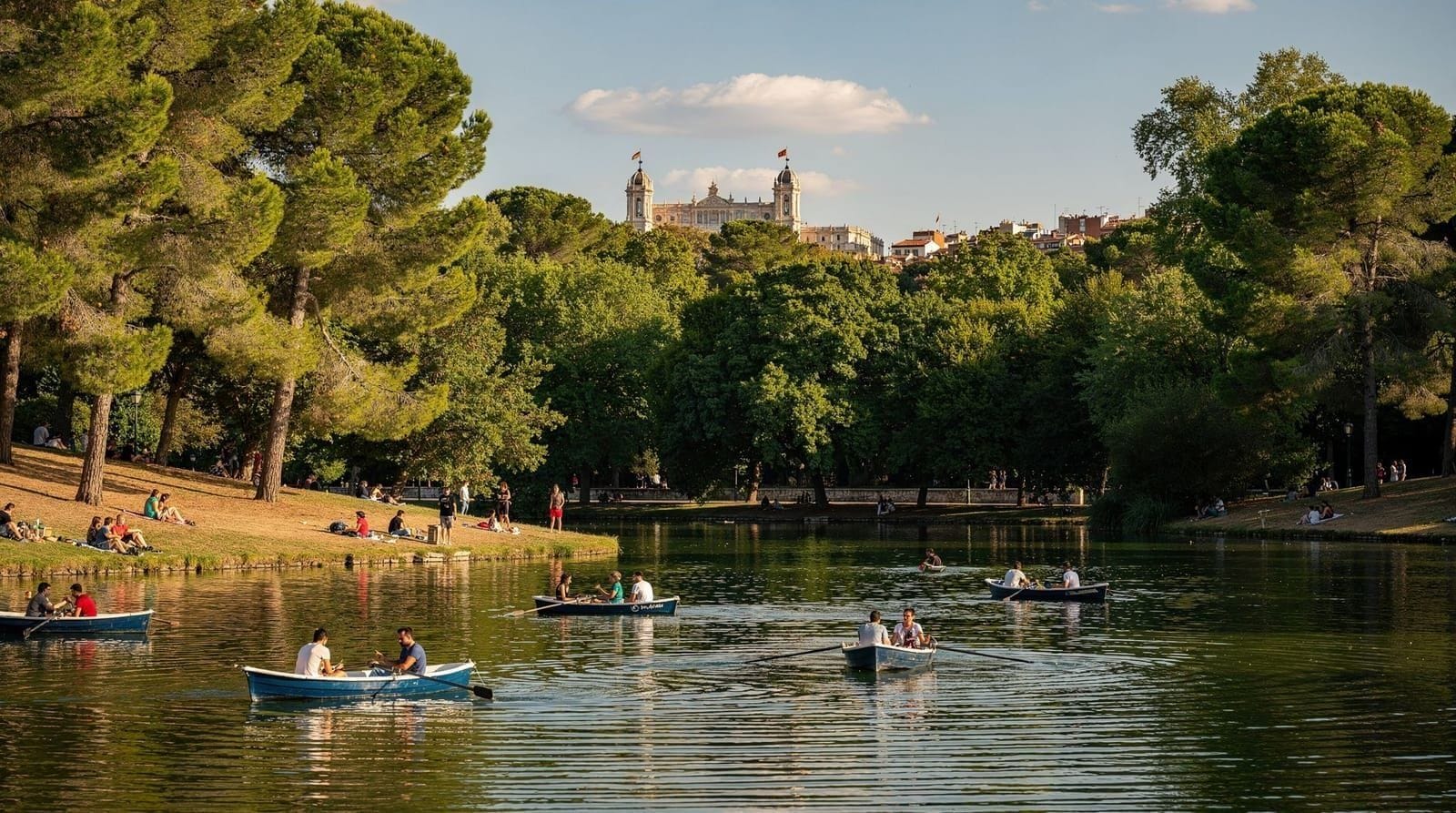
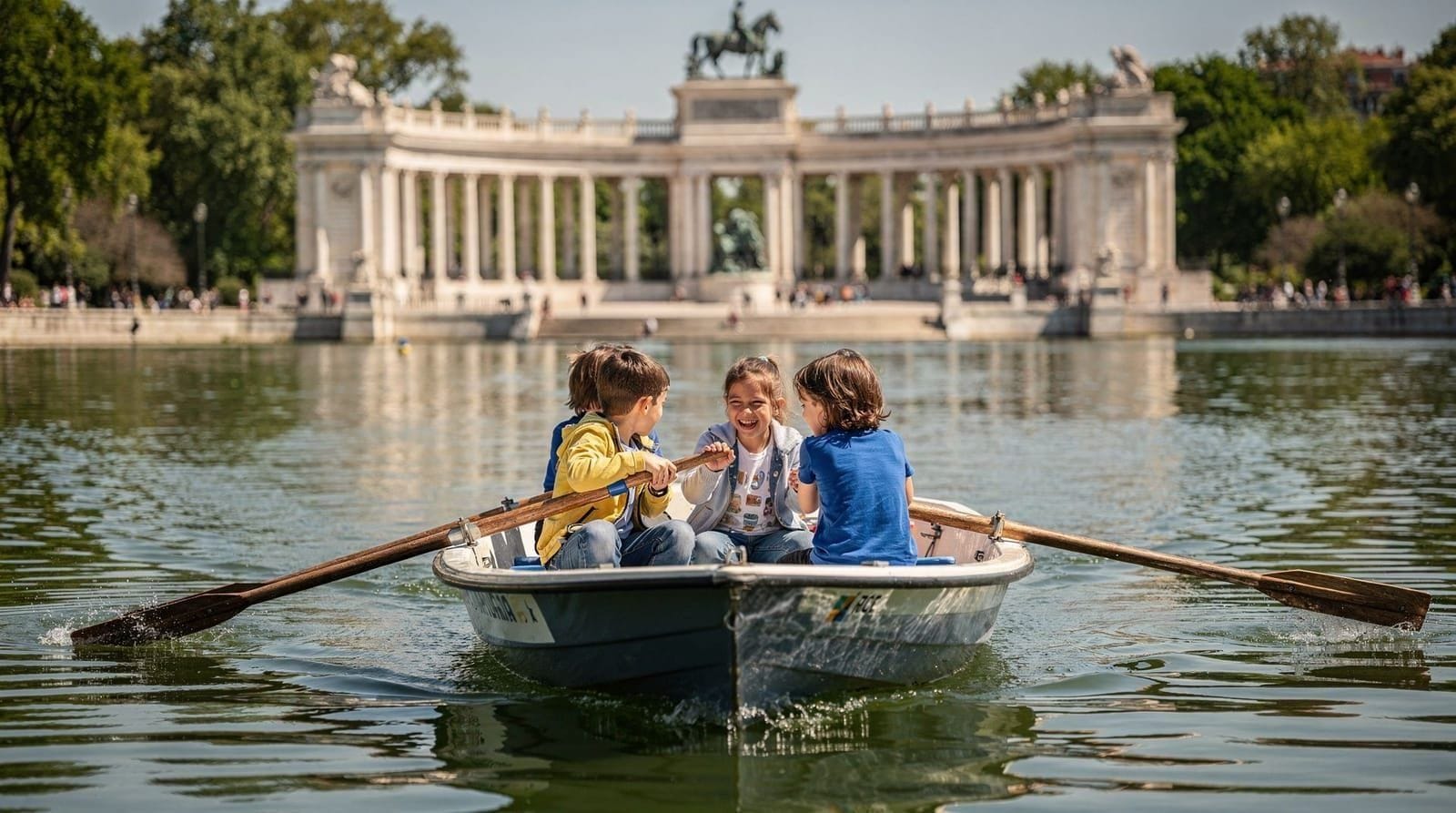
El Lago area (10-minute walk south): The Casa de Campo lake, used for rowing and paddle boating in summer. The surrounding paths are popular with cyclists and joggers.
Zoo-Aquarium de Madrid (20-minute walk southwest): One of the major family attractions in Madrid, housed in the Casa de Campo. See the Madrid with kids guide for the full review.
Parque de Atracciones (adjacent to Zoo): Amusement park with rides; the Parque de Atracciones guide covers entry costs and what’s worth the trip.
On foot/cycle back: A pedestrian/cycle bridge connects the Casa de Campo to the Manzanares riverbank and the Madrid Río parkway. It is a pleasant 45-minute walk back to the Rosales side without retracing the cable car route.
Practical details
Address (east terminus): Paseo del Pintor Rosales s/n, 28008 Madrid. The station is on the south side of the Paseo del Pintor Rosales, immediately west of the Parque del Oeste.
Metro: Argüelles (Lines 3/4/6), then a 10-minute walk through the Parque del Oeste to the Rosales terminal. Or bus 21, 74, 133.
Booking: The cable car is closed for an overhaul (reopening expected in the first quarter of 2027, EMT Madrid); ticketing arrangements will be announced at reopening.
Photography: The cable car windows are clean and the gondola has enough space to position a camera. The midpoint of the crossing gives the best angles — roughly 5 minutes into the journey.
Combining the Teleférico with the Temple of Debod
The Teleférico station on Paseo del Pintor Rosales is 5 minutes’ walk from the Temple of Debod viewpoint — they are adjacent to each other in the Parque del Oeste area. Once the cable car reopens, a logical afternoon will combine both:
- Afternoon (17:00): Walk through the Parque del Oeste to the Teleférico station
- 17:00–18:00: Take the cable car, explore the Casa de Campo arrival area, return
- 18:30–19:30: Walk to the Temple of Debod reflecting pool for the sunset
While the cable car is closed for an overhaul (reopening expected in the first quarter of 2027, EMT Madrid; check before planning), keep the free part: a walk through the Parque del Oeste and the sunset at the Temple of Debod. The free things to do guide notes that the Temple of Debod sunset is free.
Honest assessment
The Teleférico (currently closed for an overhaul) is not in the same category as Madrid’s museums or the day trip network. It is a pleasant 45-minute diversion with genuinely good views from the midpoint of the crossing. Once reopened, it is reasonable for families with young children for whom the aerial crossing is exciting in itself.
For adults without children, the value depends on weather and what else is nearby. If you are in the Parque del Oeste area for the Temple of Debod sunset and have an hour to spare, the cable car is worth adding. As a specific purpose destination from central Madrid, it is less compelling.
The Madrid with kids guide covers the Teleférico as part of a broader family day in the Casa de Campo area, combined with the Zoo-Aquarium.
The history of the Teleférico de Madrid
The Teleférico was inaugurated on 4 July 1969 — originally conceived as a tourist attraction and as a connection between the city and the recreational areas of the Casa de Campo. At its opening it was operated by CTSA (Cía. Teleférico, S.A.) and quickly became a popular weekend destination for Madrileños who could afford the novelty.
During the 1970s and 1980s, the Casa de Campo terminus served a different function from today — the park itself was used for nighttime street prostitution from the 1970s onwards, concentrated in specific areas away from the tourist facilities. This situation was gradually addressed by the city in the 2000s, and the Casa de Campo today is a recreational park without the safety concerns of earlier decades. The Teleférico terminus area and the lake are entirely family-oriented.
The cable car system has been upgraded twice — in 1994 and again in 2006 — with new gondolas replacing the original 1969 cabins. The current gondolas are modern, stable, and climate-controlled.
What the view looks like at different times of year
January–February: If the Sierra de Guadarrama has snow (common above 1,500m from November–April), the western view from the midpoint of the cable car includes white peaks against a blue sky — a striking image that is rarely associated with Madrid. The city is cold (0–8°C) but the cable car is heated.
April–May: The Casa de Campo below turns green; the Manzanares riverbank along Madrid Río has spring flowers. The Guadarrama still has snow on the higher peaks in April. Optimal combination of pleasant temperature and good visibility.
June–August: The strongest light but also the most haze. The city below shimmers in the heat. Views of the mountains are often obscured by the heat haze. The Casa de Campo is dry and brown by July. If going in summer, early morning (first operating slot) is significantly better than afternoon.
October–November: Autumn colour in the Casa de Campo and along the Manzanares. First mountain snow arriving in November on the higher peaks. Clear autumn light — often the best photography conditions of the year.
Access from the Argüelles neighborhood
Paseo del Pintor Rosales, where the Teleférico station stands, is the main boulevard of the Argüelles neighborhood — a pleasant residential area immediately north of the Parque del Oeste. The boulevard has café terraces used by local residents, which are good for a coffee before or after the cable car.
From the Argüelles Metro station (Lines 3/4/6), the walk to the Teleférico follows Paseo del Pintor Rosales south through the residential streets of Argüelles, passing several good neighbourhood cafés. This area is one of the quieter residential sectors of central Madrid — less tourist traffic than Malasaña or Chueca, used primarily by university students and families from the nearby Ciudad Universitaria.
The Parque del Oeste begins immediately south of the Rosales esplanade; the Temple of Debod is visible on its hilltop to the southeast from the Teleférico station.
Family logistics for the Zoo-Aquarium combination
If combining the Teleférico with the Zoo-Aquarium de Madrid (Madrid’s main zoo, located in the Casa de Campo), the practical sequence:
- Take the cable car to the Casa de Campo terminus (one-way ticket, not return)
- Walk south 20 minutes (or take a taxi) to the Zoo entrance
- Spend 3–4 hours at the Zoo
- Take a taxi or the Zoo-Aquarium shuttle back to the city
Do not attempt to walk back to the Teleférico terminus after the Zoo — the two are in different parts of the Casa de Campo and the walk is significant. The Zoo-Aquarium is adjacent to the Parque de Atracciones (amusement park); combining Zoo + Atracciones in one day is the classic family Madrid combination and warrants a full day.
Entry to both attractions should be pre-booked online — both have skip-the-line systems and the queues on summer weekends are substantial without advance tickets. The Madrid with kids guide covers current pricing and practical details for both.
The return journey: what to look for heading east
On the return journey (Casa de Campo back to Rosales, heading east), the view is toward the city. Notable sightlines looking east:
- The Royal Palace dome and the Almudena Cathedral towers are visible to the south-southeast
- The Palacio de Comunicaciones (Cibeles Palace) copper dome further southeast
- The Cuatro Torres business district skyscrapers in the northeast
- Directly below: the Manzanares riverbank and the Madrid Río park cycle path
The royal skyline view from the cable car — palace, cathedral, the hillside gardens — is genuinely photogenic and different from any ground-level approach. For visitors with limited time who want the aerial view of the palace without a longer detour, the cable car’s east-facing view on the return leg provides it in 11 minutes.
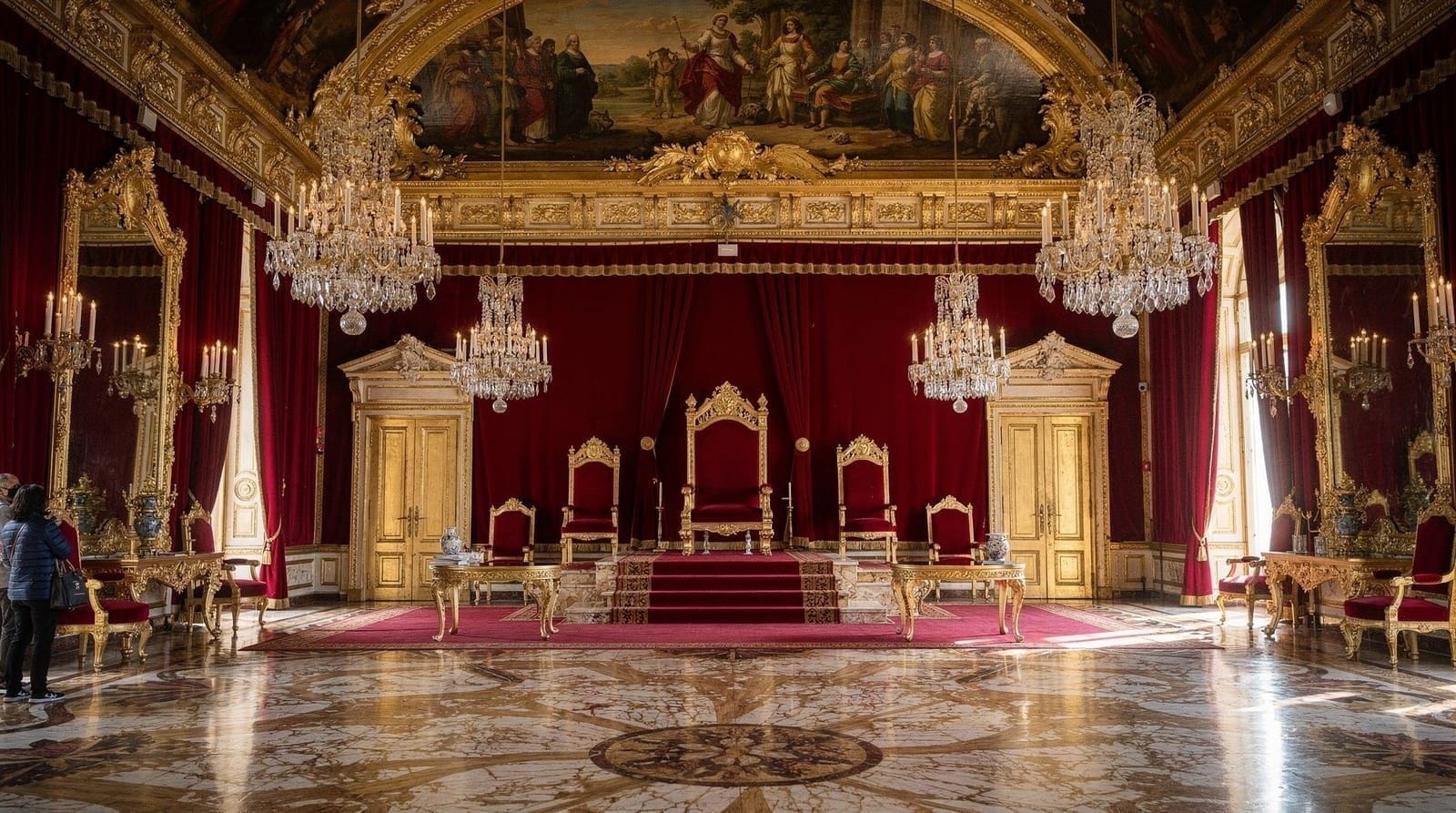
If seeing the palace from above makes you want to see it from the inside, the Royal Palace guide explains what the visit involves, and you can book fast-access entry to the Royal Palace in advance so the interior does not cost you a long wait at the door.
The Casa de Campo: what the forest actually is
The Casa de Campo on the western side of the cable car crossing is one of Europe’s largest urban parks — 1,700 hectares, more than six times the size of the Retiro park. It was a royal hunting ground from the 16th century until 1931, when the Second Republic opened it to the public. The monarchs are gone but the forest remains: holm oaks, pines, and scrub vegetation on the flat Meseta terrain.
Within the Casa de Campo, beyond the Zoo-Aquarium and Parque de Atracciones at the southern end:
The lake (Lago de Casa de Campo): A reservoir at the park’s center, used for rowing and pedal-boating. The lakeside restaurants and bars are popular on summer weekends. The lake is visible from the southern leg of the cable car crossing.
Cycling and running paths: The Casa de Campo has extensive marked cycling routes, and the Madrid Río park connects to the eastern edge of the Casa de Campo along the Manzanares riverbank. This makes the Casa de Campo accessible by bicycle from central Madrid without any road cycling.
Night circuit: From the 1970s to the 2000s, the northern areas of the Casa de Campo were associated with street prostitution — a widely-known urban geography that was gradually suppressed by city policing in the 2000s. The area near the Teleférico terminus and the lake is now entirely family-oriented.
Practical comparison with other Madrid transport experiences
The Teleférico is one of several distinctive Madrid transport experiences that function as attraction in themselves:
Teleférico de Madrid: 11 minutes, aerial; closed for an overhaul, reopening expected Q1 2027 (EMT Madrid). Best for views and novelty with children.
Madrid Río cycle path: Free, along the Manzanares riverbank below the cable car. The bike route from Madrid Río under the Teleférico crossing gives a ground-level view of the same valley the cable car crosses above.
Retiro park rowing boats: Rowing on the Estanque del Retiro is the classic Madrid park experience — €8 for 45 minutes, queues on weekends. Different geography, different experience.
Segway in Retiro: Several operators run 90-minute Retiro park Segway sessions. The Retiro Segway guide covers current options.
Of these, the Teleférico is the most genuinely aerial and the most useful for children under 10 for whom the simple act of flying over trees and water is exciting. For adults without children, the Madrid Río cycle below the cable car is free and arguably a better afternoon activity.
Getting the most from a 3-hour Teleférico afternoon (once it reopens)
13:00: Depart from Metro Argüelles, walk 10 minutes to the Rosales station.
13:15–14:00: Take the cable car to the Casa de Campo. Walk to the El Lago area (10 minutes). Have lunch at the lakeside restaurants (budget option: bring food, there are benches; mid-range: El Lago restaurant, €20–30 per person for lunch).
15:00–16:00: Return by cable car to Rosales, or take a taxi from the Zoo/Atracciones area back to central Madrid.
16:00 onwards: Walk through the Parque del Oeste to the Temple of Debod for the late-afternoon/sunset viewpoint.
The cable car is closed for an overhaul (reopening expected in the first quarter of 2027, EMT Madrid): check before planning, and replace the crossing with a walk or Metro Line 10 or bus to the Casa de Campo if it is still closed. The Madrid with kids guide extends this programme for families adding the Zoo or Atracciones.
If you want the city views explained
The cable car shows you the skyline but says nothing about it. Visitors who would like context for what they are looking at — the palace, the cathedral, the old streets below the promontory — can pair the crossing with a private tour of the old town and its city views, then use the cable car as the relaxed, unguided part of the day. The private guide in Madrid page compares that format with other options.
Photography tips specific to the crossing
The midpoint of the crossing (roughly 5 minutes in, in either direction) gives the widest, most unobstructed views and is the best window for photography — the gondola is at maximum height and clear of the tree canopy on both sides. Shoot through the glass at a slight angle to avoid reflections; a polarising filter, if you carry one, helps cut glare on hazy days. The east-facing return leg (Casa de Campo to Rosales) is generally the stronger photography direction because the Royal Palace, Almudena Cathedral, and the Cuatro Torres skyline are all in frame simultaneously, whereas the outbound westward leg is dominated by forest canopy with the mountains as a more distant backdrop. For sunset photography specifically, aim for the outbound (westward) leg in the final 30–40 minutes before sunset, when the Sierra de Guadarrama silhouette is at its most dramatic.
Seasonality at a glance
| Season | Conditions | Verdict |
|---|---|---|
| Winter (Dec–Feb) | Cold but heated cabins, possible snow on the Sierra | Best clarity, fewest crowds |
| Spring (Apr–May) | Mild, green Casa de Campo | Optimal balance of weather and visibility |
| Summer (Jun–Aug) | Hot, hazy midday | Go early morning, avoid midday heat haze |
| Autumn (Sep–Nov) | Crisp light | Best photography conditions of the year |
The cable car is closed for an overhaul, with reopening expected in the first quarter of 2027 (EMT Madrid); this table applies once it reopens.
Is it worth it for adults without children?
Yes, conditionally. Adults travelling without kids get real value from the Teleférico on a clear day, particularly paired with the Temple of Debod sunset a few minutes’ walk away. The honest caveat: on a hazy summer day, or if time is tight and the itinerary is already full of major sights, the Teleférico is the first thing to cut without real loss — the Faro de Moncloa delivers a comparable or better panoramic view in less time and without weather dependency. For a first-time, time-limited Madrid visit prioritising the Royal Palace, the Golden Triangle museums, and the historic centre, the Teleférico is a pleasant add-on rather than an essential.
Alternatives while the Teleférico is closed or if it is not for you
The cable car is closed for an overhaul until its expected reopening in the first quarter of 2027 (EMT Madrid), and wind closures happen afterwards. While it isn’t running, or if it simply isn’t your thing, Madrid has comparable west-side viewpoint options nearby: the Faro de Moncloa observation tower gives a 360° panorama without weather dependency, and the Temple of Debod terrace offers a free, always-accessible sunset view over the same valley the cable car crosses. Neither replicates the specific aerial-crossing sensation, but both deliver strong views of the Royal Palace and the Guadarrama without a ticket or a queue.
Frequently asked questions about Teleférico de Madrid
Is the Teleférico de Madrid open, and what are the prices and hours?
No. The cable car is closed for a full overhaul, with reopening expected in the first quarter of 2027 according to EMT Madrid, the operator. No prices or hours are given here because they will be set at reopening — check the EMT Madrid website before planning a visit. Once running, it will again close in strong wind.Where does the Teleférico start and finish?
It departs from Paseo del Pintor Rosales in the Argüelles/Parque del Oeste area, and arrives at a restaurant building on the edge of the Casa de Campo park on the west bank of the Manzanares. The journey is 2.5 km in 11 minutes.What can you see from the Teleférico?
The main views on the outward (east to west) journey: the Manzanares valley below, the Casa de Campo forest, and on clear days the Sierra de Guadarrama mountains. Looking back (east): the city skyline with the Royal Palace silhouette visible to the south. The best aerial view of the city is from the midpoint of the crossing.Is the Teleférico good for children?
Yes, once it reopens — it is one of the more genuinely child-appealing activities in central Madrid. The cable cars hold 6–8 people in a closed gondola; children can look straight down at the river and the forest below. The arrival point at Casa de Campo has the Zoo-Aquarium and Parque de Atracciones within walking or cycling distance.Is there a restaurant at the Teleférico arrival point?
Yes — the El Lago restaurant at the Casa de Campo terminus served meals and drinks, with views of the lake. Quality is average; the location is pleasant on a good day. The Casa de Campo itself is free to explore on foot from the terminus.What can I do while the Teleférico is closed?
The cable car is closed for an overhaul until its expected reopening in the first quarter of 2027 (EMT Madrid). Once it reopens, wind closures are announced with little notice on the operator's website and at the station. In the meantime, the Faro de Moncloa observation tower and the Temple of Debod terrace nearby offer alternative views over the same Manzanares valley and Sierra de Guadarrama without any weather dependency.Can I buy Teleférico tickets online in advance?
Not at the moment: the cable car is closed for an overhaul, with reopening expected in the first quarter of 2027 (EMT Madrid). Ticketing arrangements and prices will be announced by the operator at reopening — check the EMT Madrid website before planning.