Teleférico Madrid with kids: the cable car families actually like
Madrid: Old Town Walking Tour
Is the Madrid Teleférico worth it for families with children?
The cable car is closed for a full refurbishment, with reopening planned for the first quarter of 2027 (EMT Madrid) — check before planning. Once it reopens, yes: it is short and children consistently enjoy it. The 11-minute crossing over Casa de Campo gives aerial views of the park forest, the city skyline, and on clear days the Sierra de Guadarrama mountains. Best combined with Parque de Atracciones or the Zoo on the same day. Adults without children enjoy it as well — the views at sunset are excellent.
In brief: The Madrid Teleférico is one of the city’s most consistently enjoyed family experiences — a short aerial crossing that children find exciting without being frightening, and that connects two sides of Casa de Campo in a way that adds genuine value to a family day out.
Closed for refurbishment: the Teleférico de Madrid is closed for a complete overhaul, with reopening planned for the first quarter of 2027 (source: EMT Madrid, the operator). Check the official EMT Madrid website before planning around it. In the meantime, the Faro de Moncloa, the Temple of Debod, the Parque del Oeste and Casa de Campo (reachable on foot, by Metro Line 10 or by bus) remain open for a family day. The rest of this guide describes the experience once the cable car reopens.
| Where | Parque del Oeste ↔ Casa de Campo |
| Status | Closed for refurbishment; reopening planned Q1 2027 (EMT Madrid) |
| Time needed | 11 minutes each way, 40–50 min for a simple return (once reopened) |
| Getting there | Metro Argüelles (Lines 3, 4, 6), 5-min walk |
What the Teleférico is
The Teleférico de Madrid is an urban cable car that has operated since 1969, crossing from the Parque del Oeste neighbourhood (Paseo del Pintor Rosales, near the Temple of Debod) to the heart of Casa de Campo in the west. The crossing is 2.5 kilometres, takes approximately 11 minutes each way, and reaches a maximum height of 40 metres above the ground.
This is not an alpine cable car. There are no mountains, no vertigo-inducing drops into valleys, and no extreme weather closures that define high-altitude cable cars elsewhere. It is a city cable car crossing a large urban park — a leisure attraction that has been carrying Madrid families since the late 1960s. The gondolas are small (6–8 people), enclosed with glass windows, and move at a moderate speed.
The Teleférico is operated as a tourist attraction, not a commuter service. It is currently closed for refurbishment (see the note above); check the EMT Madrid website for the reopening date and the operating calendar.
The adult guide to the Teleférico with historical context and viewpoint detail is at the Teleférico Madrid guide. This guide focuses on the family experience.
Why children enjoy it
The novelty of elevation: Even 40 metres above a park is a significant perspective change for a child. Being able to see the tops of trees, then watch the city skyline appear as the cable car gains its midpoint, then descend into the Casa de Campo forest on the far side — this simple sequence is memorable for children in a way that is disproportionate to its cost and duration.
The gentle movement: The gondola sways slightly in the wind, particularly when passing over the pylons (the momentary jolt as the cable transfers). Children find this exciting rather than alarming — it is movement without the speed and force of a theme park ride.
The enclosed space: Unlike open-top observation towers (which some children find alarming), the Teleférico gondola has windows all around but is enclosed. Children can press their faces to the glass and look straight down without any sense of physical exposure.
The brevity: Eleven minutes is the exact right duration for this age group. Long enough to build anticipation, see the views, and feel like an event. Short enough that no child becomes bored or uncomfortable.
The immediacy of the return: Children who enjoyed the outbound journey will want to go back immediately. The return journey from Casa de Campo to Parque del Oeste takes the same 11 minutes but gives you the reverse perspective — now the city skyline approaches rather than recedes.
What you see
The views from the Teleférico depend on the direction of travel and the time of day.
From Parque del Oeste looking west: As you leave the station, you quickly gain height over the Parque del Oeste. The first section looks over formal gardens and the start of the Casa de Campo tree canopy. On clear days, the Sierra de Guadarrama appears on the horizon to the northwest — snowcapped in winter, blue in summer.
At the midpoint (maximum height): Looking back east, you see the city skyline with the Royal Palace visible on its hill above the Manzanares valley. The Cuatro Torres business district towers are visible to the north. The Temple of Debod is on the hill to the northeast, though small from this distance.
Descending into Casa de Campo: The tree canopy of Casa de Campo rises around you. The lake appears below. The park’s scale — 1,700 hectares, the largest urban park in Spain — becomes apparent in a way that is impossible to appreciate from within it at ground level.
What children point at: Invariably: the lake (where are the boats?), the swans (if any are visible from altitude), the road below (a car going under us!), and the pylons (what happens when we pass them?).
Practical details
Station locations:
Parque del Oeste station: Paseo del Pintor Rosales (the promenade along the park’s eastern edge), at the corner with Calle Marqués de Urquijo. The nearest metro is Argüelles (Lines 3, 4, 6) — a 5-minute walk. There is a small café at the station and a terrace overlooking the Rose Garden.
Casa de Campo station: In the park itself, adjacent to the Venta del Batán restaurant and the Casa de Campo lake area. From here you can walk to the lake for boat hire (10 minutes), to the Zoo Aquarium (20 minutes), or to Parque de Atracciones (15 minutes).
Opening hours and tickets: The cable car is closed for refurbishment, with reopening planned for the first quarter of 2027 (EMT Madrid). Hours and fares have not been confirmed for the reopening: check the official EMT Madrid website before planning your day around the cable car.
Duration of a simple return trip: The 11-minute crossing, plus 10–15 minutes at each end for boarding, alighting, and enjoying the view: approximately 40–50 minutes for a simple return.
How to combine the Teleférico with other activities
With Parque de Atracciones:
This is the natural combination. The Parque de Atracciones entrance is a 15-minute walk from the Casa de Campo cable car station through the park. The Teleférico makes a good opening or closing ceremony to a day at the rides.
Suggested sequence: Metro to Argüelles → cable car to Casa de Campo → walk to Parque de Atracciones (15 minutes) → rides all day → metro home from Casa de Campo station (Line 10).
Or the reverse: metro to Casa de Campo → Parque de Atracciones → cable car back to Parque del Oeste → evening drinks at the Paseo del Pintor Rosales terrace.
With Zoo Aquarium:
The Zoo is further from the cable car station (20-minute walk from the Casa de Campo cable car landing, in a different direction from Parque de Atracciones). The combination is possible but involves more walking. Better for older children (8+) who can manage the distance comfortably.
Standalone as an afternoon activity:
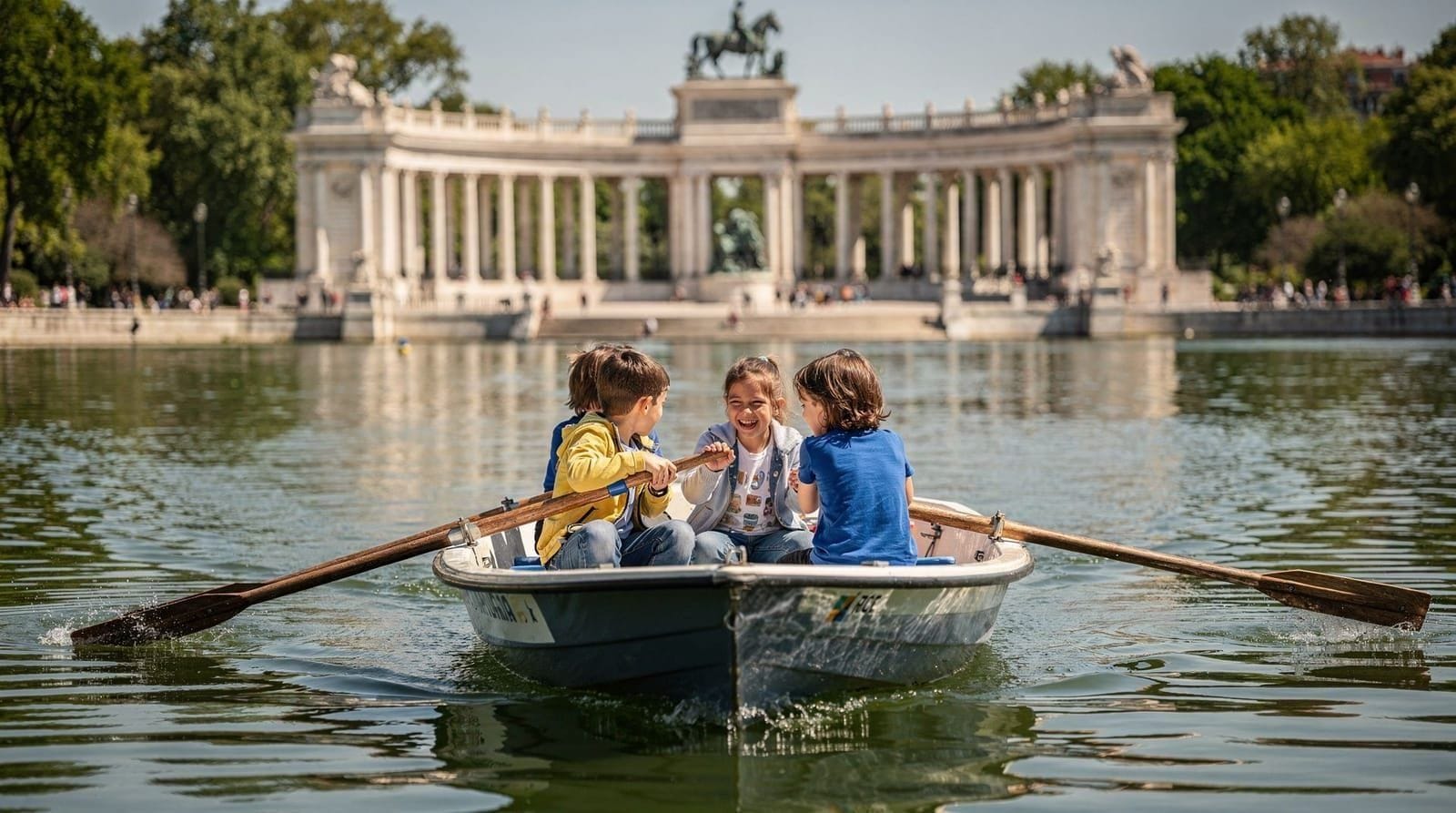
Arrive at the Parque del Oeste station, cross to Casa de Campo, spend 30–45 minutes by the lake (boat hire possible — rowing boats for approximately €7–8/hour), have an ice cream at the Venta del Batán café, cross back. Under 2 hours in total once the cable car has reopened. A reliable low-effort family afternoon that requires minimal planning.
As a viewing experience at sunset:
The return journey (Casa de Campo back to Parque del Oeste, facing east) at sunset gives you the illuminated city skyline as a backdrop. The golden light on the Royal Palace and the Almudena Cathedral visible in the distance is photogenic. The Temple of Debod is a 10-minute walk from the Parque del Oeste station — combining cable car at sunset with Temple of Debod viewing is one of Madrid’s more pleasant adult-and-child evenings.
Important notes for families
Wind closure: The cable car suspends operation when wind exceeds a set threshold. This is uncommon in Madrid (the city is not particularly windy compared to coastal Spain) but worth knowing. Strong autumn and winter winds can cause brief closures. Check the forecast and have a backup plan.
Pushchairs: Foldable pushchairs can be brought into the gondola. Large, rigid pushchairs that cannot fold compactly are impractical — the gondola is small. A carrier (front or back) is the most practical option for babies.
Fear of heights: The gondola is enclosed and the height is moderate. Children who are comfortable in lifts, on balconies above a few floors, or at the top of observation towers are generally fine. Children who have strong height anxiety should know what to expect before boarding — the view straight down through the floor is visible through the lower glass panels.
Group capacity: Each gondola holds 6–8 people. Families of 5+ may be separated across consecutive gondolas (30-second wait between them).
Timing: Once the cable car has reopened, avoid the busiest windows (summer weekends around midday) and check the current hours with EMT Madrid.
What the cable car is not
To manage expectations: the Teleférico is not a thrilling ride, not a significant viewpoint (the Faro de Moncloa gives a better panorama), and not a long experience. It is a charming, reliably enjoyable family experience that takes 40 minutes round-trip and produces a specific kind of pleasure — the aerial perspective, the forest crossing, the approach to the city skyline — that is not replicated by any other attraction in Madrid.
Children who are genuinely curious about “what is up there?” will be satisfied. Children who were hoping for a rollercoaster should visit Parque de Atracciones.
The honest summary
Currently closed for refurbishment (reopening planned Q1 2027, EMT Madrid). Once reopened: consistently enjoyable for children aged 2–12. Combines naturally with the best family attractions in Casa de Campo. At sunset, an unexpectedly beautiful experience.
The Teleférico is not Madrid’s most impressive attraction. It is one of its most reliable — a small, genuine pleasure that requires minimal planning and delivers consistently for families who include it in their day.
For the broader family planning picture, see the Madrid with kids guide and the family itinerary.
The history of the Teleférico de Madrid
The cable car opened on 16 June 1969, built by the Austrian engineering firm Doppelmayr. It was originally conceived as part of the development of the Casa de Campo as a public leisure park under the Franco dictatorship — the regime was expanding Madrid’s recreational infrastructure in the late 1960s as part of a modernisation programme.
The original gondolas from 1969 were replaced in 1999 with the current enclosed cabins, and the system underwent a significant technical overhaul in 2006. Despite its age (over 55 years in operation), the cable car is maintained to current safety standards and has an excellent safety record.
The cable car was temporarily closed during the COVID-19 pandemic and underwent additional maintenance work before reopening. Since 2026 it has been closed for a complete refurbishment, with reopening planned for the first quarter of 2027 (EMT Madrid).
For children who are interested in “how things work,” the cable car pylons and the terminal machinery are visible and can be explained as a practical engineering lesson: how do you move a cabin across 2.5km of cable without it stopping?
What children remember about the Teleférico
The experiences children most often describe from the Teleférico:
The sway: As the gondola passes over a pylon (the supporting tower midway across), there is a brief jolt and the cabin rocks. This is the moment most children find most exciting. They invariably want it to happen again.
Looking straight down: Through the floor panel (which is transparent glass or strong plastic, depending on the cabin), children can look directly down at the ground passing below. This specific perspective — feet over nothing, ground far below — is novel even for children who are not afraid of heights.
Counting things below: Children identify cars, people, trees, birds, and landmarks as the cabin crosses. The game of pointing and identifying from altitude is universal and occupies the full 11 minutes.
The forest feeling: As the cable car descends into Casa de Campo on the west side, the tree canopy rises around the cabin. The transition from open sky to being enveloped by forest, while still in the air, is an unusual sensation.
Adults without children: is it still worth it?
Yes. The Teleférico is explicitly enjoyable for adults — particularly at sunset.
The golden hour crossing (approximately 90 minutes before sunset in spring and autumn, 2 hours in summer) from Parque del Oeste to Casa de Campo gives you the Royal Palace and Almudena Cathedral illuminated from the east, the Sierra silhouetted to the northwest, and the park forest below. The return journey as the light fades is equally good.
The Paseo del Pintor Rosales promenade — at the eastern cable car station — has several outdoor bar terraces that fill from 19:00 onward. The combination of a sunset cable car round trip and an evening aperitivo on the promenade is a genuinely pleasant Madrid evening. The Temple of Debod is 5 minutes’ walk from the cable car station — combining both in a single sunset visit is easy.
The Teleférico and the Rosaleda
Immediately adjacent to the Parque del Oeste cable car station, the Rosaleda de Madrid is one of the largest and most important rose gardens in Europe. Every May (typically the second half of the month), the garden holds the Concurso Internacional de la Rosa, when hundreds of new rose varieties compete for international recognition.
In late May and early June, the garden is in peak bloom — over 4,000 rose bushes in hundreds of varieties. The scent and colour combination at peak bloom is extraordinary. Completely free entry, open daily.
For families visiting in spring: combine the Rosaleda (May) with the Teleférico, once it has reopened, for a morning that covers photography, flowers, and an aerial experience.
Accessibility notes
Wheelchair users: The cable car is accessible with a manual wheelchair — ramps at both stations, space inside the gondola for one wheelchair. Electric wheelchairs or large mobility scooters may not fit; contact the operator in advance to confirm.
Pushchairs/strollers: Compact, folding pushchairs fit inside the gondola. Large, rigid frames may not. A carrier for very young children is the most practical option.
Vertigo: The enclosed gondola significantly reduces the open-exposure sensation associated with height anxiety. Most adults with mild vertigo manage the Teleférico without significant discomfort. Those with severe vertigo should avoid it.
Motion sickness: The swaying motion over the pylons is brief (1–2 seconds per pylon). The journey is smooth otherwise. Motion sickness from the Teleférico is uncommon but not unheard of — if a child is prone to car or boat sickness, factor this in.
Other Madrid cable cars and aerial experiences
Faro de Moncloa: The telecommunications tower with a 92-metre observation platform gives the best panoramic view of Madrid. Not a cable car, but the most impressive aerial perspective in the city. A 10-minute walk from the Teleférico station. See the Faro de Moncloa guide.
Teleferico de Rascafría: In the Sierra de Guadarrama mountains (60km from Madrid), a longer cable car serving the ski resort. Seasonal and weather-dependent; a different experience from the urban Teleférico.
For the full Casa de Campo context, see the Casa de Campo guide.
Cost for a family of four
Fares are not published while the cable car is closed for refurbishment (reopening planned Q1 2027, EMT Madrid): check the official EMT Madrid website for the new prices before budgeting.
| Item | Cost |
|---|---|
| Cable car tickets | To be confirmed by EMT Madrid at reopening |
| Ice cream or drink at Venta del Batán | ~€8–12 |
| Rowing boat hire, 1 hour (optional) | ~€7–8 |
Rainy day and bad weather contingency
The Teleférico is currently closed for refurbishment (reopening planned Q1 2027, EMT Madrid). Once reopened, it closes in strong wind and can be affected by heavy rain, so it is not a reliable rainy-day fallback. If the forecast looks uncertain, have a backup plan: the Madrid with kids guide lists indoor family options, and the Zoo-Aquarium’s indoor sections (aquarium, reptile house) remain open in light rain even when outdoor enclosures are less appealing. Once it has reopened, check the Teleférico’s operational status on the EMT Madrid website the morning of your visit rather than assuming standard hours apply. A wind closure is usually announced with little notice, so building a flexible half-day around the cable car — rather than a tightly scheduled single activity — protects the trip if conditions change.
Age-by-age guide to the Teleférico
Toddlers (2–4): Enjoyable but keep expectations modest — the elevation and motion can be exciting or, occasionally, unsettling for the youngest children. Hold a toddler on your lap rather than letting them stand at the window unsupervised; the gondola sway near pylons can surprise a small child. A carrier is more practical than a rigid pushchair.
Young children (5–8): The sweet spot. Old enough to actively enjoy the view and the sway, young enough that 11 minutes feels like an adventure rather than a routine ride. This age group is also comfortable with the walk to Parque de Atracciones or the Zoo afterward.
Older children (9–12): Still enjoyable, though the novelty factor is lower than for younger siblings — pairing the Teleférico with Parque de Atracciones rides gives older kids the bigger thrill they’re often looking for. The 20-minute walk to the Zoo-Aquarium is easily manageable at this age.
Teenagers: Honestly optional unless the sunset timing or the photography angle appeals; most teenagers get more out of Parque de Atracciones or a Faro de Moncloa visit for the view. Combine rather than treat as a standalone destination for this age group.
Building a full family day around the cable car
The Teleférico works best as the hinge of a day rather than the whole of it. Because it lands inside Casa de Campo, the second half of the day is already set up: the park has space to run, shade to rest in and several attractions within walking distance. The Casa de Campo guide covers the park itself, and the Parque del Oeste guide describes the gardens you leave behind at the Pintor Rosales end.
A slow morning option. Start with the rose garden and the promenade, cross to Casa de Campo, and let children burn off energy near the lake before lunch. Older children who like cycling may prefer to see the park on wheels: an e-bike ride along the river and through Casa de Campo is a different way to use the same green space, and the e-bike tours guide explains how these outings work for mixed-age groups. Families who prefer their own pace can read the Madrid Río guide for car-free paths nearby.
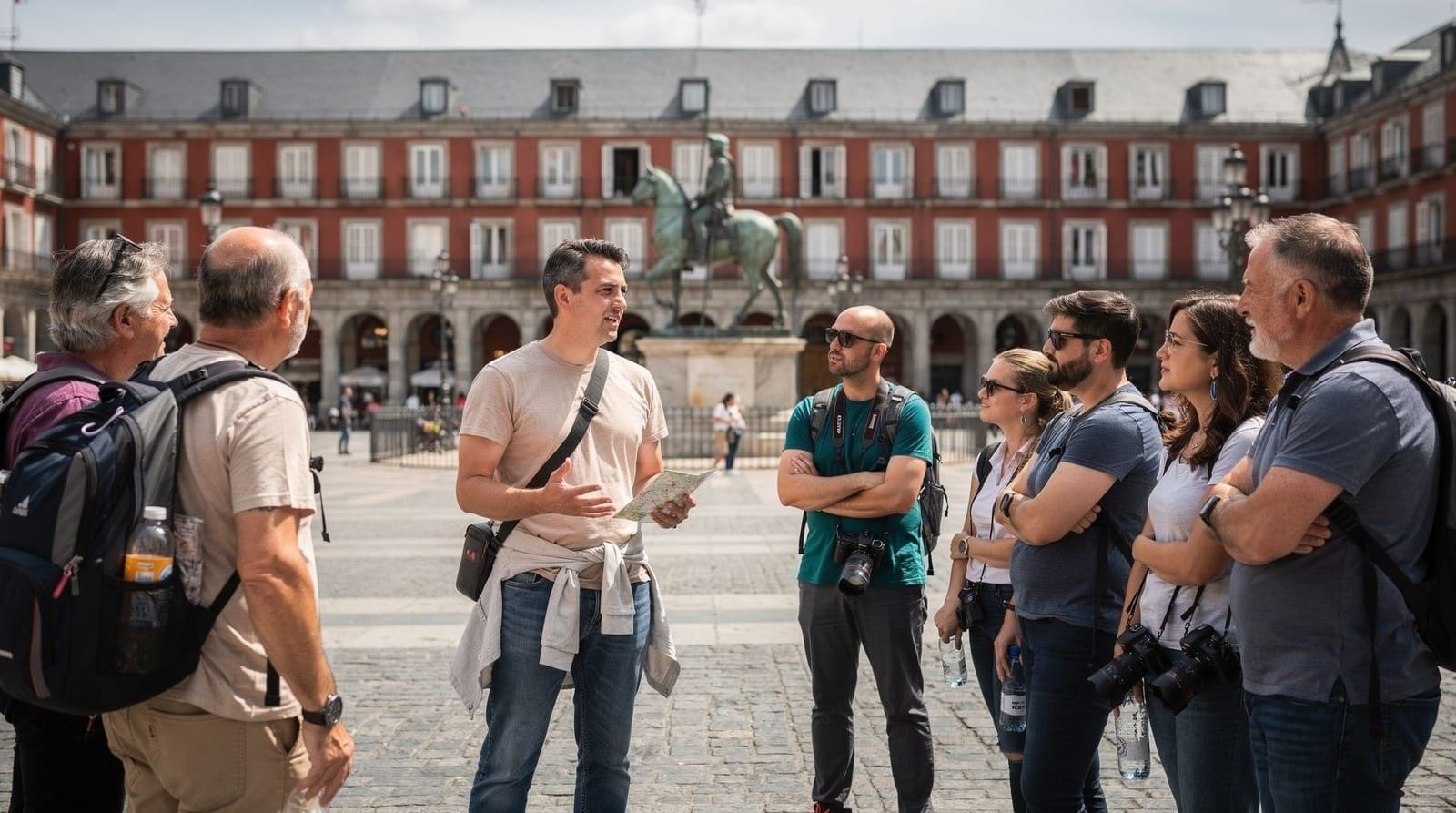
A city-centre pairing. If the cable car is only one stop on a longer visit, pair it with the old centre on another half-day. A short, guided introduction suits restless children better than a long museum slog, and a guided walk through the old town gives a parent the context for the Royal Palace area and the Plaza Mayor without having to read signs aloud. The Royal Palace guide and the Plaza Mayor guide are useful companions if you would rather walk it on your own.
Spreading the days out. Children cope better when a big sightseeing day is followed by a gentle one, and the Teleférico is exactly that kind of gentle day. The 3-day itinerary and the Madrid with family itinerary show where an easy cable car afternoon fits between heavier days, while the how many days in Madrid guide helps you decide whether you have room for it at all.
Getting there and back with children
The Metro is the simplest way to reach the Parque del Oeste end, and the getting around by Metro guide explains how to move a family through the network without stress. Families staying in the centre often find that the walk to the station is part of the fun, especially if it passes through the park. After the crossing, remember that the way home is a separate decision: you can ride the cable car back, or leave through the Casa de Campo side if you have spent the day there. Agree on the plan with older children before boarding so nobody is surprised at the far end.
When the weather or the mood turns
Children are unpredictable, and a good family plan allows for a change of heart. If the cable car is closed or a child refuses to board, there are easy alternatives close by. The Faro de Moncloa offers a different view, and the Temple of Debod is a short walk away and costs nothing to look at from the outside. On a day that has turned grey, a museum visit keeps everyone dry: a day tour that includes the Prado and the Royal Palace suits families with older children who can sustain a longer outing, while the rainy day with kids guide lists lighter options for younger ones. The blog post on rainy day Madrid with kids adds more ideas, and the Madrid with toddlers article is worth a look if your youngest is under four.
Top experiences
Bookable activities with verified prices and instant confirmation on GetYourGuide.