Faro de Moncloa: Madrid's 360-degree panoramic viewpoint
Madrid: Royal Palace Entry Small Group
Is the Faro de Moncloa worth visiting and how much does it cost?
Yes. The Faro de Moncloa is a 110-metre telecommunications tower with a public observation deck at 92 metres. Entry is €4 (reduced €2 or €1). The 360-degree view covers the full Madrid skyline, the Sierra de Guadarrama mountains, and the Manzanares valley. Open Tuesday to Sunday, 9:30–20:00; the viewpoint closes in bad weather. One of the best-value views in Madrid.
In brief: The Faro de Moncloa is a 110-metre observation tower at the Moncloa interchange, open Tuesday to Sunday, 9:30–20:00 (€4). The 360-degree view — mountains, skyline, and Manzanares valley — is one of Madrid’s best panoramas. Closed in bad weather; verify hours before visiting.
| Where | Av. de la Memoria 2, Moncloa (Metro Line 6) |
| Cost | €4 (reduced €2 / €1) |
| Time needed | 45 minutes |
| Open | Tuesday–Sunday, 9:30–20:00 (last ascent 19:30); closed Mondays |
| Best for | Clear winter/spring mornings, mountain views |
Madrid’s underrated viewpoint
The Faro de Moncloa (Moncloa Lighthouse) is a telecommunications tower built in 1992 for the Universal Exposition and later equipped with a public observation deck. It stands at 110 metres — the observation deck is at 92 metres — on high ground at the northern edge of the Moncloa district, northwest of the city centre.
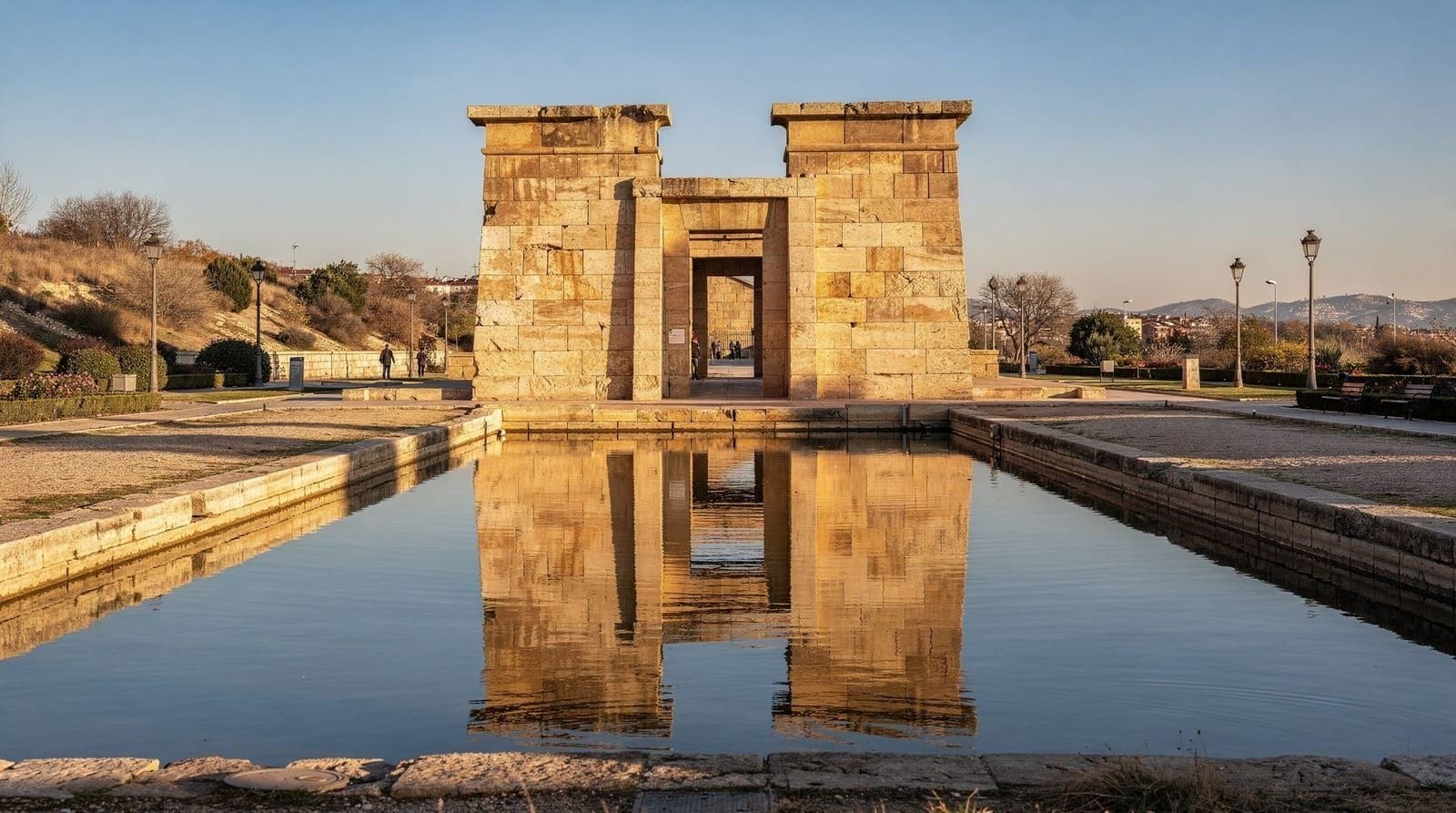
Unlike Madrid’s other viewpoints (the Temple of Debod at 650m altitude, the Círculo de Bellas Artes rooftop at about 30m), the Faro’s combination of height and elevated ground gives it one of the widest sightlines in the city. On a clear winter or spring morning, the Sierra de Guadarrama mountains — visible from many points in Madrid — appear dramatically close, their snowfields white against the blue sky.
The observation deck is small and capacity is limited, which keeps it from becoming overwhelmed. It is also largely absent from the main tourist itineraries, meaning the crowds here are far lighter than at the Retiro, Sol, or the Prado.
Because so few visiting guidebooks mention the Faro, most people who reach the observation deck are locals — families, joggers taking a break, older Madrileños who remember it from before the Cuatro Torres skyline existed. This gives the visit a genuinely local feel that is increasingly rare among Madrid’s viewpoints, and it is one of the few places in the city where you can watch the Sierra de Guadarrama and the Madrid skyline in the same unhurried glance without competing for space at the railing.
What you see from 92 metres
The observation deck has no obstructions — the platform wraps around the tower with 360 degrees of visibility. The key sightlines:
Northwest (best view): The Sierra de Guadarrama fills the horizon. The closest peaks are the Puerto de Navacerrada pass and the Siete Picos (Seven Peaks) range, about 50 km away. In winter and spring when snow-capped, this view is the primary reason to visit. The Sierra de Guadarrama day guide covers the accessible peaks for day visitors.
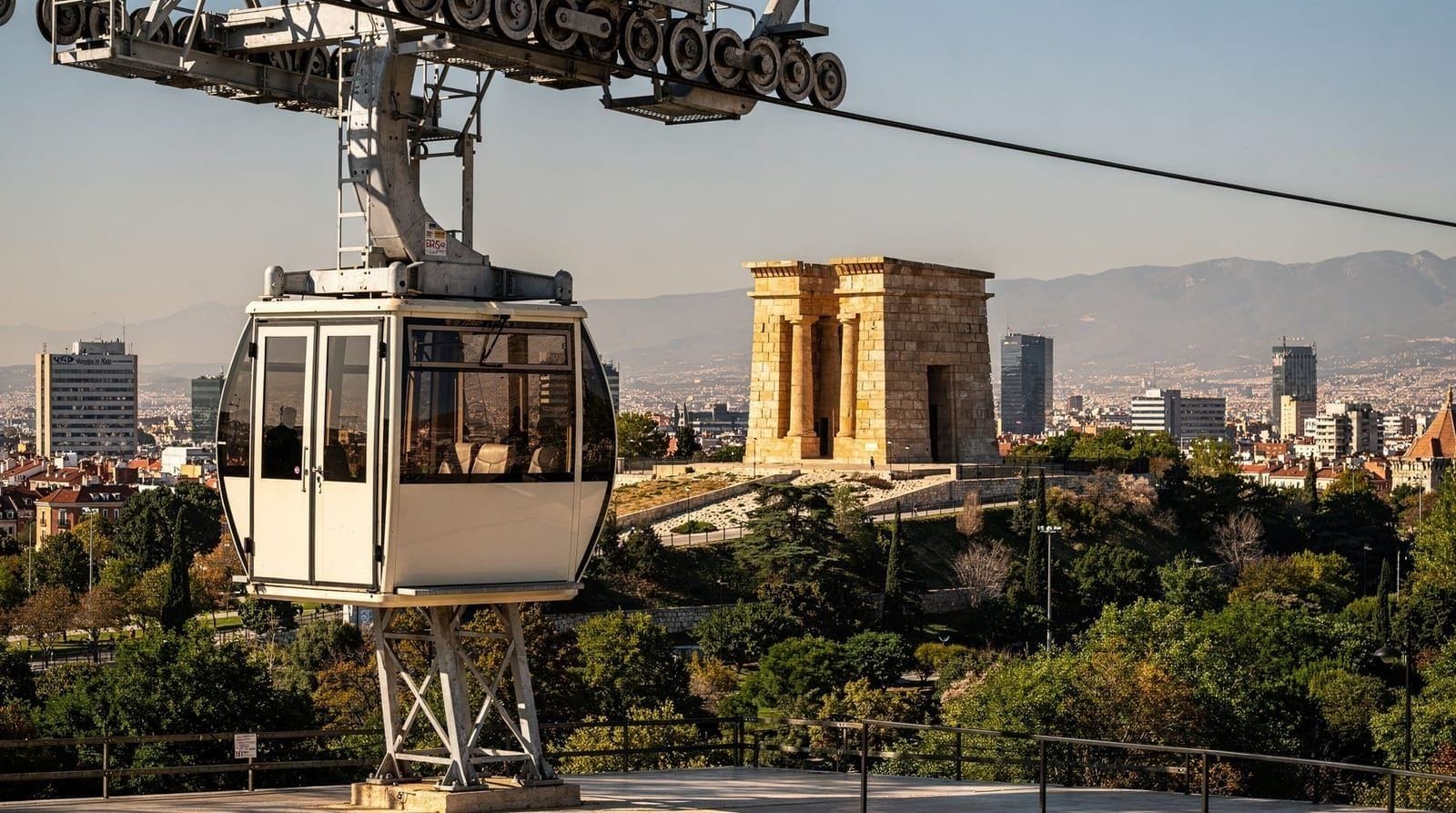
West: The Casa de Campo forest extends to the Manzanares valley; the Teleférico de Madrid cable car line crosses the valley (the cable car is closed for a full refurbishment, reopening expected in the first quarter of 2027 according to EMT Madrid). Beyond the Casa de Campo, more sierra ridges.
Southeast: The Madrid city centre skyline — the Royal Palace dome and the Almudena Cathedral are identifiable to the southeast. Closer, the University Campus buildings.
East and northeast: The main Madrid skyline with the Cuatro Torres business district skyscrapers (between 225m and 250m tall) visible in the distance. On very clear days, the Alcalá de Henares plain extends toward the horizon.
South: The valley of the Manzanares and the suburban spread of southwestern Madrid.
When to visit
Winter (December–February): The best mountain views, with snow visible on the peaks. Cold and clear is the ideal combination. Check the official hours before you go, especially around Christmas and New Year.
Spring (March–May): Second best for mountain views. Mountains still snow-capped into April; air clarity improving after winter. Most pleasant temperatures.
Summer (June–August): Heat haze reduces mountain visibility significantly. The view is still worthwhile for the city panorama; the mountains may be indistinct. Wait for a clear morning if the mountains matter to you.
Autumn (September–November): Mountain snow returns from November; October can be excellent for clarity. Autumn light (lower angle) can make the city skyline more dramatic than summer.
Practical details
Address: Av. de la Memoria 2, 28040 Madrid. Adjacent to the Moncloa transport interchange.
Metro: Moncloa (Line 6), exit toward Moncloa interchange — the tower is visible from the plaza. 3-minute walk.
Bus: The Moncloa interchange is the hub for buses to the university campus, Pozuelo, and the Sierra mountains (buses to El Escorial and Navacerrada depart from here). It is one of Madrid’s major transport nodes.
Tickets: Tickets are for a set time slot; buy them in the entrance lobby or online through the Madrid Destino ticket shop. Waits are typically short except on clear-day winter weekends when the mountain view draws more visitors.
Photography: Good opportunities at any time. Bring a polarising filter in summer to reduce haze. Wide-angle or moderate telephoto lenses are most useful; a long telephoto can isolate the mountain peaks.
Weather closures: The viewpoint can close in adverse weather. If the weather is marginal, check the official Madrid City Council page or the ticket shop before you go.
Combining the Faro with Moncloa area
The Moncloa district is Madrid’s university quarter — the Ciudad Universitaria campus extends northwest from the tower. On weekdays, the area is full of students; on weekends, families use the surrounding parks.
Parque del Oeste: Walking south from Moncloa takes you through the Parque del Oeste, one of Madrid’s most pleasant green spaces (English-style garden, rose garden). The Temple of Debod is at the southern edge of the park, 20 minutes on foot from the Faro.
A practical afternoon: Faro de Moncloa (€4, 45 minutes) → Parque del Oeste walk south (20 minutes) → Temple of Debod sunset (free). This is an inexpensive afternoon with genuinely excellent views from two different vantage points and a pleasant park walk connecting them.
The free things to do in Madrid guide includes the Temple of Debod among the best free viewpoints in the city.
Why it’s undervisited
The Faro is absent from most Madrid travel guides and tour itineraries because it requires a specific metro journey to an area (Moncloa) that is not otherwise on the tourist circuit. For visitors staying near Sol or the Prado, the logical priorities are the Golden Triangle museums and the Royal Palace; adding a Moncloa trip requires planning an additional half-day.
For visitors with more than 3 days in Madrid — or those planning a Madrid 4–5 day itinerary — the Faro is an excellent addition to a morning that continues into the Sierra day trip network. Buses to Navacerrada for mountain hiking depart from the adjacent Moncloa interchange, making the Faro a logical stop before or after a sierra day trip.
The Moncloa interchange: Madrid’s gateway to the Sierra
The Faro stands immediately adjacent to the Moncloa transport interchange — one of Madrid’s largest bus terminals and a metro hub (Line 6). This location is significant for anyone planning excursions into the Sierra de Guadarrama:
Buses to El Escorial: Herranz bus service (lines 661/664) departs from Moncloa approximately every 30–60 minutes; journey time approximately 1 hour. This is the cheapest access to the El Escorial monastery.
Buses to Navacerrada and the mountain passes: Connections to the Navacerrada pass (1,860m), the highest accessible point for day visitors from Madrid by public transport. Walking trails from the pass into the Guadarrama peaks are detailed in the sierra day trip guide.
Buses to Manzanares el Real: Access to the Embalse de Santillana reservoir and the outside of the medieval castle (currently closed to visits).
A visit to the Faro at 10:00 (observe the morning mountain views), followed by a bus from Moncloa at 11:00 to El Escorial or the sierra, is a well-structured morning that combines the urban viewpoint with the sierra landscape.
The Ciudad Universitaria around the Faro
The Moncloa district is Madrid’s university quarter. The Ciudad Universitaria campus — established in the 1920s and significantly rebuilt after the Civil War destroyed much of it — extends northwest from the Faro along the Carretera de La Coruña. The campus buildings include several pieces of significant early 20th-century Spanish architecture: the Facultad de Filosofía y Letras (1933, by Agustín Aguirre), the rectorate building, and the hospital complex.
The campus was the front line during the Siege of Madrid (November 1936 – March 1939) — the Republican and Nationalist forces held the university buildings on opposite sides of the same streets for nearly three years, firing at each other across faculty corridors. Several buildings still show repairs to bullet-damaged facades; the university established a memorial programme to these traces in the 2000s.
For visitors interested in Civil War history and urban archaeology, the Ciudad Universitaria campus offers a half-day walk through the siege geography. The Moncloa neighbourhood walking map connects these sites.
Weather and visibility conditions
The Faro’s utility as a viewpoint is almost entirely dependent on visibility. Madrid’s high-plateau climate (650m) means that the mountains are visible in clear conditions with remarkable frequency — more than 200 days per year by local estimates. The conditions that reduce visibility:
Summer heat haze (June–September): The combination of 35–40°C temperatures and low humidity creates refractive haze that blurs the mountain profiles. The haze is worst in the afternoon; mornings are clearer. On the clearest summer mornings (often after a storm), the mountains can still be sharp.
Inversions (October–March): Madrid occasionally experiences temperature inversions where cold air pools in the Manzanares valley and lower suburbs, visible as a distinct brown-grey layer below the viewpoint. From the Faro, you can look down on the inversion layer with clear mountain views above it — a spectacular effect that is actually best photographed from elevated positions.
Pollution haze: Madrid’s air quality has improved significantly since the 2010s expansion of low-emission zones, but particulate pollution can still reduce visibility on windless days in winter.
The best conditions: the two to three days after a storm front passes through in winter or spring, with a clear north-northwest wind. The mountains appear to be 20km away rather than 50km.
Visiting with a photography focus
For landscape and urban photography specifically:
Mountain telephoto shots: A 200–400mm equivalent focal length isolates the Guadarrama peaks from the Madrid foreground — good for showing Madrid’s unique quality of having alpine-scale mountains visible from the city centre.
City panorama: A 16–35mm wide-angle captures the full city arc from the Cuatro Torres district (northeast) through the historic center to the Casa de Campo and valley (west). For a true panoramic stitch, the observation platform has enough width to take 3–5 frames.
Blue hour: The Faro is open until 20:00 (last ascent 19:30) — which can capture the blue hour in autumn and winter, when sunset is earlier. The combination of lit city below and darkening sky above is the most atmospheric urban photography condition.
The Madrid in winter guide specifically recommends the Faro during the snow season as one of the city’s most atmospheric experiences.
The Faro in Madrid’s viewpoint hierarchy
Madrid has a surprisingly rich set of elevated viewpoints for a city without significant natural topography:
Faro de Moncloa (this guide): 92m observation deck, €4, Tuesday–Sunday. Best for mountain panoramas and full-city orientation.
Círculo de Bellas Artes rooftop (Calle de Alcalá 42): ~30m height, €6, daily. Best for close-up views of Gran Vía architecture and the historic centre. More atmospheric than the Faro for urban photography.
Cibeles Palace Mirador (Cibeles Palace guide): Similar height to the Círculo, €4, Tuesday–Sunday. Best for views down the Calle de Alcalá and the Paseo del Prado.
Temple of Debod viewpoint (Temple of Debod guide): Ground level at elevated position, free, daily. Best for the western horizon and the Royal Palace silhouette at sunset.
NH Collection hotel rooftops and other private venues: Various heights, typically €10–20 for a drink. Variable quality.
The Faro is at the top of this hierarchy for raw height and panoramic reach — it has no equal for the mountain views. The trade-off is the entrance fee and the weather dependency.
The Moncloa area beyond the Faro
The Moncloa district has several other attractions for visitors who have come specifically to this area:
Museo de América (Av. de los Reyes Católicos 6, 10 minutes from the Faro): Spain’s museum of pre-Columbian and colonial Americas — one of the finest such collections in Europe. Free on Sundays, Thursday afternoons from 14:00 and for under-18s and over-65s; general €3. The Quimbaya Treasure (Colombian gold objects, 15th century) is the highlight. Open Tuesday–Saturday 09:30–15:00 (Thursday until 19:00), Sunday 10:00–15:00; closed Monday.
Palacio de la Moncloa: The Spanish Prime Minister’s official residence is adjacent to the Faro area — not publicly accessible, but the exterior is visible from the nearby streets. Security fencing limits approach.
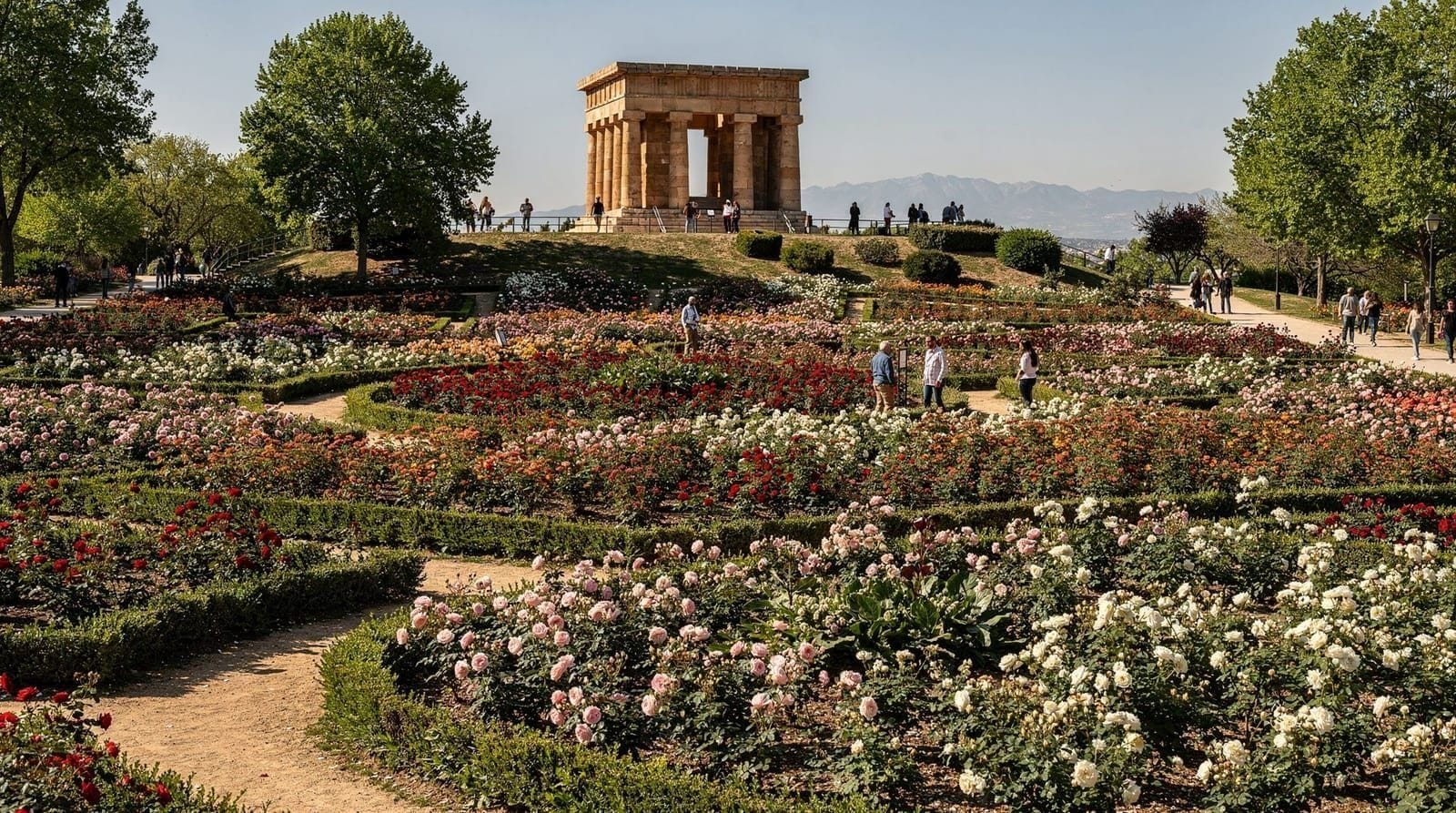
Parque del Oeste rose garden (20 minutes on foot south): The Parque del Oeste contains one of Madrid’s finest rose gardens (Rosaleda del Parque del Oeste), best visited in May–June when the roses are in full bloom. Free; one of the most visited free attractions in the western Madrid parks.
The Parque del Oeste guide covers the full park.
Comparing the Faro with mountain-town viewpoints in the Sierra
For visitors planning a sierra day trip, a comparison: the viewpoint from the Faro looks toward the mountains at approximately 50km distance. From the Navacerrada pass (1,860m), you look back at Madrid in the valley at 650m — the reverse perspective, and quite different in character. The city appears remarkably flat from the mountains; the flatness of the Meseta is only legible from elevation.
These two perspectives — Madrid from the mountains, the mountains from Madrid — complement each other in a way that is worth planning deliberately. The Faro in the morning, a sierra bus from Moncloa at midday, the Navacerrada pass in the afternoon, return by bus: a full day that covers the full visual relationship between Madrid and its surrounding landscape.
Accessibility notes
The Faro de Moncloa is fully accessible by lift. The observation platform is at a standard height for wheelchair users; the entire viewing circuit is accessible. The Moncloa Metro station (Line 6) has lift access.
The bus platforms at the Moncloa interchange are accessible. The combination of the Faro + a Sierra bus trip from Moncloa is feasible for visitors with mobility impairments who might otherwise assume mountain access is unavailable.
How the Faro relates to Madrid’s skyline evolution
When the Faro was built in 1992, it was among Madrid’s tallest structures visible from this direction. The 2008–2012 construction of the Cuatro Torres business district (four towers of 225–250m, about 5km northeast of the Faro) changed the city’s skyline dramatically. From the Faro observation deck, the Cuatro Torres are now the dominant built feature in the northeastern view — a cluster of glass-and-steel towers that Madrid’s tourism literature tends to ignore because they are architecturally unremarkable, but which are genuinely visible landmarks from most elevated positions in the city.
This skyline evolution from a historically low-profile city (most Madrid buildings were 6 storeys until the 1960s) to one with a defined business district is part of what the Faro captures as a viewpoint. Standing at 92m and looking northeast at 250m towers 5km away puts Madrid’s recent growth in literal visual perspective.
Planning a Faro visit
The Faro is closed on Mondays, so check your dates before building it into your plan. The most efficient approach is a morning slot (before 11:00), when both the light and the crowd levels are best, followed directly by the Parque del Oeste walk toward the Temple of Debod described above. This avoids returning to Moncloa a second time and uses the natural downhill gradient from the tower toward the park.
With children: The lift access and short visit duration (45 minutes) make the Faro genuinely manageable with young children, unlike many Madrid viewpoints that involve stairs. Combine it with the nearby Parque del Oeste playground areas for a half-day that mixes a “wow” moment (the view) with unstructured park time. See the Madrid with kids guide for the wider family planning context.
With a sierra day trip: If your itinerary already includes a sierra day trip or a visit to El Escorial, both of which depart by bus from the adjacent Moncloa interchange, the Faro is a natural early-morning addition before catching the bus — you lose no extra travel time since you’re already at Moncloa.
If the Faro is closed or the weather is poor: other ways to see the city
On Mondays, or on a day of bad weather, the Faro will not be open. The view of the skyline does not have to be lost: the Royal Palace dome you pick out from the deck can be seen up close on a Monday, for example with a small-group visit inside the palace, which pairs well with the Faro’s distant perspective.
For an overview from street level rather than from a tower, a panoramic hop-on hop-off bus ride links the main districts and gives a sense of how the areas fit together; our hop-on hop-off verdict explains who it suits. If you would rather see the lit city after dark, an evening panoramic bus tour is a weekday-friendly substitute for the blue-hour view described above.
Frequently asked questions about Faro de Moncloa
What are the Faro de Moncloa opening hours?
The observation deck is open Tuesday to Sunday from 9:30 to 20:00 (last ascent 19:30; ticket office 9:30–19:30) and closed on Mondays, except on certain holidays. On 24 and 31 December it closes at 17:00 (last ascent 16:30); on 25 December and 1 January it opens at 11:00. The viewpoint can close in adverse weather. Check the official Madrid City Council page before your trip.How much does the Faro de Moncloa cost?
General admission is €4. Reduced €2: ages 7–14, over-65s, unemployed people and people with disabilities. Super-reduced €1: children under 7, official tour guides and teachers with school groups. Tickets are for a set time slot and are sold in the entrance lobby or online through the Madrid Destino ticket shop. Lifts take you to the observation level; capacity is limited.What can you see from the Faro de Moncloa?
The observation platform at 92 metres offers unobstructed 360-degree views. Notable sightlines: the Sierra de Guadarrama mountains to the northwest (snow-capped October–May), the full Madrid skyline including the Cuatro Torres business district, the [Royal Palace] and [Almudena Cathedral] to the southeast, and the Casa de Campo forest and Manzanares valley to the south.Where is the Faro de Moncloa and how do I get there?
The tower stands on the Av. de la Memoria, near Plaza de Moncloa. Metro Line 6 (Moncloa), 3-minute walk. The Moncloa transport interchange is adjacent — this is also where buses depart for El Escorial and the Sierra de Guadarrama.Is the Faro de Moncloa better than the Círculo de Bellas Artes rooftop?
They offer different things. The Faro is higher (92m vs roughly 30m) and gives a true panorama including the mountains. The Círculo de Bellas Artes (Calle de Alcalá) offers a closer view of Gran Vía and the historic centre in a more atmospheric setting. The Faro is better for landscape photography; the Círculo is better for the urban architectural experience. The Círculo is open every day.