Cerro Tío Pío: Madrid's park with the city's best free panoramic views
Madrid: Royal Palace Skip the Line Entry Guided
What is Cerro Tío Pío and why do locals go there for sunset?
Cerro Tío Pío is a small hill park in the Vallecas district of southeast Madrid, known among locals for having the best free panoramic views of the city and a much-photographed hilltop swing set. The views from the top stretch across Madrid's skyline — the Cuatro Torres business towers to the north, the Almudena Cathedral and Royal Palace to the west, and the full urban panorama in between. Almost no tourists go here (it is not on the traditional tourist circuit); that is exactly why locals love it. Free, open all hours, 20 minutes from Retiro by Metro.
Madrid’s best view that tourists miss
| Where | Vallecas, southeast Madrid, around 20 min from Retiro by Metro |
| Cost | Free, no gate |
| Time needed | 1–2 hours including the walk up and sunset |
| Getting there | Metro Line 1 to Portazgo or Buenos Aires, then a 15-min walk |
| Best time | 60–90 minutes before sunset, spring or autumn |
There is a hilltop in the Vallecas district where, on a clear evening, you can see virtually the entire Madrid skyline — from the Cuatro Torres skyscrapers in the north to the Almudena Cathedral in the west, the Sierra de Guadarrama mountains behind everything, and the full expanse of the city laid out in between. It is free, it requires no queue, and the crowd consists entirely of local Madrileños rather than tourists. It is called Cerro Tío Pío.
The park’s distinctive feature, beyond the views, is a set of swings at the summit — the famous “swings of Tío Pío” (columpios del Cerro Tío Pío) that, because of the hill’s altitude, give the sensation of swinging out over the Madrid skyline. The image of someone on these swings with the city spread below has been reproduced in enough photographs and travel blog posts that the swings are something of an unofficial Madrid icon among those who know the park. The tourists who queue for Templo de Debod at sunset seem largely unaware that this alternative exists.
The views
From the summit of Cerro Tío Pío (elevation approximately 695 m above sea level — slightly higher than the central city plateau):
North: The Cuatro Torres (Four Towers) business district — Madrid’s skyline of four skyscrapers completed in the early 2010s, between 250–250 m tall. The crystal and steel shapes are the most identifiable element of Madrid’s modern skyline.
Northwest: The Guadarrama mountains, consistently the best element of any Madrid panorama on a clear day. The highest peaks (Peñalara, 2,428 m) are snow-capped October–May.
West: The Royal Palace dome, the Almudena Cathedral tower, the outline of the Parque del Oeste hillside.
Central: The Gran Vía axis visible as a cut through the city fabric, the Retiro park as a green rectangle, the Paseo del Prado corridor.
South and east: The suburban expansion of Madrid into the Vallecas, Moratalaz, and Vicálvaro districts — the working-class and residential Madrid that tourists rarely see.
The view is genuinely panoramic — 360° is possible from the summit with minor movement. The best photography direction is west toward the Royal Palace and mountains in late afternoon and evening light. The sunset itself is behind the Guadarrama from October to February, creating dramatic mountain silhouettes.
The swings
The swing set at the summit is functional and available to use; there is no age restriction, though the sets are designed for adults rather than children (sturdy construction, adult-size seats). Queues form for the most popular swings on good weather evenings — mostly young Madrileños, sometimes couples, occasionally tourists who have specifically sought out this experience.
Using the swings while watching the sun set behind the Guadarrama with the city below is one of those experiences that is genuinely impossible to photograph as well as it actually feels. Worth experiencing rather than just documenting.
Getting to Cerro Tío Pío
Metro: Portazgo or Buenos Aires (Line 1) — walk east and south from either station, approximately 15 minutes to the park.
Alternatively, El Pacífico (Line 1) or Vallecas (Line 1) — the station choices give slightly different approach angles.
From central Madrid: Retiro (Line 2) to Portazgo (Line 1) requires a change at Sol — total journey approximately 20–25 minutes.
Navigation: The park is on the hill visible from the Avenida de la Albufera. The main entrance is from Calle de Peña Gorbea (southern approach) or from Calle Valdebernardo (eastern approach). The summit is visible from below — follow the path uphill.
The neighbourhood: Vallecas
Cerro Tío Pío is in Vallecas, a working-class district of southeast Madrid with a distinct identity within the city. Vallecas is historically associated with Madrid’s industrial and immigrant working class (waves of internal migration from Andalusia and Extremadura in the 20th century, followed by international immigration from Latin America and North Africa).
The neighbourhood has a community character and political culture (historically Republican and left-leaning) that is genuinely different from central Madrid. The bars and restaurants in Vallecas are working-class in price and local in character — tapas with your drink as a matter of course, prices noticeably lower than Malasaña or the Barrio de las Letras.
Combination visit: The most honest version of Vallecas requires accepting that the neighbourhood’s appeal is in its ordinariness — good local bars, the Mercado de Vallecas (neighbourhood market, daily), the view from Cerro Tío Pío, and the sense that you are somewhere genuinely Madrileño. The combination of an afternoon in Vallecas followed by sunset at Cerro Tío Pío is one of the better off-tourist-trail activities available in Madrid.
Sunset at Cerro Tío Pío vs Temple of Debod
The two compete as the best free sunset viewpoints in Madrid. They offer different experiences:
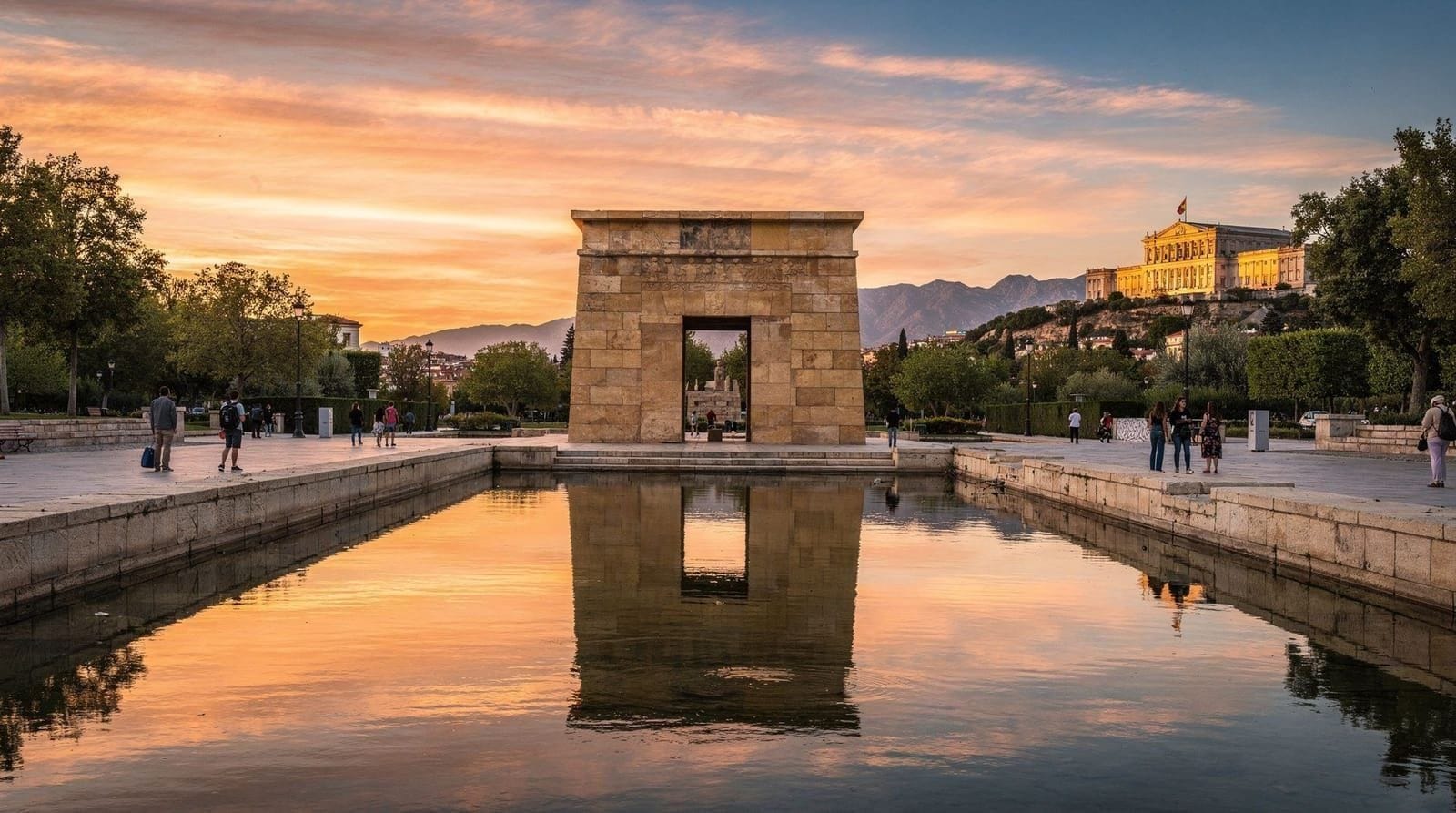
Temple of Debod: Egyptian temple as foreground, Royal Palace visible to the south, closer to the city centre and tourist circuit, more photographed, crowds on popular evenings, better known internationally.
Cerro Tío Pío: 360° panorama, famous swings, genuinely local crowd, further from the centre (20 minutes by Metro), less visible in tourist guides, better mountain views because of the higher elevation and south-facing aspect.
Recommendation: If you are visiting Madrid for 2+ days, do both. If you have time for only one sunset viewpoint, Debod is easier to combine with a central Madrid day; Cerro Tío Pío requires specifically committing to the trip to Vallecas.
Practical information
Entry: Free, open all hours (no gate).
Facilities: The park has basic benches and the swing set; limited other infrastructure. No kiosks or toilets in the park itself — facilities are in the surrounding neighbourhood streets.
Timing: The park is busiest 1–2 hours before sunset in warm months. Early morning is the quiet alternative for running and the views without the social atmosphere.
Weather: The hill is exposed; bring a layer for evenings even in summer, particularly if there is any wind. In winter, the summit can be cold and windy.
Safety: The park is safe during the day and in the evening. The surrounding Vallecas neighbourhood is a normal working residential district — not a tourist area, but not unsafe. The standard Madrid precautions (phone in pocket, bag awareness) apply everywhere.
For the wider context of Madrid’s alternative viewpoints and free activities, see free things to do in Madrid and the overrated and underrated guide.
Eating and drinking in Vallecas
Part of the experience of going to Cerro Tío Pío is the neighbourhood. The bars and restaurants around the park are Vallecas local — not designed for tourists, priced accordingly, and serving the kind of food (heavy traditional Spanish, generous portions, cañas with free tapas as standard) that has become hard to find in gentrified central Madrid.
Recommended approach: Arrive in Vallecas an hour before sunset. Have a beer and tapas at one of the bars along the Avenida de la Albufera or Calle de Peña Gorbea (the main approach streets). Then walk up to the park for the sunset. Return to the neighbourhood for dinner (Spanish eating rhythm — the restaurants fill from 21:00). This is a full evening for €20–30 per person including dinner.
Local bar culture: Vallecas maintains the tradition where the price of a beer (caña, approximately €2–2.50) includes a small tapa — a slice of tortilla, a piece of bread with something on it, or similar. This disappeared from most of central Madrid with the tourist inflation of the 2010s but persists in working-class neighbourhoods like Vallecas.
Photography tips for the panoramic view
The summit of Cerro Tío Pío is one of the better photography viewpoints in Madrid for capturing the full urban panorama. Technical notes:
Equipment: A wide-angle lens (24mm or wider on full-frame) captures the full 360° sweep but requires multiple shots for a panorama. A standard 50mm is better for isolating specific elements (Cuatro Torres, Royal Palace).
Time of day for the best light:
- Sunrise (facing east): catches the low sun on the eastern Madrid suburbs and the city’s main boulevard axis. Few people present.
- Late afternoon (facing west): the Royal Palace and mountains are in the best light from 1–2 hours before sunset. The swings photograph well with the city as background at this hour.
- Blue hour (just after sunset): the city lights come up before the sky goes fully dark, creating the classic cityscape effect.
The swings in photos: Photographing someone on the swings requires either a fast shutter speed (to freeze the motion) or deliberate motion blur (to emphasise movement). The best background angle faces northwest — Royal Palace visible over the left shoulder, city panorama behind.
The wider context: Madrid’s southeast
The Vallecas district and the wider southeast of Madrid is the part of the city that functions as the working-class hinterland — the districts that absorbed waves of internal migration from Andalusia, Extremadura, and Murcia in the 1950s and 1960s, when Madrid’s industrial expansion drew workers from across Spain. The population of Vallecas, Moratalaz, Vicálvaro, and Carabanchel built much of modern Madrid.
This history is visible in the architecture (1950s–70s blocks built quickly for a rapidly growing population), the demographics (an older population in the original immigrant generation, a younger immigrant population from Latin America and Africa in the more recent wave), and in the political culture (Vallecas was strongly Republican before and during the Civil War, and has maintained left-leaning politics since the transition to democracy).
Cerro Tío Pío’s existence as a public park — maintained by the city of Madrid, with the famous swings that have become a neighbourhood symbol — is part of how these districts understand themselves: not tourist destinations, but real parts of a real city, with views that are better than anything in the tourist circuit.
Cerro Tío Pío in a Madrid itinerary
The park works as a specific evening destination rather than a midday stop. Suggested combinations:
- Afternoon in Lavapiés (street art, alternative culture) followed by Metro to Vallecas for Cerro Tío Pío sunset — the combination covers two non-tourist Madrid areas in one afternoon/evening
- Rastro Sunday: El Rastro flea market (morning, Embajadores area) → Lunch in Lavapiés → Afternoon in Vallecas → Cerro Tío Pío for late afternoon views → dinner back in Lavapiés
- Running day: Morning run at Retiro Park, afternoon at Cerro Tío Pío for the view and the swings, dinner in Vallecas
See Madrid on a budget for a full free-and-cheap day combining the park with other no-cost Madrid experiences.
The swings: history and what to expect
The swings (columpios) at Cerro Tío Pío are part of the park’s standard municipal playground infrastructure — they were not installed as a tourist attraction or a scenic enhancement. They are simply adult-scale swings that happen to be at the summit of a hill with an extraordinary view, which is what makes them significant.
The combination means that swinging produces the sensation of floating above the Madrid skyline. The highest point of the swing arc puts you several metres above the hilltop, with the city spread below in every direction. The sensation is immediately childlike — purely physical, impossible to overthink — and also genuinely spectacular.
Queues: On popular sunset evenings (weekends, spring and autumn), there can be a wait of 10–20 minutes for the most popular swings. The atmosphere is social and generally good-natured — predominantly young Madrileños, some couples, occasional tourists who have discovered the spot. People are generally courteous about the queue, though it is informal rather than organised.
Who uses them: The swings are used by a wide age range — teenagers, twentysomethings, couples in their 30s–40s. Less so by older adults, but there is no rule. Children are also present, though the adult-scale equipment is sized for grown-ups.
Other alternative viewpoints if you want more
Cerro Tío Pío is the best-known local alternative to Temple of Debod, but Madrid has a handful of other elevated spots worth knowing about if you want to build a small viewpoint circuit during your stay:
Faro de Moncloa: A paid observation tower (around €4) in the west of the city with a 92-metre elevator ride to a 360° enclosed viewing platform — the most reliable option in bad weather since it’s indoor and glass-enclosed, unlike the exposed hilltop at Cerro Tío Pío. See the Faro de Moncloa guide.
Círculo de Bellas Artes rooftop: A paid rooftop terrace (around €6) in the city centre near Gran Vía, popular for sunset cocktails with a more polished, tourist-oriented atmosphere than Cerro Tío Pío’s local feel.
Mirador de Madrid at the Cibeles Palace: The cheapest indoor viewpoint in the centre, around €4, looking directly down Calle de Alcalá toward Gran Vía. See the Cibeles Palace guide.
Temple of Debod: The classic free sunset spot, already compared above — closer to the centre, more crowded, more photographed.
How they compare: Cerro Tío Pío remains the only one of these that is both free and offers a genuine 360° open-air panorama with no entry gate or opening hours to work around — the trade-off is the extra travel time to Vallecas. If you have three or more days in Madrid, doing both Cerro Tío Pío and one paid viewpoint gives a useful contrast between the local and the polished tourist experience.
Getting the most from the visit
Arrive early in the golden hour: The light 60–90 minutes before sunset is the best for both viewing and photography. At this time the city is visible in good detail, the sun is at an angle that gives depth to the urban landscape, and the swings are accessible without a long wait.
Bring a picnic: There are no food vendors in the park. Bringing food from a local shop or bakery in Vallecas (before you ascend) means you can sit on the hilltop benches and eat while watching the light change. This is the most relaxed way to experience the view.
Stay after sunset: In the 20–30 minutes after the sun disappears, the city lights come up and the sky transitions through a range of colours. The Cuatro Torres buildings are particularly good in this post-sunset blue hour. Most people leave at sunset; staying longer means less crowded access to the swings.
Combine with the neighbourhood: The most satisfying visit pairs the sunset with a walk through Vallecas — either before (afternoon in the neighbourhood, then ascend for sunset) or after (descend and eat dinner in the neighbourhood). This makes the trip to Vallecas a full evening rather than a single activity.
What locals know about Cerro Tío Pío
The park’s official name is Parque de las Siete Tetas (Park of the Seven Breasts) — a reference to the seven rounded hilltops visible from the area, though the park itself is on one of them. The folk name “Cerro Tío Pío” (Uncle Pio’s Hill) is older and more commonly used. The origin of the name is disputed: it may refer to a person named Pío who owned land nearby, or to an older territorial marker. The official and popular names coexist without confusion for residents.
The view is genuinely a local secret in the sense that it is not featured in major international travel guides, not included in standard “what to see in Madrid” itineraries, and not mentioned in most hotel concierge recommendations. It circulates through word of mouth among visitors who ask Madrileños what they actually do rather than what tourists are supposed to do.
This is, of course, changing — the swings photograph well and social media distribution has increased its visibility significantly over the past 5 years. But the essential character remains local; the fundamental experience of watching the sun set over Madrid from a Vallecas hilltop with a beer in hand is not compromised by the presence of more visitors who also know about it.
Pairing the hilltop with a day in the centre
Because the trip out to Vallecas is best kept for the evening, the daytime is free for the big central sights. The view from the hill makes more sense once you have walked through what you can see from it: the Royal Palace and the Almudena Cathedral on the western skyline, the green rectangle of Retiro, the Gran Vía axis. A morning at the Royal Palace is easier with a guided Royal Palace visit with skip-the-line entry, and the Almudena Cathedral sits right next door. Then you spot both from the summit that evening, which is a satisfying way to close the loop.
Art lovers can do the same with the Golden Triangle art walk by day and the hill at dusk; the Prado Museum guide helps plan the museum half. If you would rather have someone shape the day around your pace, a half-day local-led tour of the Royal Palace and Retiro fits neatly before an evening in Vallecas.
A few more guides help you build the surrounding plan:
- Getting around by Metro explains the lines you will use to reach Vallecas and get back.
- Madrid at night covers what to do once you come down from the hill.
- Madrid in spring and Madrid in autumn cover the seasons when the evening light and air are at their best.
- The one-day itinerary and the three-day itinerary show where a sunset on the hill can slot in.
- Sorolla Museum and Temple of Debod are good daytime companions if you want a calmer, smaller-scale stop earlier on.
Frequently asked questions about Cerro Tío Pío
Is Cerro Tío Pío suitable for young children?
The park itself is safe and open, but the swings are adult-sized rather than designed for small children, and the hilltop paths have some uneven ground. Older children who can handle a moderate walk and a busy adult swing set will enjoy it; for toddlers, the flat lake circuit at Casa de Campo or Retiro Park is a gentler choice.What's the best time of year to visit Cerro Tío Pío?
Spring and autumn evenings give the clearest air and the most comfortable temperatures for the walk up. Summer sunsets are popular and crowded around the swings; winter visits are quieter and colder, with the exposed summit needing a proper layer even if the city below feels mild.