Street art in Lavapiés: Madrid's most creative neighbourhood
Madrid: Welcome Guided Walking
Is Lavapiés worth visiting for street art and what else does the neighbourhood offer?
Yes. Lavapiés is Madrid's most multicultural neighbourhood and has the highest concentration of murals, paste-ups, and commissioned street art in the city. Beyond the art, it has some of Madrid's most interesting independent bars, alternative theatres, and a street-level energy distinct from the tourist core. It's most rewarding explored on foot for 2–3 hours, starting at Plaza de Lavapiés and working through the side streets toward Calle Embajadores. Free, no entry required.
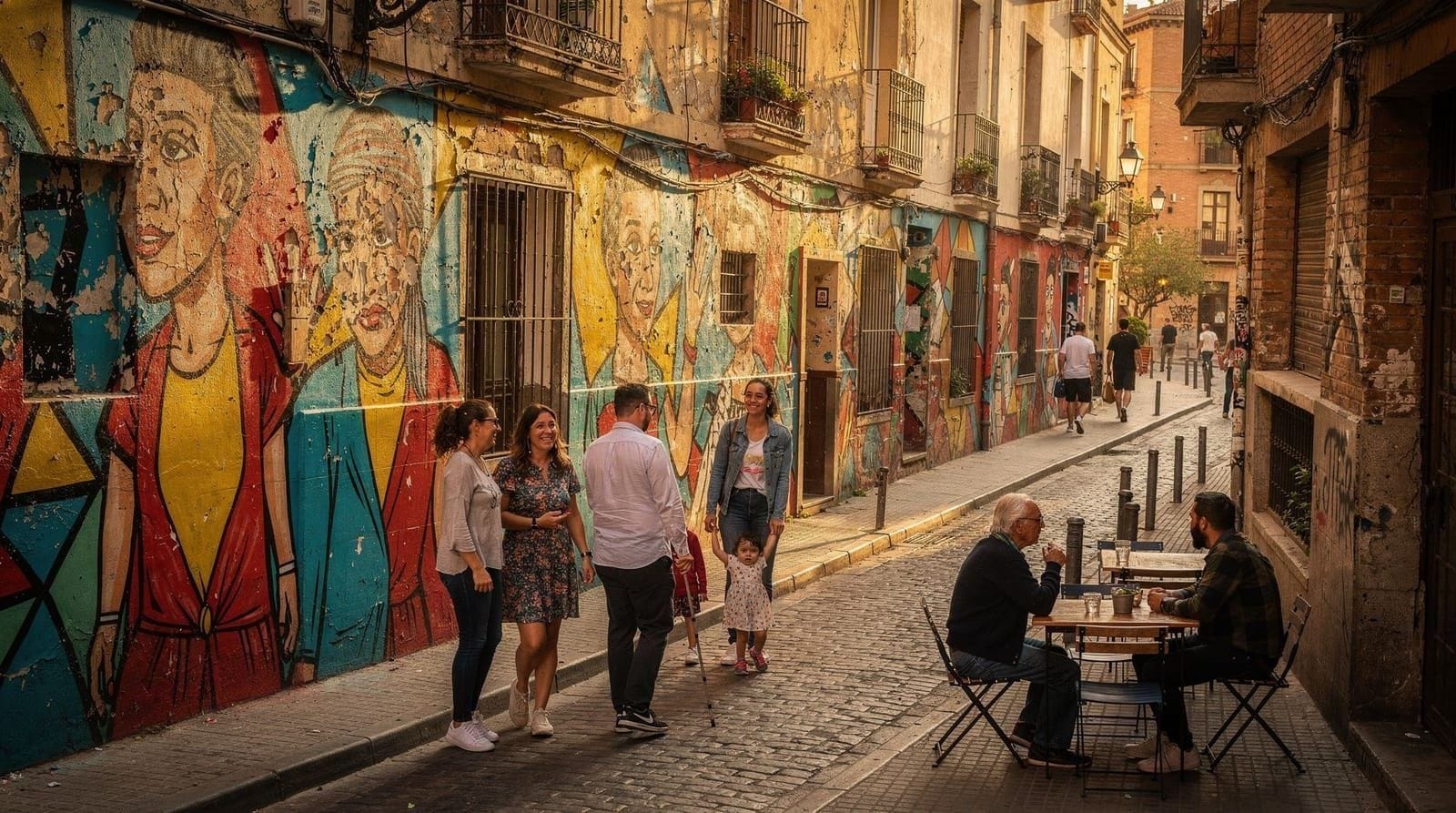
Lavapiés rewards visitors who walk slowly and look up. Nothing about the murals is signposted or curated for tourists — this is a working neighbourhood where art appears on the walls it can find, and the best way to see it is on foot, with no fixed route required.
| Where | Lavapiés, south of Sol, around Plaza de Lavapiés |
| Cost | Free — no tickets, no timed entry |
| Time needed | 2–3 hours on foot |
| Getting there | Metro Lavapiés (Line 3) |
| Best time | Weekday mornings for photography; avoid El Rastro peak (Sun 11:00–14:00) if you want quiet streets |
Why Lavapiés became Madrid’s street art centre
Lavapiés did not become Madrid’s street art capital by design. It became it because it was the neighbourhood where the conditions were right: cheap rents for artists, landlords less likely to immediately paint over murals, a politically active community that valued public art, and a long tradition of alternative culture and immigration that made visual experimentation culturally acceptable.
The neighbourhood has been Madrid’s primary immigrant quarter for over a century — Moroccan, Chinese, Pakistani, Bengali, Senegalese, Central African, South American communities established alongside old Castilian families and a wave of artists and young Madrileños priced out of Malasaña and Chueca. The result is a neighbourhood that looks and feels unlike any other in Madrid — dense, layered, occasionally chaotic, and full of colour.
The street art reflects this. Much of it is explicitly political — anti-gentrification, anti-racism, feminist — but there is also purely aesthetic work from both Spanish artists and international figures who have made a point of painting in Lavapiés because of its reputation.
The key streets and locations
Plaza de Lavapiés
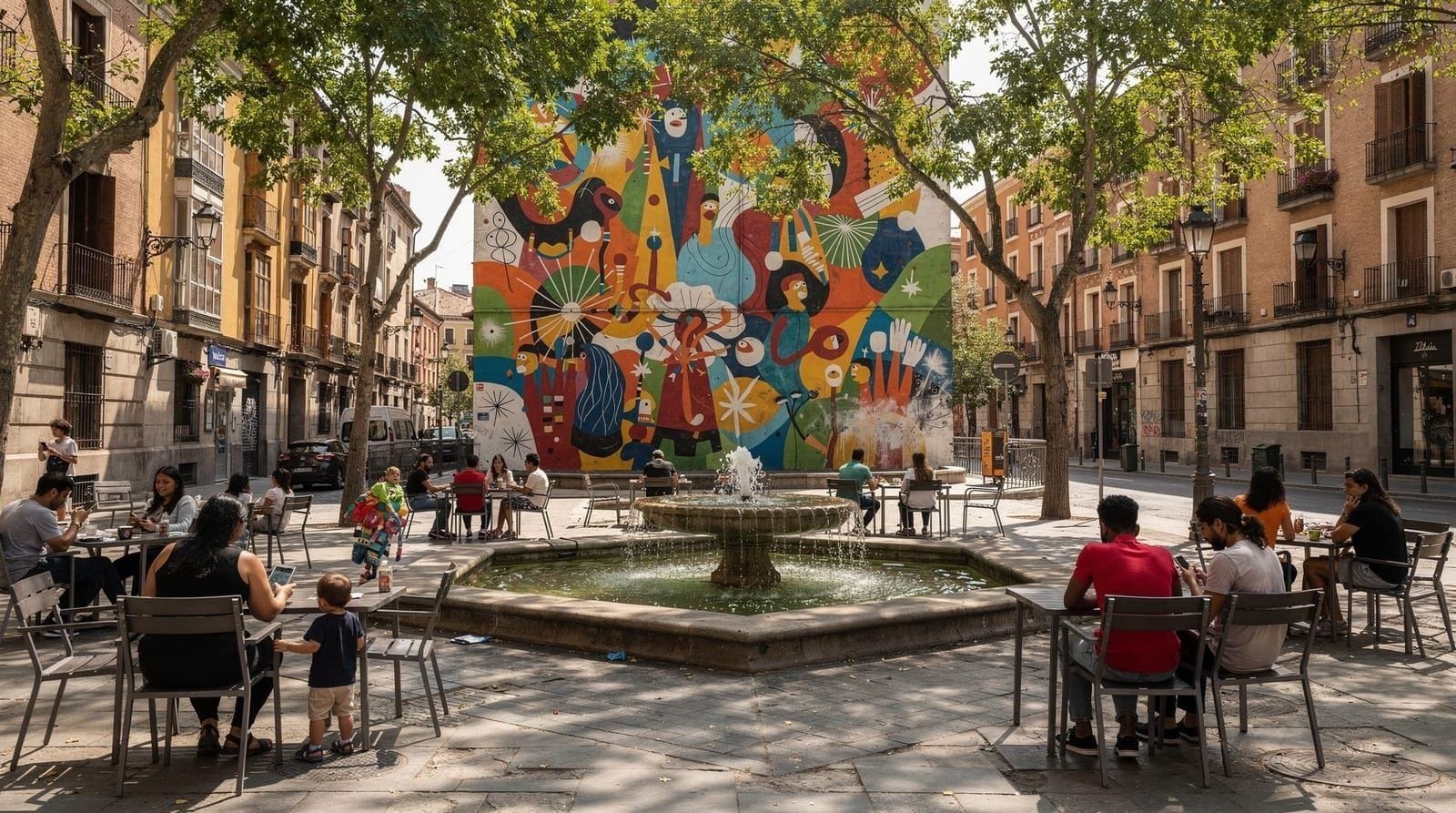
The neighbourhood’s central square — a slightly scruffy, sloping plaza where old men play cards, young people sit on the steps, and children cycle around the fountain. The facades surrounding the plaza have murals, political posters, and paste-ups in various states of layered accumulation. This is the starting point for any street art walk.
The Centro de Arte Dramático (CDNM) building on the south side of the plaza was redecorated after renovation — its exterior walls have hosted large-format commissions.
Calle de Lavapiés and its side streets
Walking south from the plaza, the narrow streets between Lavapiés and Calle Embajadores contain the highest density of work. Key alleys: Calle del Olivar, Calle de Zurita, Calle de Argumosa. The work changes frequently — paste-ups fade, new pieces go up, landlords occasionally whitewash. This is the nature of street art as a living medium.
Calle de Embajadores and surroundings
The long Calle de Embajadores, running diagonally through the neighbourhood, has large-format murals on several building facades. This is one of the main pedestrian arteries and the murals here tend to be more official commissions (permitted by building owners) and therefore more stable than the spontaneous work in smaller streets.
La Tabacalera
The former Royal Tobacco Factory (Calle de Embajadores 53) is now a cultural centre managed partly by the Ministry of Culture and partly by a network of collectives and local associations. The exterior walls are one of the most important legal mural sites in Madrid — regularly updated, high quality, large format. The interior courtyard is open to the public and hosts markets, cultural events, and exhibitions. Worth visiting even if street art is only a secondary interest.
Calle de la Cabeza and the El Rastro perimeter
The area around the El Rastro flea market (which occupies the streets around Calle de la Ribera de Curtidores on Sunday mornings) has a secondary concentration of street art — the walls of the market infrastructure and adjacent buildings accumulate work year-round.
Organised and commissioned murals
Some of the most technically impressive work in Lavapiés is commissioned rather than guerrilla:
Muros Tabacalera — A series of large-scale mural commissions facilitated by La Tabacalera in collaboration with the Ministry of Culture, bringing international artists to paint the factory’s exterior. Several of these are permanent or semi-permanent (refreshed every 2–3 years).
Festival Boa Mistura — The Madrid-based collective Boa Mistura has created multiple works in Lavapiés, including pieces that play with perspective on narrow streets — the works are designed to read correctly only from a specific vantage point, which you discover by moving through the street.
El Frente (The Front) — Several building facades in the area around Calle de Mesón de Paredes were painted as a coordinated neighbourhood mural project; look for large-format political and social-realist imagery on the end walls of apartment blocks.
Street art vs Malasaña
Visitors sometimes compare Lavapiés with Malasaña as alternative-culture neighbourhoods. The differences are significant:
Malasaña street art: more concentrated in specific streets (Calle del Pez, Espíritu Santo, Corredera Baja de San Pablo), more deliberately aesthetic and design-oriented, with a stronger gallery-to-street pipeline — many Malasaña murals are by artists with gallery representation. The neighbourhood’s gentrification is more advanced, which means fewer spontaneous pieces and more commissioned works.
Lavapiés street art: denser, more politically charged, more multicultural in its references, and more likely to include genuinely unsanctioned work alongside commissions. The pace of change is faster; a wall photographed in 2023 may look entirely different in 2026.
If you can only choose one for street art, Lavapiés is the richer concentration. But an afternoon that covers parts of both neighbourhoods (they are adjacent via the Lavapies-Tirso de Molina corridor) is the most rewarding option.
The neighbourhood context: what else Lavapiés offers
Street art is not the only reason to be in Lavapiés. The neighbourhood has a cultural density that rewards slower exploration:
Alternative theatre: The Teatro del Barrio (Calle Zurita 20) — founded in 2014 by actor Juan Diego Botto — stages politically engaged productions in Spanish. Teatro Valle-Inclán (part of the Centro Dramático Nacional on Plaza de Lavapiés) programmes more institutional but still adventurous theatre.
Food: The neighbourhood’s population diversity shows in the food options. Pakistani restaurants on Calle de Lavapiés. Senegalese and West African food around Plaza de Agustín Lara. Chinese restaurants that cater to Chinese residents rather than the tourist Chinatown stereotype. Some of Madrid’s best cheap eating is in Lavapiés.
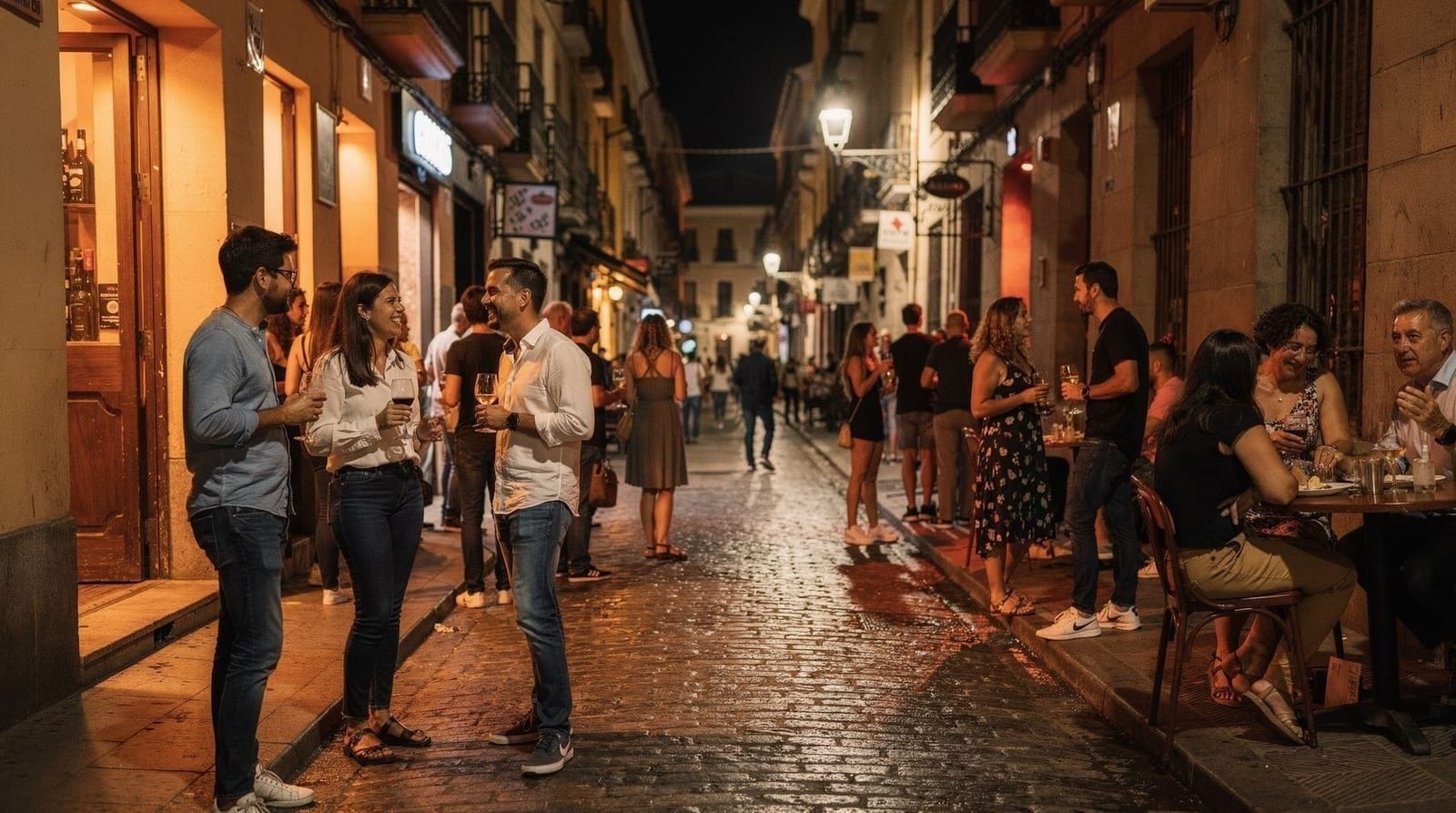
Bars: La Musa de Espronceda (Calle de Argumosa), Taberna de Antonio Sánchez (Calle de Mesón de Paredes 13 — reportedly the oldest bar in Madrid, operating since 1830, with original fittings), El Calandrio (terrace bar on Calle de Argumosa). The Argumosa terrace strip is popular in warm months.
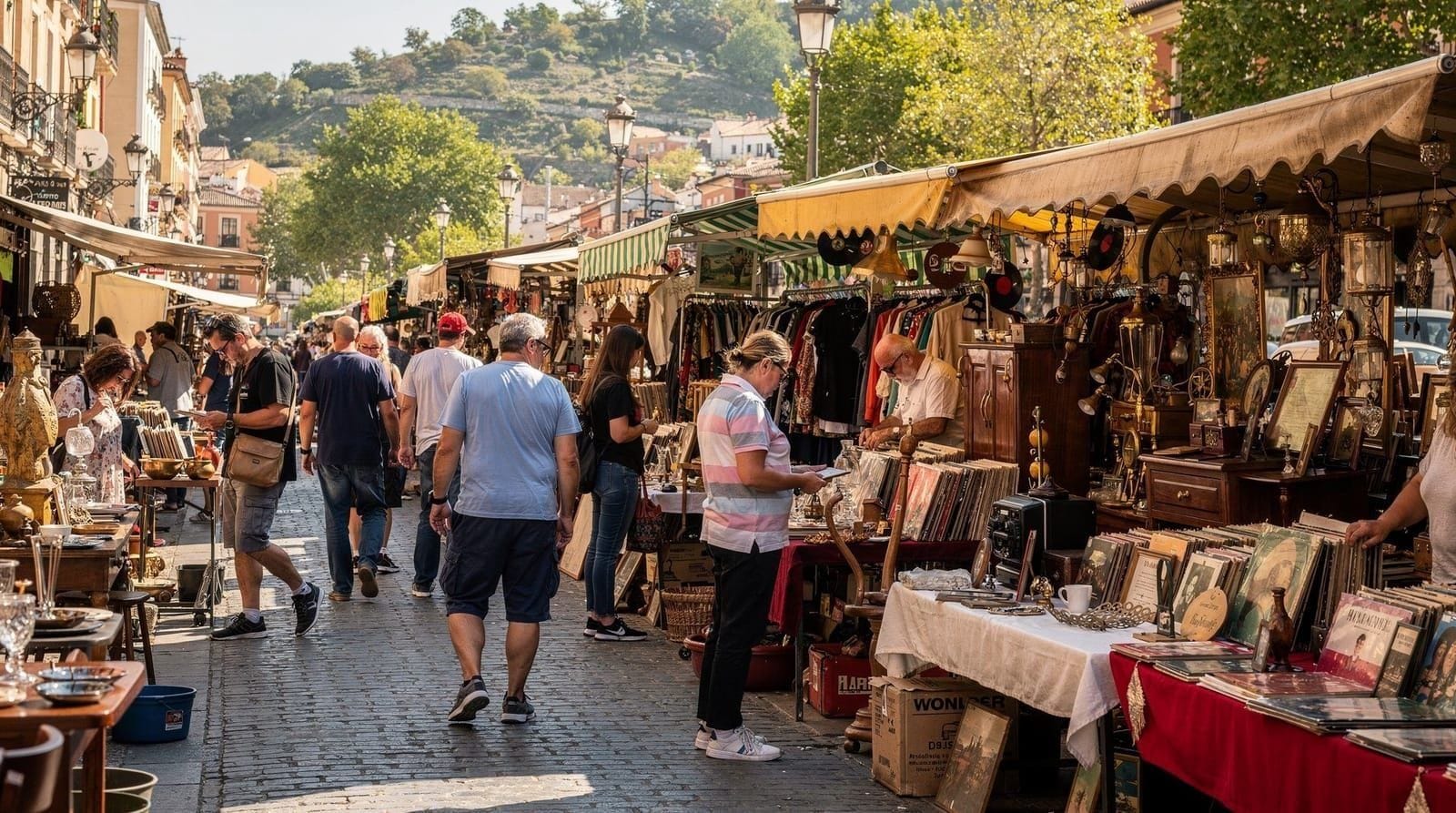
El Rastro: Every Sunday morning (09:00–15:00), the neighbourhood extends south into the open-air flea market — 3,500+ stalls selling antiques, clothing, books, art, and assorted objects. One of Madrid’s great free experiences. Pickpocket risk is real; keep valuables secure.
See the Lavapiés neighbourhood guide for a broader neighbourhood overview.
Walking the street art: a practical route
Duration: 2–3 hours on foot, mostly steep streets
Start: Metro Lavapiés (Line 3)
- Plaza de Lavapiés — photograph the facades, note the political posters layered over years
- Calle del Olivar heading south — murals on left-hand walls particularly
- Left onto Calle de Zurita — check Teatro del Barrio facade and surrounding walls
- Continue to Calle de Argumosa — the pedestrianized bar street, then turn onto smaller side streets south
- La Tabacalera (Calle Embajadores 53) — the main mural site; enter the courtyard if open
- Walk north along Calle de Embajadores — large-format commissioned murals on building ends
- Loop back through Calle de Mesón de Paredes — Taberna de Antonio Sánchez for a mid-walk drink
- Return to Plaza de Lavapiés
Best time: Weekday mornings are quietest for photography. Weekends are livelier but the El Rastro crowds (Sunday) make street navigation difficult before 15:00.
Connecting Lavapiés to the broader Madrid visit
Lavapiés sits between La Latina (north and west — the historic Austrias quarter and medieval streets) and the Barrio de las Letras (east — the literary quarter around Cervantes). A half-day that moves through Lavapiés and into the literary quarter covers the cultural extremes of Madrid’s alternative and classical traditions.
The Reina Sofía museum — 10 minutes walk east from Plaza de Lavapiés — is the institutional counterpart to the neighbourhood’s street art: both engage with questions of politics, identity, and artistic expression that have been central to Spanish culture since at least the Civil War. Combining a morning in Lavapiés with an afternoon at the Reina Sofía (Guernica, the documentary photography rooms, the Civil War material) creates an unusually coherent cultural day.
For the broader context of alternative Madrid neighbourhoods, see the Malasaña guide and the Chueca guide.
Street art and gentrification
Lavapiés is in an ongoing tension between its role as Madrid’s most affordable creative neighbourhood and the gentrification that creative neighbourhoods tend to attract. Property prices in Lavapiés have risen substantially since 2012; the neighbourhood’s reputation as a street art destination and alternative culture hub has made it visible to tourists and young professionals who push up rents and gradually price out the artists and immigrant communities that created the culture in the first place.
This process is slower in Lavapiés than in Malasaña or Chueca, partly because of the neighbourhood’s size and population density, and partly because its specific character — genuinely multicultural, politically engaged, with a strong community identity — creates more resistance to homogenization than most neighbourhoods. But it is happening.
The street art itself reflects this tension. Some of the most politically charged murals deal explicitly with gentrification and displacement — the irony of anti-gentrification murals becoming tourist attractions is not lost on the artists who create them.
Photography in Lavapiés
Street art photography in Lavapiés requires some navigation:
Best light: The narrow streets mean direct sunlight is limited; the best light for photographing murals is either indirect (overcast days) or the specific 20–30 minute windows when direct sun enters a particular street. Late afternoon (16:00–18:00) catches the sun in west-facing alleys.
Composition challenges: The proximity of parked cars, waste bins, and other street furniture to the murals means clean compositions require patience and positioning. The large La Tabacalera murals are the easiest to photograph cleanly — they are on exterior walls with more space.
Legal note: Street art photography for personal use is unrestricted. Commercial photography of street art has copyright implications depending on the specific work and the visibility of the piece — a largely academic consideration for tourist photography but worth noting for professional use.
The food scene: what Lavapiés actually eats
The neighbourhood’s international character extends to its food. Lavapiés has:
Pakistani and Bangladeshi restaurants: The longest-established immigrant community has the highest restaurant density — restaurants along and around Calle de Lavapiés offer subcontinental food at prices significantly below the city average. Biryani, nihari, and halal meat are the staples.
Senegalese and West African: A cluster around Plaza de Agustín Lara (off Calle de Embajadores) offers Senegalese dishes (thieboudienne — the national rice dish with fish; yassa chicken) at very low prices. Primarily takeaway but some have simple seating.
Traditional Castilian (old guard): Taberna de Antonio Sánchez (Calle de Mesón de Paredes 13, operating since 1830) is the neighbourhood’s most historically significant bar — original fittings, bullfighting memorabilia, traditional tapas. One of the few Madrid bars that appears in serious food histories.
Natural wine bars: La Musa de Espronceda and similar venues represent the newer gentrification-era addition — craft beer, natural wine, small plates at mid-range prices.
The contrast between these tiers — subcontinental for €8, old Castilian for €12, natural wine bar for €20+ — captures Lavapiés’ contradictions in its food.
Planning a Lavapiés day
Morning (09:00–12:00): Street art walk as described above. Plaza de Lavapiés → Calle del Olivar → La Tabacalera exterior. Breakfast at a Pakistani bakery or one of the traditional cafes along Calle de Embajadores.
Midday (12:00–14:00): El Rastro perimeter streets (the flea market on Sunday — otherwise just the permanent antique shops along Calle de la Ribera de Curtidores). Browse the street.
Lunch (14:00–16:00): At one of the neighbourhood’s working restaurants — Taberna de Antonio Sánchez for traditional, or one of the subcontinental options for budget.
Afternoon (16:00–19:00): La Tabacalera interior courtyard (if open, check programme). Theatre del Barrio (check their programme if interested). The neighbourhood street walk.
Evening (19:00–22:00): Pre-dinner drink on Calle de Argumosa terrace. Dinner in the neighbourhood or in the adjacent Barrio de las Letras.
Total cost for a full day in Lavapiés, eating and drinking at neighbourhood prices: approximately €25–40 per person.
Notable murals worth seeking out
A handful of specific works reward a slight detour beyond the main circuit:
- The Boa Mistura perspective piece (off Calle de Argumosa): Painted letters that only resolve into readable words when viewed from one exact spot in the street — walk past it first from the wrong angle to see the illusion collapse into abstract colour.
- The La Tabacalera rotating façade: Because the Muros Tabacalera commissions refresh every 2–3 years, a mural photographed in a guidebook may already be gone. Treat any specific description of the exterior as provisional and look at what is actually there.
- El Frente’s end-wall pieces (Calle de Mesón de Paredes): Large-format, social-realist in style, painted on the blank end walls of apartment blocks — visible from a distance in a way most Lavapiés work is not.
- Small-scale paste-ups on Calle del Olivar: Less permanent than the commissioned murals, and the most likely to have changed since any given photograph — part of the appeal is that this layer is always in flux.
Street art materials and why the work looks the way it does
Most large-format Lavapiés murals are spray paint and acrylic on plaster or brick, sealed with a protective varnish where the building owner has commissioned the work (this is why La Tabacalera’s murals stay vivid for years while unsanctioned paste-ups fade within months). Smaller interventions — stencils, paste-ups, stickers — use cheaper, faster materials precisely because they are not expected to last; a piece pasted up on Monday may be painted over or peeled away within weeks. Understanding this distinction helps explain why the neighbourhood looks different on every visit: the commissioned layer is stable, the guerrilla layer is not, and the contrast between the two is part of what makes Lavapiés feel alive rather than curated.
For context on the wider budget-conscious, free side of Madrid that Lavapiés belongs to, see the free things to do in Madrid guide and Madrid on a budget. For a broader sense of where Lavapiés sits among Madrid’s first-time-visitor neighbourhoods, see best area for first-time visitors.
When a local guide adds something
Lavapiés is one of the few Madrid neighbourhoods where going with a local genuinely changes what you see. Much of the work has no signage, and the stories behind a wall — who painted it, why it went up on that particular building, what the neighbours made of it — rarely appear anywhere you can read on your phone. If you would rather have the context than wander, a local-led walking tour is worth weighing against the self-guided route above. For a looser introduction to the city on foot, a guided walk that introduces the city through its streets and neighbourhoods pairs well with a free afternoon of street art afterwards, and the free walking tours guide explains how the pay-what-you-like format works.
If your interest is in the neighbourhood’s cooking as much as its walls, a walking food tour with a local guide is a good way to taste the tiers described above without guessing which doors to open; our food walking tour guide and is a food tour worth it help you decide. Travellers who want to shape the day around their own interests, such as murals, theatre and markets, can ask for a private, customised outing with a local guide; the private guide in Madrid page covers what to expect.
Pairing the walk with nearby neighbourhoods
Because Lavapiés borders several other quarters, it is easy to stretch the day. To the north-west, La Latina and its tapas-bar scene are a natural next stop once you are hungry. To the east, the Barrio de las Letras guide covers the literary streets, and Atocha and the Prado area are close enough to add a museum if the weather turns. If you are building a full visit, the Madrid for foodies itinerary and the three-day itinerary both leave room for a slow neighbourhood afternoon like this one, and the Lavapiés destination page is the quick reference for the area. For evenings, vermouth culture in Madrid fits the Argumosa terrace mood well.