Dos de Mayo: Madrid's uprising, Goya, and the Malasaña neighbourhood
Madrid: Prado Guided Skip the Line
What is Dos de Mayo in Madrid and is the annual festival worth attending?
Dos de Mayo (2 May) commemorates the 1808 popular uprising in Madrid against the French Napoleonic occupation — an event Goya captured in two of the most famous paintings in the Prado. The neighbourhood of Malasaña is named for one of the uprising's heroes (Manuela Malasaña, 17 years old when she died). The annual festival on 2 May is Madrid's equivalent of a local independence day — free concerts, neighbourhood parties, traditional dress, and celebrations centred on Malasaña's Plaza del Dos de Mayo. Worth attending if you're in Madrid around the date.
| Where | Malasaña, centred on Plaza del Dos de Mayo |
| Cost | Free — the festival and the paintings (Prado ticket separate) |
| Time needed | An evening for the festival; 2–3 hours for the Goya/history walk |
| Getting there | Metro Tribunal (Lines 1 and 10) or Noviciado (Line 2) for Malasaña |
| Best time | 2 May itself, from late afternoon into the evening |
The morning of 2 May 1808
In early May 1808, Madrid was under effective French military occupation. Napoleon’s forces had entered Spain ostensibly as allies, but the emperor’s manipulation of the Spanish royal succession — engineering the abdication of both Charles IV and Ferdinand VII in favour of his brother Joseph — had made the occupation’s real character obvious. On the morning of 2 May, news spread through the city that the last members of the Spanish royal family were being removed from the Royal Palace to France.
The crowd that gathered outside the palace was unarmed. When French troops moved to clear the plaza, violence broke out. The uprising spread through the streets of Madrid during the day — artisans, water carriers, knife-grinders, women and children fighting with whatever they had against professional French cavalry and infantry. By nightfall the French military governor Murat had suppressed the revolt. The reprisals followed on 3 May: hundreds of captured and suspected insurgents were shot in the gardens of the Buen Retiro and along the hillsides of the Príncipe Pío cemetery.
The two-day event was militarily insignificant — the French remained in Madrid for years afterward. Its symbolic significance was enormous. The Peninsular War (Guerra de la Independencia) that followed — 6 years of guerrilla warfare across Spain and Portugal — is traced to this moment of popular resistance. It became Spain’s first myth of popular sovereignty, the demonstration that resistance to occupying power could come from the people rather than from the state.
Goya painted it
Francisco de Goya, then 62 years old and already partially deaf from illness, was court painter in Madrid during the occupation. In 1814, with Napoleon defeated and Ferdinand VII restored to the Spanish throne, Goya painted two canvases documenting the 2–3 May events. Both are in the Prado.
The Second of May 1808 (El dos de mayo de 1808 en Madrid) — Mameluke cavalry of the French Imperial Guard being attacked by Madrid residents in the Puerta del Sol. The painting shows the chaos of close combat — horses falling, knives drawn, the crowd and the trained military in equally violent proximity. It is technically brilliant and emotionally disturbing: Goya does not romanticize the violence.
The Third of May 1808 (El tres de mayo de 1808 en Madrid) — The execution of insurgents at the Príncipe Pío hill by French firing squad. This is one of the most famous paintings in Western art. A man in a white shirt stands at the centre of the canvas with his arms outstretched in the shape of crucifixion — not Christ, not a saint, an ordinary person facing a firing squad in the lamplight, his face a mask of terror and incomprehension. The soldiers are anonymous, mechanical, backs to the viewer. The painting is a direct ancestor of Picasso’s Guernica in its use of visual language to document political violence.
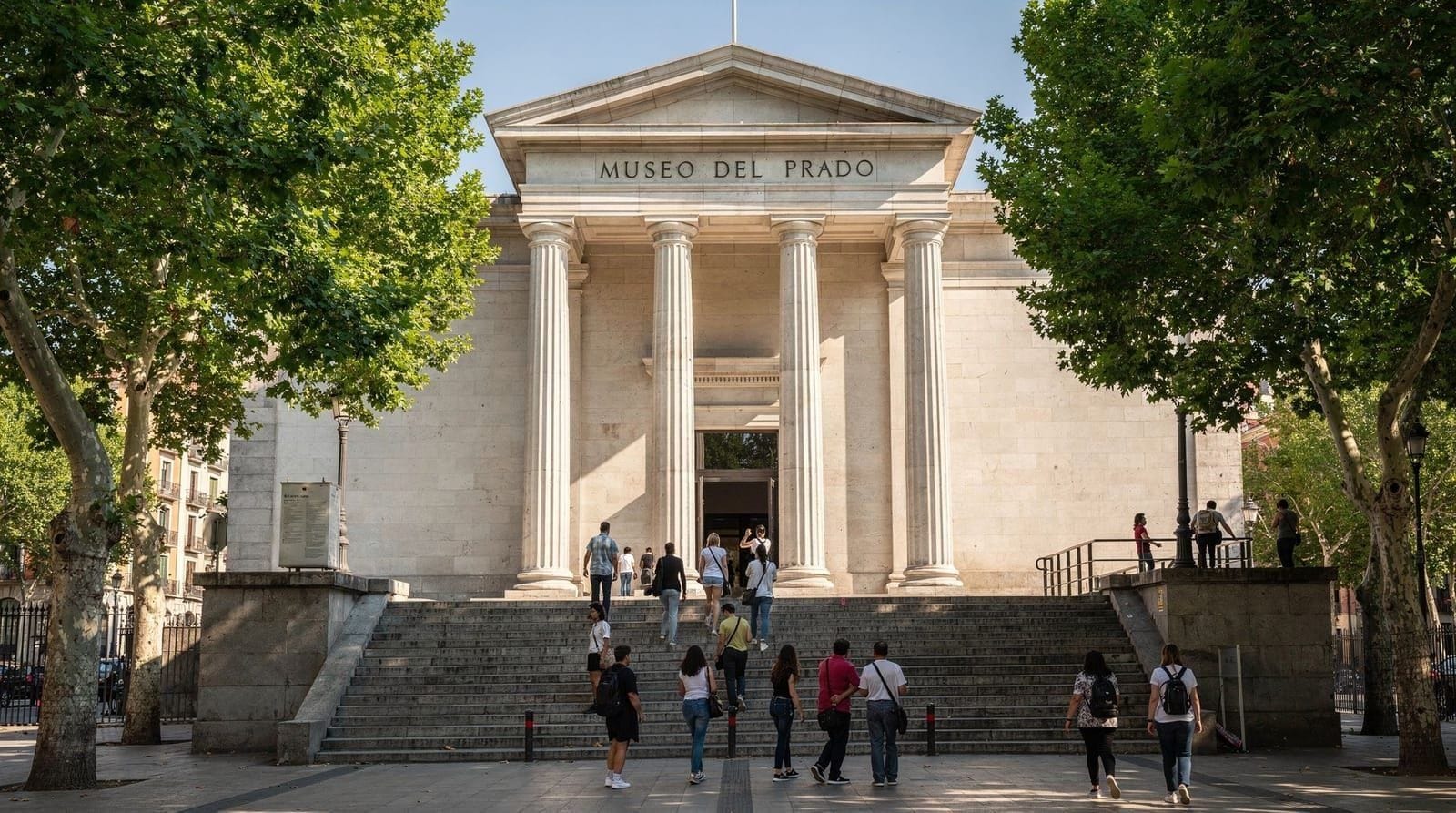
Both paintings hang in the Prado — the Third of May in Room 64, the Second of May nearby. They are the strongest reason the Prado’s collection extends beyond court portraiture and religious painting into something that engages with historical violence and political reality.
Manuela Malasaña and the neighbourhood’s name
The neighbourhood now known as Malasaña — the area between Calle Fuencarral, Gran Vía, Calle San Bernardo, and Calle Carranza, immediately north of the historic centre — takes its name from a 17-year-old seamstress who died on or around 2 May 1808.
Manuela Malasaña, according to the tradition, was seized by French soldiers who found scissors in her pocket — tools of her trade — and interpreted them as a weapon under the French ban on civilians carrying arms. She was executed. The historical evidence for this specific story is contested by historians (the documentary record is thin), but the story became part of Madrid’s popular memory of the uprising, and the neighbourhood’s Plaza del Dos de Mayo has carried her memorial for over a century.
The neighbourhood had another name before — La Maravillas (The Wonders) — which is still occasionally used by old residents. The Malasaña name became standard in the 20th century, particularly after the movida madrileña of the 1980s, when the neighbourhood became the centre of Madrid’s post-Franco youth culture explosion.
The Plaza del Dos de Mayo
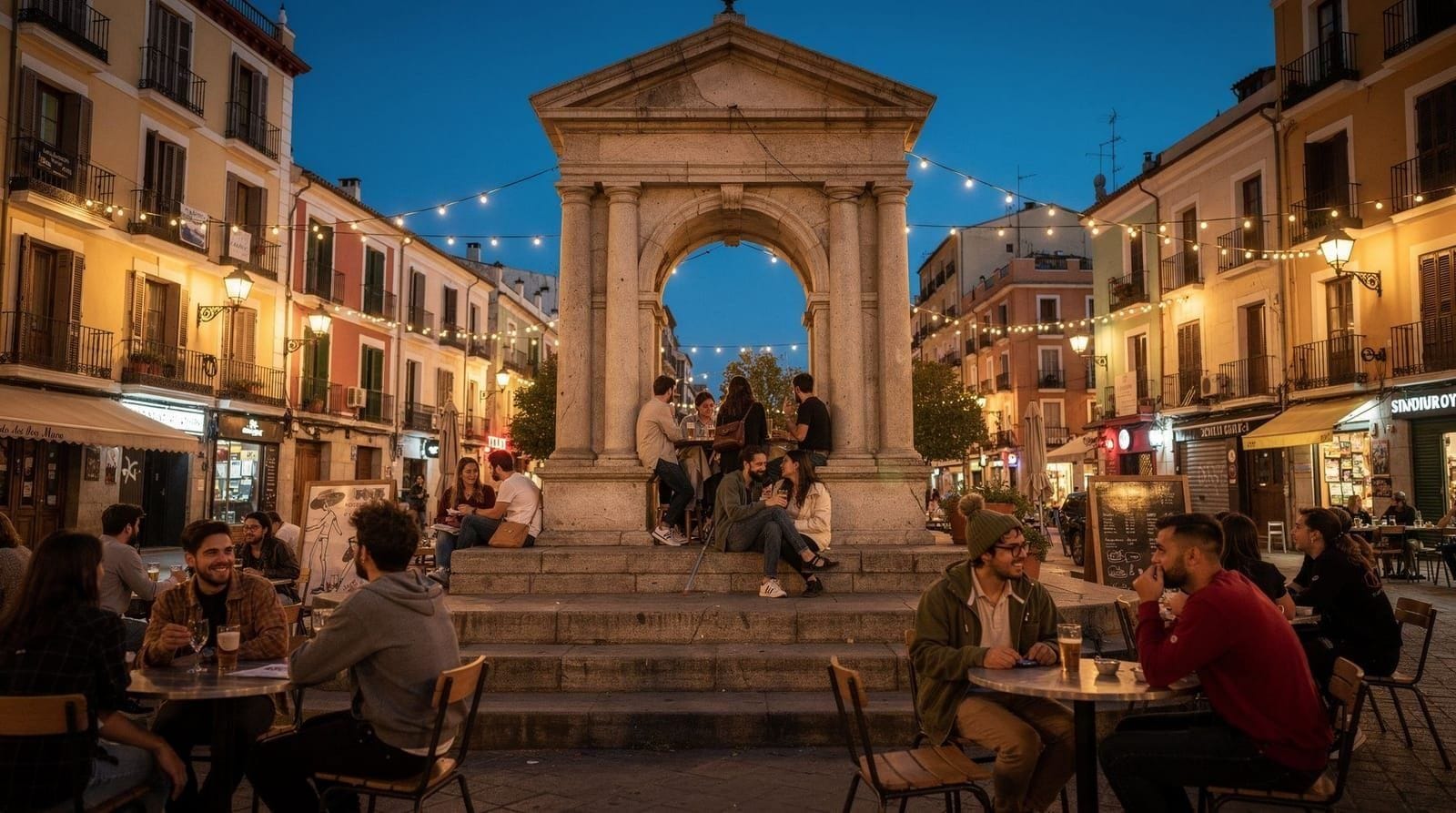
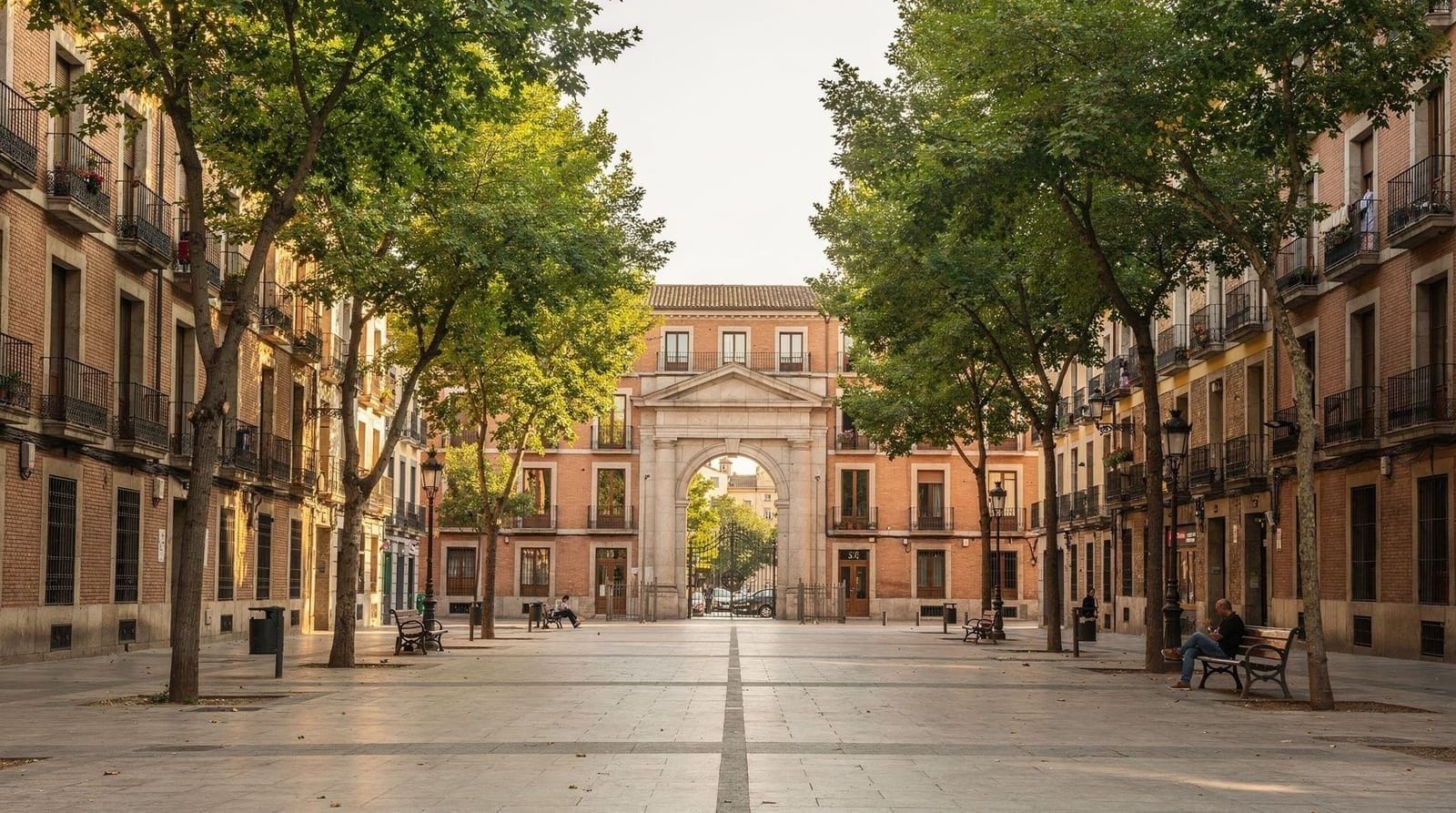
The central square of the Malasaña neighbourhood, the Plaza del Dos de Mayo, contains the most visible memorial to the uprising: a neoclassical arch that originally stood at the entrance to the Monteleón artillery barracks where some of the fiercest fighting occurred. The arch was moved to the plaza when the barracks were demolished.
The square is marked by a monument to artillery officers Luis Daoíz and Pedro Velarde, who died in the defence of the Monteleón barracks — they are the named heroes of the 2 May uprising, though the popular resistance was much broader.
Today the Plaza del Dos de Mayo is the social centre of Malasaña — surrounded by bars, occupied by benches, and used for community gatherings. On 2 May, the plaza becomes the focal point of the annual festival.
The annual Dos de Mayo festival
Each year on 2 May, Madrid holds a public holiday and a programme of events centred on the Malasaña neighbourhood. The Comunidad de Madrid (regional government) typically organises:
- Free concerts in the Plaza del Dos de Mayo and in the streets of Malasaña throughout the day and evening
- Traditional Madrileño dress: chulapos (men) and chulapas (women) in traditional early 20th-century costumes that have become the visual emblem of Madrileño popular culture
- Cultural events at the Centro Cultural Conde Duque and other Malasaña venues
- Street market components and neighbourhood activities
The official programme is published by the Comunidad de Madrid in the weeks before 2 May (madridcomunidad.es). The day is genuinely festive — more local than tourist in its character, which makes it interesting to visit if you happen to be in Madrid.
If 2 May falls on a weekend, the celebrations extend across the full weekend. If it falls mid-week, events cluster around the actual date.
Practical: The Plaza del Dos de Mayo and surrounding streets get crowded from late afternoon. The concert programme typically runs 18:00–23:00 or later. Come hungry — the neighbourhood restaurants all run the day’s specials, and the street food vendors that appear for the festival are good.
Exploring Malasaña around the 2 May history
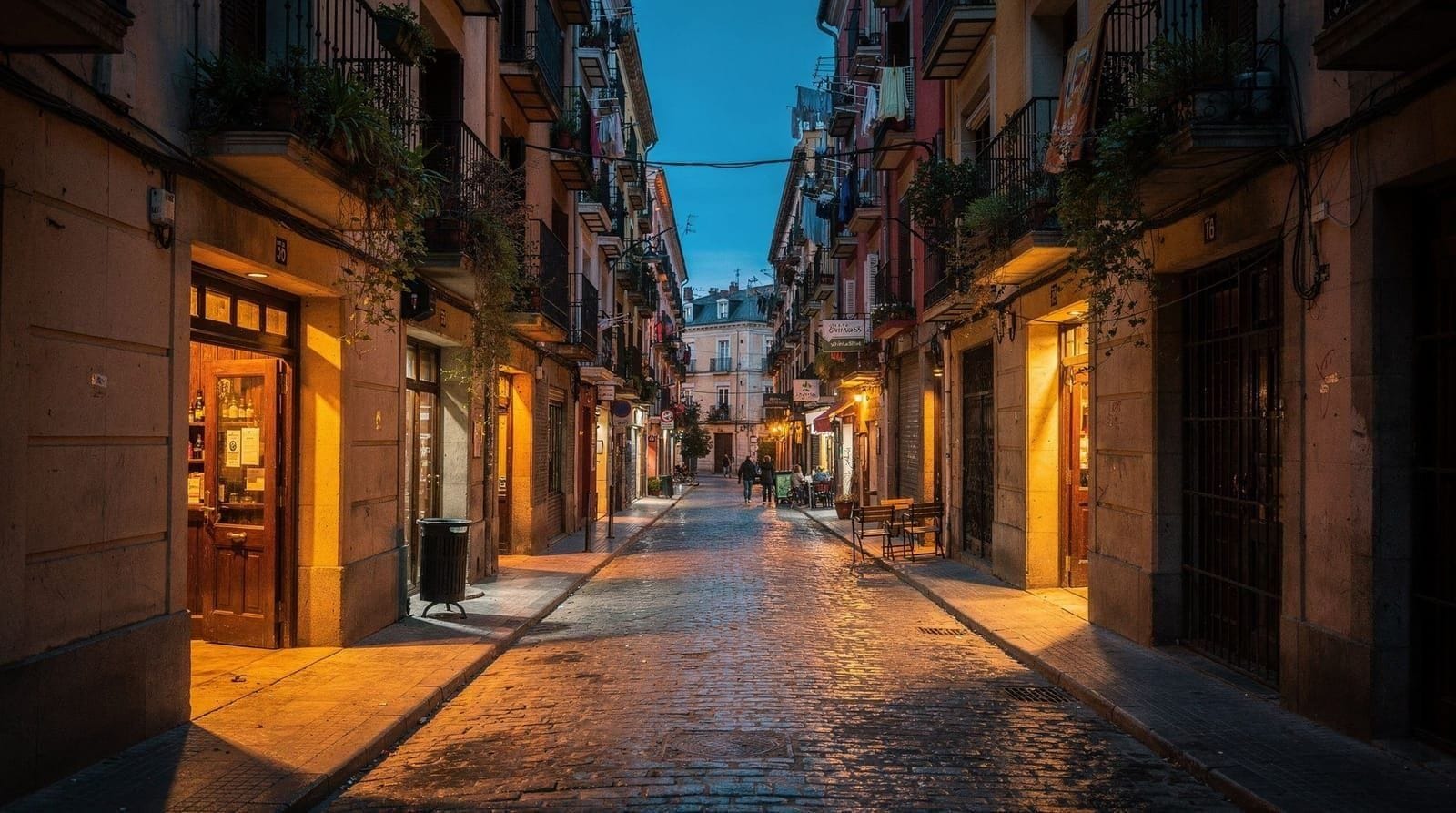
The Malasaña neighbourhood is worth exploring independently of the Dos de Mayo anniversary. It is one of Madrid’s most characterful districts — a mixture of old apartment buildings, independent shops and bars, and the residual energy of its 1980s movida identity.
Key spots:
- Plaza del Dos de Mayo — the central square with the Daoíz and Velarde monument
- Calle del Pez — the main commercial street for independent shops
- Calle de San Bernardino and Espíritu Santo — bars, wine shops, live music venues
- Mercado de los Mostenses (adjacent neighbourhood, Calle de los Mostenses) — a working market with Asian and Latin American food vendors
- Centro Cultural Conde Duque (Calle del Conde Duque 9–11) — the converted barracks that replaced the Monteleón; now a cultural centre with exhibition spaces and a pleasant courtyard
The Malasaña guide covers the neighbourhood for eating, drinking, and independent shopping in full detail.
Goya’s Madrid: a historical walk from the Prado to Malasaña
The Goya connection creates a possible itinerary that links the Prado paintings to their historical location:
- Prado — Rooms 64–65, the Third and Second of May paintings. Allow 90 minutes for this section of the museum.
- Walk north to Puerta del Sol — the site of the cavalry attack on 2 May, now one of Madrid’s busiest pedestrian intersections
- Continue north to Malasaña (20 minutes from Sol on foot, or Metro to Tribunal Line 10)
- Plaza del Dos de Mayo — the Monteleón arch memorial
- Café Commercial (Glorieta de Bilbao 7) — Madrid’s oldest café, open since 1887, a 5-minute walk from the plaza. An appropriate place to end.
This route traces the geography of the 2 May uprising in reverse — from the artistic record to the historical sites.
Historical context: before and after 2 May
The uprising did not come from nowhere. Spain had been in dynastic and political crisis for years before 1808 — the Bourbon court of Charles IV was unstable, Prime Minister Godoy was widely resented, and the alliance with Napoleonic France had already produced military humiliations.
After the Peninsular War (1808–1814), Spain’s position in the world changed fundamentally. The disruption of the Napoleonic period accelerated the independence movements in Spanish America — most of Spain’s American colonies became independent states between 1810 and 1825. The liberal political movements that emerged in Spain during the war (including the first Spanish constitution, 1812, written in Cádiz while Madrid was occupied) set the terms of 19th-century Spanish political conflict.
The Habsburg and Bourbon history guide covers the dynastic background to this period. The Goya paintings of 2–3 May are one answer to the Bourbon court portraits of the same era — the contrast between the official representation of monarchy and the unofficial recording of popular resistance defines the historical significance of both.
Malasaña today: the neighbourhood’s character
The Malasaña neighbourhood is one of Madrid’s most visited for its independent character — a mix of old apartment buildings, vintage shops, craft bars, and the residual identity of its role in the 1980s movida madrileña (the explosion of cultural freedom that followed Franco’s death and the transition to democracy).
What the movida was: In the late 1970s and early 1980s, Madrid — particularly Malasaña and Chueca — became the centre of Spain’s post-Franco youth culture. Film directors (Almodóvar shot his first films in the neighbourhood), musicians, artists, and writers created a scene that was consciously transgressive after four decades of censorship. The movida was not a political movement; it was cultural liberation, deliberately frivolous, consciously opposed to the seriousness of anti-Franco politics. Its legacy is visible in the neighbourhood’s self-image: creative, independent, slightly subcultural.
How to see it today: The visible elements of Malasaña’s character are concentrated in Calle del Pez (independent shops, record stores), Calle de Manuela Malasaña (named for the uprising heroine), and the streets around Plaza del Dos de Mayo. The neighbourhood’s bars open late and stay open later — this is not primarily a dinner neighbourhood but a drinking neighbourhood, with peak activity from 22:00 onward on weekends.
The Dos de Mayo uprising in European context
The Madrid uprising of 2 May 1808 is significant not only for Spanish history but for European political history. It was one of the first European examples of what military theorists would later call “popular resistance” or “people’s war” — armed civilians, not regular armies, fighting professional military forces using guerrilla tactics in an urban environment.
Napoleon’s subsequent experience in Spain — the “ulcer” of the Peninsular War, as he called it — was a significant drain on French military resources and morale that contributed to the eventual French defeat. The Spanish resistance, inspired partly by the 2 May example, demonstrated that occupying a country whose population refuses to accept occupation is fundamentally different from defeating a regular army in a set battle.
The political philosophy that emerged from this period — popular sovereignty, national resistance, constitutional liberalism — influenced revolutionary and independence movements across Europe and the Americas in the following decades.
The Prado paintings: a note on viewing them
When you stand in front of the Third of May at the Prado, several things are worth noting that photographs and reproductions do not convey:
Scale: The canvas is 2.68 m × 3.47 m — significantly larger than most reproductions suggest. The central figure (the man in the white shirt) is approximately life-size. This matters for how you experience the work.
The lantern: The large painted lantern on the ground between the figure and the firing squad is the primary light source in the painting. The soldiers are in shadow; the condemned man is fully lit. The lantern creates the theatrical illumination effect while also being entirely plausible as a practical detail of a nocturnal execution.
The preceding painting: The Second of May (the cavalry attack) is in the adjacent or nearby room and significantly less famous. Looking at the two together — the chaotic melee of the cavalry attack on 2 May and the cold, systematic execution on 3 May — creates the full narrative arc that Goya was documenting.
Both paintings can be found in the Prado’s Goya rooms (rooms 64–65). The Prado museum guide covers how to find them efficiently and what else to see nearby.
If you would rather have the context delivered as you stand in front of the canvas, a guide changes the experience: someone who can explain the 1814 commission, the lantern and the reading of the white shirt turns a few minutes of looking into a proper understanding. Options include a guided Prado visit with skip-the-line entry, or, for art lovers who want to continue to Picasso’s response to political violence, a combined guided visit to the Prado and the Reina Sofía. The comparison with Guernica is explored in the Reina Sofía museum guide and in the blog piece on what to know about Guernica.
For a slower, art-focused day built around the same themes, the Madrid for art lovers itinerary and the Golden Triangle art walk place the Goya rooms alongside the other great collections, while free art in Madrid and the museum free hours guide help with budgeting the visit.
Planning a Dos de Mayo visit
The annual 2 May festival in Malasaña is worth timing a trip around if you can — it is one of the most genuinely local of Madrid’s major festivals. But the historical and cultural significance is present year-round:
- The Goya paintings are at the Prado every day
- The Plaza del Dos de Mayo and the Monteleón arch are always accessible
- The Malasaña neighbourhood is worth visiting as a living neighbourhood on any day
If you are in Madrid in late April or early May, the combination of San Isidro (15 May, the patron saint festival) and Dos de Mayo (2 May) makes this two-week window one of the most culturally dense periods in the Madrid calendar. Spring weather (15–22°C, parks in bloom) adds to the case.
See Madrid in spring for the full picture of what May brings to the city.
The festival is also an excuse to see how Madrid celebrates beyond the tourist core. Pair it with the San Isidro festival blog post for the second big local celebration of the season, and with the Puerta del Sol guide for the square where the 1808 fighting began. For how the whole trip fits together, the three-day Madrid itinerary is a good framework to slot the Goya-to-Malasaña route into.
What visitors often miss
Most visitors who happen to be in Madrid on 2 May stumble into the festival without knowing its origin, treat it as a generic street party, and miss the historical layer entirely. A few things reward a closer look: the Daoíz and Velarde monument in the plaza is not decorative — both men are buried nearby at the Basílica de Nuestra Señora de Atocha, having genuinely died defending the Monteleón barracks. The chulapo and chulapa costumes worn by many attendees date specifically from early 20th-century Madrid working-class fashion (the castizo tradition), not from 1808 — a common point of confusion. And the free concerts, while genuinely enjoyable, are secondary to the quieter historical walk described above; going early in the day for the Goya-to-Malasaña route, then returning in the evening for the festival, gets the best of both.