Golden triangle art walk: Prado, Reina Sofía, and Thyssen-Bornemisza
Madrid: Three Museums Golden Triangle
What is Madrid's golden triangle of art and how do you visit it?
The golden triangle is three world-class museums within 15 minutes' walk of each other on the Paseo del Prado: the Museo del Prado (Velázquez, Goya, El Greco), the Museo Reina Sofía (Picasso's Guernica, Miró, Dalí), and the Museo Thyssen-Bornemisza (van Eyck to Hockney). All three offer free entry windows — Prado free Mon–Sat 18:00–20:00 and Sun 17:00–19:00; Reina Sofía free Mon/Wed–Sat 19:00–21:00 and Sunday 12:30–14:30; Thyssen free Mondays 12:00–16:00 and Saturdays 21:00–23:00.
Three museums, one boulevard, one of the world’s great art concentrations
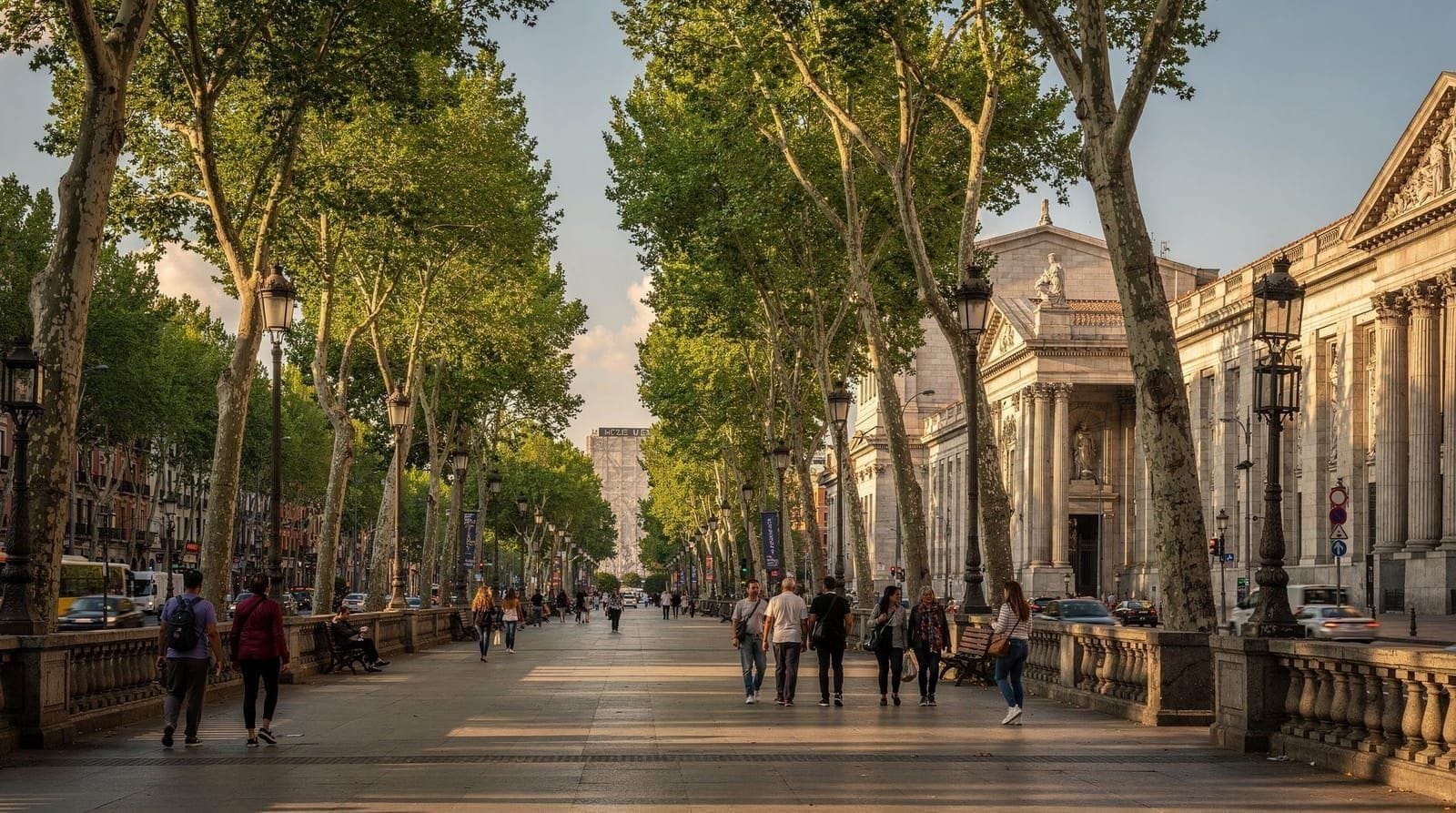
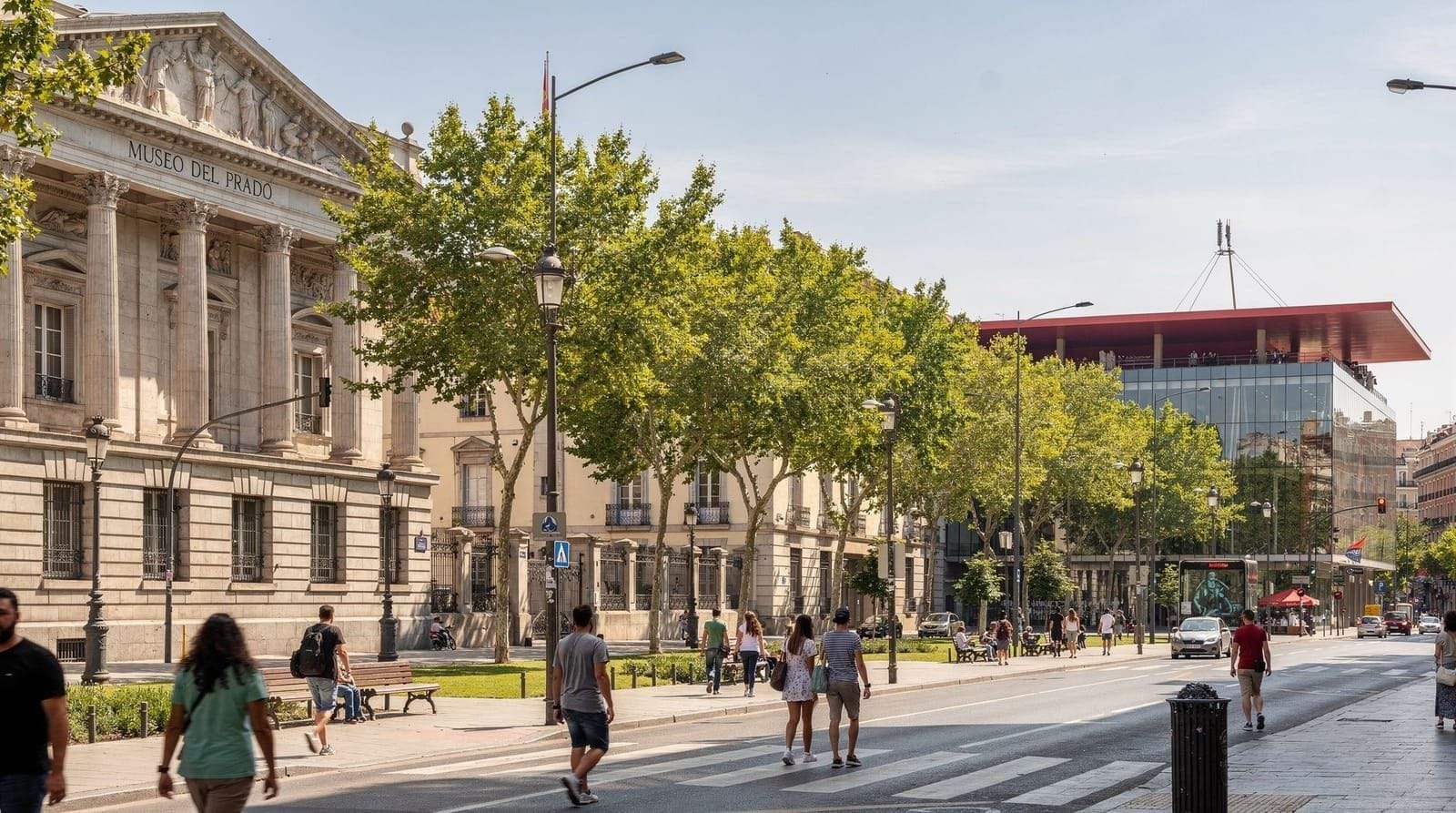
No other capital in the world has three museums of this calibre within 15 minutes’ walk of each other. The Paseo del Prado, a tree-lined boulevard running north–south through central Madrid, forms the spine of what locals and tourism boards alike call the “golden triangle of art”: the Museo del Prado at its centre, the Museo Reina Sofía at the southern end near Atocha station, and the Museo Thyssen-Bornemisza just to the north.
Together they span roughly 700 years of Western art — from 14th-century Flemish primitives in the Thyssen to Picasso and Dalí in the Reina Sofía, with Velázquez, Goya, El Greco, Rubens, and Titian in between at the Prado. This guide tells you how to plan the visit, what to prioritise, and how to do it without paying full price.
| Where | Paseo del Prado, central Madrid — all three within a 15-minute walk |
| Cost | around €12–15/museum, or free in the evening/Sunday windows above |
| Time needed | half a day for highlights only, 1.5–2 days for a proper visit |
| Getting there | Metro Banco de España, Atocha or Retiro; all walkable from Sol/Retiro |
| Best time | weekday mornings at opening; avoid weekend afternoons in spring/autumn |
The three museums at a glance
| Prado | Reina Sofía | Thyssen-Bornemisza | |
|---|---|---|---|
| Era covered | 12th–19th century | 20th–21st century | 14th–20th century |
| Signature work | Las Meninas (Velázquez) | Guernica (Picasso) | Old masters + Impressionism |
| Time needed | 2.5–3 hours | 1.5–2 hours | 1.5–2 hours |
| Closed | Never (open all week) | Tuesdays | Never (Mondays 12:00–16:00 only) |
| Best for | Spanish old masters | Modern/political art | Filling the gaps between the other two |
The Prado: Spain’s greatest museum
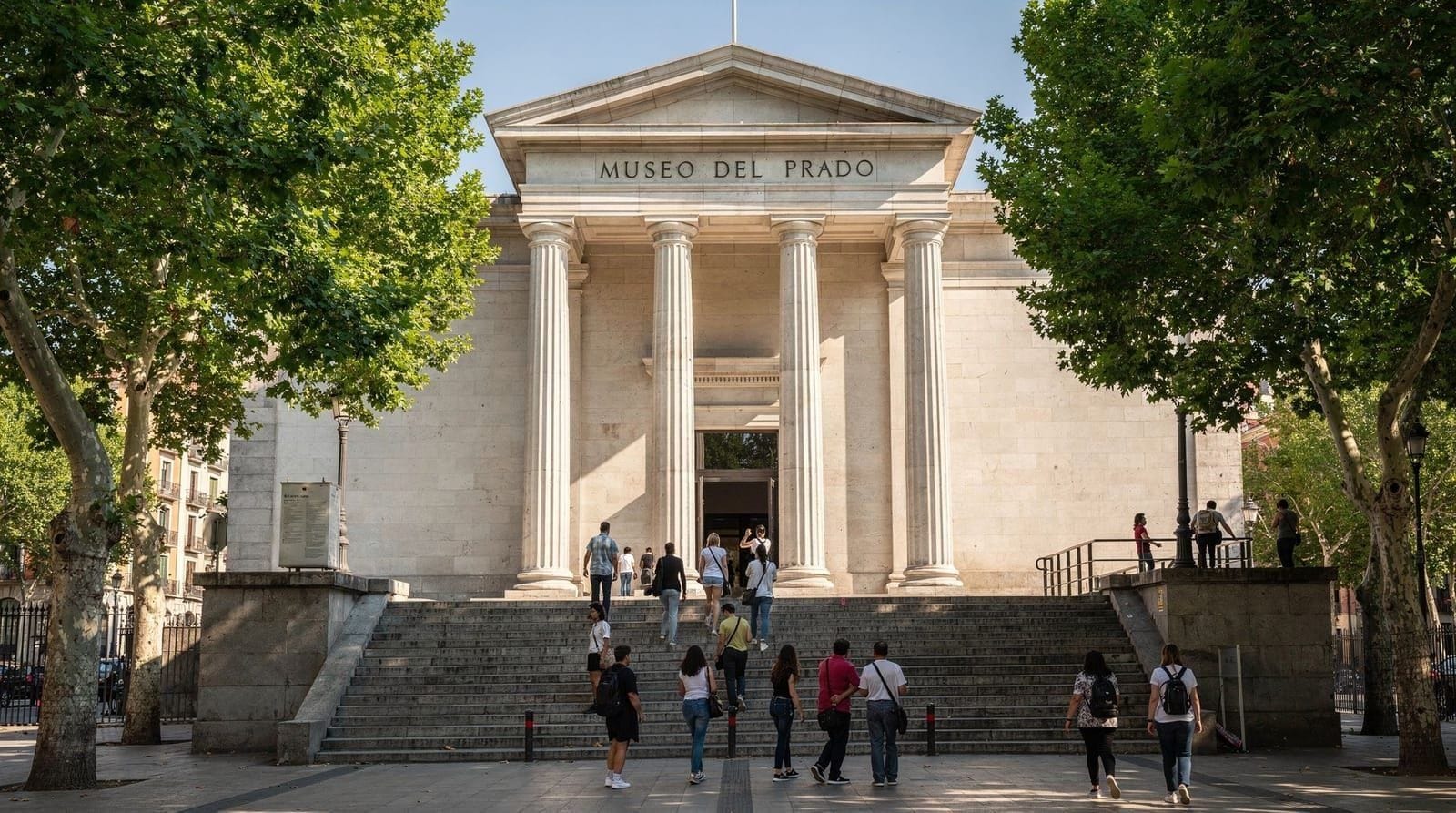
The Museo del Prado is the reason many people visit Madrid. Founded in 1819 as a public museum from the Spanish royal collections, it holds one of the deepest concentrations of European old master paintings on earth — 8,000 works on display from a total collection of over 22,000.
What makes it unlike anywhere else: The Prado has the world’s best collection of Spanish painting from the 16th–18th centuries. Other museums have individual Velázquez or Goya works; the Prado has dozens of each, allowing you to trace careers across decades. The court portraits, the mythological paintings, the religious commissions — all in one building.
Non-negotiable works:
- Las Meninas (Velázquez, 1656) — Room 12, and probably the most analysed painting in Western art. The game Velázquez plays with perspective, reflection, and the viewer’s position in the scene repays close attention. Arrive early; it gets crowded.
- The Black Paintings (Goya, c. 1820–1823) — Rooms 66–67. Saturn Devouring His Son is the image, but the full cycle of 14 works Goya painted on the walls of his house near the Manzanares river is extraordinary as a sequence. Dark, unsettling, proto-expressionist.
- The Garden of Earthly Delights (Bosch, c. 1490–1510) — Room 56A. The triptych the Spanish royal family owned for 500 years. Get close to the details.
- El Greco’s room — The Adoration of the Shepherds and The Knight with his Hand on his Breast show what El Greco’s mannered Byzantine-influenced style achieved in Toledo and Madrid.
Practical:
- Hours: Mon–Sat 10:00–20:00, Sun and holidays 10:00–19:00. Closed 1 January, 1 May, 25 December.
- Tickets: €15 adults. Free Mon–Sat 18:00–20:00 and Sun/holidays 17:00–19:00 (arrive 30–45 minutes early to queue).
- The Prado app has an excellent audio guide (free after ticket purchase).
- Cloakrooms and lockers are free and mandatory for large bags and backpacks — factor a few minutes for this on arrival, especially at busy times.
The Reina Sofía: Guernica and 20th-century Spain
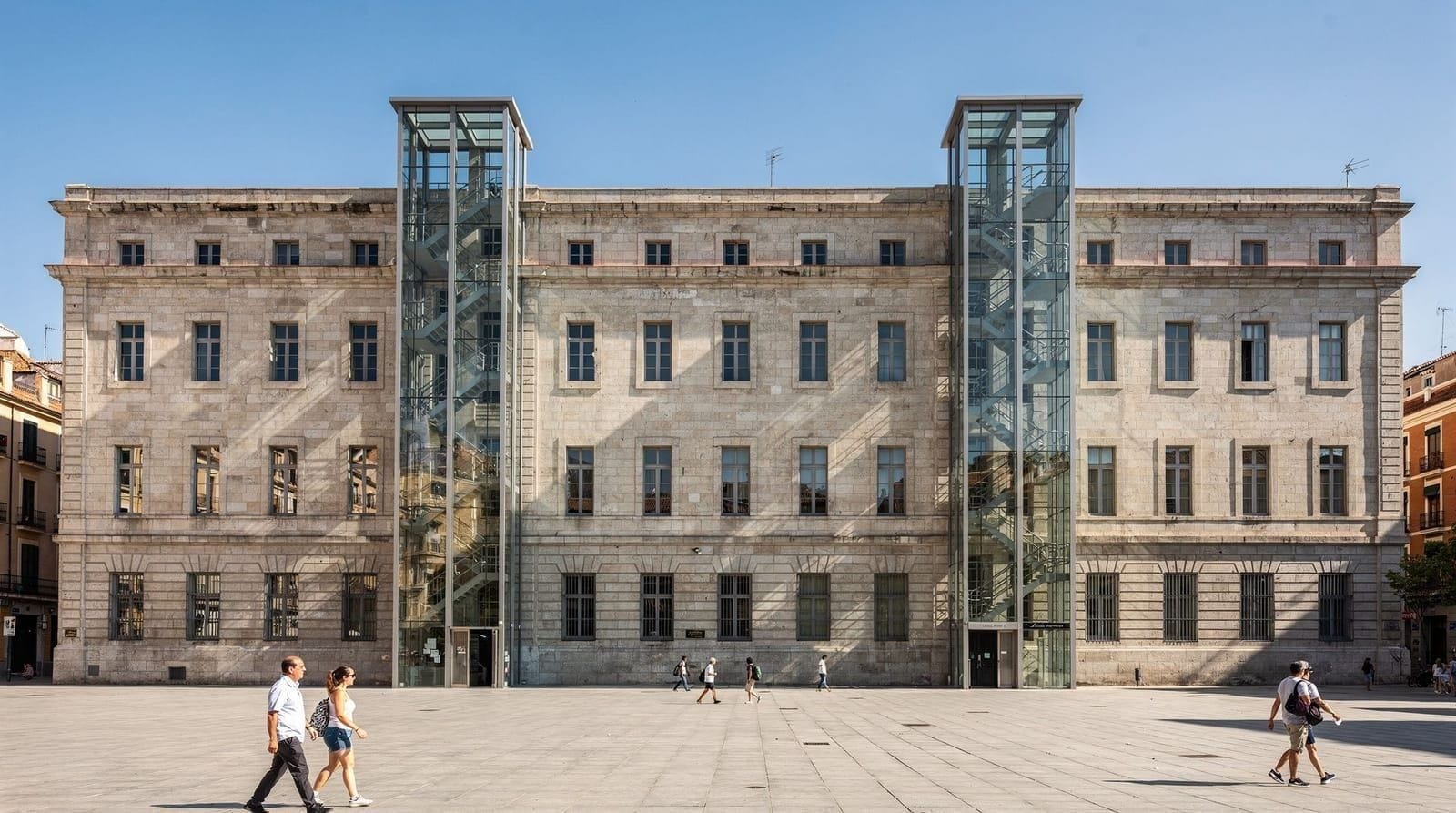
Ten minutes’ walk south, the Museo Reina Sofía occupies a converted 18th-century hospital near Atocha station, extended in 2005 by a striking glass annex by Jean Nouvel. Where the Prado covers old masters, the Reina Sofía focuses on 20th and 21st-century art — specifically the Spanish context: Cubism, Surrealism, the Civil War, and the political art of the Franco and post-Franco periods.
The central room: Guernica (Picasso, 1937)
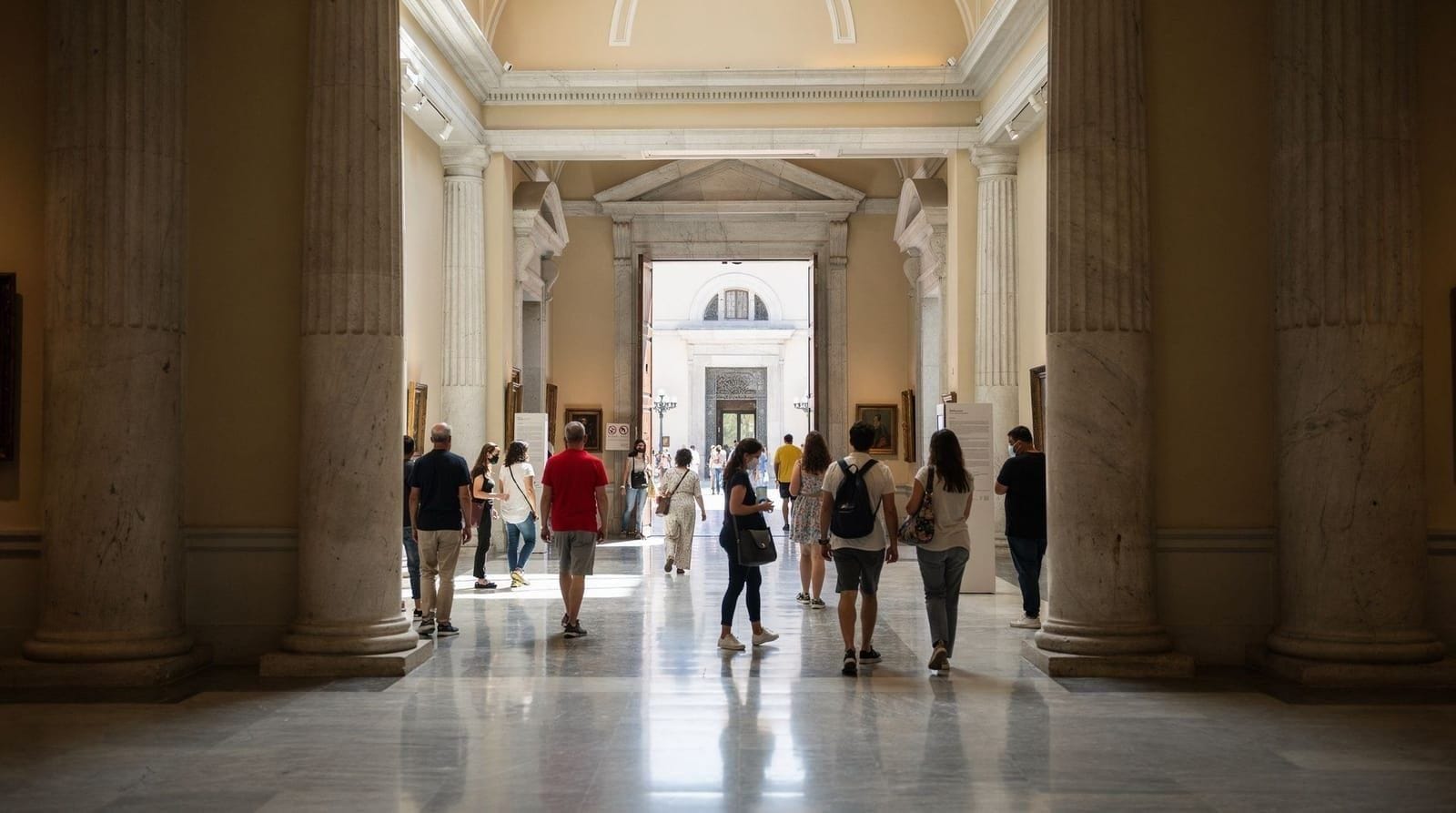
Room 206 on the second floor (Edificio Sabatini) holds Picasso’s enormous grey-scale painting documenting the bombing of the Basque town of Guernica by Nazi German and Fascist Italian aircraft at the request of Franco in April 1937. At 3.5 m tall and nearly 8 m wide, it is a work you have to stand in front of to understand. The surrounding rooms show Picasso’s preparatory studies and the photographs taken by Dora Maar that documented the creation of the painting — essential context.
Beyond Guernica:
- Miró — Large canvases and sculptures in the permanent collection, particularly from his late period.
- Dalí — The Great Masturbator and other Surrealist works, including some rarely-seen Dalí paintings outside of Catalonia.
- Juan Gris — The Reina Sofía has the best Gris collection outside Paris.
- The Civil War rooms — Posters, documentary photography, and propaganda art from both Republican and Nationalist sides provide historical context that no other museum in Spain presents so directly.
Practical:
- Hours: Mon, Wed–Sat 10:00–21:00, Sun 10:00–14:30. Closed Tuesdays.
- Tickets: €12 adults. Free Mon, Wed–Sat 19:00–21:00 and Sunday 12:30–14:30 only.
- The Nouvel annex is worth exploring even if you don’t love the modern art collection — the architecture is dramatic.
- The rooftop terrace and café in the Nouvel extension are a quiet spot to rest between galleries, with views back toward the Atocha station roofline.
A guided visit combining the Prado and Reina Sofía covers the highlights of both collections in a single half-day with an expert guide who provides context the audio guide cannot.
The Thyssen-Bornemisza: the missing piece
The Museo Thyssen-Bornemisza is the youngest and least obviously “essential” of the three, but it plugs important gaps in the other two. The collection — assembled by Baron Hans Heinrich Thyssen-Bornemisza and his father over 60 years, sold to the Spanish state in 1993 — runs from 14th-century Italian and Flemish primitives through Dutch Golden Age, Italian Baroque, German Romanticism, French Impressionism, Expressionism, and American pop art.
Where it fills gaps:
- The Prado has almost no Impressionism or Post-Impressionism (Monet, Renoir, Cézanne, van Gogh). The Thyssen has all of them, in good examples.
- The Reina Sofía’s coverage of early 20th-century German Expressionism is limited. The Thyssen has Kirchner, Nolde, Beckmann.
- For old masters, it adds significant Dürer, van Eyck, Caravaggio, and Rubens works that complement rather than duplicate the Prado’s holdings.
What to prioritise:
- Floor 2 (old masters): Portrait of a Young Woman (Petrus Christus, 1470), Portrait of a Young Man (Raphael), Christ and the Samaritan Woman (Jacopo Bassano)
- Floor 0 (20th century): The Swaying Dancer (Degas), Metropolis (George Grosz), and the American pop art section — Roy Lichtenstein, David Hockney, Richard Estes
Practical:
- Hours: Tue–Fri and Sun 10:00–19:00 (Tue–Fri until 21:00 in July–August), Sat 10:00–23:00, Mon 12:00–16:00.
- Tickets: €14 adults. Free Mondays 12:00–16:00 and Saturdays 21:00–23:00.
- The Thyssen extension (Carmen Thyssen collection) is in an adjacent building; the combined ticket covers both.
- The Thyssen tends to be the quietest of the three even at peak times, since it’s less well known to first-time visitors — a genuine advantage if you want a calmer museum experience without sacrificing quality.
Planning your golden triangle visit
One day, highlights only (8 hours):
- 10:00 — Prado opens, arrive early for Las Meninas, the Black Paintings, and Bosch without crowds. Allow 2.5 hours.
- 12:45 — Walk 8 minutes north to Thyssen. Focus on floors 2 and 0. 90 minutes.
- 15:00 — Late lunch on the Paseo del Prado or in Barrio de las Letras nearby.
- 17:00 — Walk south to Reina Sofía. Focus on Guernica and the surrounding rooms. 2 hours.
- 19:00 — Reina Sofía free entry window starts if you timed it correctly.
Two days, proper visits:
- Day 1: Prado morning (10:00–13:00, full visit, audio guide), Thyssen afternoon (15:00–17:30). Dinner in Barrio de las Letras.
- Day 2: Reina Sofía morning (10:00–13:00 before tour groups dominate), free afternoon for Paseo del Retiro or Barrio de los Austrias.
Using free windows: The evening free-entry queues at the Prado are significant in peak season. The Reina Sofía’s Sunday free window is only 2 hours (12:30–14:30), so arrive shortly before 12:30 and go straight to Guernica; expect it to be busy.
A guided tour of all three golden triangle museums takes the planning pressure off and provides historical context for collections that span 700 years.
The Paseo del Prado walk
The boulevard connecting the three museums is itself worth attention. Declared a UNESCO World Heritage Site in 2021 as part of the “Landscape of Light,” the Paseo del Prado is a 17th–18th-century tree-lined promenade with neoclassical architecture on both sides.
Walking south from the Thyssen to the Reina Sofía (about 15 minutes):
- Real Academia Española on the western side — the authority on the Spanish language, founded 1713
- Neptune Fountain (Fuente de Neptuno) — meeting point for Atlético de Madrid fans after victories (the Atlético of the streets; Real fans go to Cibeles fountain)
- Cibeles Fountain — at the northern end of the Paseo, the city’s central emblem, inside what is now the Palacio de Cibeles (City Hall with a rooftop terrace open to the public)
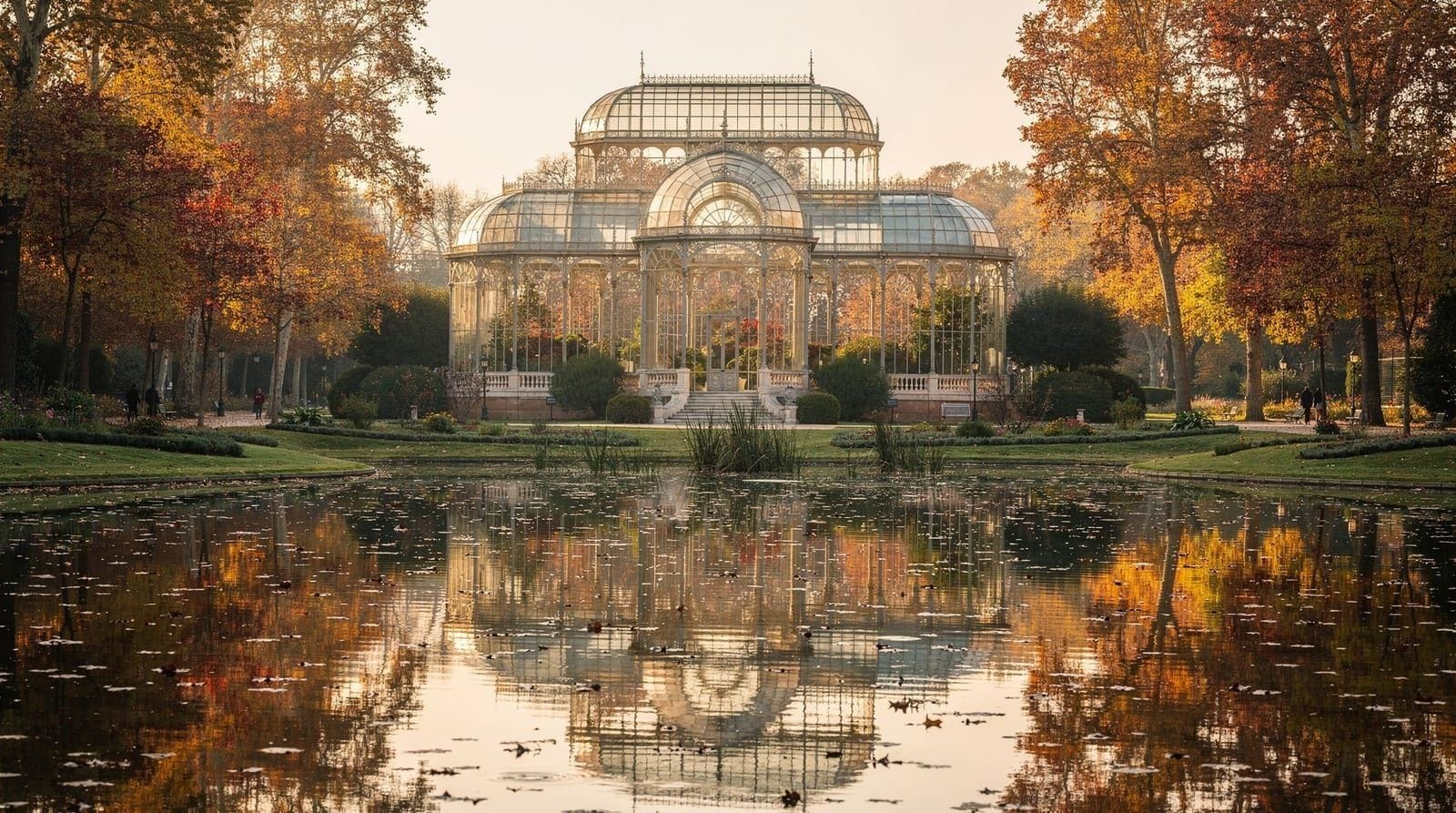
- Real Jardín Botánico — the Royal Botanic Garden, immediately south of the Prado main building, entry €4, worth 45 minutes in spring and autumn — a genuinely restful stop between two museums if you need a break from indoor galleries
Beyond the triangle: the Barrio de los Jerónimos
The Prado sits in the Retiro and Jerónimos district, a neighbourhood of aristocratic churches and museums. After your visits, the Iglesia de los Jerónimos (next to the Prado) is one of Madrid’s oldest churches and free to enter. The Parque del Retiro — 125 hectares of park with the Crystal Palace, the Rosaleda rose garden, and the rowing lake — is a 5-minute walk and free.
For eating, the Barrio de las Letras immediately west of the Paseo del Prado is the literary quarter (home of Lope de Vega and Cervantes in the 17th century, now full of restaurants and wine bars that cater to a local rather than tourist crowd). Better value and more interesting than the cafeterias immediately outside the museum entrances.
For a change of pace after a morning of paintings, the Retiro Park guide covers the rowing lake, the Crystal Palace, and the rose garden in more detail than a quick walk-through allows — worth returning to on a separate afternoon rather than squeezing in as an afterthought.
Art walk itinerary: the two-hour version for art lovers who are already decided
If you know exactly what you want and don’t need the full museum experience, this route covers the golden triangle’s exterior architecture and public spaces:
- Start at Cibeles fountain (north end of the Paseo del Prado) — photograph the Banco de España and Cibeles palace
- Walk south past the Thyssen (pause at the exterior sculpture garden on Calle Moret)
- Continue to the Prado main facade (Herrera the Younger, 1785) — the bronze Velázquez statue on the north side
- Turn left to the Real Jardín Botánico entrance
- Walk south to the Reina Sofía — the Jean Nouvel glass annex provides a dramatic exterior view
- End at Atocha station (designed by Alberto de Palacio, 1892) — the interior atrium with tropical plants is free to enter and one of the city’s hidden pleasures
This covers the architectural heritage of the boulevard in 2 hours without entering a single museum.
An art walk pass combining entry to all three museums is the most flexible option for independent travellers who want combined entry without committing to a fixed time slot.
Fitting the golden triangle into a broader Madrid itinerary
The golden triangle anchor is a half-day to full-day commitment, best placed at the beginning of a trip when energy is highest. Suggested combinations:
- 2-day trip: Golden triangle day 1 (Prado focus), Royal Palace and historic centre day 2 — covers the two headline sights without rushing.
- 3-day trip: Golden triangle day 1, day trip to Toledo or Segovia on day 2 (both under 35 minutes by AVE), Madrid neighbourhoods day 3.
- Art lovers’ itinerary (3–4 days): Madrid for art lovers itinerary adds the Sorolla Museum, the Real Academia de Bellas Artes de San Fernando, and the Thyssen extension to the core triangle.
See how many days in Madrid for the full planning breakdown.
Budget version: doing the golden triangle for close to free
The free entry windows above are real and generous by international museum standards, and a determined budget traveller can see all three without paying admission: Prado (Mon–Sat 18:00–20:00 or Sun 17:00–19:00), Reina Sofía (Mon/Wed–Sat 19:00–21:00 or Sunday 12:30–14:30), Thyssen (Monday 12:00–16:00 or Saturday 21:00–23:00). The trade-off is time pressure — free windows are 2 hours or less, and queues form early, so you will see less than on a paid, unhurried visit. For a first Madrid trip, it is reasonable to pay for the Prado (the collection rewards unhurried time the most) and use free windows for the other two. Compare this against the Madrid City Card, which costs the same as the Zone A transport pass and adds discounts at other attractions in the city rather than free entry to these three museums.
Crowds and queueing: what to expect
Peak season (April–June, September–October) brings the longest queues, particularly at the Prado’s free evening window and on weekend mornings generally. Arriving at opening (10:00) is consistently the single best crowd-avoidance tactic across all three museums — it beats arriving at any other time of day, including supposedly quieter mid-afternoon slots, because tour groups typically start around 11:00–11:30. If you can only choose one museum to see at opening, make it the Prado: it is both the most crowded and the one where crowding most affects the experience, since key rooms like the Las Meninas gallery are narrow.
Frequently asked questions about Golden triangle art walk
Can you visit all three golden triangle museums in one day?
Technically yes, but inadvisable unless you rush. Each museum requires 2–3 hours to do justice to the highlights. A two-day split works better: day one Prado in the morning (arrive at opening to beat crowds, 2–3 hours for the highlights) plus Thyssen in the afternoon; day two Reina Sofía, starting at 11:00 before the tour groups arrive. If you only have one day, prioritise the Prado and Reina Sofía — they are the two most significant collections.What are the free entry times for the golden triangle museums?
Prado: free Mon–Sat 18:00–20:00, Sun and public holidays 17:00–19:00 (last admission 30 min before closing; queues form 45 min early). Reina Sofía: free Mon, Wed, Thu, Fri, Sat 19:00–21:00, and Sunday 12:30–14:30 only (closed Tuesdays; also free all day on 18 April, 18 May, 22 May, 12 October and 6 December). Thyssen: free Mondays 12:00–16:00 and Saturdays 21:00–23:00.Is it worth buying a combined three-museums pass?
The Paseo del Arte card (€32.80) covers one timed entry to each museum with a discount vs. buying individually. It is worthwhile if you plan to pay for all three and visit on days without free windows, or if you want to skip online booking queues during peak weeks. It covers the permanent collections and only selected temporary exhibitions. Buy online in advance, especially for spring and autumn.Which museum should you visit first?
The Prado, almost always. It is the most visited, the most complex, and the one where fatigue will most affect your experience. Visit it rested, ideally arriving at 10:00 when the building is emptiest. The Thyssen is the easiest to navigate in an afternoon when you're slightly tired — chronological layout, diverse collection, manageable size. Save the Reina Sofía for a late morning when you can spend 90–120 minutes on Guernica and the Cubist rooms without rushing.How do you get between the three golden triangle museums?
All three are within a 15-minute flat walk along the Paseo del Prado boulevard. Prado to Thyssen: 8 minutes north on the Paseo del Prado, or cross the paseo to the Thyssen on Calle Moret side. Prado to Reina Sofía: 10 minutes south along the Paseo del Prado to Atocha. Thyssen to Reina Sofía: 15 minutes south. The walk along the Paseo del Prado itself is pleasant — wide avenue, sculpture, fountains.Do you need timed entry tickets for the golden triangle museums?
Yes, especially for the Prado in peak season (spring and September–October). The Prado sells timed-entry slots that sell out days in advance for popular weekend slots. Reina Sofía and Thyssen are less frantic but booking ahead is still recommended in April–May and September–October. For free entry windows, the Prado operates a queue system (arrive 30–45 minutes early). All three museums have their own booking sites; third-party skip-the-line tours also exist.What should you absolutely not miss at each museum?
Prado: Velázquez's Las Meninas (room 12), Goya's Black Paintings (Sala 66–67, the dark grotesque masterpieces), and El Greco's Adoration of the Shepherds. Reina Sofía: Picasso's Guernica (room 206 on the second floor), accompanied by Picasso's own studies and photographs that explain the context. Thyssen: floor 2 (old masters — van Eyck, Dürer, Caravaggio), and the American pop art rooms on the lower ground floor (Lichtenstein, Hockney).Are guided tours of the golden triangle worth it?
For first-time visitors who want to understand what they're seeing rather than walking past, a guided tour adds real value — especially at the Prado, where the historical and technical context of 17th-century Spanish painting is not self-evident. A combined three-museums tour covers highlights efficiently. Single-museum private tours go deeper. Free audio guides (available at each museum and via apps) are a practical middle ground.
Top experiences
Bookable activities with verified prices and instant confirmation on GetYourGuide.