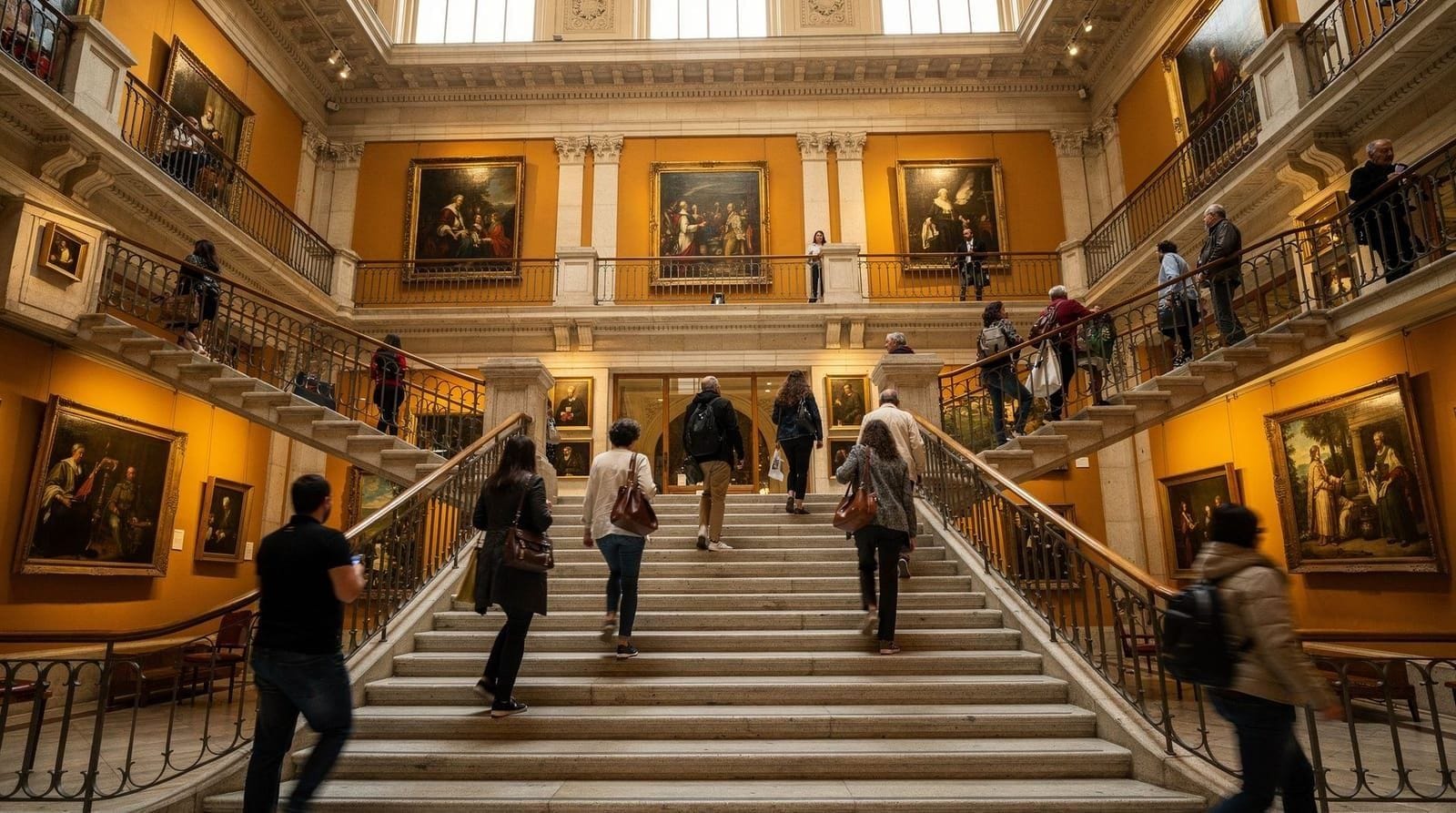
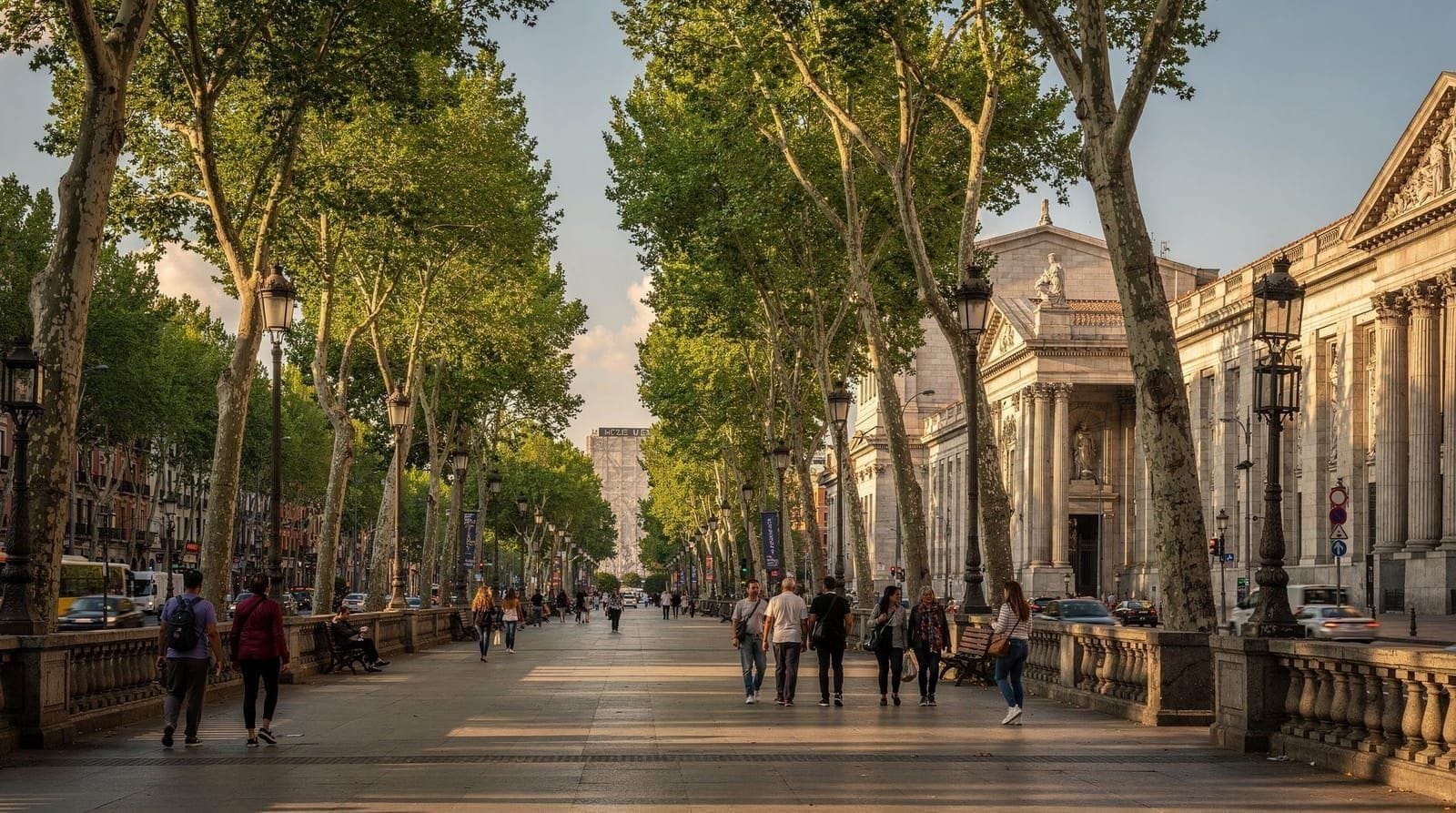
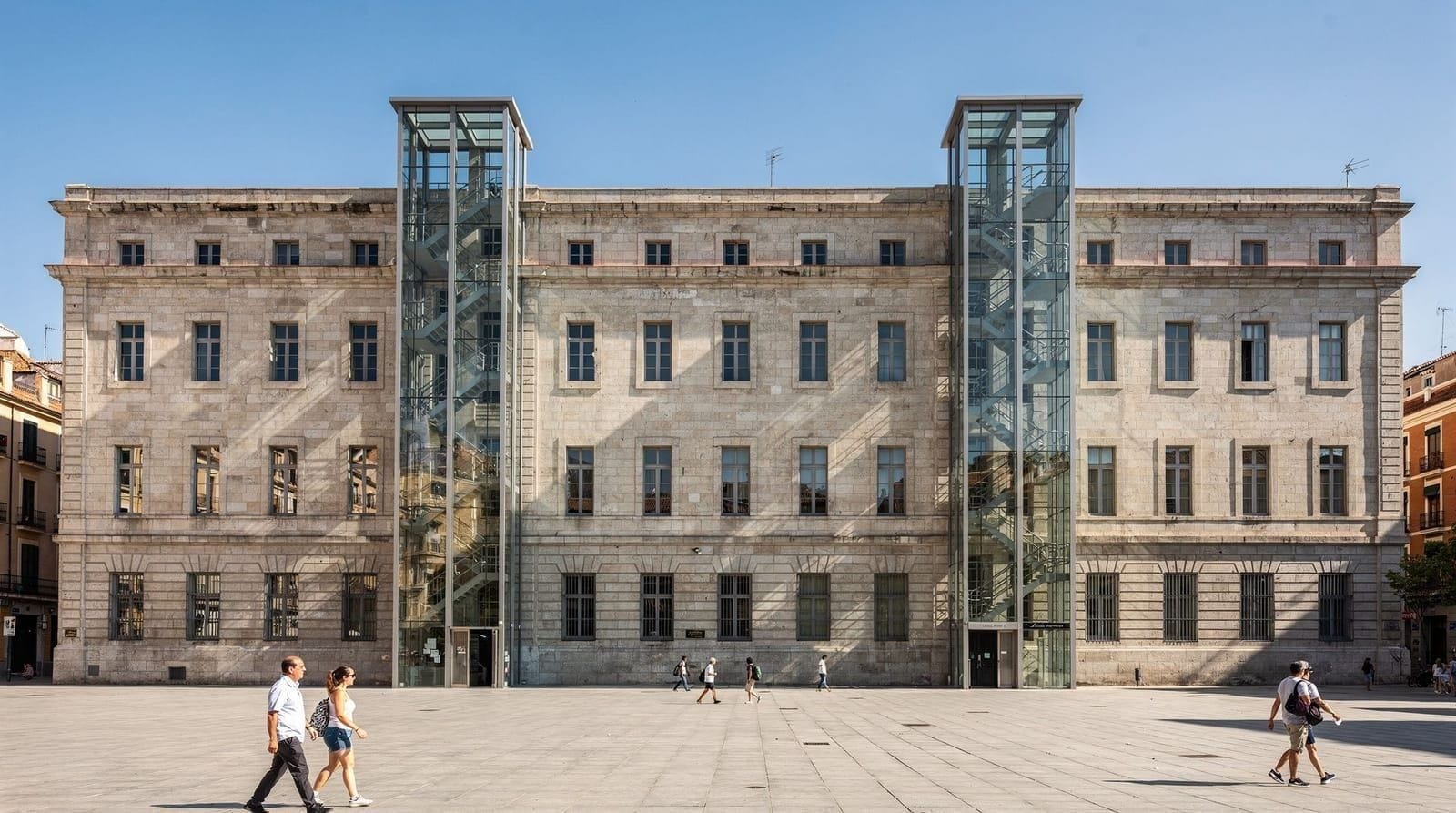
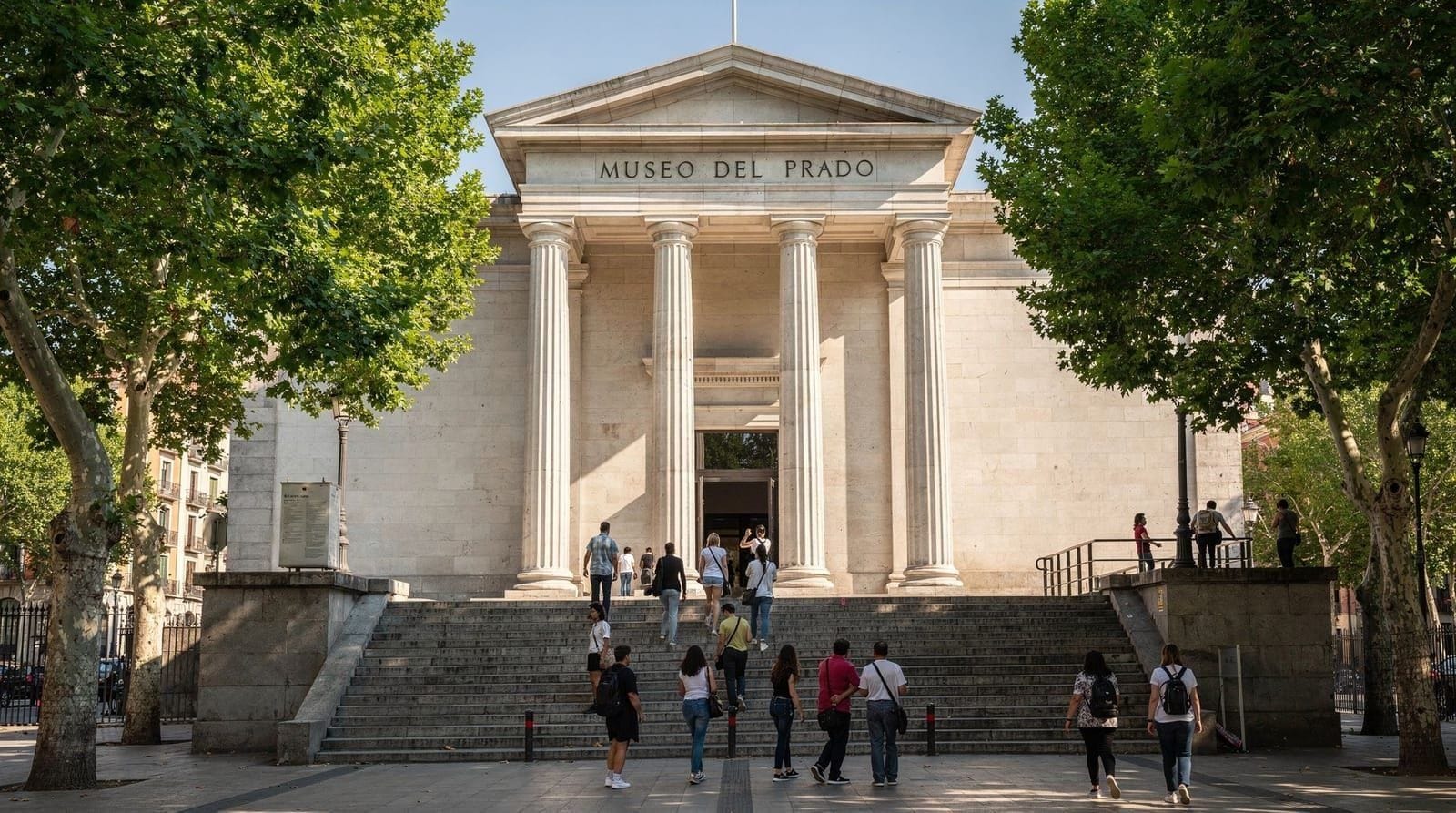
Thyssen-Bornemisza museum guide: eight centuries of art in one building
Madrid: Thyssen Guided Entry
When is the Thyssen Museum free and what makes it different from the Prado?
The Thyssen is free every Monday 12:00–16:00, permanent collection and current exhibitions included. Unlike the Prado (Spanish/Flemish masters) and Reina Sofía (20th-century Spanish art), the Thyssen covers eight centuries across all major European and American movements — medieval to Hopper — making it the most encyclopaedic of the three Golden Triangle museums.
In brief: The Thyssen-Bornemisza completes Madrid’s Golden Triangle — eight centuries of Western art in a 19th-century palace on the Paseo del Prado. The permanent collection is free every Monday 12:00–16:00. It is the most accessible of the three Triangle museums for visitors unfamiliar with art history.
| Where | Paseo del Prado 8, opposite the Prado |
| Cost | €14 general; free Mondays 12:00–16:00 |
| Time needed | 90 min if selective, 2.5–3 hrs for the full collection |
| Getting there | Metro Banco de España (Line 2), 5-min walk |
| Best time | Monday free window; weekday mornings otherwise |
The private collection that became a national museum
The Thyssen-Bornemisza Museum occupies the Palacio de Villahermosa, a 19th-century neoclassical palace on the corner of the Paseo del Prado and Carrera de San Jerónimo. The collection itself was assembled by two generations of the Thyssen-Bornemisza family — Baron Heinrich (1875–1947) and Baron Hans Heinrich (1921–2002) — over six decades of systematic acquisition across every major Western art movement.
What distinguishes the Thyssen from other major collections is its intentional completeness. Most museums are the product of a nation’s historical circumstances — what got looted in wars, what was inherited, what patrons happened to care about. The Thyssen was deliberately constructed to represent eight centuries of Western art chronologically, from the Italian and Flemish primitives through Renaissance, Baroque, Romanticism, Impressionism, Expressionism, Fauvism, Cubism, and American Realism. Gaps were identified and filled systematically.
Spain acquired the collection in 1993 for €350 million — considered by most art historians to have been a remarkable deal — and it has been in the Villahermosa palace ever since. Carmen Cervera (the baron’s wife and Spain’s most famous art collector) donated a personal collection of 200+ works in 2004, now housed in an extension.
What the Thyssen has that neither the Prado nor the Reina Sofía can offer
Impressionism and Post-Impressionism: This is the gap in the other two collections. Monet, Renoir, Degas, Pissarro, Sisley — the Thyssen holds a serious Impressionist collection that is almost entirely absent from the Prado (focused on Spanish and Flemish pre-19th-century work) and irrelevant to the Reina Sofía’s modern mandate.
Northern European Renaissance and Baroque: Albrecht Dürer, Hans Memling, Jan van Eyck, and contemporaries — in depth, not just single examples. The Prado has Flemish Baroque, but the Thyssen’s northern European Renaissance rooms are more comprehensive for early German and Dutch painting.
Early American painting: Winslow Homer, Edward Hopper, and the Hudson River School — wholly absent from the other two Madrid collections. For anyone interested in American art history, this is the only place in Madrid to see it.
20th-century movements from outside Spain: Expressionism (Ernst Ludwig Kirchner, Ernst Nolde), Fauvism, Dada, Surrealism (beyond the Spanish figures at the Reina Sofía), and Pop Art in a single building.
Room-by-room highlights
Floors 2 and 1 (Medieval to Baroque, descending)
Floor 2, Room 1: The collection opens with Italian primitives and the Duccio school — gold-ground panel paintings from the 13th–14th centuries. They look stylized to modern eyes, but the detail work repays close attention.
Room 7: Hans Memling’s Portrait of Giovanna degli Albizzi Tornabuoni (1488) is one of the Thyssen’s signature works — a Florentine noblewoman at the peak of the Renaissance, against a neutral background that focuses all attention on her face and jewellery.
Room 8: Vittore Carpaccio’s The Knight (1510), a full-length portrait of a young Venetian nobleman in armour, surrounded by animals and a detailed Venetian landscape. Long disputed as to its subject, now generally attributed to Carpaccio.
Room 11: Caravaggio’s Santa Catalina de Alejandría (c. 1599) is the Thyssen’s Baroque anchor — the saint’s face illuminated by the characteristic Caravaggio raking light, palm frond and sword at her side. Direct, human, psychologically present.
Floor 0 (19th century and early 20th century)
Rooms 28–32: The Impressionist rooms. Monet’s Thaw at Vétheuil (c. 1881), Renoir’s Woman with a Parasol in a Garden, Degas’ Swaying Dancer — the group of Impressionist holdings is substantial enough that it would constitute a worthy small collection on its own.
Room 33: Van Gogh’s Les Vessenots en Auvers (1890), painted six weeks before his death. The turbulent sky and vivid green fields anticipate the later expressionist artists the Thyssen displays in adjacent rooms.
Rooms 35–37: Expressionism — Kirchner, Nolde, Beckmann, Egon Schiele. One of the strongest Expressionist collections in any Spanish museum.
Room 44: Edward Hopper’s Hotel Room (1931), a woman alone at a train station, reading a letter. All the hallmarks of Hopper’s particular loneliness: bright light, simplified geometry, and an emotional ambiguity that opens to multiple interpretations. Often cited as one of the most discussed American paintings in Europe.
A small-group Thyssen guided tour limits attendance to seven people per guide, allowing for real discussion in front of key works rather than talking over a crowd.
Practical logistics
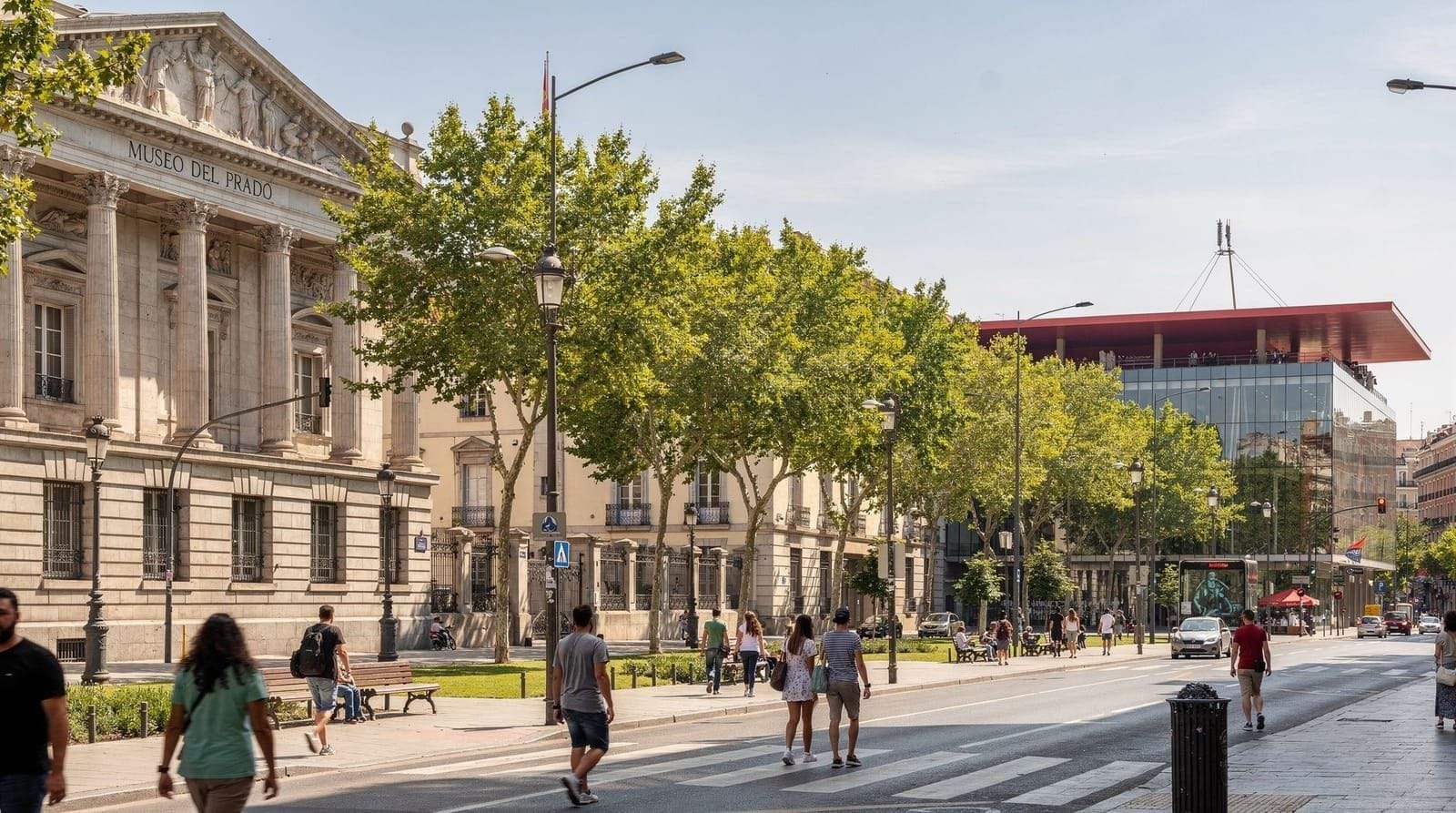
Address: Paseo del Prado 8, 28014 Madrid. The entrance is on the Paseo del Prado, directly facing the Prado across the street.
Getting there: Metro Line 2 (Banco de España), 5-minute walk down Paseo del Prado. Metro Line 1 (Atocha), 8-minute walk north. The Thyssen is positioned exactly between the Prado and the Reina Sofía — convenient for triangle visits.
Monday free entry (12:00–16:00): Arrive by 11:30 to queue ahead of the noon opening. This is significantly less crowded than Prado or Reina Sofía free windows because the Thyssen Monday window is less publicized.
Temporary exhibitions: Displayed on the ground floor and in the Carmen Thyssen extension. These are high-quality shows (past examples: comprehensive Gauguin and Toulouse-Lautrec retrospectives) but cost extra and require a separate or combined ticket.
Audio guide: €5 at the desk. The Thyssen app (free) covers the permanent collection. Worth using — the audio guide has unusually good commentary on individual works.
Café and restaurant: A ground-floor café-bar (reasonable prices, good coffee) and the La Terraza del Thyssen rooftop restaurant (dinner only; book ahead in summer). Both accessible without museum entry.
Combining the Thyssen with the rest of the Golden Triangle
The Thyssen sits at the midpoint of the Paseo del Prado museum walk — 5 minutes south of the Prado, 10 minutes north of the Reina Sofía. This makes it the logical middle stop in a triangle day, or the final stop if approaching from the Reina Sofía end.
For budget visitors using free windows: Reina Sofía on a Sunday (free 12:30–14:30 only) → lunch in Barrio de las Letras → Thyssen Monday (free 12:00–16:00, but note Sunday and Monday are different days) → Prado evening window (free 18:00–20:00 Monday–Saturday). This covers all three institutions for free across two days.
The Golden Triangle art walk guide provides walking routes between all three, with rest stops and context.
A guided tour covering all three Golden Triangle museums is the most efficient way to get orientation across all three collections in a single day.
What to prioritize if you only have 90 minutes
- Santa Catalina de Alejandría (Caravaggio, Room 11) — 10 minutes
- Portrait of Giovanna degli Albizzi Tornabuoni (Memling, Room 7) — 10 minutes
- Impressionist rooms 28–32 — 25 minutes (Monet, Degas, Renoir)
- Expressionist rooms 35–37 — 20 minutes (Van Gogh, Kirchner)
- Hotel Room (Hopper, Room 44) — 10 minutes
That leaves 25 minutes for transitions and anything that catches your eye.
The Carmen Thyssen extension and garden
The 2004 Carmen Thyssen collection — 200+ works donated by Carmen Cervera, the baron’s widow and Spain’s most prominent private art collector — occupies a wing adjacent to the main Villahermosa palace. The collection has a different character from the main permanent holdings: stronger on Spanish 19th-century painting, 20th-century Impressionist works Cervera collected independently, and a group of North American landscapes that complement the Hopper and Hudson River School material in the main building.
The small garden courtyard between the two buildings is a quiet retreat in summer — often missed by visitors who exit through the main Paseo del Prado entrance.
Honest advice for first-time visitors
The Thyssen can be done in 90 minutes if selective. Unlike the Prado (which tempts visitors into a 3-hour marathon that leaves them overwhelmed), the Thyssen’s moderate size and clear chronological layout make it tractable in a single focused visit. Use the floor plan to identify 8–10 works in advance, navigate to each, and spend real time rather than drifting through every room.
The Impressionist rooms alone justify the visit for anyone who has seen the Prado and Reina Sofía and wonders why Madrid’s art scene feels incomplete. The answer is the Impressionists — and they are all here, in rooms 28–32.
The free Monday window (12:00–16:00) is the Thyssen’s best-kept secret. Less publicized than the Prado or Reina Sofía free windows, it draws significantly smaller queues. For budget visitors building a free cultural Madrid day, this window is the entry point.
The La Terraza del Thyssen (rooftop restaurant, dinner only) has been one of Madrid’s better rooftop dining options in recent seasons — good food at prices below comparable rooftop venues in the city. Reservation essential in summer. The kitchen focuses on modern Spanish cuisine with seasonal ingredients.
Understanding the Thyssen in context
The Thyssen arrived in Madrid at a pivotal moment — the early years after Spain’s transition to democracy, when the country was asserting its place in European cultural life. Acquiring the Thyssen-Bornemisza collection was a statement: Madrid could compete with Paris, London, and Amsterdam as a destination for serious art. The €350 million purchase in 1993 was controversial at the time; in retrospect, most art economists consider it one of the shrewdest cultural acquisitions by any European government in the 20th century.
For visitors trying to understand why Madrid has the Golden Triangle status it does, the Thyssen is the piece that makes the argument most clearly. The Prado and Reina Sofía are impressive but they are national museums covering national history. The Thyssen is something rarer — an encyclopaedic collection with no nationalist agenda, assembled on pure aesthetic and historical grounds. Its presence in Madrid is a function of timing, money, and the persuasiveness of King Juan Carlos I’s invitation to the baron.
The Madrid for art lovers itinerary gives the Thyssen a full morning slot on Day 2, after the Prado is covered on Day 1 — the sequence allows you to move from Spain’s greatest national collection to its greatest private acquisition and understand each in the other’s light.
Practical security and bag policy
The Thyssen has a mandatory bag check for large bags and backpacks (standard museum policy, free). Small handbags and messenger bags may be carried in. The cloakroom is at the entrance level. Photography is permitted in the permanent collection; check individual room signage for current restrictions.
Accessibility: The Villahermosa building is fully accessible by lift from the main entrance. The Carmen Thyssen extension is also accessible. Wheelchairs are available at the entrance desk on request.
The museum shop: Located at the ground floor exit. Well-stocked with reproduction prints, art books, and design objects — slightly more commercial than the Prado shop but with some genuinely good Impressionist print options at reasonable prices.
Eating and drinking around the Thyssen
Within the building: The ground-floor café-bar (Paseo del Prado side) serves reasonable coffee and light food at prices below the Prado equivalent. Worth a stop for post-visit coffee.
La Terraza del Thyssen (rooftop, dinner only, summer): Book in advance — one of Madrid’s better-value upscale rooftop dining options. Modern Spanish cuisine, good wine list, views of the paseo below.
Nearby alternatives: The Barrio de las Letras starts two blocks east — significantly better food at lower prices than the Paseo del Prado tourist restaurants. For a quick post-Thyssen lunch, walk east along Carrera de San Jerónimo to the Huertas area.
The Neptune fountain terrace: Between the Thyssen and the Reina Sofía, the Neptune fountain area has café terraces in summer. These are priced at tourist-zone rates but the setting (fountain, plane trees, paseo atmosphere) is pleasant for a cooling drink.
Why the Thyssen is the best entry point for the Golden Triangle
Of the three Golden Triangle museums, the Thyssen is the most accessible for visitors who are not specialists in art history. The reasons:
Familiar works: The Impressionist and Post-Impressionist rooms contain works that most educated visitors will recognize — Monet, Renoir, Van Gogh are cultural references even for people who don’t regularly visit museums. Starting with the familiar and working outward to the medieval and Renaissance rooms is a more comfortable entry into art-museum culture than the Prado’s immediate immersion in 17th-century Spanish Baroque.
Manageable scale: At 3–4 floors rather than the Prado’s sprawl across two buildings, the Thyssen is legible on a first visit without a map study session beforehand.
The chronological clarity: The collection progresses from medieval to 20th century in a clear sequence that provides a useful art-history overview. After the Thyssen, the Prado’s focus on Spanish Golden Age and the Reina Sofía’s 20th-century Spanish modernism fit into this broader framework.
For first-time Madrid visitors who are uncertain about how to approach the three museums, the sequence Thyssen → Prado → Reina Sofía (on consecutive visits, not the same day) allows each subsequent museum to build on the preceding one.
Who the Thyssen suits best
First-time art museum visitors: Start here rather than the Prado. The chronological layout and the presence of familiar Impressionist names ease you into art-museum navigation before tackling the Prado’s denser Spanish Golden Age rooms.
Visitors on a tight schedule: At a manageable 3–4 floors, the Thyssen is the Golden Triangle museum most realistically covered in a single focused hour if time is genuinely short — neither the Prado nor the Reina Sofía compress as gracefully.
Impressionism and modern art enthusiasts: This is the only place in Madrid to see serious depth in Monet, Degas, Renoir, Van Gogh, and the Expressionists — reason enough on its own for anyone who has visited the Prado and Reina Sofía and felt something was missing.
Visitors who dislike crowded museums: The Monday free window and the Thyssen’s generally lower visitor numbers relative to the Prado make it one of the calmer major-museum experiences in central Madrid, even during peak tourist season.
How the Thyssen compares to the Prado and Reina Sofía
| Thyssen | Prado | Reina Sofía | |
|---|---|---|---|
| Focus | Eight centuries, all Western movements | Spanish/Flemish masters, Golden Age | 20th-century Spanish, Guernica |
| Free window | Monday 12:00–16:00 | Mon–Sat 18:00–20:00 | Mon, Wed–Sat 19:00–21:00; Sun 12:30–14:30; see museum free hours |
| Size | Moderate, 3–4 floors | Large, easy to spend 3+ hours | Large, focused wings |
| Best for | Impressionism, first-time art visitors | Velázquez, Goya, El Greco | Guernica, Picasso, Dalí, Miró |
Building a Golden Triangle day or two
If you have one day: Pick two of the three rather than rushing all three — the Prado and Thyssen pair naturally given their five-minute proximity, leaving the Reina Sofía for a separate visit when Guernica gets the focused time it deserves.
If you have two days: Day one, Prado morning plus Thyssen afternoon; day two, Reina Sofía with time to properly absorb Guernica and the 20th-century collection. This sequencing is exactly what the Madrid for art lovers itinerary recommends, and it avoids the museum fatigue that a single marathon day produces.
Budget approach across both days: Reina Sofía free window → lunch in Barrio de las Letras → Thyssen Monday free window (different day) → Prado evening free window. This sequence, detailed earlier in this guide, covers all three national collections without paying full admission to any of them.
Frequently asked questions about Thyssen-Bornemisza museum guide
What are the Thyssen Museum's opening hours?
Tuesday–Friday and Sunday 10:00–19:00 (Tuesday–Friday until 21:00 in July and August). Saturday 10:00–23:00, with free entry 21:00–23:00. Mondays 12:00–16:00 (free). Closed 1 January, 1 May and 25 December.How much does the Thyssen cost?
General €14, reduced €10 (over 65s, retirees, students), free on Mondays 12:00–16:00 and Saturdays 21:00–23:00. Under-18s free at all times. Combined permanent + temporary ticket available.What are the must-see works at the Thyssen?
Caravaggio's Santa Catalina de Alejandría, Dürer's Jesus among the Doctors, Hals' Family Group in a Landscape, Manet's Woman in a Tub, Degas' Swaying Dancer, and Hopper's Hotel Room. The Thyssen is the only place in Madrid with significant Impressionist and American Realist works.Is the Thyssen suitable for people who don't usually like museums?
More so than the Prado, for most people. The collection's chronological range (medieval to 1980s) and the inclusion of well-known modern works (Impressionists, Pop Art, Hopper) make it more accessible. The building is also smaller and easier to navigate without feeling overwhelmed.Can I visit all three Golden Triangle museums in one day?
Physically yes, but exhaustingly so. A rushed Golden Triangle day (Prado 10:00–12:30, lunch, Thyssen 14:00–16:00, Reina Sofía 19:00–21:00 free) covers all three but leaves you saturated. Better to spread over two days. The free windows make this economically viable.Is the Thyssen's Monday free window as crowded as the Prado's evening free window?
No — it's noticeably less crowded. The Thyssen Monday window (12:00–16:00) is less publicised than the Prado's daily evening free hours, so queues are typically shorter even on weekends. Arriving by 11:30 to queue ahead of the noon opening is still worthwhile in peak season, but the crush is generally lighter than at the other two Golden Triangle museums.
Top experiences
Bookable activities with verified prices and instant confirmation on GetYourGuide.