Lavapiés
Lavapiés is Madrid's most multicultural district — immigrant food, street art, Reina Sofía nearby, genuine neighbourhood life. Honest 2026 guide.
Madrid: Reina Sofía Skip the Line Ticket
Quick facts
- Metro
- Lavapiés (L3), Tirso de Molina (L1), Embajadores (L3/5)
- Character
- Multicultural, working-class, gentrifying, street-art rich
- Distance from Reina Sofía
- ~5 minutes on foot
- Best for
- Cheap diverse food, street art, La Tabacalera cultural centre
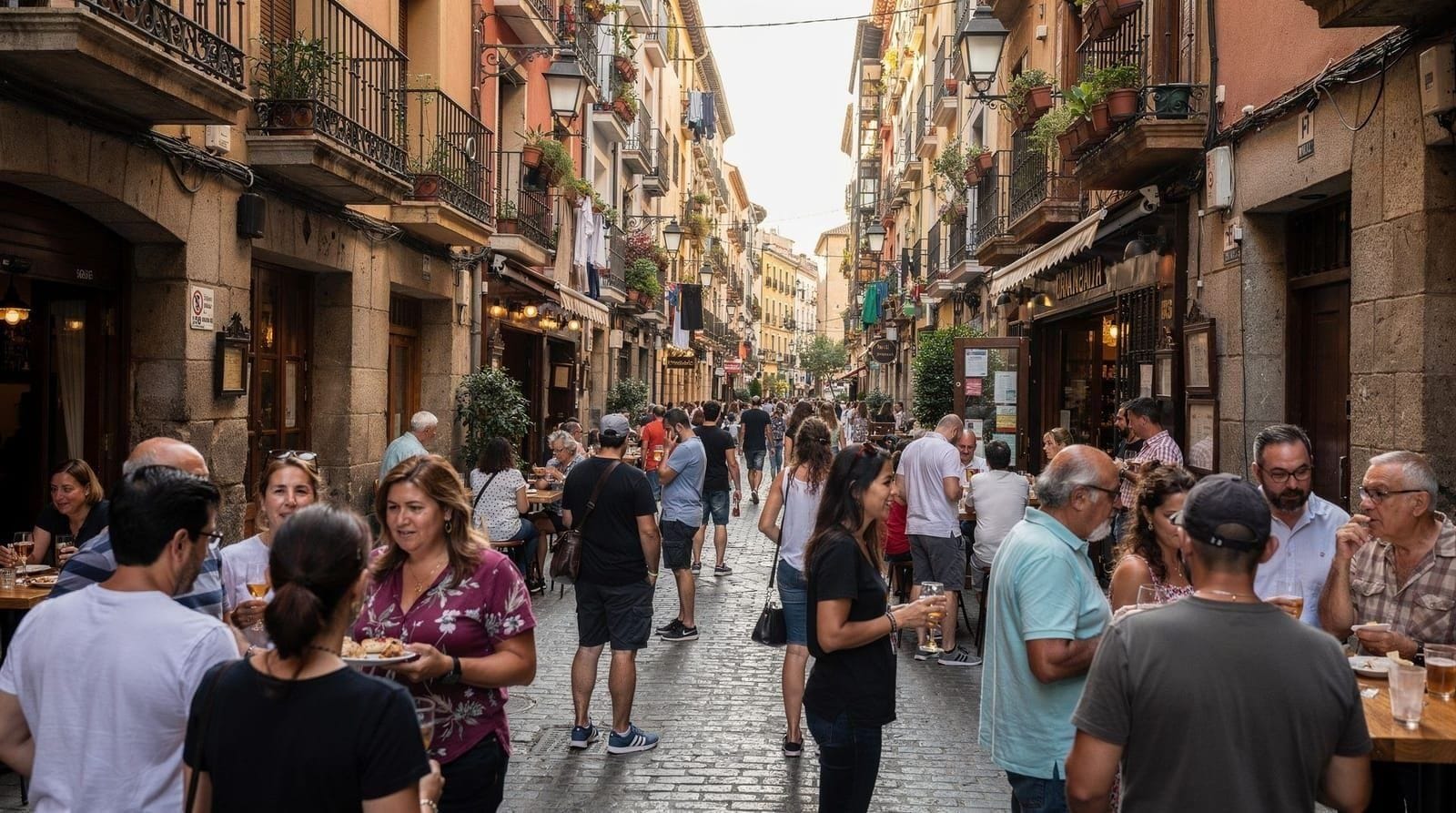
Lavapiés is the most complicated neighbourhood in central Madrid to describe fairly. It is working-class and gentrifying simultaneously, multicultural and contested, full of genuinely interesting food and simultaneously raw around the edges in ways that some visitors find energising and others find uncomfortable. No other neighbourhood in the city presents such a direct confrontation with the question of what happens when a historically poor district gains cultural capital from the outside.
The neighbourhood’s history is layered: it was the morería and judería (Moorish and Jewish quarters) in medieval Madrid, later a working-class barrio with a strong socialist political identity, then one of the first areas where immigrant communities from outside Spain settled in the 1990s and 2000s. The influx of Indian, Bangladeshi, Moroccan, Chinese, Senegalese, and Latin American residents transformed the food landscape in ways that Madrid’s official restaurant culture was slow to recognise. The cheap Indian restaurants around Calle del Mesón de Paredes, the Moroccan tea houses, and the West African grocery stores are a direct result of that demographic shift — a genuine economy, not staged multiculturalism.
Now, as with most urban areas with this story, rising rents are reshaping the mix again. Many immigrant-owned businesses that defined Lavapiés in the 2000s are under pressure from the same gentrification that is bringing specialty coffee and gallery spaces. The neighbourhood in 2026 exists in an unstable middle phase.
| Where | South of Barrio de las Letras, 5 min from Reina Sofía |
| Cost | Meals €6–€12; La Tabacalera and street art are free |
| Time needed | Half a day; combine with Reina Sofía and Barrio de las Letras |
| Getting there | Metro Lavapiés (L3), Tirso de Molina (L1), or Embajadores (L3/5) |
| Best time | Daytime for food and street art; standard caution after dark |
History: from medieval quarter to working-class barrio
The area now called Lavapiés has been continuously occupied since at least the 13th century, when it formed part of the Moorish and Jewish communities that lived outside the main Castilian settlement. After the Reconquista and the 1492 expulsion of the Jews, the neighbourhood changed character: its geographic position (on a slope descending south and east from the centre) and its relative distance from the royal palaces made it naturally working-class, and it remained so for five centuries.
By the 19th century, Lavapiés was associated with the majos — a working-class culture of distinctive dress and attitude that became romanticised by Goya in his Madrid tapestry cartoons. The majos were the lower-class counterpart to the aristocratic French fashions that were also fashionable in 18th-century Madrid; Goya painted both with affectionate precision.
In the 20th century, the neighbourhood was strongly Republican and anarchist during the Civil War — its working-class character made it a natural base for the left. The post-war period was difficult: poverty, overcrowding, and the Francoist state’s neglect of working-class districts.
The current multi-ethnic character dates from the 1990s, when Spain’s economy attracted immigration at a rate Spanish cities had not previously experienced. Lavapiés, with its low rents and central location, absorbed a significant proportion of this new population.
Eating in Lavapiés
The most interesting food in Lavapiés is not Spanish — it is the product of the neighbourhood’s immigrant communities, which have produced a genuine culinary ecosystem that Madrid’s Castilian-dominant food culture lacks almost everywhere else in the centre.
Indian restaurants around Calle del Mesón de Paredes: the highest concentration of subcontinental restaurants in central Madrid. Prices are significantly below tourist-area equivalents — €6–€10 for a main course, set menus at €8–€12, large portions. Quality varies considerably, but the best options (worth checking recent Google Maps reviews as the restaurant landscape shifts) are far better than most visitors would expect for the price. The specific kitchen skills — proper dhal, good biryanis, accurate spice levels — represent something genuinely absent from mainstream Madrid cuisine.
Bangladeshi tea houses and sweet shops: several establishments near the Lavapiés metro selling chai (milk tea), Bengali sweets, and pastries that have no equivalent elsewhere in the city. A €1 cup of chai here is a complete change of register from a café con leche, and worth seeking out even for visitors who wouldn’t normally think to stop for tea mid-walk.
Moroccan tea houses (Calle de la Fe and adjacent streets): mint tea, pastillas (pastry with egg or chicken), a quiet atmosphere that feels entirely different from the tapas-bar culture of La Latina five minutes to the west. The tea houses are typically visible from the street by the decorative Arabic script and the smell of mint through the door.
La Indiana (Calle de Jesús y María 4): a long-running Colombian restaurant that represents the Latin American community that arrived in the 1990s. Ajiaco (chicken and potato soup), bandeja paisa, and other Colombian staples at very affordable prices.
Bar Melo’s (Calle de Ave María 44): a neighbourhood classic serving the zapatillas (a type of large bocadillo) that are something of a Lavapiés institution. Cash only, no frills, unreservedly local. The pork-and-cheese zapatilla is the ordering benchmark. Expect a queue at peak lunch hours; it moves quickly.
El Estragón (Plaza de la Paja, at the La Latina boundary): one of Madrid’s oldest vegetarian restaurants, operating since 1979. Cheap, characterful, popular with the neighbourhood’s bohemian and artist community. The fixed lunch menu is particularly good value.
Casa Amadeo (Plaza de Cascorro 18, at the La Latina/Lavapiés boundary): a traditional taberna unchanged in character since the 1950s, famous for its caracoles en salsa (snails in a spiced sauce). The snails are a specific and intense flavour — this is a genuine local specialty rather than standard tourist tapas. If you want to understand what Madrid ate before tourism shaped the restaurant landscape, this is one of the most vivid surviving examples.
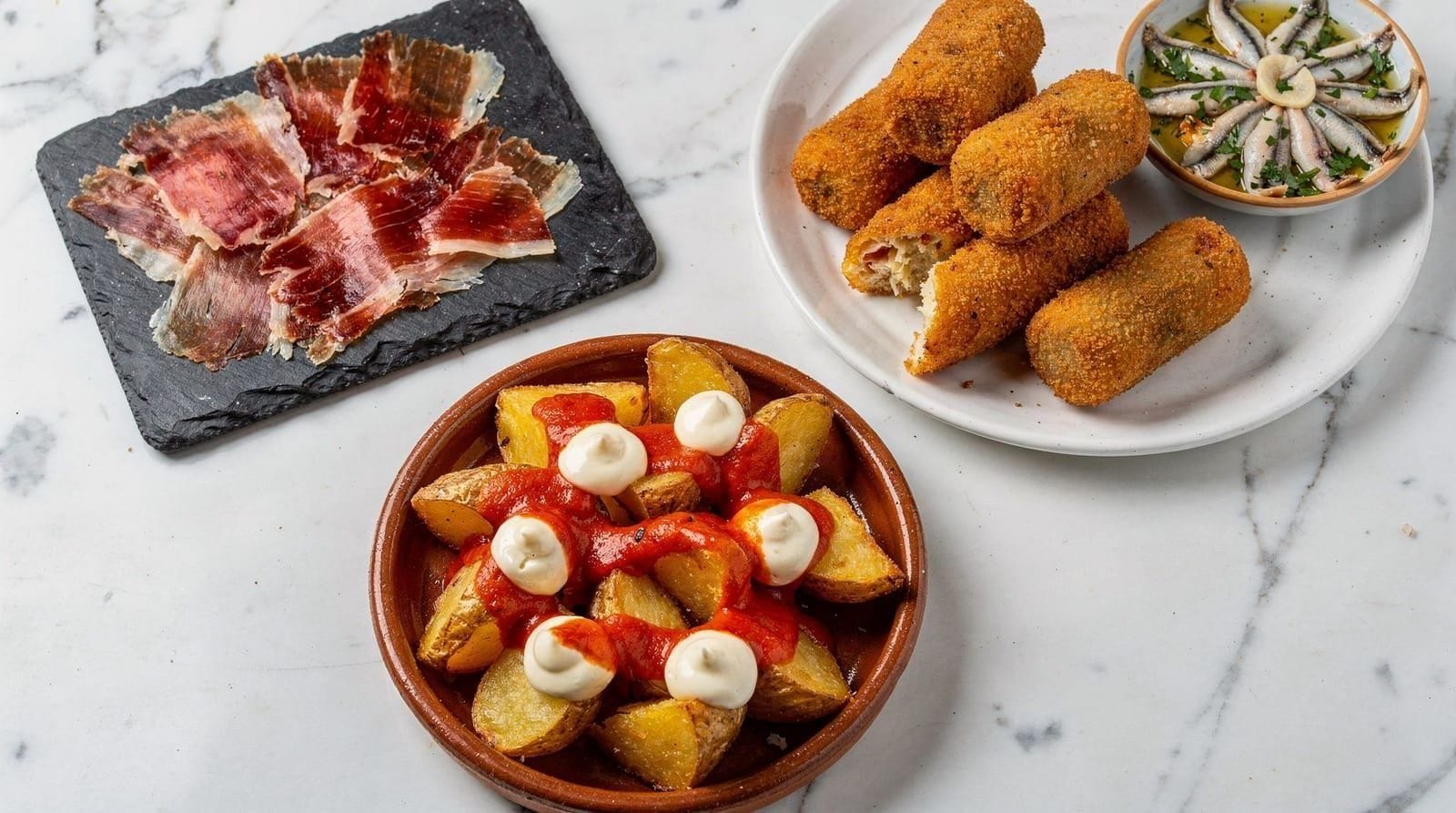
If you would rather eat your way through the area with someone who knows which doors to push, a guided tapas and wine tasting with a local host is a gentler way in than choosing blind. For the wider picture of how Madrilenians eat, the eat like a local guide and the Madrid tapas guide explain the rhythm of the day, and the food walking tour guide helps you decide whether a organised route is worth it for you. Travellers building a whole trip around meals will find the Madrid for foodies itinerary a useful frame, with Lavapiés as the counterweight to the more traditional tapas districts.
Street art
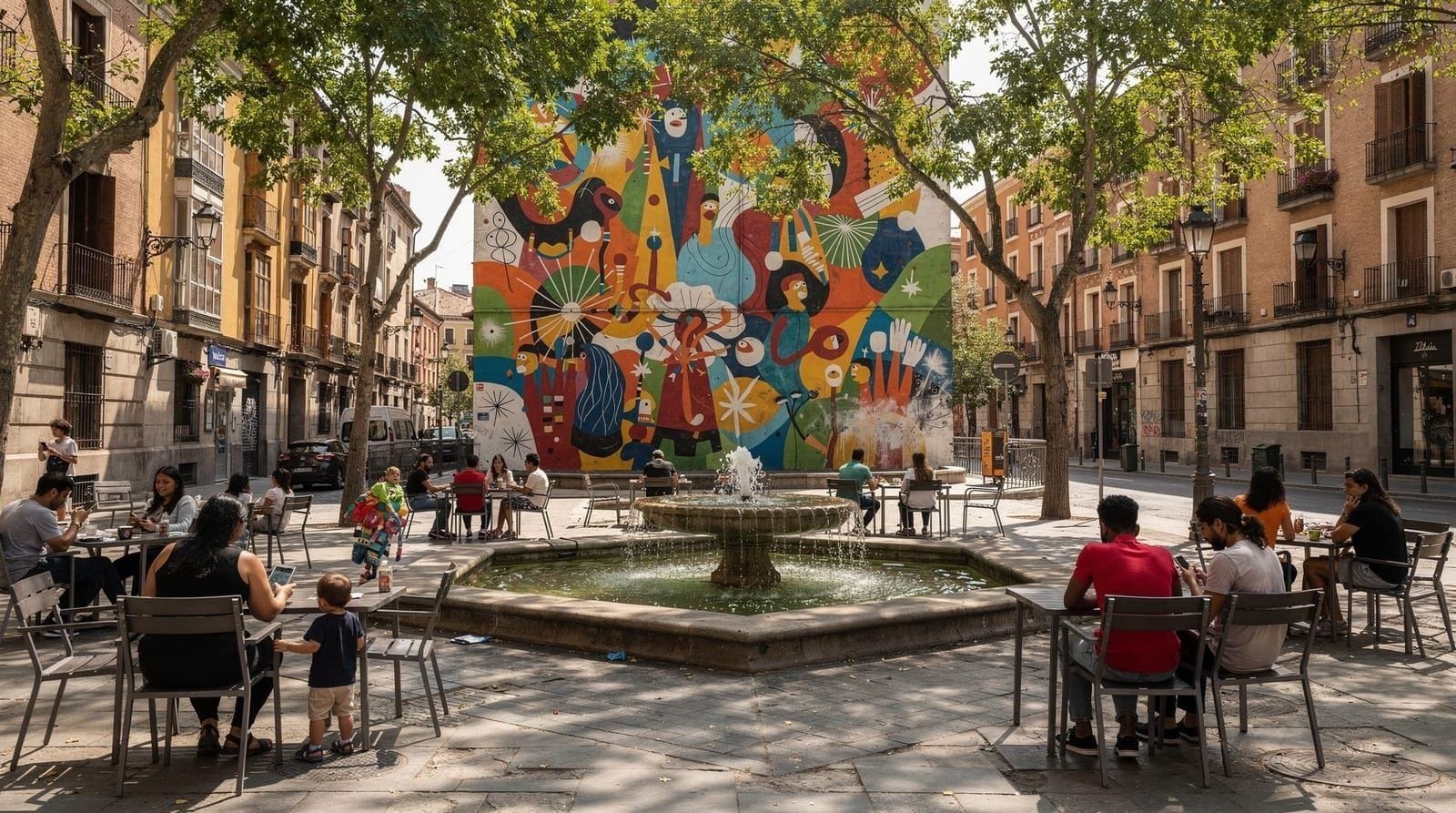
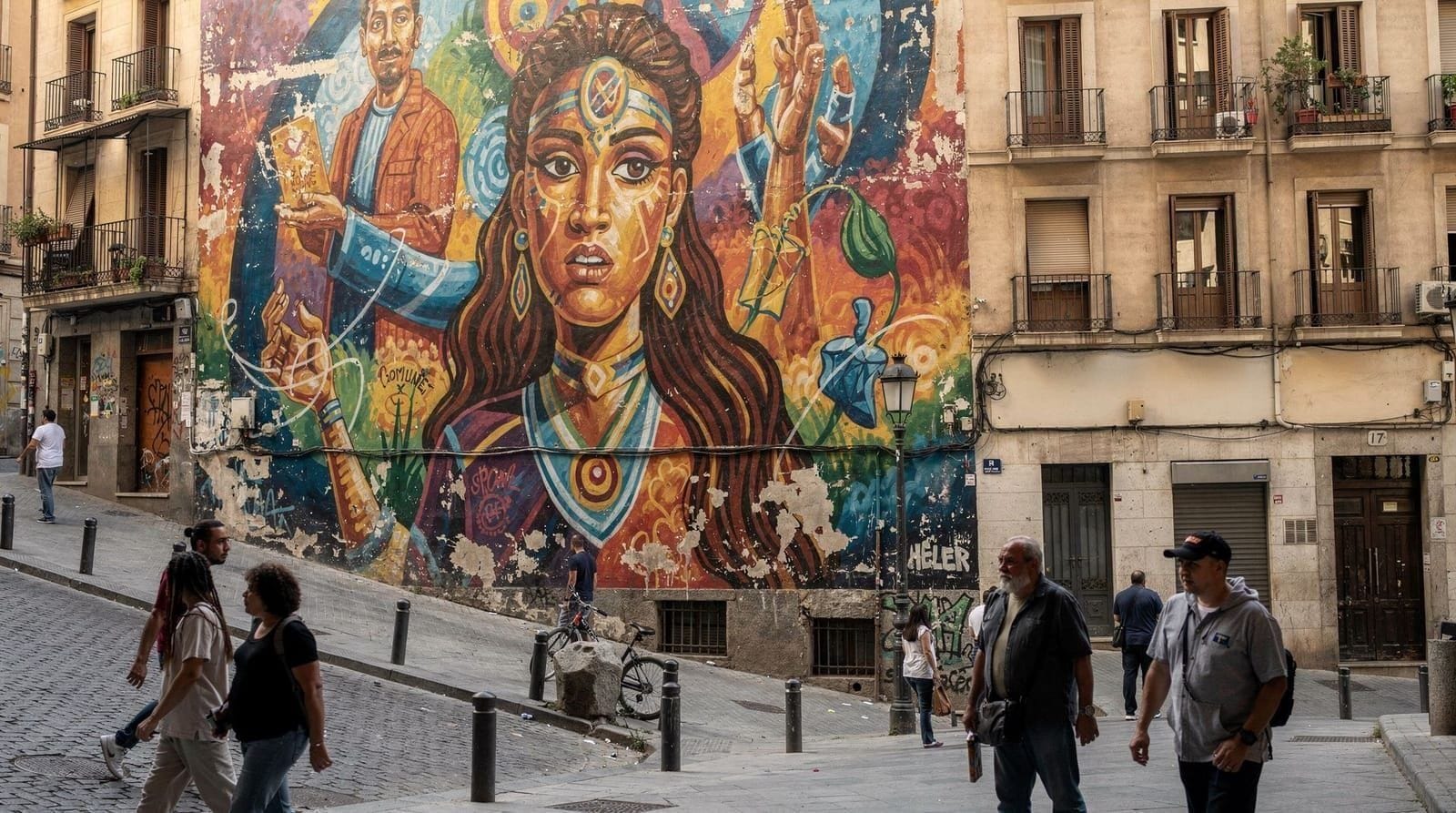
Lavapiés has a concentration of street art that is remarkable even by Madrid standards. The most dense area is around Calle Embajadores, Calle de la Calatrava, and the streets running south toward the Rastro/La Latina boundary. The art ranges from ephemeral stencil work to large-scale commissioned murals that have been on their walls for years.
Several works by internationally recognised artists are present — look for the large-scale Civil War-themed murals on Calle de Amparo, the political and identity-focused work on the side walls of apartment buildings around Calle de la Calatrava, and the ongoing accumulation of poster-art and wheatpaste work on the walls around the Lavapiés metro.
The street art in Lavapiés is more politically engaged than the decorative mural work in other parts of the city — themes of gentrification, immigration, solidarity, and anti-fascism recur. This reflects the neighbourhood’s political character and the artists’ relationships with it. No organised street art tour covers specifically Lavapiés, but walking the streets between the metro and Embajadores for 60–90 minutes will cover the main works. The street art in Lavapiés guide has a fuller walking route with specific mural locations.
La Tabacalera
The former Royal Tobacco Factory (Real Fábrica de Tabacos, built 1809) on Calle de Embajadores 53 has been operating as a self-managed social and cultural centre since 2010. The space is enormous — multiple halls, a large courtyard, a series of studios and workshop spaces — and hosts free events ranging from theatre and live music to contemporary art exhibitions and neighbourhood assemblies.
The philosophy is explicitly non-commercial; admission is always free. The political character is activist and anarchist in flavour — this is a space that debates gentrification in the neighbourhood it occupies, which gives it a certain self-awareness.
The building alone justifies a visit: the 19th-century industrial interior (brick vaulting, heavy timber structures, the scale of the original factory floor) is extraordinary and substantially different from the institutional architecture visible elsewhere in the city. Open most days from midday; check the social media channels for what is programmed during your visit.
Matadero Madrid
At the southern edge of Lavapiés, where the neighbourhood merges into the Arganzuela district along the Madrid Río park, the former city slaughterhouse (1910–1924) has been converted into one of Madrid’s most interesting contemporary arts spaces. Matadero Madrid (Paseo de la Chopera 14, also reachable via the Madrid Río park) hosts theatre, visual art, music, architecture exhibitions, design shows, and has a large outdoor space that serves as a community park.
The conversion has preserved the original industrial buildings — low brick sheds with metal roofs, organised around a central axis — and the result is a campus that works both as an arts complex and as public space. Admission to most areas is free or low-cost (€3–€8 for specific performances). The outdoor terrace café is one of the best in this part of the city.
Matadero and La Tabacalera together give Lavapiés a genuine claim to being Madrid’s most active alternative-culture district — both are self-consciously non-commercial, both programme work that would not fit comfortably in the city’s mainstream museums, and both are within walking distance of each other and the rest of the neighbourhood, making a combined arts-and-food afternoon straightforward to plan.
Reina Sofía museum skip-the-line ticket — Guernica, Dalí, 20th-century artMarkets and food shopping
Beyond the restaurants, Lavapiés has some of the best food shopping in central Madrid for anyone interested in ingredients rather than just meals. The Indian and Bangladeshi grocery shops around Calle del Mesón de Paredes stock fresh curry leaves, whole spices, and rice varieties genuinely hard to find elsewhere in the city. Mercado de San Fernando (Calle Embajadores 41), the neighbourhood’s historic covered market, has been partially revitalised with a mix of traditional stalls (fish, meat, produce) and newer food and drink vendors, giving it a more contemporary, mixed-use character than a purely functional local market.
It is less polished and less expensive than Mercado de San Miguel, and considerably more useful if you actually want to buy ingredients rather than browse. For the more famous, more tourist-oriented side of the market story, the Mercado de San Miguel guide and the guide to Madrid’s markets put the two in context, so you can choose the one that matches what you came for.
The Reina Sofía connection
The Museo Reina Sofía (Calle Santa Isabel 52, Metro Atocha) sits at the northeastern corner of Lavapiés — five minutes on foot from the Lavapiés metro station. This proximity makes the neighbourhood a natural pre- or post-museum destination. The museum’s free entry window (Mon and Wed–Sat 19:00–21:00, all day Sunday until 14:30) aligns well with a morning walk through Lavapiés followed by a late-afternoon museum visit.
A logical Lavapiés day: arrive at 10:00, walk the street art route (90 minutes), lunch at an Indian restaurant or Casa Amadeo (13:30–14:30), explore La Tabacalera if there is programming, arrive at the Reina Sofía at 19:00 for the free window. This covers the Guernica, the Dalí rooms, and the permanent collection without a ticket cost.
The Reina Sofía guide covers what to prioritise inside, particularly how to approach Guernica in the context of the room and the artist’s biography. If the free window does not fit your schedule, the museum free hours guide compares the options across the city, and the Golden Triangle art walk shows how the Reina Sofía fits with the Prado and Thyssen. Art-focused visitors can build a whole stay around it with the Madrid for art lovers itinerary. Those who prefer context over wandering alone can look at a guided small-group visit to the Reina Sofía.
The Indian community and food
The Indian and Bangladeshi community in Lavapiés dates primarily from the late 1990s and early 2000s, when Spain’s construction boom attracted immigration on a scale the country had not previously experienced. Many of those who settled came from Gujarat (western India) and Bangladesh; their commercial presence is concentrated in Lavapiés because the rents were low and the neighbourhood had existing immigrant infrastructure.
The Indian grocery shops around Lavapiés serve both the community and an expanding group of Madrileños interested in South Asian cooking: fresh curry leaves (widely unavailable elsewhere in Madrid), whole spices, dals, rice varieties, and frozen subcontinental prepared foods. For a cook interested in Indian food, an hour in these shops is more useful than any specialty food hall.
The restaurants range from the genuinely home-kitchen-style (lunch boxes, fixed menus, aimed at the community) to slightly more polished establishments aimed at a mixed clientele. The best — and this requires recent local knowledge rather than a fixed recommendation because the restaurant landscape shifts — offer food that bears no resemblance to the adapted “Spanish-Indian” food that appears in tourist-facing restaurants in other parts of the city.
The neighbourhood’s political character
Lavapiés has a long tradition of left-wing political activism — the neighbourhood’s working-class socialist history of the early 20th century has continued in different forms through the anarchist squatter movement of the 1980s–90s, the anti-gentrification campaigns of the 2000s–10s, and the neighbourhood assemblies that continue to organise around housing rights. The 15-M (Indignados) movement of 2011 — Spain’s equivalent of the Occupy movement — had significant presence in Lavapiés.
This political character is visible in the neighbourhood: in the graffiti, in the notices posted on walls about community meetings and tenant rights, in the banners hanging from balconies. It is not performative political tourism; it is an actual political community that uses its neighbourhood as its organisational space.
The tension between this community and the gentrification brought by rising rents and new arrivals (including, honestly, some of the tourists who come to see the “authentic” neighbourhood) is one of the live debates in contemporary Madrid urbanism.
Safety and navigation
Lavapiés has a mixed reputation. The main tourist-facing areas (around the metro, toward the Reina Sofía) are fine during daylight hours and busy evenings. The neighbourhood has improved considerably in the past decade as investment has flowed in.
The narrower side streets toward the south and west — particularly at night — require standard urban awareness. The neighbourhood has a higher rate of street-level drug dealing (primarily cannabis, not visible in the main tourist areas) than the adjacent districts. This does not constitute a specific danger for visitors but is part of the neighbourhood’s character.
For a broader view of which parts of the city call for more attention, the pickpockets and safe areas guide is a sensible companion, and the Lavapiés neighbourhood guide goes further into practical detail. Since the food here is so affordable, the neighbourhood also fits naturally into a Madrid on a budget plan.
During daylight hours, Lavapiés is one of the more interesting walks in central Madrid — the street art, the food shops, and the genuine neighbourhood character are all present and accessible.
Lavapiés compared to other multicultural European neighbourhoods
Visitors who know districts like Kreuzberg in Berlin or Belleville in Paris will find a familiar structure in Lavapiés — a historically poor, centrally located neighbourhood that absorbed successive waves of immigration and became, almost as a side effect, one of the city’s more interesting food and culture districts. What distinguishes Lavapiés is its scale: at roughly 1 km across, it is small enough to walk end to end in 15–20 minutes, which concentrates the contrasts (the mosque and the specialty coffee shop, the tenant-rights poster and the gallery opening) into a much tighter physical space than the sprawling equivalents in larger capitals. This compactness is part of why a half-day visit works so well here in a way it might not in a similarly characterised but more spread-out district elsewhere.
Getting to Lavapiés
Metro: Lavapiés (Line 3) is the central station. Tirso de Molina (Line 1) for the northern edge and El Rastro area. Embajadores (Lines 3/5) for the southern section and the street art district.
On foot from La Latina: 10 minutes east, a short and pleasant walk that most visitors do without a second thought. From the Reina Sofía: 5–10 minutes west. From Barrio de las Letras: 10 minutes south. Combined with the Retiro and Jerónimos area, these four neighbourhoods form a natural full-day walking loop through central Madrid’s most contrasting districts.
Frequently asked questions about Lavapiés
Is Lavapiés safe for tourists?
During daytime hours and busy evenings, yes. The main streets are active and the neighbourhood does not have the specific tourist-targeting crime (pickpocketing, scams) of Sol or Gran Vía. Standard urban precautions apply in the quieter streets after dark.
What is the best food in Lavapiés?
The Indian restaurants around Calle del Mesón de Paredes for the best value and something genuinely different from mainstream Madrid cuisine. Casa Amadeo for the most traditional working-class Madrid experience (caracoles). La Tabacalera’s café when open.
Is La Tabacalera worth visiting?
If you have any interest in alternative culture, self-organised arts spaces, or 19th-century industrial architecture, yes. The programming is unpredictable — check their social media before visiting. Entry is always free.
How does Lavapiés connect to other neighbourhoods?
It borders La Latina to the west (10 minutes on foot), Barrio de las Letras to the north, the Arganzuela district (Madrid Río, Matadero) to the south. A morning walking from La Latina through Lavapiés to the Reina Sofía is one of the best half-days available in central Madrid.
Is Lavapiés worth a dedicated visit or just a walkthrough?
A dedicated few hours is worthwhile — the food, street art, and cultural centres reward slowing down rather than passing through on the way to Reina Sofía.
Is the gentrification of Lavapiés visible?
Very much so — and the neighbourhood is largely self-aware about it. The contrast between the established immigrant food economy and the new specialty coffee shops opening on the same streets is visible on almost every block. Whether this constitutes “interesting tension” or “sad displacement” depends on perspective, but it is honest to note both.
Top experiences
Bookable activities with verified prices and instant confirmation on GetYourGuide.