Madrid de los Austrias and Plaza Mayor
Madrid's oldest quarter — Plaza Mayor, Royal Palace, Almudena Cathedral, Habsburg alleyways. Real history, honest practicalities, no tourist traps.
Madrid: City Walking Royal Palace Skip the Line
Quick facts
- Also called
- Habsburg Quarter / Madrid de los Austrias
- Metro
- Sol (L1/2/3), Ópera (L2/5), La Latina (L5)
- Plaza Mayor arcades
- 237 arches, built 1617–1619
- Royal Palace
- 3,418 rooms, ~50 open to public, ticket ~€18
- Best time to visit
- Early morning (before 10:00) or late afternoon
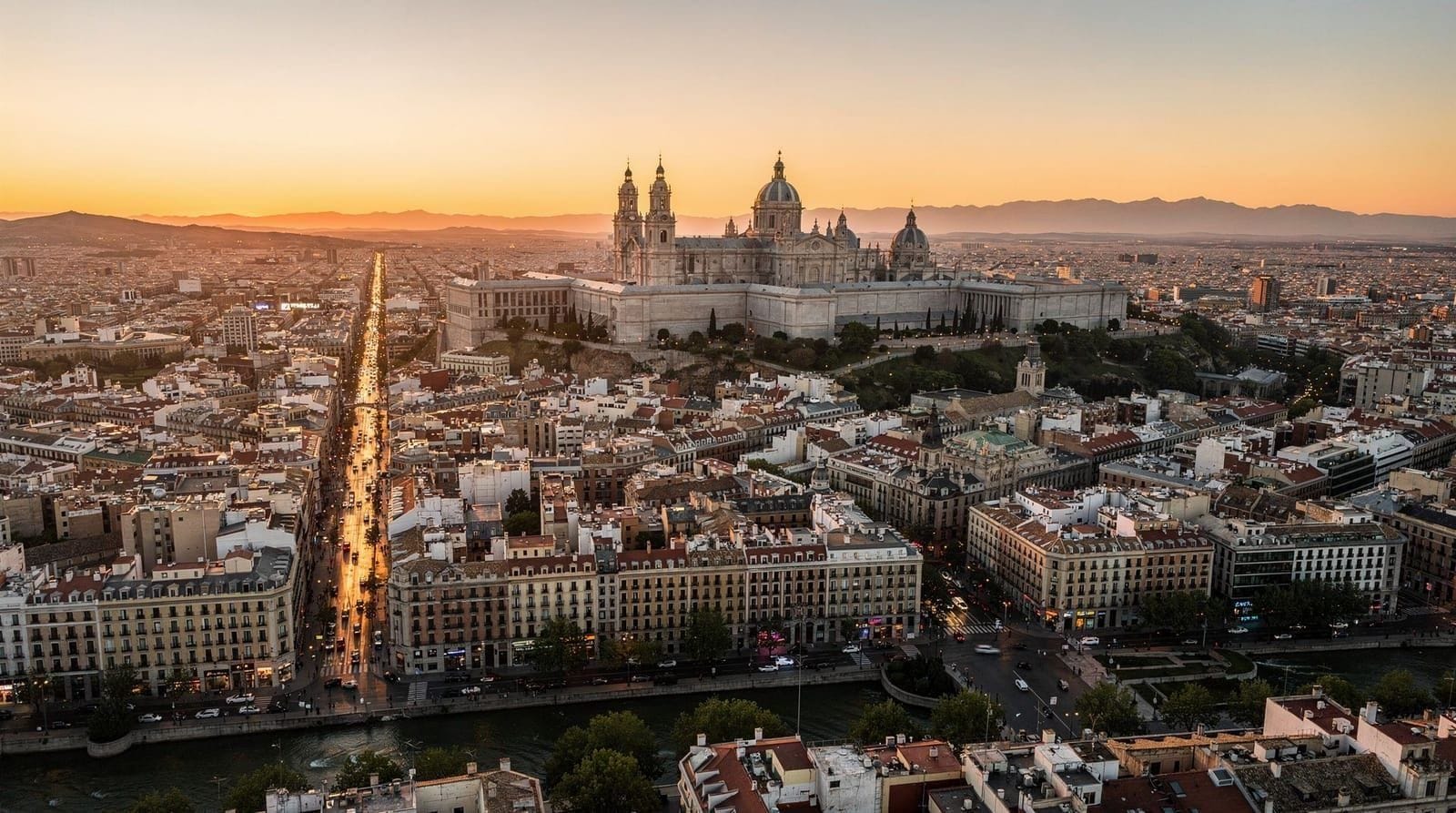
The oldest part of Madrid is also the most photographed, the most historically dense, and — if you approach it correctly — genuinely impressive rather than merely tourist-crowded. The Habsburg quarter covers the area roughly bounded by the Royal Palace to the west, Puerta del Sol to the east, Gran Vía to the north, and Calle Segovia to the south. It is where Madrid’s story begins and where most visitor itineraries correctly start.
The nickname “Madrid de los Austrias” refers to the Habsburg dynasty (the House of Austria — Habsburgo in Spanish) that made Madrid the capital of the Spanish Empire in 1561 under Philip II. Before then, Madrid was a minor Castilian town of perhaps 20,000–30,000 people, less important than Toledo, Valladolid, or Sevilla. Within a generation of becoming the capital, it had transformed into the administrative centre of the world’s largest empire: the Americas, the Philippines, large parts of Italy and the Low Countries, and the Portuguese territories after the union of 1580. The architecture — the slate-and-brick Herreran style that distinguishes Habsburg Madrid from the Baroque elsewhere — is the physical legacy of that transformation.
| Where | Central Madrid, between the Royal Palace and Puerta del Sol |
| Getting there | Metro Sol (L1/2/3) or Ópera (L2/5) |
| Royal Palace ticket | ~€18 standard (guided visit €26) |
| Time needed | Half to full day |
| Best time | Early morning (before 10:00) or late afternoon |
The Habsburg architectural style
The specific visual character of the Habsburg quarter is worth understanding before you walk it. The Herreran style (named after Juan de Herrera, Philip II’s principal architect, who also designed El Escorial) is defined by:
- Grey granite and dark slate: Madrid’s Habsburg buildings are in a cooler, more austere palette than the warm stone of Salamanca or the white of Seville.
- Sharp geometric forms: towers with slate spire roofs, flat facades, minimal ornament. An anti-Baroque aesthetic that expressed a specific ideology — Philip II’s vision of power as serious rather than pleasure-seeking.
- Slate-roofed towers at corners: the characteristic silhouette visible on buildings throughout the quarter.
The best surviving examples in Madrid are the Plaza Mayor buildings, the Torre de los Lujanes (one of the oldest buildings in Madrid, 15th century), and several of the palace buildings around the Royal Palace.
For the wider story of how the two dynasties shaped the city, the Habsburg and Bourbon history guide gives the context that makes these streets easier to read, and the Madrid royal sites itinerary links the quarter with the other royal residences around the capital.
Plaza Mayor
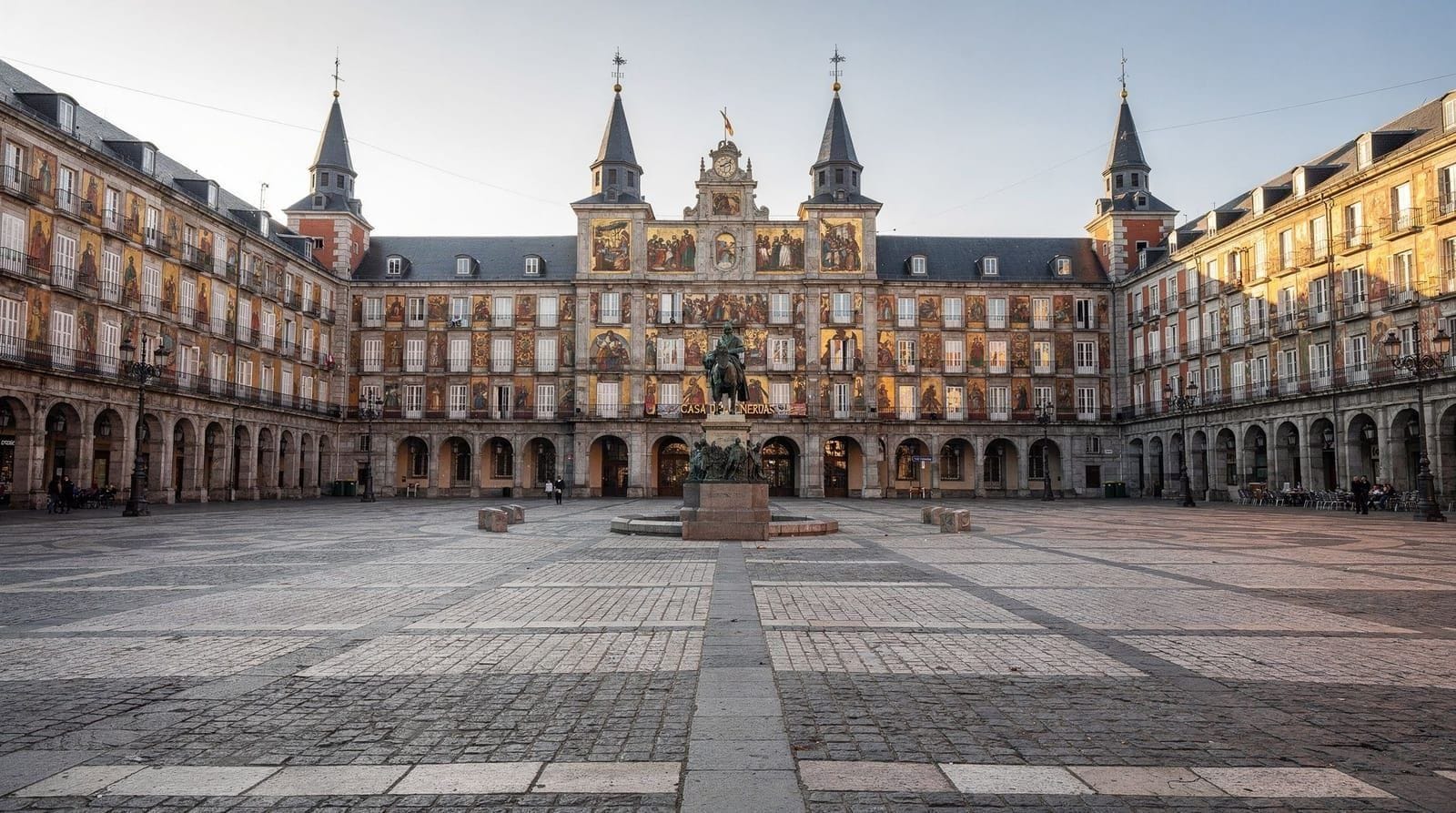
The great arcaded square (238 m × 122 m) was built between 1617 and 1619 under Philip III, who sits in the central equestrian bronze (added 1616, though the existing statue is a copy). The original design by Juan Gómez de Mora unified the square architecturally — all the surrounding buildings follow the same pattern of arcaded ground floors and slate-roofed towers.
The history of the square: markets on Tuesdays and Saturdays (from the 13th century onwards), bullfights (corridas de toros) until the Retiro became the standard venue, autos-da-fé (public inquisition proceedings — the most famous, in 1680, involved 118 prisoners including 21 who were burned in effigy), royal proclamations, coronation celebrations, and state executions. The square has served as the stage for public life in Madrid for four centuries.
Today it is primarily a tourist gathering point. The restaurants under the arcades are notably overpriced — plan to eat elsewhere. But the architecture of the square — the unified Herreran facades, the Philip III equestrian statue, the Casa de la Panadería frescoes — is worth 20–30 minutes.
Casa de la Panadería (the building with the frescoed facade on the north side): the frescoes were painted in 1992 when the building was renovated; the original 1619 facade was plain. The current painted scenes reference Madrid’s mythology and history. Inside there is a tourist information office and changing exhibition space.
What not to do at Plaza Mayor: eat at the restaurants. The markup is significant — €18–€24 for paella that costs €13–€16 two streets away. Walk five minutes south to La Latina for much better food at lower prices.
If you want the square in more depth, the dedicated Plaza Mayor guide covers its details, and the Plaza Mayor overpriced guide and the blog post on Plaza Mayor restaurants explain why the arcade menus disappoint. Puerta del Sol is the next landmark east, a short walk away.
Royal Palace (Palacio Real)
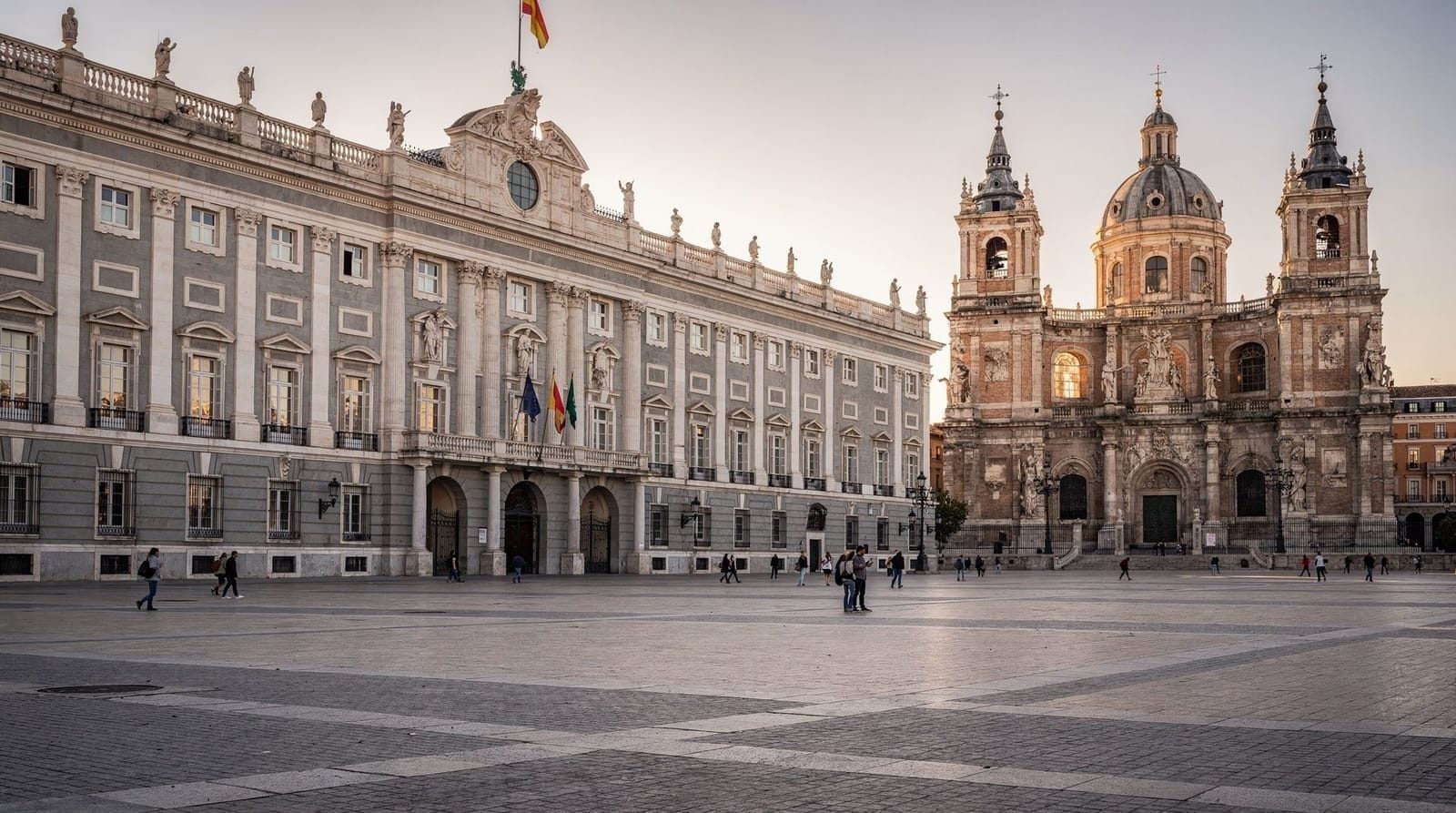
The largest palace in Western Europe by floor area (135,000 m², compared to Versailles’ 67,000 m² open to visitors), completed in 1764 under Charles III following the destruction of the previous Habsburg palace by fire in 1734. The Bourbon replacement that Charles III commissioned was deliberately designed to exceed every other palace in Europe — the brief given to the Italian architect Filippo Juvara (and completed by Giovanni Battista Sacchetti after Juvara’s death) was to build something that would announce Spain’s continued power.
The royal family has not lived here since 1931 (they reside at the Palacio de la Zarzuela, outside the city), but it remains the official palace and is used for state ceremonies including the swearing-in of governments and the reception of foreign heads of state.
Of the 3,418 rooms, approximately 50 are open to visitors on the standard route:
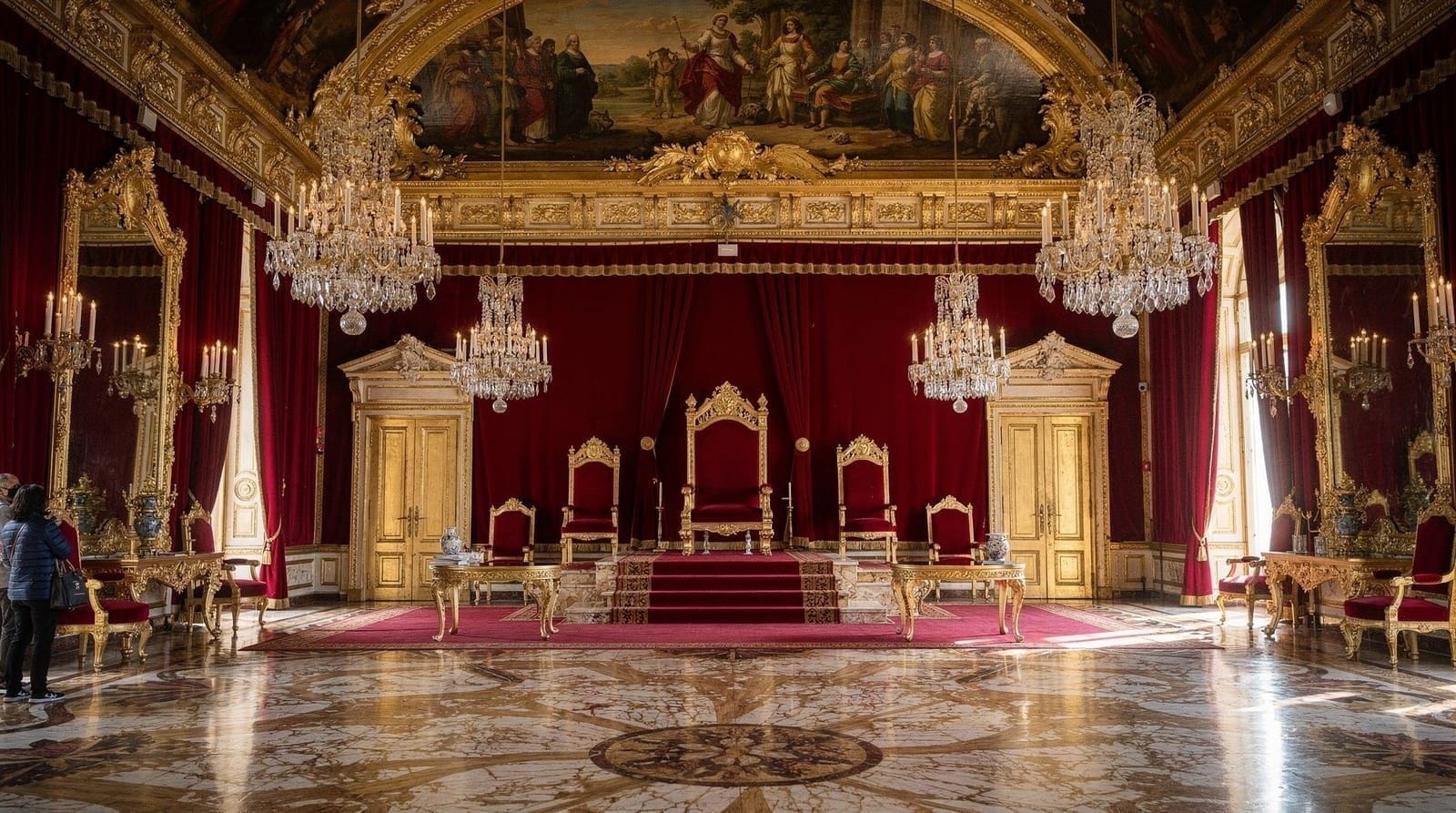
Throne Room (Salón del Trono): the most spectacular room in the palace — the Tiepolo ceiling fresco (The Apotheosis of the Spanish Monarchy, 1762–1764) is one of the largest Tiepolo works in existence and completely overwhelming in person. The two lion-guarded thrones date from 1651. This is the room where foreign ambassadors still present their credentials to the king.
Royal Armoury (Real Armería): one of the finest collections of European armour in the world. The armour of Charles V (Holy Roman Emperor, the most powerful man of the 16th century) is displayed in full equestrian form. Philip II’s armour, several sets commissioned for royal children (small enough to hold), and the ceremonial parade armour of multiple monarchs are all here.
Gasparini Room (Salón de Gasparini): the most extravagant decorative room in the palace — embroidered silk walls, mosaic floors, painted stucco ceiling, all in an overwrought 18th-century Rococo aesthetic that represents the absolute limit of that style. Exhausting and extraordinary.
Royal Pharmacy and Royal Kitchen: in the complex but not always part of the standard route — ask at the ticket office.
Ticket: €18 (standard); guided visit €26. The ticket queues in summer can be 45–60 minutes; online booking with a timed entry window is strongly recommended. Skip-the-line guided tours are available and worth considering for the context they provide — the palace’s rooms are difficult to read without knowing what the ceremonial function of each was.
Royal Palace skip-the-line guided tour with expert Habsburg commentaryOur full Royal Palace guide walks through the rooms in visiting order, which helps if you prefer to go without a guide. Anyone who enjoys the Armoury and the Throne Room may also like the Descalzas Reales convent, another royal foundation a short walk away.
Almudena Cathedral
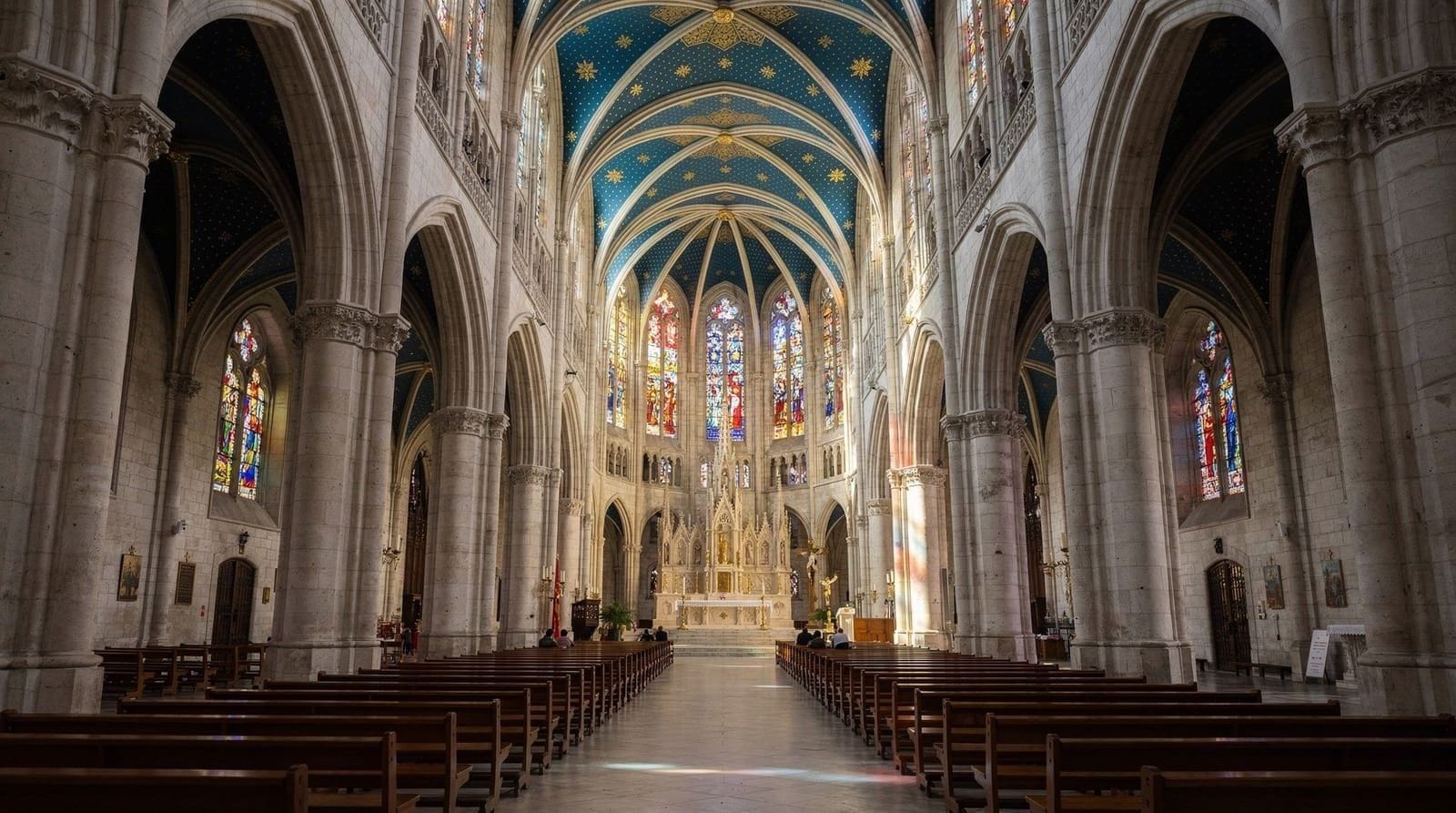
The cathedral adjacent to the Royal Palace was consecrated in 1993 — a remarkable lateness for a capital city cathedral, explained by centuries of religious controversy, financial difficulties, and political obstacles. Construction began in 1879 under the neo-Gothic design of Francisco de Cubas; the neo-Gothic approach was abandoned in the 1940s and the main body was completed in a neo-Romanesque/neo-Classical style under Fernando Chueca Goitia, with the current design finished in 1993.
The result is architecturally awkward — a building whose exterior (neo-Gothic) does not match its interior (surprisingly bright neo-Classical with colourful modern glass) — but historically interesting precisely because of this incoherence. It is a cathedral built in the modern era while pretending to be medieval, in a city that wanted a grand cathedral but kept being interrupted by financial crises, civil wars, and political revolutions.
Entry: free. The crypt is the oldest part of the building (1883–1911) and has a genuinely medieval atmosphere — low vaulting, atmospheric lighting, a marked contrast to the bright interior above. The rooftop tour (limited spaces; check prices and booking on the cathedral’s official website) gives views over the palace gardens and the Manzanares valley that are among the best available in this part of the city.
The Almudena Cathedral guide goes further into the building’s history and the practicalities of the crypt and rooftop.
The Habsburg alleyways: between Plaza Mayor and the Palace
Some of the most interesting walking in the quarter is between Plaza Mayor and the Royal Palace — a series of quiet streets and small squares that give a better sense of historic Madrid than the main tourist axes:
Plaza de la Villa: a small three-sided square containing the most concentrated assembly of historical architecture in Madrid. The Casa de la Villa (1640–1696, the old city hall), the Torre de los Lujanes (late 15th century, one of the oldest buildings in Madrid, used as a prison for Francis I of France after his capture at Pavia in 1525), and the Casa de Cisneros (1537, plateresque style) form three sides. The square is completely undemanding of tourists and consequently very quiet — one of the best places in the old city to sit for a few minutes without a crowd.
Calle Mayor: the main artery connecting Sol to the Royal Palace; less interesting architecturally than the side streets but historically the most important commercial street in Madrid. Shops have operated here continuously since the 16th century.
Calle Bailén: running along the western edge of the quarter, with views from the bridge over the Manzanares valley and the Casa de Campo park. The Viaducto de Segovia (built 1934) crosses the valley here; the views from the parapet toward the palace and cathedral are among the best in the city.
Jardines de Sabatini: the formal gardens laid out on the north side of the Royal Palace (open daily, free). Originally designed in the 18th century, the current garden is a 1930s recreation. Neat hedges, fountains, and views up to the palace facade.
Further west the Temple of Debod and the Parque del Oeste make a natural extension if you still have energy, particularly toward sunset. The literary quarter and Cervantes guide covers the neighbouring streets to the east.
Sobrino de Botín: the world’s oldest restaurant
Sobrino de Botín (Calle de los Cuchilleros 17) holds the Guinness World Record as the oldest continuously operating restaurant in the world, established 1725 and in continuous operation since. Hemingway ate here (he mentions it in The Sun Also Rises); so have several Spanish monarchs. The wood-fired Castilian oven (still operational) is the centrepiece of a menu built around cochinillo asado (roast suckling pig) and cordero asado (roast lamb). Both dishes require the kind of oven heat and long cooking that restaurant ovens cannot replicate.
Cost: €30–€45 per person for a full meal. The atmosphere — the cramped cellar rooms, the age of the walls, the kitchen visible through a hatch — is unlike any other restaurant in Madrid. Book well in advance for weekend dinners.
Walking tour of Madrid’s old town: Habsburg quarter, Plaza Mayor, SolThe Christmas market on Plaza Mayor
From late November to 6 January, Plaza Mayor hosts one of Madrid’s most atmospheric seasonal markets. The stalls sell ornaments, nativity figures (particularly the belén figurines used in the elaborate nativity scenes that are a major Christmas tradition in Spain), sweets, and seasonal crafts. The market is more traditional and less artisan-craft-focused than northern European equivalents.
The best time for the market is an evening visit — the square lit with Christmas lights, the frescoed facade of the Casa de la Panadería illuminated, vendors selling roasted chestnuts and mulled wine (ponche) on a cold December night. The atmosphere in the evening is genuinely attractive and worth experiencing if you are in Madrid in the Christmas period.
The Inquisition and the auto-da-fé
The Plaza Mayor’s history includes one of the most dramatic and disturbing uses of a public space in early modern Europe: the auto-da-fé, or public act of faith, in which the Inquisition announced and carried out its sentences against those convicted of heresy, apostasy, or related charges. The most significant auto-da-fé held in the plaza was in 1680, presided over by Charles II and his court, involving 118 accused prisoners: 21 were burned in effigy (meaning they had escaped or died before sentence was carried out), 18 were burned in person, and the remainder received flogging, galley service, or imprisonment.
This is not a comfortable history, and the square’s architecture — the same facades that now frame tourist restaurants and Christmas markets — was designed with these events in mind. The Casa de la Panadería provided the royal viewing balcony; the crowds on all sides watched a judicial spectacle that served as both religious enforcement and public theatre.
The Inquisition used public spaces precisely because visibility was part of the deterrent function: the message was communicated to the entire population, not just to the accused. Understanding this history changes the character of the square in a way that no amount of architectural appreciation can — the beautiful uniformity of the arcades was the setting for state-sanctioned violence, and acknowledging that is part of engaging honestly with what the space is.
Eating and drinking: honest assessment
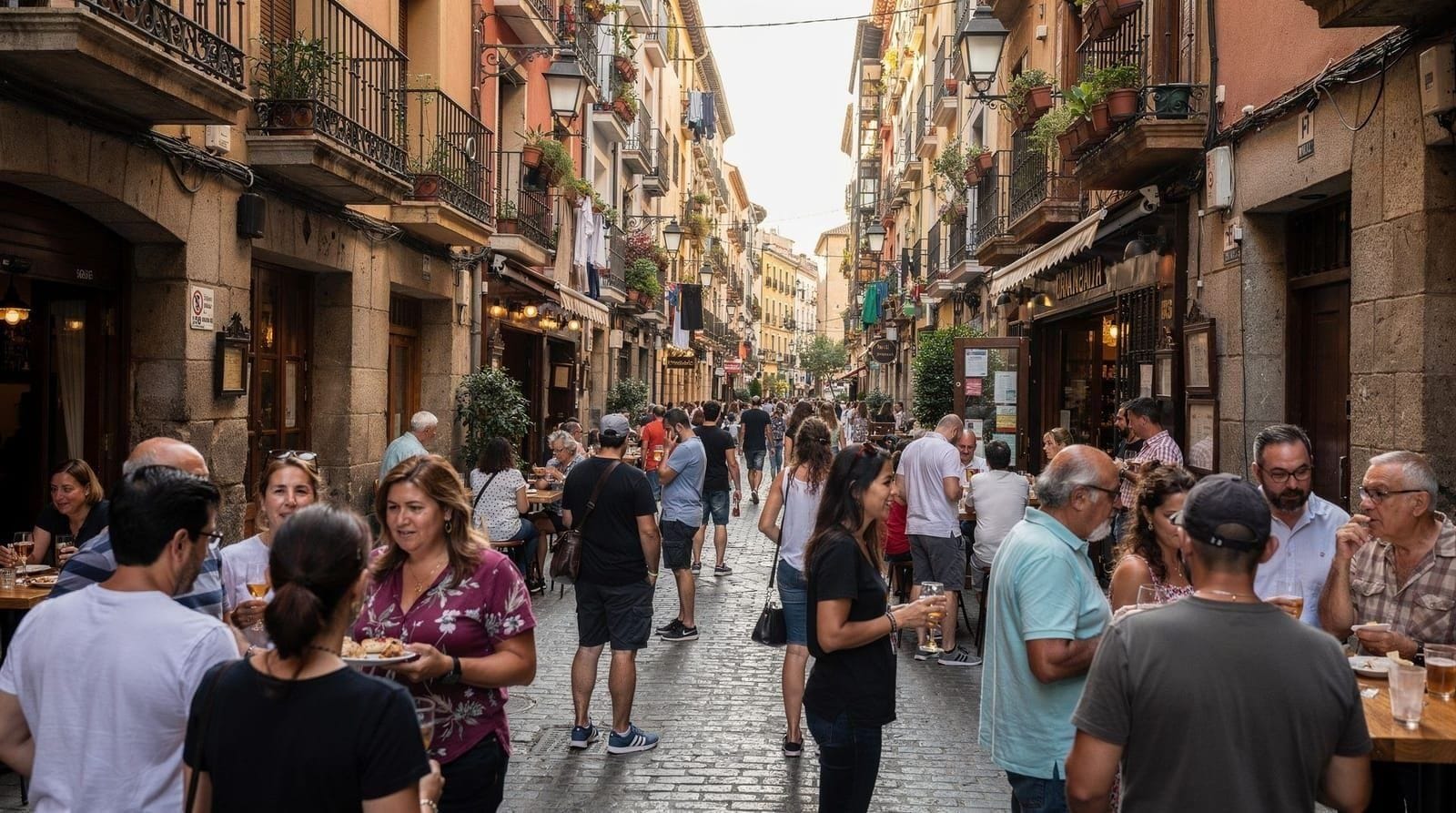
The Habsburg quarter has a reputation for tourist restaurants that is, unfortunately, mostly justified on the main tourist axes (Plaza Mayor, Calle Mayor, Puerta del Sol approach). Move one street away and the price-quality ratio improves immediately:
Calle Cuchilleros and Cava Baja (both immediately south of Plaza Mayor): the cave restaurants carved into the hillside on Calle Cuchilleros are old Madrid institutions — Sobrino de Botín is the most famous, but several others serve traditional Castilian cooking. Cava Baja is the La Latina tapas street, 5 minutes south of the square.
Mercado de San Miguel (Plaza de San Miguel, one minute from Plaza Mayor): the 1916 cast-iron market converted to a food hall — shellfish, jamón, croquetas, wine. Prices are above neighbourhood equivalents but the produce quality is high. See the Mercado de San Miguel guide for what to order, and the where to eat in La Latina guide and tourist menu traps for choosing well elsewhere.
A half-day route through the quarter
For visitors with limited time, this sequence covers the essentials without backtracking: start at Plaza Mayor (20–30 minutes, ideally before 10:00), walk west through Plaza de la Villa (10 minutes, quiet and usually empty), continue to the Royal Palace (1.5–2 hours including the Armoury), cross to the Almudena Cathedral and its crypt (30–45 minutes), then finish with a walk down Calle Bailén for the Manzanares valley views before dropping south into La Latina for tapas. The full sequence takes 4–5 hours at an unhurried pace and ends exactly where the best early-evening food is.
Travellers building a longer stay can slot this route into the Madrid first weekend itinerary or the Madrid 3 days itinerary, both of which place the Habsburg quarter on day one for good reason — everything else in central Madrid radiates from here.
Getting there
Metro: Sol (Lines 1/2/3) or Ópera (Lines 2/5) both put you within 5 minutes of Plaza Mayor. On foot from the Prado: about 20–25 minutes along Calle Atocha.
For route planning across the whole city, see the Madrid metro guide, and for the neighbouring district the Sol and Gran Vía destination page. The Madrid overview places the quarter in the context of the whole city. Beware of crowded spots here; the pickpockets and safe areas guide has practical advice.
Frequently asked questions about Madrid de los Austrias
What is the best time to visit Plaza Mayor?
Early morning (07:30–09:30) before the tour groups arrive, or late afternoon (18:00–20:00). The midday tourist peak in summer is genuinely intense. The Christmas market in the evening is the most atmospheric seasonal visit.
Are the restaurants at Plaza Mayor worth it?
No — charge 30–50% more than equivalents two streets away for similar quality. Eat in La Latina (five minutes south on foot) or Barrio de las Letras (ten minutes east) and visit Plaza Mayor before or after.
How long does the Royal Palace visit take?
1.5–2 hours for the standard route. With the Armoury and the Almudena Cathedral crypt, budget 2.5–3 hours. Book online to avoid the ticket queue.
Is the Habsburg quarter walkable from the Prado?
Yes — about 20–25 minutes on foot via Calle Atocha. A logical full-day pairing: Prado in the morning (10:00–13:00), Habsburg quarter and Royal Palace in the afternoon, La Latina for tapas in the early evening.
What is the best small square in the quarter?
Plaza de la Villa — three historically significant buildings, no tourist density, a genuine sense of old Madrid. Takes 10 minutes to see and is completely free.
Do I need to book the Royal Palace in advance?
Strongly recommended, especially April–September. Online booking with a timed entry slot avoids the door queue, which regularly runs 45–60 minutes in summer. Winter mornings sometimes allow walk-up entry without a long wait, but booking ahead removes the risk entirely.
Can I see the Habsburg quarter and La Latina in one visit?
Yes, and it’s the natural pairing — La Latina begins about five minutes south of Plaza Mayor on foot. A common pattern is Habsburg-quarter sightseeing in the morning and early afternoon, then La Latina’s Cava Baja tapas bars from early evening onward, particularly on a Sunday after El Rastro.
Top experiences
Bookable activities with verified prices and instant confirmation on GetYourGuide.