Barrio de Salamanca
Barrio de Salamanca is Madrid's upscale district — Serrano for shopping, the Thyssen nearby, some of the best fine dining in Spain. Honest 2026 guide.
Madrid: Thyssen Guided Entry
Quick facts
- Metro
- Serrano (L4), Velázquez (L4), Goya (L2/4)
- Character
- Wealthy, conservative, excellent restaurants, luxury retail
- Key streets
- Calle Serrano, Calle Velázquez, Calle Ortega y Gasset
- Distance from Thyssen
- ~15 minutes on foot southwest
- Best for
- Luxury shopping, fine dining, Sorolla Museum, Thyssen
Barrio de Salamanca is Madrid’s most affluent central district — the uptown quadrant northeast of the Prado, laid out in the 1860s on an orthogonal grid plan by the Marqués de Salamanca (the property developer and speculator, no relation to the Castilian university city). The neighbourhood was built wealthy, stayed wealthy, and its streets still reflect the original intention: wide avenues, handsome late 19th-century apartment buildings in yellow stone, tree-lined sidewalks, and a concentration of high-end retail and restaurants that serves both Madrid’s upper middle class and the visitors who come specifically for the shopping.
| Where | Northeast of the Prado, central Madrid |
| Getting there | Metro Serrano or Velázquez (L4), Goya (L2/4) |
| Distance to Thyssen | ~15 minutes on foot southwest |
| Time needed | Half a day shopping; full evening for dinner |
| Best for | Luxury shopping, fine dining, Sorolla Museum |
In several respects, Salamanca is the opposite of Lavapiés, which is geographically only 2 km away. That contrast is part of what makes Madrid interesting: it is a city that contains both, visibly, without one having been entirely subordinated to the other. If you want to see the other side of that contrast, the Lavapiés guide and the Lavapiés neighbourhood page describe a district with a completely different rhythm.
Salamanca also fits easily into a wider plan. The Madrid destination overview shows how the districts relate to one another, and the best area for first-time visitors guide helps you decide whether to stay here or elsewhere. For a more detailed walk through the streets covered on this page, see the Salamanca district guide.
The neighbourhood’s history
The Marqués de Salamanca (José de Salamanca y Mayol, 1811–1883) was the most important property developer in 19th-century Madrid — a speculator who made and lost several fortunes, built and went bankrupt from railways, banks, and land deals. His most lasting legacy was the neighbourhood that now bears his name. Beginning in the 1860s, he developed the land east of the Paseo de Recoletos into a planned residential district for the bourgeoisie, with wide streets on a regular grid (unusual for Madrid), modern apartment buildings with lifts and indoor plumbing, and a character quite different from the medieval organicism of the city centre.
The neighbourhood attracted Madrid’s professional and merchant classes from the start, and the character has been reinforced by every subsequent wave of development. The French and Bauhaus embassy buildings (many of the foreign missions chose Salamanca for their early 20th-century construction), the luxury retailers who followed the affluent residents, and the fine dining restaurants that serve this clientele have all accumulated into one of the more coherent upscale urban environments in southern Europe.
Shopping: the Milla de Oro
The “Golden Mile” of Madrid’s luxury retail runs along Calle Serrano and spreads across Calle Velázquez, Calle Ortega y Gasset, and Calle José Ortega y Gasset. The concentration of Spanish and international luxury brands genuinely rivals similar streets in Milan or Paris:
Calle Serrano: Spain’s flagship shopping street. Loewe (the Spanish luxury leather goods house, founded 1846 in Madrid), Massimo Dutti, the upper-range Zara, and international brands including Gucci and Louis Vuitton. The Spanish brands are meaningfully better represented here than in their international franchises, and prices on certain Spanish luxury goods (particularly Loewe) are noticeably lower than in London, Paris, or New York.
Casa del Libro (Calle Serrano 29): one of Madrid’s best general bookshops with a genuinely good English-language section, covering travel, Spanish history, fiction, and reference. Worth visiting for books in English if your hotel or apartment is in this part of the city.
El Corte Inglés Serrano (Calle Serrano 47 and 52): two adjacent branches of the national department store, more focused on fashion and homeware than the Callao branches. The food hall in the basement is one of the best in the city for high-quality Spanish products — jamón ibérico, aged cheeses, excellent wines, conservas (tinned fish and vegetables) — at prices that represent genuine value for the quality. Useful for gifts and provisions.
Calle Ortega y Gasset: the ultra-high end — Chanel, Hermès, Bulgari, Dior, and several Spanish luxury brands. The street is worth walking for the window displays even if you are not buying; the concentration of flagship stores is rare.
Calle Velázquez: connects Serrano and Goya and has a more mixed character — antique dealers, art galleries, the kind of specialist shop (fine stationery, bespoke leather goods) that exists in this neighbourhood because the clientele supports it.
Loewe: the Spanish luxury house
A specific note on Loewe because it is genuinely significant and underrecognised outside Spain. Founded in 1846 as a leather goods workshop in Madrid, Loewe is one of the few true Spanish luxury houses — the Spanish equivalent of Hermès, in the sense that it represents genuinely excellent craft in leather rather than licensed aspirational goods. The brand is now owned by LVMH (since 1996) and has been elevated further under the creative direction of Jonathan Anderson since 2013.
The Serrano store is the original flagship, with the broadest range of bags, accessories, and clothing. For non-EU visitors, the price differential between Loewe in Madrid and Loewe in London or New York is substantial (roughly 10–20% lower before VAT reclaim). For EU visitors, the range is the primary advantage.
If shopping is the main reason for your visit, the dedicated Salamanca luxury shopping guide goes deeper into individual streets and stores. Visitors who prefer high-street fashion and department stores over designer flagships will find the Gran Vía shopping guide a useful counterpoint, and the souvenirs guide suggests more modest things to bring home.
Mercado de la Paz
The neighbourhood’s food market on Calle Ayala 28 is one of the best traditional food markets in Madrid — serving the residential community rather than tourists. The fish hall (open from 09:00, best before 10:30 for selection), the cheese vendors, the jamón counters, and the fresh pasta and bread stalls are of consistently high quality. The market is worth visiting simply for the atmosphere of a functioning neighbourhood market; buying is incidental. Open Tuesday–Saturday mornings.
Restaurants: the case for Salamanca dining
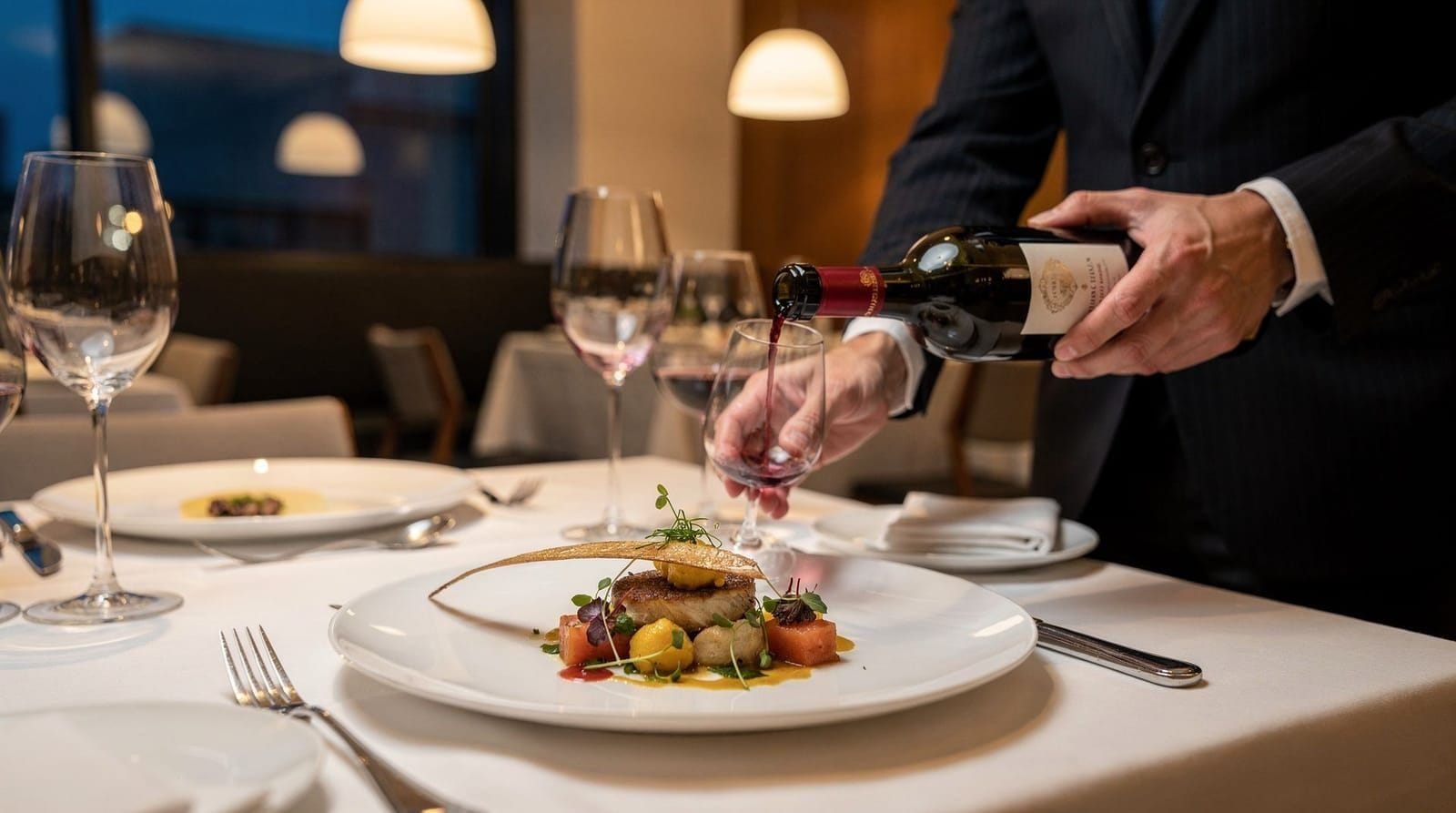
Barrio de Salamanca has the highest concentration of serious restaurants in the city — not tourist-facing, not casual tapas bars, but the establishments where the city’s food culture operates at its most skilled and most ambitious.
Santceloni (Hotel Hesperia, Paseo de la Castellana 57): two Michelin stars, Spanish tasting menu with Catalan ingredients and classical technique. The most technically accomplished restaurant in the neighbourhood and one of the best in Madrid. Expect €100–€150 per person for the full tasting menu with wine pairing. Reserve well in advance.
Saddle (Calle de Amador de los Ríos 6): one Michelin star, European-classical cooking interpreted through Spanish seasonal ingredients. More relaxed in atmosphere than Santceloni, equally precise. €70–€100 per person.
DiverXO (Hotel NH Collection Eurobuilding, Calle de Padre Damián 23): three Michelin stars, the most celebrated and boundary-pushing restaurant in Madrid, run by chef Dabiz Muñoz. A completely different kind of experience from the classical restaurants — creative, playful, technically demanding, and considerably expensive (€250–€300 per person for the tasting menu). Reservations released months in advance; the waiting list is long.
Arzábal (Calle Hermanos Bécquer 4): a modern tapas bar operating above the standard La Latina format — the menu is creative, the ingredients are excellent, and the prices are mid-range rather than fine dining (€25–€45 per person). Good for a Salamanca meal without the Michelin commitment.
La Daniela (Calle del General Pardiñas 21): the essential recommendation for anyone who wants to understand Madrid’s signature dish without paying fine-dining prices. La Daniela serves cocido madrileño — the three-course chickpea-and-meat stew that is Madrid’s closest equivalent to a national dish. The format: first the broth with vermicelli noodles (sopa de fideos), then the chickpeas and vegetables, then the various meats (usually including morcilla, chorizo, tocino, and chicken). Price approximately €25 per person including bread and a glass of wine. Thursday lunch is the most traditional service; book ahead.
El Paraguas (Calle Jorge Juan 16): consistently good traditional Spanish cooking in an elegant setting. The rabo de toro (ox tail) and the Iberian pork dishes are the menu’s strengths. Mid-to-upper range (€35–€55 per person).
Guided tour of the Thyssen-Bornemisza Museum — comprehensive collection visitThe Thyssen-Bornemisza Museum connection
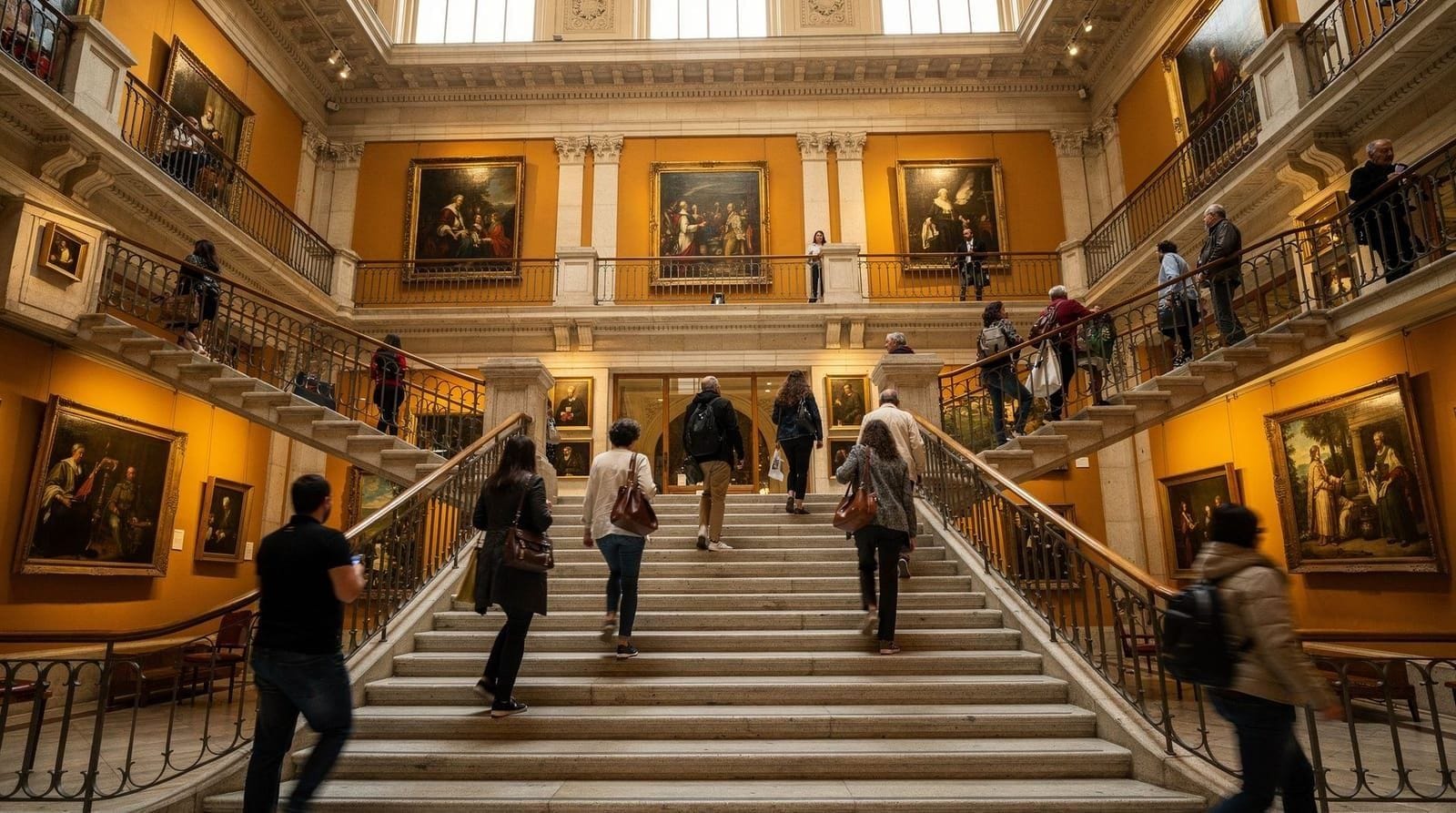
The Thyssen-Bornemisza (Paseo del Prado 8) sits at the southwestern corner of Barrio de Salamanca, making the neighbourhood the natural base for a combined museum visit and lunch or dinner. The museum’s free Monday window (permanent collection) is particularly aligned with a Salamanca morning: arrive at the Thyssen at 10:00, spend 2–3 hours, then walk 15 minutes northeast to a Salamanca restaurant for the late lunch (14:00–15:00).
The Thyssen collection covers European painting from medieval to 20th-century in a way that neither the Prado nor the Reina Sofía does — the Prado focuses on Spanish and Habsburg-commission art; the Reina Sofía on 20th-century. The Thyssen’s early Netherlandish painting (the Jan van Eyck Virgin and Child, Petrus Christus), the German Expressionists (Kirchner, Grosz), the American 20th-century (Hopper, Rothko, Lichtenstein), and the 17th-century Dutch rooms are all genuinely exceptional.
The full Thyssen-Bornemisza museum guide covers the rooms in order, while the Prado museum guide and the Reina Sofía museum guide explain how the three collections complement each other. Anyone planning all three in one trip will find the Golden Triangle art walk and the Madrid for art lovers itinerary a practical way to sequence them, and the museum free hours guide helps you time the visits.
Sorolla Museum (adjacent to Salamanca)
The Museo Sorolla (Calle del General Martínez Campos 37, at the Chamberí boundary) is one of the most pleasurable smaller museums in Madrid and practically adjacent to the Salamanca neighbourhood. The original house-museum of Joaquín Sorolla (1863–1923), with his own collection, personal effects and the Andalusian garden he designed, is closed for renovation (source: the museum’s official site, Ministry of Culture). Only the new building (Calle Zurbano 68, opened 15 October 2026) is open, free of charge: Tuesday–Saturday 09:30–20:00, Sunday and public holidays 10:00–15:00, last entry 45 minutes before closing, closed Monday, 1 and 6 January, 1 May, 24, 25 and 31 December. Check the museum’s official site for news of the house’s reopening.
Sorolla’s paintings are a different kind of light from the Prado’s darkness — Mediterranean, warm, impressionist-influenced. His beach paintings, particularly those from Valencia and San Sebastián, represent one of the most distinctive visual languages in Spanish art.
The museum pairs naturally with a slow morning in Salamanca followed by lunch in the neighbourhood. See the Sorolla Museum guide for more on the museum and how to fit it into a day.
Antique dealers and art galleries
The streets between Velázquez and Castellana — particularly Calle Villanueva, Calle Hermosilla, and Calle Jorge Juan — have a concentration of antique dealers and contemporary art galleries that makes the neighbourhood worth exploring for buyers and browsers alike. The antique trade has operated here for decades because the neighbourhood’s wealthy residents both supply and demand high-quality items; the turnover of estate contents and the curatorial standards of the better dealers are notably high.
Arte Feria ARCO (when it occurs, usually early March): Madrid’s international contemporary art fair is held at IFEMA, but many of the participating galleries have permanent spaces in Salamanca. The weeks around ARCO (Arte Contemporáneo) are particularly lively in the neighbourhood’s gallery circuit.
The antique shops specialise across different periods — several focus on Spanish silver and ceremonial objects, others on European furniture from the 18th–19th centuries, and a few on early 20th-century Spanish posters and graphic art. Prices are set rather than negotiated (unlike El Rastro), and the quality of attribution and description is generally reliable.
Cafeterías and traditional bars
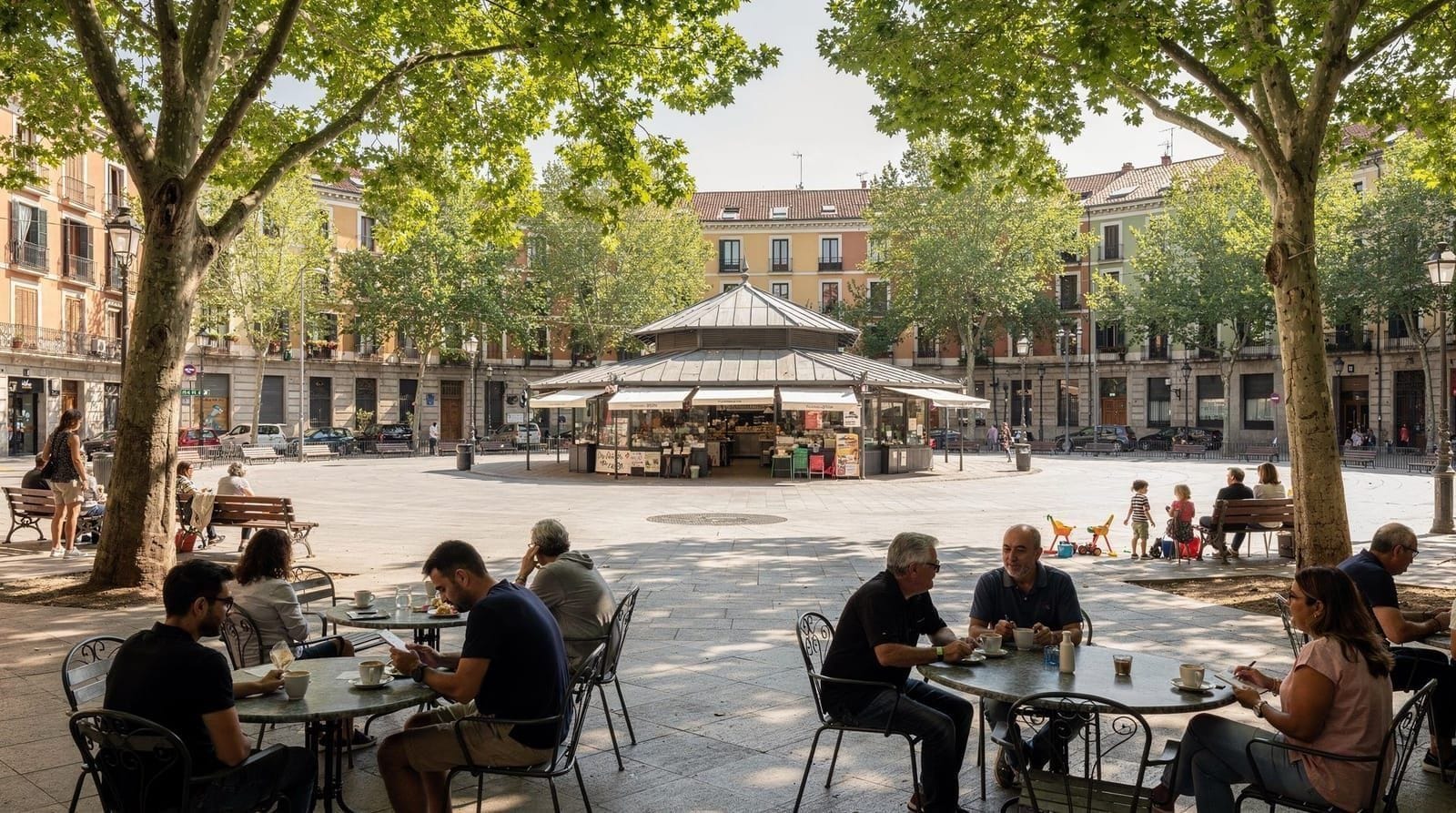
The Salamanca neighbourhood has maintained its traditional café culture better than much of central Madrid. The cafeterías on Calle Lagasca, Calle Hermosilla, and the side streets around Serrano serve the local professional population its morning café con leche and media mañana, and are open for the traditional late breakfast (desayuno, 09:00–11:00) in a way that the tourist-facing cafés around the Prado are not.
These establishments — often with unchanged interiors from the 1960s–80s, marble counters, brief menu boards chalked up daily — represent one of the more authentic aspects of the Salamanca experience. The food is simple (tostada con tomate y aceite, churros on request, occasionally a bocadillo) and the coffee is standard Café Fortaleza rather than specialty. They exist for the same reason the neighbourhood market exists: to serve the people who live here.
Street life and residential character
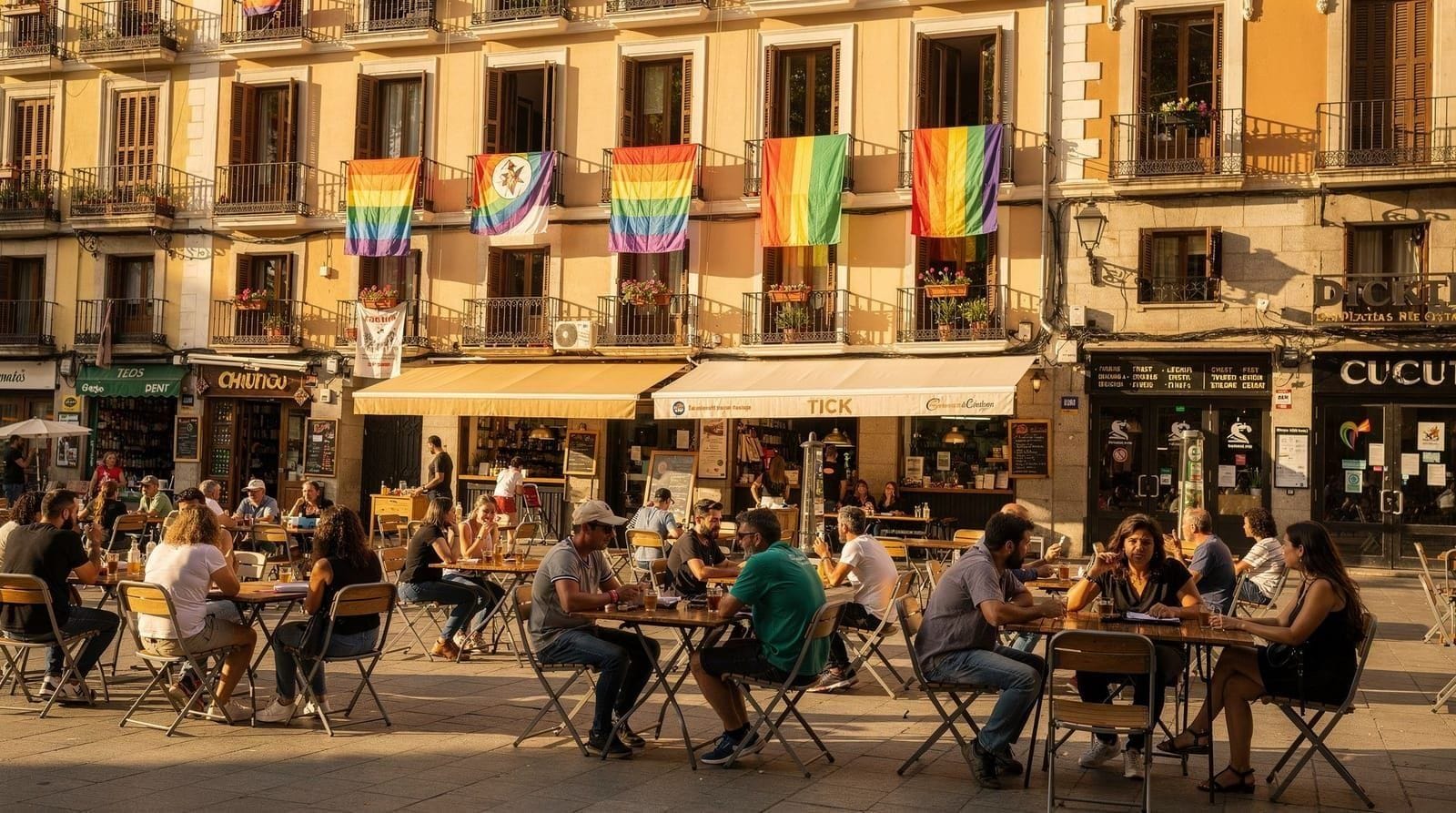
Barrio de Salamanca’s street life operates at a pace set by wealthy residents and the professional class that works in the neighbourhood’s offices and embassies. The cafeterías (traditional Spanish café-restaurants) have survived here better than elsewhere in central Madrid — places like the historic La Bien Aparecida and several unnamed local bars on the residential streets of Lagasca and Hermosilla serve the same professional clientele they have for decades.
The neighbourhood has a significant embassy presence (many foreign missions are on Serrano, Velázquez, and the streets between) which contributes to the international character of the restaurants and the slightly more formal atmosphere.
The Sunday market at Plaza de Colón (just west of the Salamanca boundary) offers a less tourist-heavy alternative to El Rastro — a twice-monthly antiques and design market worth exploring. For the more famous alternative, the El Rastro flea market guide explains how to approach it.
Food lovers staying in the area can build a full plan around the Madrid for foodies itinerary, and the cocido madrileño guide explains the dish served at La Daniela in more detail.
Madrid full-day flexible private tour with a local guideGetting to Barrio de Salamanca
Metro: Serrano (Line 4) is the central station for the main shopping area. Velázquez (Line 4) for the upper luxury retail. Goya (Lines 2/4) for the eastern section and easy transfer connections to the centre.
On foot from the Prado: 15–20 minutes northeast. From the Thyssen: 10 minutes northeast. From the Retiro Park: 5–10 minutes east along Calle Alcalá or Calle Serrano.
The neighbourhood is well served by public transport, and the Madrid metro guide explains how to use the network. If you arrive from the airport, the airport to city guide lays out the options. A good way to spend a free afternoon is to combine the area with Retiro and Jerónimos, which sits right next door.
Salamanca dining by budget
Barrio de Salamanca’s restaurant scene spans an unusually wide price range, and knowing where you land on it before arriving avoids both sticker shock and missed opportunities:
| Budget | Where | What to expect |
|---|---|---|
| Under €20/person | La Daniela (weekday lunch), Mercado de la Paz stalls | Cocido madrileño, market food, café con leche culture |
| €25–€55/person | Arzábal, El Paraguas | Modern tapas or elegant traditional Spanish cooking |
| €70–€150/person | Santceloni, Saddle | Michelin-starred tasting menus, wine pairing |
| €250+/person | DiverXO | Three-Michelin-star avant-garde tasting menu, book months ahead |
The useful insight for visitors on a budget is that La Daniela genuinely competes with the fine-dining tier on the specific dish it does best (cocido), which is why it appears repeatedly in local recommendations despite costing a fraction of its Michelin-starred neighbours. The Michelin Madrid guide covers the full landscape of starred restaurants across the city, and where to stay in Madrid explains why Salamanca is also a popular base for visitors prioritising this kind of dining.
Frequently asked questions about Barrio de Salamanca
Is Barrio de Salamanca worth visiting for non-shoppers?
Yes. La Daniela for the best mid-price cocido madrileño in the city. The Sorolla Museum (new building, free entry). The Mercado de la Paz for a functioning neighbourhood market. The neighbourhood architecture is pleasant walking territory even without shopping intent.
What is Loewe and why does it matter here?
Loewe is a 177-year-old Spanish luxury leather goods and fashion house, founded in Madrid in 1846. It is Spain’s closest equivalent to a French luxury house — genuine craft, museum-quality leather work, a creative direction (Jonathan Anderson) that has produced some of the most discussed fashion of the 2010s–20s. The Serrano flagship has the widest range; non-EU visitors can reclaim VAT.
Is the fine dining worth it in Salamanca?
If food is a priority and the budget allows: yes. Santceloni and Saddle operate at the highest level. DiverXO is the most ambitious restaurant in Madrid. La Daniela makes the argument that the best meal in Salamanca does not require a Michelin star.
How does Barrio de Salamanca compare to Chamberí for an authentic local experience?
Salamanca is wealthier and more focused on shopping and formal dining. Chamberí is more residential-neighbourhood in character, with genuine local bars (Calle Ponzano) and a less curated feel. Both offer good alternatives to the tourist centre, for different reasons.
Is August a good time to visit Barrio de Salamanca?
Not particularly — many of the residents leave for the coast and the mountains, and several local restaurants and shops close for part of August. The tourist-facing establishments near the Thyssen stay open, but the neighbourhood’s authentic appeal (local diners, market trading) is diminished. September is considerably better.
Can I visit Salamanca on a tight budget?
Yes — the neighbourhood is not exclusively fine dining and luxury retail. Mercado de la Paz, the traditional cafeterías on Calle Lagasca and Calle Hermosilla, and La Daniela’s weekday cocido lunch all offer genuine value. Window shopping on Calle Serrano and Calle Ortega y Gasset costs nothing, and the Sorolla Museum’s new building has free entry.
How far is Barrio de Salamanca from the Retiro Park?
About 5–10 minutes on foot along Calle Alcalá or Calle Serrano, making it easy to combine a Retiro Park visit with Salamanca shopping or dinner in the same afternoon. See the Retiro Park guide for the park itself.
Top experiences
Bookable activities with verified prices and instant confirmation on GetYourGuide.