Rooftop bars in Madrid: the honest guide to views, prices, and crowds
Madrid: Royal Palace Skip the Line Entry Guided
What are the best rooftop bars in Madrid?
The Círculo de Bellas Artes rooftop (Calle de Alcalá 42) has the best 360-degree view for €6 entry. The El Corte Inglés Callao rooftop has free access and good Sol–Gran Vía views. Premium hotel rooftops (Riu, ME Madrid) charge €10–18 per drink. Booking ahead is required for weekends at the hotel bars.
In brief: Madrid’s rooftop bar scene has exploded in the last decade. The best-value view is the Círculo de Bellas Artes rooftop (€6 entry, 360-degree views). The premium hotel rooftops are genuinely impressive but charge €12–18 per drink and require advance booking on weekends. The free El Corte Inglés Callao terrace is the easiest entry point.
| Where | Gran Vía, Plaza del Callao, and Plaza de Santa Ana |
| Cost | Free (Callao) to €6 entry (Círculo de Bellas Artes) to €12–22 per drink (hotel rooftops) |
| Time needed | 1 hour for orientation, longer for a proper drink |
| Getting there | Metro Callao, Gran Vía, or Sevilla |
| Best time | Afternoon (16:00–20:00) for views, evening for the social scene |
Madrid’s rooftop culture: the context
Madrid’s rooftops have become one of the city’s most active social spaces — a consequence of the climate (hot, clear summers), the city’s consistent high-altitude light (700 metres above sea level gives Madrid unusually clear air and dramatic sunsets), and the Spanish preference for outdoor socialising over indoor bars.
The rooftop scene has also become significantly more commercialised in the last five years. What began as informal terraces on hotel and building tops has evolved into managed experiences with bookings, minimum spend requirements, and PR-curated aesthetics. The authentic and the tourist-performative now sit side by side.
This guide separates the two.
The best rooftop views in Madrid
Círculo de Bellas Artes (Calle de Alcalá 42)
The most practically useful rooftop in Madrid. The Círculo de Bellas Artes is a cultural centre that has operated a rooftop terrace (La Azotea) for decades. Entry costs €6 (€5 reduced) — tickets are sold online or at the reception desk. The terrace gives a 360-degree view across central Madrid: the Gran Vía to the west, the Prado area to the south, the Salamanca skyline to the east, Malasaña and Chueca to the north.
Drinks are priced as a regular bar (beer €4–6, wine €4–7) rather than at hotel premium rates. The terrace is open until late and does not require booking on weekdays. On summer weekends, queues form from around 19:00.
The honest assessment: This is the best rooftop in Madrid for first-time visitors. €6 entry, genuine 360-degree views, honest drink prices, cultural institution context. The only downside is that it is now well-known and can be crowded in high season.
El Corte Inglés Callao (Plaza del Callao 2)
The department store’s rooftop restaurant and terrace bar — accessed via an elevator inside El Corte Inglés, exit at the top floor. Free access (no entry fee). The views look directly across the Gran Vía and over Sol, with the sierra visible on clear days.
Food and drink at standard department store café prices: €3–6 for a coffee or beer, €12–18 for a meal. The quality is unremarkable — this is a department store café — but the access is free and the view is excellent for orientation. Useful for a first look at the city’s geography before committing to more expensive options.
Hotel Riu Plaza España (Gran Vía 84)
A premium-tier hotel rooftop with arguably the most dramatic position in central Madrid — a 1950s skyscraper at the top of Gran Vía, with views over the entire city including the Real Madrid stadium, the sierra, and the Casa de Campo. Drink minimum: €12–18. Reservations essential on weekends; often fully booked 2–3 weeks in advance during summer.
The view is genuinely extraordinary — this is not overrated. The prices are what they are. If you want to splurge on one impressive rooftop drink, this is the candidate.
ME Madrid Reina Victoria (Plaza de Santa Ana 14)
A boutique hotel on the Barrio de las Letras, with a rooftop bar (The Roof) that looks over Plaza de Santa Ana and toward the Prado. Fashionable crowd, expensive drinks (€14–20 cocktails), and a booking-required policy during busy periods. The atmosphere is more nightlife-oriented than view-oriented — the vibe targets the Instagram crowd more than serious view-seekers.
Hotel Almeida Madrid (Gran Vía 7)
Less famous than the Riu but equally impressive views from a slightly different angle on Gran Vía. Good cocktails (€12–16), reservation system slightly less brutal than the Riu. Worth investigating as an alternative when the Riu is fully booked.
The difference between day and night
Rooftop bars in Madrid serve two fundamentally different purposes depending on time:
Afternoon (16:00–20:00): The view-and-drink experience. The light in Madrid at 17:00–19:00 in summer is extraordinary — the city turns gold. The Círculo de Bellas Artes is perfect at this time. Crowds are building but not yet overwhelming.
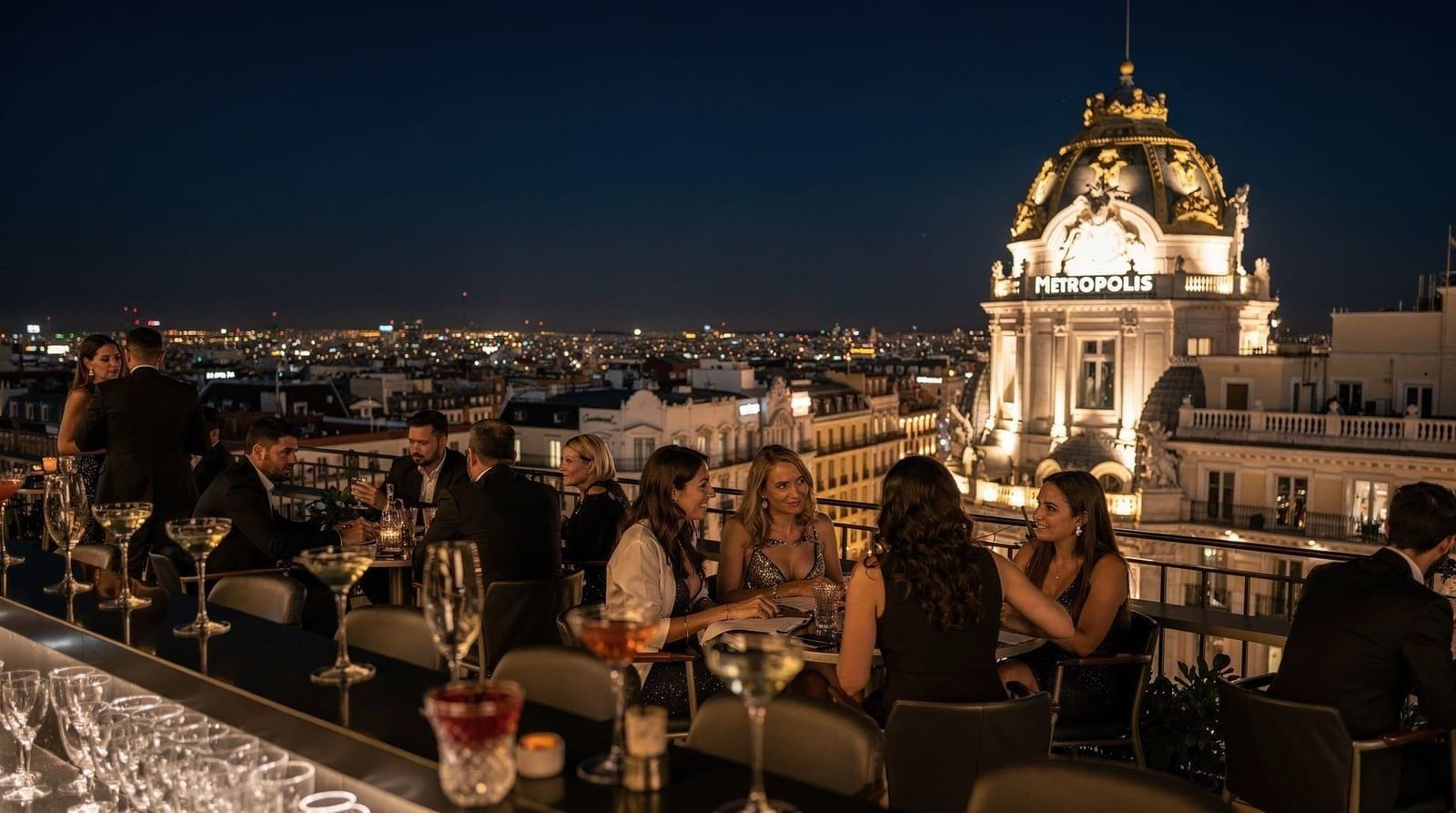
Evening (20:00–00:00): The social experience. The hotel rooftops come into their own at night — the city lights, the warm air, the cocktail culture. This is when the premium spots are most appealing and most crowded. See the rooftop bars at night guide for the nightlife-specific picture.
What to order and what it costs
Standard hotel rooftop: Beer €10–14, wine €12–18, cocktail €14–22. Minimum spend sometimes required (€15–20 per person). If you are having one drink and leaving, confirm there is no minimum spend when booking.
Círculo de Bellas Artes: Beer €4–6, wine €4–7, soft drinks €3–4. No minimum spend.
El Corte Inglés Callao: Café prices — €3–6.
Rooftop bars in Madrid are approximately 2–3 times the price of an equivalent drink at a street-level bar. The price covers the view, the curation, and in the hotel cases, the booking and service.
Booking: when it is required
Always book in advance for:
- Hotel Riu Plaza España (book weeks ahead in summer, often months)
- ME Madrid The Roof (book 1–2 weeks ahead for weekend evenings)
- Any hotel rooftop on a Friday or Saturday evening in June–September
Usually fine without booking:
- Círculo de Bellas Artes (weekdays; queues on summer weekends)
- El Corte Inglés Callao (open access, no booking)
- Most rooftops on weekday afternoons/evenings
Practical tip: Many hotel rooftops have better availability at 18:00–20:00 than at 21:00–23:00. The view at sunset is better anyway.
What to wear
Smart casual is the norm at hotel rooftops — no shorts, no flip-flops, no football shirts. This is enforced more strictly at the premium venues (Riu, ME Madrid) than at the mid-range ones. The Círculo de Bellas Artes is casual-acceptable. El Corte Inglés is whatever you like.
The full evening picture
A rooftop drink fits naturally into a Madrid evening as the pre-dinner aperitivo — 19:00–21:00, before the city starts eating dinner at 21:30. It is not the whole night, it is one component. Follow a rooftop drink with tapas in La Latina or Malasaña, then dinner at 22:00, then — if you want the full picture — a look at the Madrid nightlife guide for what happens after midnight.
For a daytime view without a drink, the Teleférico cable car is closed for a full refurbishment, with reopening planned for the first quarter of 2027 (EMT Madrid); check before planning. The Teleférico guide covers it. Two other free or cheap viewpoints are worth knowing: the Faro de Moncloa lookout tower and the sunset gathering at the Temple of Debod.
Seasonal rooftop culture
Madrid’s rooftop culture is emphatically summer-driven. The sequence of the city’s rooftop season:
April–May: Rooftops reopen after winter. Still cool in the evenings; best in the afternoon. Not yet crowded.
June–September: Peak season. Every rooftop is in full operation. The June–July sunsets are extraordinary — the sun sets after 21:30, providing hours of golden-hour light. Booking essential for weekends. Temperatures at 21:00 are 25–32°C.
October: Rooftop season winding down. Quieter, often not requiring booking, but evenings can be cool after sunset. The autumn light quality (lower sun, clearer air) produces some of the best views of the year.
November–March: Most hotel rooftops remain open but are primarily enclosed or semi-covered spaces. The Círculo de Bellas Artes rooftop may reduce hours in winter. The outdoor terrace experience is less central to the season.
Madrid’s rooftop geography: why the views are good
Madrid sits at 667 metres above sea level — the highest capital in the European Union. The altitude has two practical effects on views:
Clarity: The city’s air is typically clear and dry (continental climate, low humidity). On a good day, you can see the Sierra de Guadarrama peaks from most central rooftops. The range is approximately 50 kilometres north of the city and is visible on clear days year-round.
Horizon: The flat Castilian plateau means no foreground obstructions. Unlike a coastal city where hills and sea cliffs create visual variety, Madrid’s views are panoramic and unobstructed. From a sufficiently high rooftop (Hotel Riu, Círculo de Bellas Artes), the city spreads in all directions to the horizon.
Light quality: The Mediterranean-influenced light at altitude creates the golden hour photographers seek. The hour before sunset on a clear day in Madrid is genuinely special — the city’s limestone and terracotta buildings glow in a way that photographs inadequately.
Lesser-known rooftop options
Beyond the well-publicised hotel terraces, several less-famous rooftop options exist:
Palacio de Cibeles (CentroCentro): The former Madrid city hall on Plaza de Cibeles has a rooftop terrace (Terraza CentroCentro) with views toward the Retiro and the city centre. Entry fee €3, with drinks and food available at additional cost. Less famous than the hotel rooftops but a better-positioned view for understanding the Gran Vía–Recoletos axis.
Hotel NH Collection Palacio de Tepa: A boutique hotel in the Barrio de las Letras with a rooftop that is smaller and less well-known than the major venues. Good quality, less booking pressure.
Azotea del Círculo — late hours: The Círculo de Bellas Artes stays open until 01:30 Sunday to Thursday and 02:00 on Friday and Saturday. This means you can combine the €6 entry rooftop view with the evening, not just the afternoon, at honest drink prices.
What to photograph from Madrid’s rooftops
If you are a photographer, the rooftop views offer specific compositional opportunities:
From Hotel Riu: The Gran Vía canyon extending eastward, the dome of Metropolis building at the curve, the Guadarrama mountains in the background. Best with the sun low in the west (evening) behind you when shooting east.
From Círculo de Bellas Artes: The full panorama including Cybele fountain (north), Prado area (south), Alcalá street corridor (east), and Gran Vía (west). The 360-degree view makes this the best general-purpose photography rooftop.
From ME Madrid: The tight foreground of Plaza de Santa Ana with the city behind. Better for architecture shots than panorama.
Technical note: Madrid’s summer haze (July–August, when dust from the Sahara occasionally reaches the city) can reduce photographic clarity. Spring (April–May) and autumn (September–October) produce the sharpest views.
Accessibility
All the mentioned hotel rooftops have elevator access. The Círculo de Bellas Artes access is via an elevator inside the building from the ground floor entrance. No stairs are required for any of the main recommendations.
Wheelchair accessibility varies — confirm with each venue when booking. The El Corte Inglés Callao rooftop is fully accessible via department store elevators.
Combining rooftop with dinner
Several of the hotel rooftops listed serve food as well as drinks — primarily sharing plates and light meals rather than full restaurant menus. If you want to combine a rooftop experience with dinner, consider:
- Hotel Riu Plaza España rooftop: Has a food menu but primarily a drinks experience. More suitable for pre-dinner drinks than dinner itself.
- Palacio de Cibeles (CentroCentro): Has a full-service restaurant on the rooftop level. Lunch and dinner bookings available. Better food than the pure bar options.
- For the full Madrid evening: Rooftop aperitivo (19:00–21:00) followed by dinner at a proper restaurant in La Latina or Malasaña at 22:00 is the most satisfying sequence. See the where to eat in La Latina guide and the Madrid tapas guide for dinner options.
The view from specific city landmarks
For orientation, these are the key landmarks visible from Madrid’s central rooftops:
Northward: The Sierra de Guadarrama mountain range, 50 km away. Visible on clear days as a white-capped line above the city’s northern suburbs. The highest peak visible from central Madrid is Peñalara (2,428m).
Northwest: The Casa de Campo — Madrid’s massive municipal park (4,000 hectares, 8x larger than Central Park). Beyond it, the Cerro de los Ángeles in the distance.
West: The Royal Palace (Palacio Real) and the Catedral de la Almudena — the most historically significant buildings in the city’s western skyline. Seeing the palace from above makes a good prompt to visit it up close: our Royal Palace guide covers the interior, and the Almudena Cathedral guide covers its neighbour. If you would rather not queue, a guided Royal Palace visit with skip-the-line entry is one way to do it.
Southwest: The Puerta de Toledo arch and the Manzanares River, with Madrid Río park visible as a green strip.
South: The industrial and residential southern suburbs, merging into the plain. Less spectacular but gives scale to the city.
East: The Parque del Retiro (see the Retiro Park guide) — the green lung of central Madrid. The glass roof of the Palacio de Cristal occasionally catches the light.
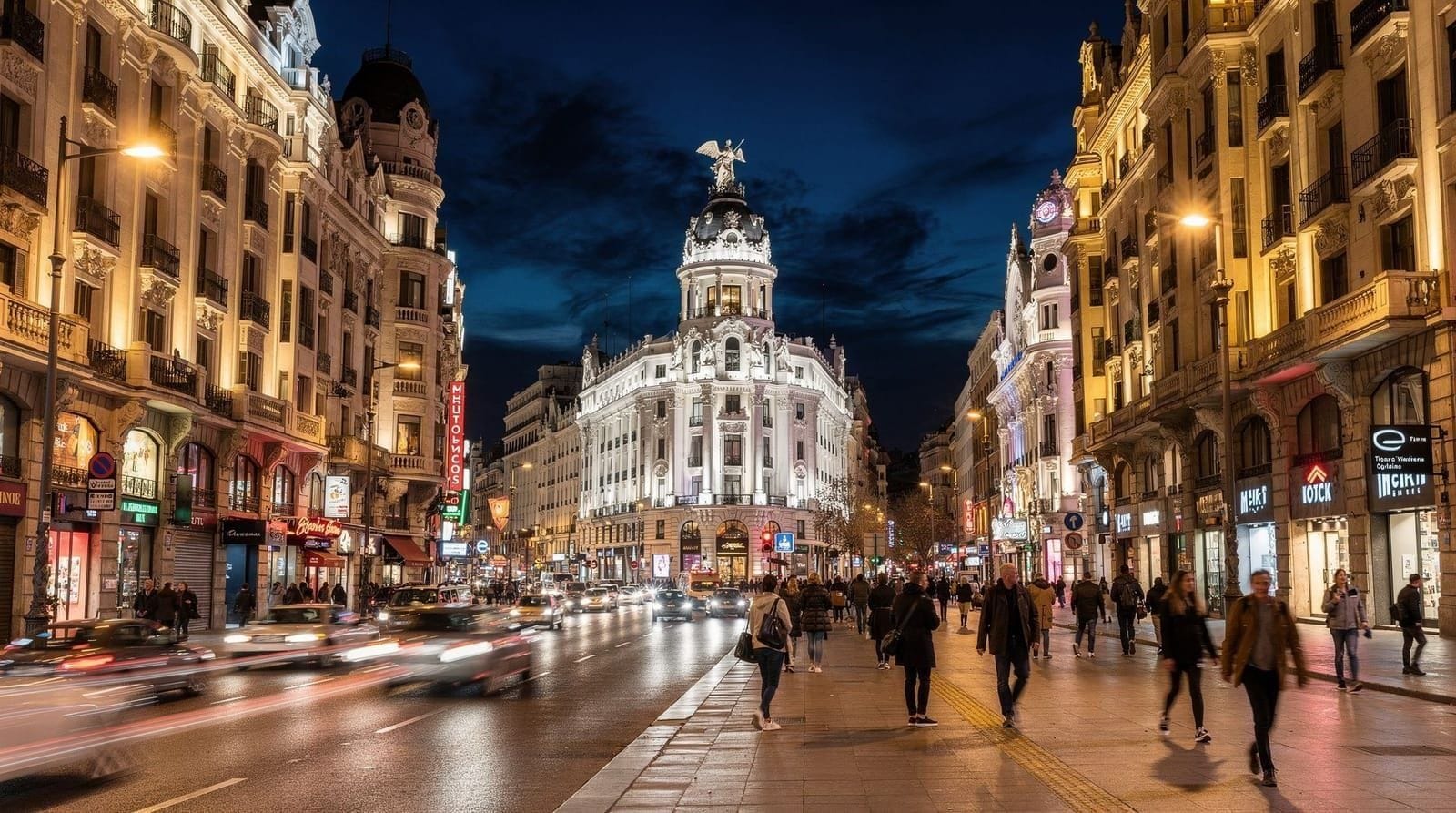
From the Hotel Riu specifically, the whole Grand Via can be seen as a canyon extending eastward — the Art Deco and Baroque facades of the buildings that line both sides, the Metropolis building’s copper dome at the curve.
Rooftop bars and Madrid’s skyline: a brief architectural history
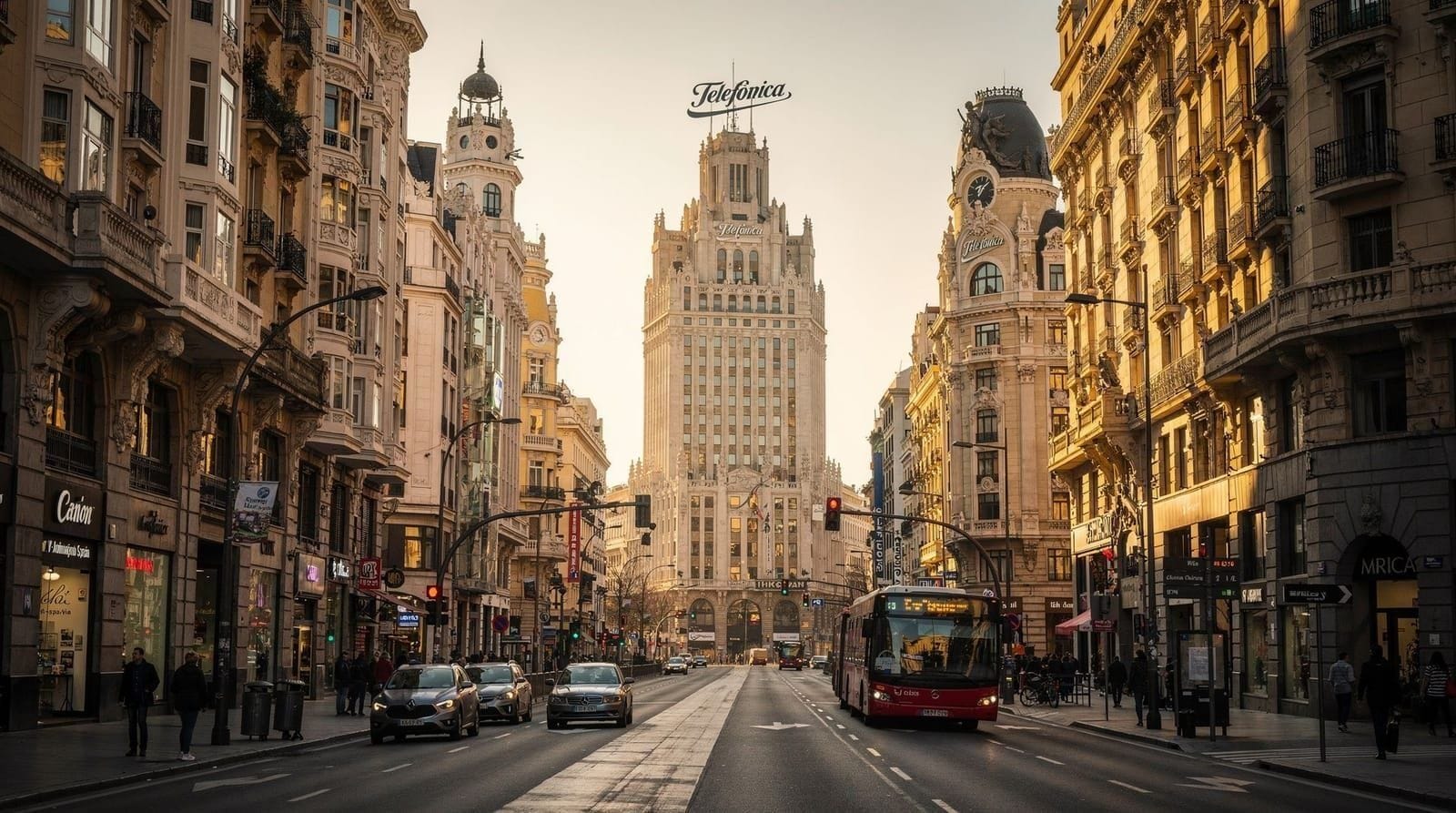
Madrid’s skyline is dominated by the Gran Vía corridor, which was constructed in four phases between 1910 and 1952. The buildings that define the view from rooftop bars were built in conscious imitation of New York and Chicago skyscraper architecture of the same era.
The Edificio Metrópolis (1911, on the corner of Gran Vía and Calle de Alcalá) with its French Second Empire zinc dome and gilded winged figure is the most photographed building in Madrid from above. The Edificio Telefónica (1929) was the first skyscraper in Europe when completed. The Edificio España and Torre de Madrid (1950s, by the Franco government) dominate the Gran Vía’s western end.
From the Hotel Riu rooftop, you are level with or above most of these buildings — a vantage point that allows you to see their rooftops, water towers, and mechanical equipment alongside the architectural facades.
Rooftop bars in context: planning your Madrid itinerary
A rooftop visit is most rewarding when it follows a ground-level visit to the areas below. The sequence:
Morning: Walk Gran Vía from Cibeles to Callao (east to west). Look up at the Art Deco facades, understand the street at human level.
Morning, continued: For the street itself, the Gran Vía guide gives the walking context. If you have time before the rooftop, the art museums of the Golden Triangle walk fit the same day, and a Prado visit with skip-the-line entry and an official guide keeps the queue from eating into your afternoon; the Prado Museum guide has the details.
Afternoon: Ascend to the Círculo de Bellas Artes rooftop or El Corte Inglés Callao. Look down at the same street from above. The geographical relationship between the places you walked through and the city beyond becomes clear.
Evening: Book the Hotel Riu for sunset (21:00–22:30). From 26 floors, the Gran Vía you walked in the morning is now a thread connecting the western and eastern parts of the city.
This three-stage approach — walking, intermediate view, high view — is how the city’s geography becomes comprehensible rather than merely beautiful. For a fuller plan around it, see the Madrid in one day itinerary or the three-day itinerary, and check Madrid in summer if you are going in peak rooftop season.
Which rooftop should you actually choose?
For visitors deciding between the options rather than trying to do all of them, the practical comparison:
| Priority | Choose |
|---|---|
| Best value | Círculo de Bellas Artes (€6, 360-degree view) |
| Zero cost | El Corte Inglés Callao |
| Most dramatic view | Hotel Riu Plaza España |
| Best food alongside the view | Palacio de Cibeles (CentroCentro) |
| Fashionable social scene | ME Madrid The Roof |