Monasterio de las Descalzas Reales: Madrid's hidden royal convent and art treasury
Madrid: Royal Palace Skip the Line Entry Guided
What is the Monasterio de las Descalzas Reales and is it worth the guided tour?
The Descalzas Reales is a 16th-century royal convent in the heart of Madrid, still inhabited by Franciscan nuns, with an extraordinary art collection accumulated by royal donations over five centuries. Entry is by guided tour only (no independent visits); the tour costs €9 and runs at fixed times through the day. It is one of the most surprising and underrated visits in Madrid.
In brief: The Descalzas Reales is a 16th-century royal convent still inhabited by Franciscan nuns, holding one of the finest collections of Flemish tapestries and royal devotional art in Europe. Guided tour only, about one hour, €9 per person. One of the most rewarding and least-crowded visits in central Madrid.
| Where | Plaza de las Descalzas 3, 2 min walk from Sol |
| Cost | Around €9 adults, free for EU and Ibero-American citizens on Wednesdays and Thursdays 16:00–18:30 |
| Time needed | Around 1 hour, including queueing |
| Getting there | Metro Sol or Callao, short walk |
| Booking | No standard pre-booking — arrive 15–20 min early |
A convent that outshines most museums
The Monasterio de las Descalzas Reales (Royal Barefoot Sisters Monastery) sits on a quiet plaza two minutes’ walk from Puerta del Sol — invisible from the main tourist circuits, identifiable only by the modest entrance gate and the Patrimonio Nacional sign. Behind the gate is one of the most extraordinary accumulations of religious art and decorative objects in Spain.
The convent was founded in 1559 by Juana of Austria, daughter of Emperor Charles V and sister of Philip II, in the former palace of Charles V’s treasurer. Juana herself entered the convent as a Franciscan novice and lived there until her death in 1573. The community she established drew donations from European royalty — Habsburg relatives, Portuguese queens, Italian nobles — over the following two centuries, accumulating what amounts to a private royal art collection deposited in a religious community.
The community of Discalced Franciscan nuns continues to inhabit part of the building, which is why independent visits are not permitted. The state (via Patrimonio Nacional) maintains the public areas and organises the guided tours; the contemplative life of the nuns continues behind closed doors.
What the guided tour covers
Tours last approximately 45–55 minutes and cover the publicly accessible areas of the convent. A guide accompanies each group (maximum 25 people) and explains each space.
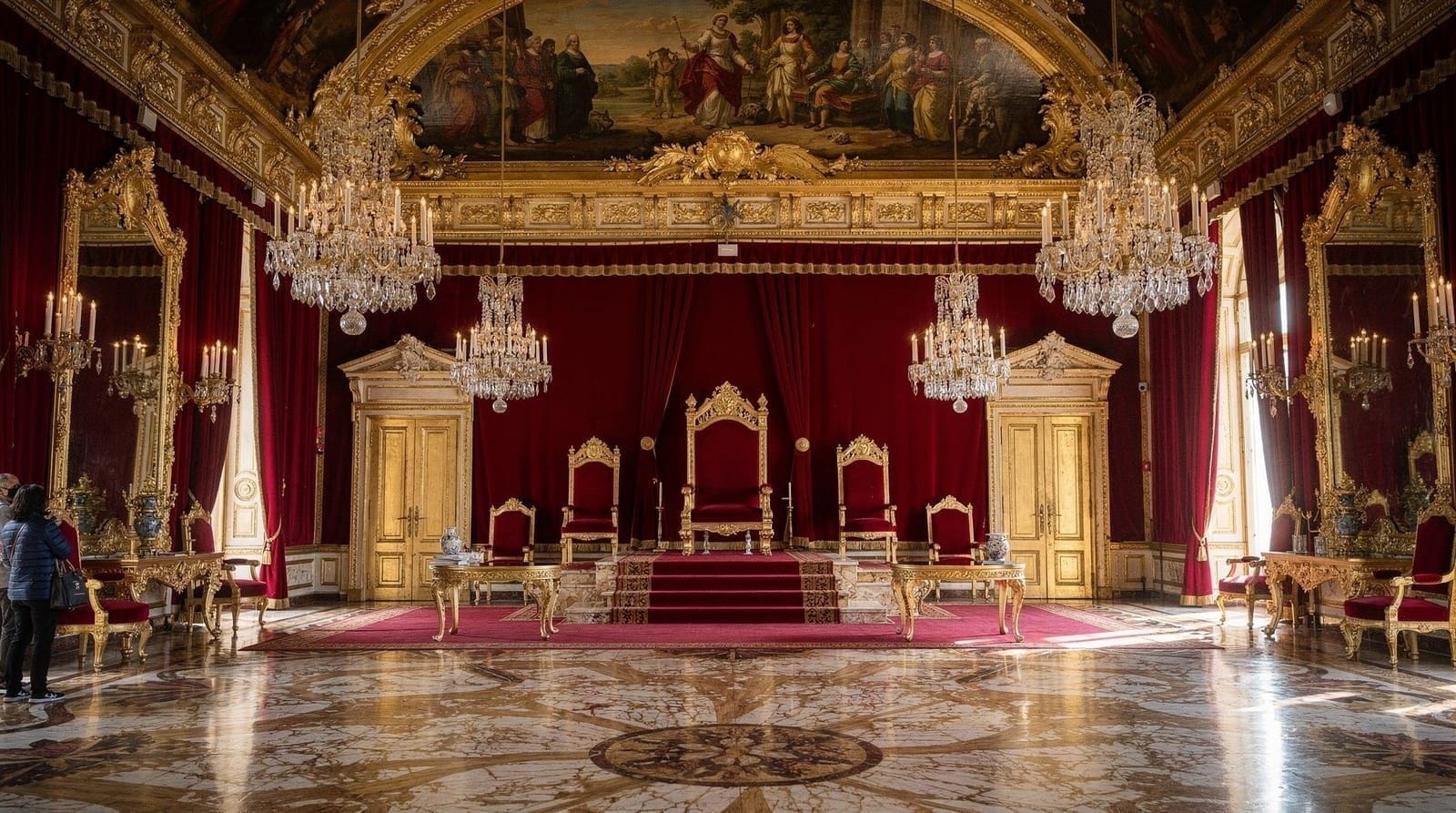
The Grand Staircase: The first and most visually spectacular stop. The staircase walls and ceiling are decorated with a 17th-century trompe-l’oeil fresco — painted figures appear to lean over a railing watching you from above, including what appear to be portraits of Philip IV and his family. The illusion is well-executed even by modern eyes; the effect is of entering a space populated by silent spectators. This is the most frequently reproduced image from the Descalzas Reales.
The Chapel Royal: The main devotional space, with an extraordinary collection of reliquaries, liturgical objects, and paintings accumulated over four centuries. The quality of individual objects is high — several reliquaries are German goldsmithwork of exceptional quality.
The Flemish Tapestry Room: Sixteen tapestries based on designs by Peter Paul Rubens depicting the Triumph of the Eucharist — a series commissioned by Infanta Isabella Clara Eugenia, daughter of Philip II and ruler of the Spanish Netherlands, and woven in Brussels in the 1620s. These are the artistic highlight of the visit: large-format tapestries in excellent condition, technically superb, and representing the pinnacle of Flemish textile art. Rubens produced the original oil sketches (now in the Prado); these tapestries are the final large-scale realisation of the series.
The Chapels: The tour passes through 12–15 side chapels, each endowed by a different royal donor. The decorative programmes range from Italian Baroque to Spanish 17th-century painting. Works attributed to Titian, Bruegel the Elder (the Elder’s followers at minimum), and Zurbarán appear in different chapels — the attribution debate is ongoing for some works, but the quality is consistently high.
The Reliquary Hall: Hundreds of reliquaries of varying size and quality accumulated over centuries of royal piety. For visitors interested in the material culture of Counter-Reformation Catholicism, this room is extraordinary — gold, silver, crystal, and enamel containers in every conceivable form, each housing a relic of greater or lesser historical provenance.
The building’s historical context
The Descalzas Reales was, for two centuries, one of the most important points of contact between the Spanish crown and European royal families. The nuns who entered the community were often the daughters or sisters of monarchs — their family connections ensured a continuous flow of gifts, diplomatic correspondence, and political information to the royal family. The convent functioned as a kind of informal intelligence network in a period when women of the highest nobility had no other means of political participation.
Juana of Austria is an interesting historical figure in her own right: she is the only woman ever officially admitted to the Jesuit order (as a secret member, a special dispensation that was kept private until her death). A portrait of her hangs in the Prado.
Practical logistics
Address: Plaza de las Descalzas 3, 28013 Madrid.
Getting there: Metro Sol (Lines 1/2/3), 3-minute walk north along Calle de Preciados, then left into Calle de las Descalzas. Or Metro Callao (Lines 3/5), 5-minute walk.
Opening hours (verify before visiting): Tuesday–Saturday 10:00–14:00 and 16:00–18:30; Sundays and holidays 10:00–15:00; closed Mondays. Tours in English run Tuesday to Sunday at 12:00. Hours can change for religious holidays when the community requires privacy.
Language: Most tours are in Spanish. English-language tours are occasionally scheduled — check the Patrimonio Nacional website. Alternatively, the guide often provides some commentary in English if the group includes English-speaking visitors.
Photography: Not permitted inside the convent.
Arrive early: Tours fill quickly — arrive 15–20 minutes before the stated time and queue at the entrance gate.
Combining with the nearby Monasterio de la Encarnación
The Monasterio de la Encarnación (Real Monasterio de la Encarnación) is a second royal convent within 10 minutes’ walk, also managed by Patrimonio Nacional and also open by guided tour. Founded in 1611 by Philip III and his wife Margaret of Austria, the Encarnación holds a different but complementary collection — paintings, sculpture, and one of the largest reliquary collections in Spain. The two convent visits pair logically for a morning dedicated to Habsburg Madrid’s religious and artistic heritage.
Combined entry for both convents is available through Patrimonio Nacional — check the current offer when booking.
Why the Descalzas Reales is Madrid’s best-kept secret
The mandatory tour format is a barrier for visitors accustomed to self-guided museum visits. But it is also what preserves the experience: the limited group size, the unhurried pace, and the guide’s explanations transform what might otherwise be a bewildering sequence of rooms into a coherent narrative about five centuries of royal patronage and religious life.
The Descalzas Reales appears in the Madrid for art lovers itinerary as a morning option for visitors who have already covered the Golden Triangle and want to understand a different register of Madrid’s artistic heritage — not the museum, but the living institution that accumulated works over time for devotional rather than display purposes.
The Descalzas Reales as political institution
The convent’s importance in 16th–18th-century Spain was not purely religious. The women who entered the Descalzas Reales were typically daughters of the highest European nobility — Habsburgs, Bourbons, Portuguese and Italian royalty. They brought personal fortunes (the entrance gift to the convent, called the dote, was substantial), family connections, and access to diplomatic networks.
The abbesses of the Descalzas Reales corresponded with foreign monarchs, received their letters, and passed information through channels unavailable to official court diplomacy. The convent functioned as a confidential archive — letters, documents, and objects that kings could not keep in official records were sometimes deposited with the nuns. Several Spanish diplomatic histories of the 16th and 17th centuries note the Descalzas as a source of intelligence.
Juana of Austria — the founder — was herself a political figure of significance. She governed Castille as regent (1554–1559) while her father Charles V and her brother Philip II were both absent from Spain, handling the affairs of the largest empire on earth from the Spanish peninsula. She chose to enter the convent partly to remove herself from the remarriage politics of the Habsburg court, which would have sent her to a foreign throne; the convent gave her independence and authority of a different kind.
The art collection: accumulation vs curation
The Descalzas Reales collection was never curated — it was accumulated. Each new donation arrived at the discretion of the donor, placed wherever was convenient, and venerated for devotional rather than artistic reasons. This means the collection is radically different in character from a museum collection: repetition (multiple versions of the same subject from different donors), inconsistency of quality, and objects whose importance is contextual rather than intrinsic.
The result, paradoxically, is a collection that art historians find fascinating precisely because it was never edited. The Rubens tapestry series — one of the highest-quality items — sits alongside much more modest devotional paintings in an arrangement that reflects the community’s priorities rather than any aesthetic hierarchy.
Several attribution debates remain open. Works in the chapels that are labeled “attributed to Zurbarán” or “school of Titian” may or may not be by those masters; the documentation of donations was not always careful about attribution. For visitors with a specialist interest, these uncertainties are part of the appeal.
Photography and publication restrictions
Photography is not permitted inside the Descalzas Reales. This is standard for active religious communities, and the restriction is strictly enforced. The exterior of the convent — the entrance portal on Plaza de las Descalzas — can be photographed freely.
For publication, high-quality images of the collection (the Grand Staircase fresco, the Rubens tapestries) are available through Patrimonio Nacional’s image archive under licence.
The Monasterio de la Encarnación: the complementary visit
The Real Monasterio de la Encarnación (Royal Monastery of the Incarnation) is a second Patrimonio Nacional convent 10 minutes’ walk from the Descalzas Reales, in the block between Plaza de Oriente and Calle del Arenal. Founded in 1611 by Philip III and his wife Margaret of Austria, it has a different and complementary character.
The Encarnación is an Augustinian convent rather than Franciscan; its architecture is more austere (influenced by the Escorial style of Juan de Herrera) and its collection is concentrated in the Reliquary Hall — one of the largest collections of sacred relics in Spain, in a room that is both beautiful and historically overwhelming. The Cristóbal de Villalpando ceiling painting and the Luca Giordano works are the artistic highlights.
Tours run on a similar schedule to the Descalzas Reales. Both convents in a single morning requires approximately 3.5 hours and a willingness to engage seriously with 16th–18th-century religious culture. For visitors on a Madrid 4–5 day itinerary, this dual convent morning is one of the most rewarding programme options that few short-visit itineraries include.
After the tour: eating near the Descalzas Reales
The Plaza de las Descalzas and the streets around Callao have reasonable café options without the Sol-area tourist markup. The Mercado de San Miguel (3 minutes east along Calle Mayor) is excellent for a mid-morning snack or a light lunch — high-quality food stalls in a 1916 iron-and-glass market hall, with prices higher than a bar but justified by the quality. The Mercado de San Miguel guide covers it specifically.
The Madrid tapas guide recommends several bars in the Callao–Sol–Arenal triangle that are used by locals working in the area rather than tourists.
Comparing the Descalzas Reales with other Madrid convent visits
Madrid has several significant convent and monastery visits within walking distance of the city centre:
Monasterio de la Encarnación (5 minutes northwest, Patrimonio Nacional): Founded 1611 by Philip III’s queen, Margaret of Austria. Augustinian community; different architectural style (Herrerian austerity, influenced by El Escorial); significant reliquary collection and 17th-century paintings. Combined ticket available with the Descalzas.
Convento de las Trinitarias (Lavapiés/Barrio de las Letras, 15 minutes southeast): Miguel de Cervantes is buried in the crypt here. The convent is not open for standard visits — the burial site was identified by researchers only in 2015 — but the exterior of the simple Baroque building is visible from Calle Huertas.
Monasterio de las Descalzas Reales (this guide): Franciscan; most artistically significant; the Rubens tapestries are the key work.
Monasterio de El Escorial (40 minutes by train, day trip): Philip II’s major monastic complex — larger scale, different character, but the same Patrimonio Nacional management system. The El Escorial guide covers it comprehensively.
For a morning specifically dedicated to Madrid’s religious and royal cultural heritage, the Descalzas + Encarnación combination is the most rewarding single-day option within the city limits.
The Descalzas Reales and Madrid’s royal topography
The Monasterio de las Descalzas Reales sits at a significant node in Madrid’s royal geography — within a 10-minute walk of the Royal Palace (west), the Almudena Cathedral (west), Puerta del Sol (east), and the Monasterio de la Encarnación (northwest). These five institutions — palace, cathedral, two convents, and Sol as the civic centre — form the core of Habsburg Madrid’s physical and institutional geography.
Walking the route between them in a morning takes about 3 hours including the Descalzas visit (1 hour) and exterior time at the other buildings. This is one of Madrid’s most historically dense walking circuits and is covered in the Madrid de los Austrias neighborhood guide.
Because the convent tour is fixed-time and walk-in, it makes sense to treat it as the anchor of the morning and build the rest around it. If the Royal Palace is next on your list, it pairs naturally with the convent as the second half of a Habsburg-and-Bourbon day, and a guided Royal Palace visit with skip-the-line entry helps connect the two stories of court and cloister. Unlike the convent, the palace can be booked ahead, so the uncertain walk-in part of the day stays limited to the Descalzas.
The convent as a living institution
The Franciscan community of the Descalzas Reales continues its contemplative life behind the tour areas. The nuns follow the Rule of Saint Clare — the Franciscan contemplative tradition that emphasises poverty, community life, and prayer. The community is small (fewer than 20 nuns as of the most recent public information) and aging; the long-term future of active religious life in the convent is uncertain.
For visitors who ask about this: the guided tour does not enter the nuns’ living area, the chapel used exclusively by the community, or any space that compromises their privacy. The boundary between the public heritage area (managed by Patrimonio Nacional) and the religious community (managed by the order and the Vatican) is maintained carefully. The experience of visiting is of entering a preserved historic space, not an intrusion on active community life.
Booking strategies for the limited tour slots
The Descalzas Reales offers 2–3 tours per day with a maximum group size of approximately 25 people. In peak season (April–May, September–October) and on long weekends, the tours fill. Strategies:
Arrive early (30+ minutes before the stated tour time): The guide assembles the group at the entrance gate at the stated time. Being in the queue early secures your place.
Avoid Spanish national holiday weekends: The Descalzas is particularly busy during Semana Santa (Holy Week), the Puente del Pilar (12 October), and the December holiday cluster.
Weekday mornings in low season (January–February, November): The 10:30 tour on a Tuesday or Wednesday in January typically has space.
Group visits (10+ people): Must be booked in advance through Patrimonio Nacional. Individual visitors can buy tickets online on the Patrimonio Nacional ticket site or at the ticket office.
Who this visit suits — and who should skip it
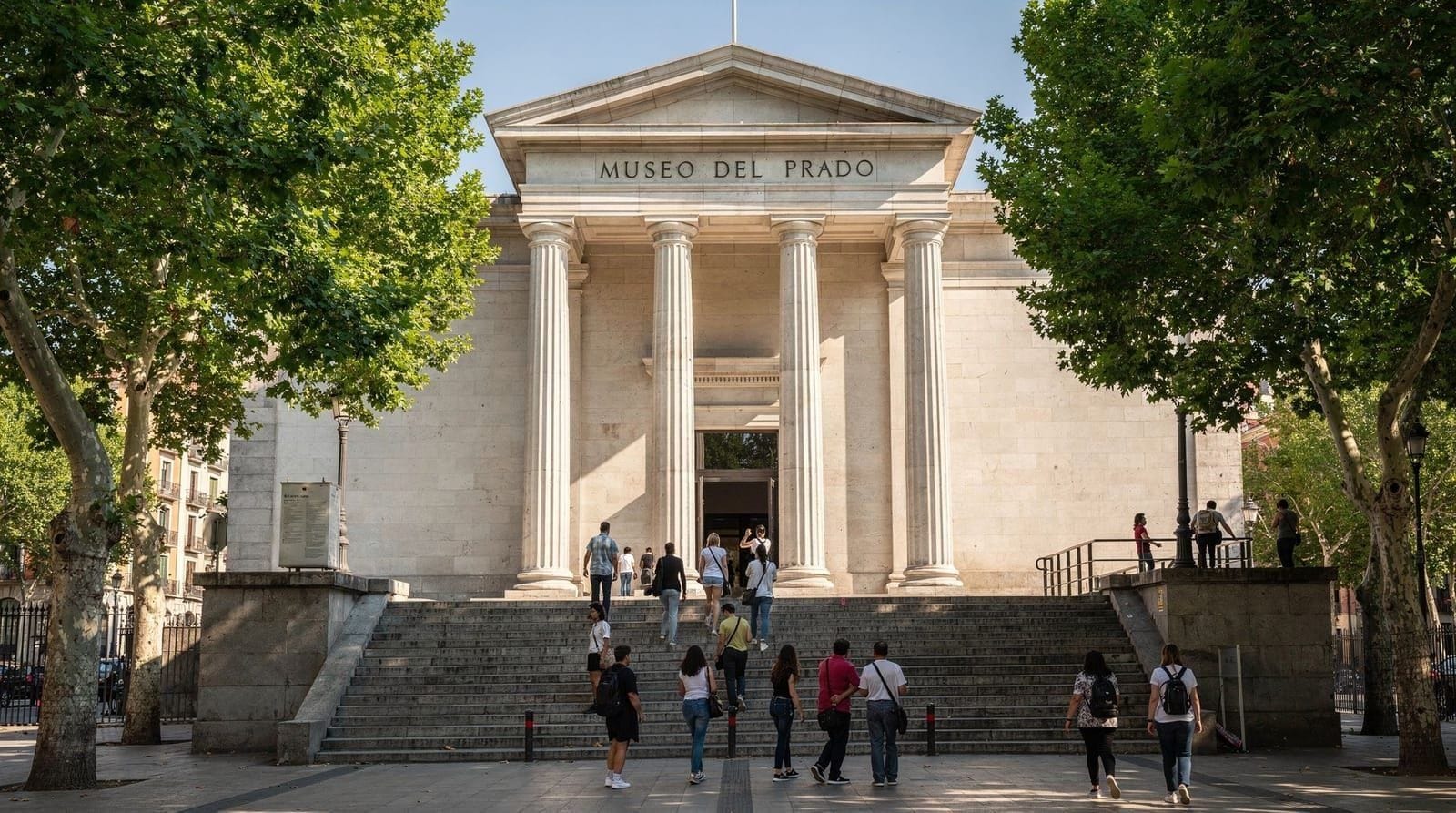
The mandatory guided tour and no-photography rule mean the Descalzas Reales rewards a specific kind of visitor: those genuinely interested in Habsburg history, religious art, or textile craft, and comfortable following a Spanish-language guide through 45 minutes of a working convent. Visitors on a tight one- or two-day Madrid itinerary who haven’t yet done the Royal Palace or the Prado should prioritise those first. For the Prado, a guided Prado visit with skip-the-line entry is an easy way to cover the highlights, and travellers who want the whole Golden Triangle can look at a guided combination of the Prado, Reina Sofía and Thyssen. The Descalzas is a superb addition to a longer stay, not a must-see for a flying visit. Families with younger children may find the fixed-pace, no-touching format harder going than a self-paced museum.
Frequently asked questions about Monasterio de las Descalzas Reales
How do I visit the Descalzas Reales?
Entry is exclusively by guided tour — no self-guided visits are permitted, as the convent remains an active religious community. Tours last about one hour and depart at fixed times. The monastery is open Tuesday–Saturday 10:00–14:00 and 16:00–18:30, Sundays and holidays 10:00–15:00, and closed on Mondays; the ticket office closes one hour before. Tours in English run Tuesday to Sunday at 12:00. Hours are subject to change; verify at Patrimonio Nacional before visiting. Maximum group size is limited.How much does the Descalzas Reales cost?
€9 for adults. Free for EU and Ibero-American citizens on Wednesdays and Thursdays 16:00–18:30 (ticket office only), for under-5s, and for everyone on 18 May and 12 October. Tickets are sold online on the Patrimonio Nacional ticket site and at the ticket office.What is inside the Descalzas Reales?
The tour covers: the Grand Staircase (with an extraordinary trompe-l'oeil fresco of a balcony full of figures watching the royal family descend), the Chapel Royal, 16 tapestries from a Flemish series based on Rubens designs, the Reliquary Room, multiple chapels decorated by donations from European royalty, and a collection of paintings including works attributed to Titian, Bruegel the Elder, and Zurbarán.Is the Descalzas Reales suitable for children?
Older children (10+) who can participate in a 45-minute guided tour without disruption. The tour is conducted in a working convent — respectful behaviour is required. The Grand Staircase fresco and the Flemish tapestries are visually striking enough to hold children's attention if they have had some prior context.Why is the Descalzas Reales so little-known outside Spain?
The mandatory guided tour format, the limited tour schedule, the lack of independent visit access, and its location slightly off the main tourist circuit (though only 5 minutes from Sol) all contribute to its obscurity. This is actually one of its attractions — on any given visit you will share the experience with 15–20 people maximum.