Literary quarter Madrid: Cervantes, Lope de Vega, and Barrio de las Letras
Madrid: Food Tour Tapas Spanish Wine
What is Madrid's literary quarter and what can you see there?
The Barrio de las Letras (Letters Quarter) is a neighbourhood between Puerta del Sol and the Paseo del Prado, named for the Golden Age writers who lived there in the 16th–17th centuries — Cervantes, Lope de Vega, Quevedo, and Góngora among them. Today you can visit the Casa Museo Lope de Vega (the playwright's actual house, largely intact), walk streets where literary quotes are embedded in the cobblestones, and use the neighbourhood as a base for the Prado and the Golden Triangle museums. Entry to the Lope de Vega house is free (guided group visits, advance booking required).
The golden age concentrated in a few blocks
Between 1580 and 1640, a remarkable concentration of Spanish literary talent lived within walking distance of each other in what is now called the Barrio de las Letras — a neighbourhood of perhaps a dozen compact blocks south of the Puerta del Sol, wedged between Calle Atocha and the Paseo del Prado.
| Where | Between Puerta del Sol and Paseo del Prado |
| Cost to visit | Free (Casa Museo Lope de Vega also free, advance booking required) |
| Time needed | 1.5–2 hours for the walking route, half a day with museums |
| Getting there | Metro Antón Martín (Line 1) or Sol (Lines 1, 2, 3) |
| Best time | Weekday morning for the museum, evening for bars |
Miguel de Cervantes (1547–1616), author of Don Quijote. Lope de Vega (1562–1635), who wrote around 3,000 works including over 400 surviving plays. Francisco de Quevedo (1580–1645), poet and satirist. Luis de Góngora (1561–1627), Baroque poet. Tirso de Molina (1579–1648), who created Don Juan as a character. All within a few streets of each other, sometimes feuding (Cervantes and Lope de Vega had a notoriously hostile relationship), sometimes collaborating, all contributing to what historians call the Siglo de Oro — the Golden Century of Spanish letters.
This was not a coincidence. The neighbourhood sat between the royal court (which needed playwrights, poets, and satirists) and the corrales de comedias — the outdoor theatres where Golden Age drama was performed for popular audiences. Writing was, in 17th-century Madrid, both a court activity and a popular entertainment. The proximity of writers to each other and to their audiences defined what they produced.
Golden Age writers at a glance:
| Writer | Dates | Address / site | What survives today |
|---|---|---|---|
| Miguel de Cervantes | 1547–1616 | Calle León 12 (demolished) | Commemorative plaque only |
| Lope de Vega | 1562–1635 | Calle Cervantes 11 | Full house-museum, original furniture |
| Francisco de Quevedo | 1580–1645 | Calle Quevedo (street name) | Street name; no house-museum |
| Luis de Góngora | 1561–1627 | Around Calle Cervantes/Calle León | Street presence only |
| Tirso de Molina | 1579–1648 | Metro station named for him | Station name; no house-museum |
What survives: the Casa Museo Lope de Vega
Of all the Golden Age writers, only Lope de Vega’s house survives in something approaching its original state. At Calle Cervantes 11 — a street named for his rival, which would have irritated him enormously — the Casa Museo Lope de Vega is the most authentic Golden Age domestic space you can visit in Madrid.
Lope de Vega lived here from 1610 until his death in 1635. He bought the house, planted a garden, and wrote a significant portion of his output in the rooms that are now open to the public. The house contains original furniture, period objects, the chapel where he celebrated mass (he was ordained as a priest in 1614, without this affecting his prodigious literary output), and the garden he wrote about in his poetry.
What to see:
- The study — where many of the plays were written, with period writing desk and bookshelves
- The chapel — small, intimate, with original religious images
- The garden — Lope de Vega’s letters describe planting specific fruit trees and flowers; the current garden maintains this in a simplified form
- The kitchen — with 17th-century domestic objects
Practical:
- Address: Calle Cervantes 11, Barrio de las Letras
- Hours: Tuesday–Sunday 10:00–18:00 (last guided visit at 17:00)
- Entry: Free
- Entry is by guided group visit only (about 35 minutes, maximum 15 people); advance booking is mandatory
- Metro: Antón Martín (Line 1) or Sol (Lines 1, 2, 3)
Cervantes: everywhere and nowhere
Cervantes himself is an irony: his name is everywhere in the Barrio de las Letras — the main street is Calle de Cervantes — but his actual house has not survived. He lived at what is now Calle León 12, where his house was demolished in the 18th century. A commemorative plaque marks the site.
What does survive, in a sense, is his remains — or rather the complicated story of his remains. Cervantes was buried in 1616 at the Convento de las Trinitarias Descalzas on Calle Lope de Vega (another street naming irony). In 2015, forensic scientists and historians excavating the convent’s crypt identified bones as likely those of Cervantes. They were reinterred in the convent chapel with a monument, visible from the street through the convent gate.
The Convento de las Trinitarias Descalzas (Calle Lope de Vega 18) is still an active convent — the nuns do not receive visitors, but you can see the exterior and the commemorative plaque. The convent is significant for another reason: Cervantes’ daughter, Isabel, was baptised nearby, and connections between the Cervantes family and the Trinitarians were long-standing.
The Instituto Cervantes (Alcalá 49, not in the Barrio de las Letras but a short walk) — the Spanish government’s organisation for promoting the Spanish language internationally — is worth noting as the institutional legacy of Cervantes’ name. The building itself (Palacio de las Cibeles, the former Bank of Spain’s building on Calle Alcalá) hosts cultural events open to the public.
The corrales de comedias: Golden Age theatre
The literary quarter’s commercial function was theatre. The corrales de comedias — open-air theatrical spaces built into the courtyards of tenement buildings — were where Lope de Vega’s plays were performed for mixed popular and aristocratic audiences. Two corrales operated in the Barrio de las Letras:
Corral del Príncipe — On what is now Calle del Príncipe. Demolished in the 19th century and replaced by the Teatro Español (still operating at Plaza de Santa Ana).
Corral de la Cruz — On Calle de la Cruz. Also demolished.
The Teatro Español (Plaza de Santa Ana) continues the theatrical tradition of the Corral del Príncipe, though in a 19th-century building. It is one of the oldest continuously operating theatres in the world and stages productions year-round, often including Golden Age plays. Tickets from €10–30 for most productions.
The neighbourhood today: wine bars and literary streets
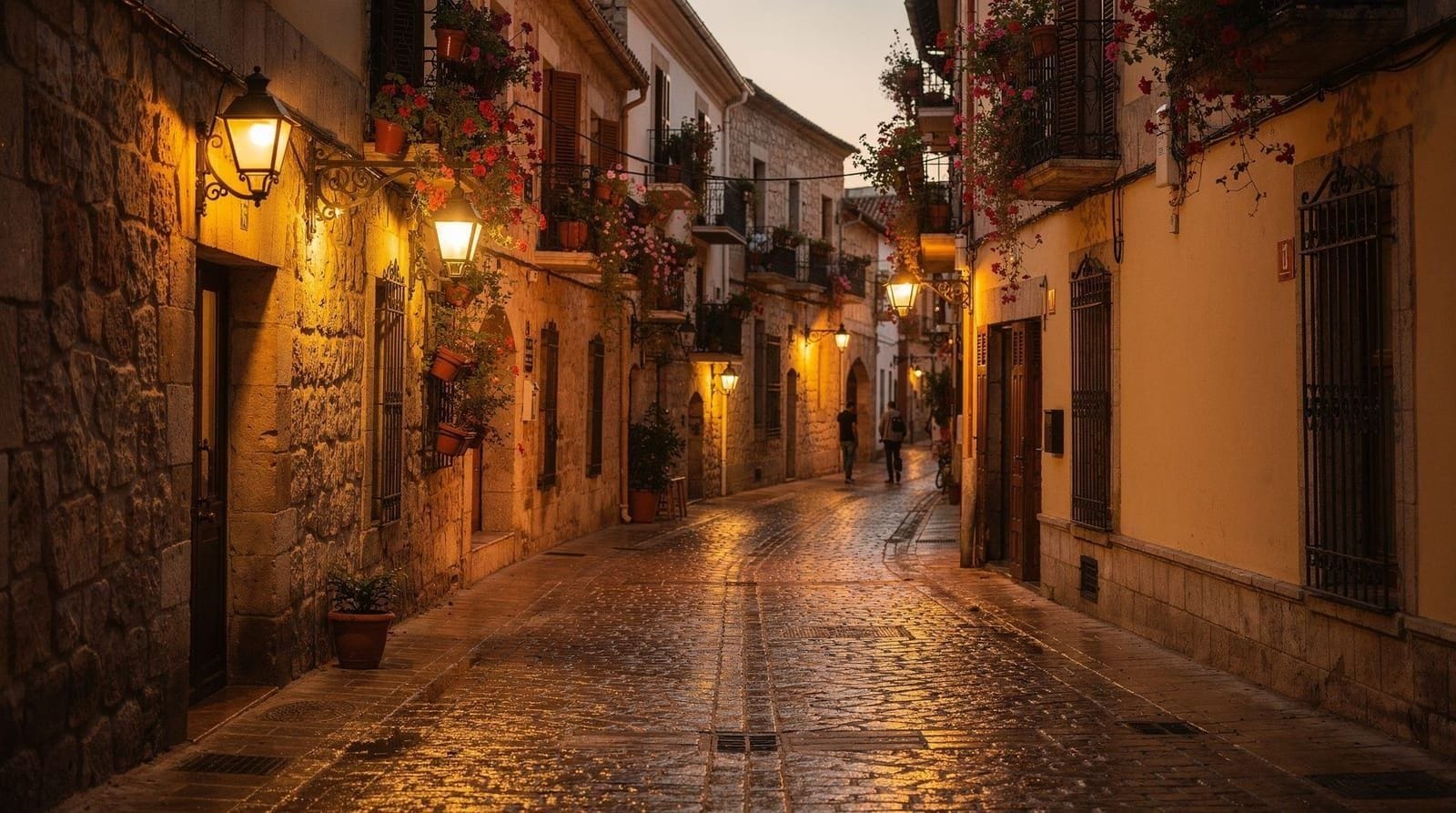
The Barrio de las Letras has reinvented itself as one of Madrid’s most appealing eating and drinking neighbourhoods. The street grid is largely unchanged from the 17th century — narrow, irregular, occasionally surprising — but the buildings are now occupied by wine bars, small restaurants, craft breweries, and independent bookshops.
Street quote tiles: On the cobblestones of Calle de las Huertas (the neighbourhood’s main pedestrian street), literary quotes from Golden Age writers are embedded in the paving in bronze lettering. Walking the length of the street is a literal walk through Spanish literary history.
Plaza de Santa Ana — The neighbourhood’s central square, surrounded by bars and with the Teatro Español on the eastern side and the Hotel Me Madrid (with its rooftop bar, open to non-guests) on the northern side. In warm months, the terrace tables of the plaza’s bars fill with a mix of local residents, tourists, and theatre-goers. This is one of Madrid’s most pleasant squares for a mid-afternoon drink.
El Lateral (Plaza de Santa Ana 12) — Popular for its excellent selection of wines by the glass and small plates.
Cervecería Alemana (Plaza de Santa Ana 6) — A 19th-century bar that was a Hemingway haunt when he lived in Madrid. The interior is unchanged; the German-style service and beer selection remain the defining features.
Casa Alberto (Calle Huertas 18) — Operating since 1827 in a building where Cervantes reportedly lived at one period (disputed by historians, but the claim is traditional). Vermouth, traditional Spanish food, good tapas at the bar.
The Barrio de las Letras as a base
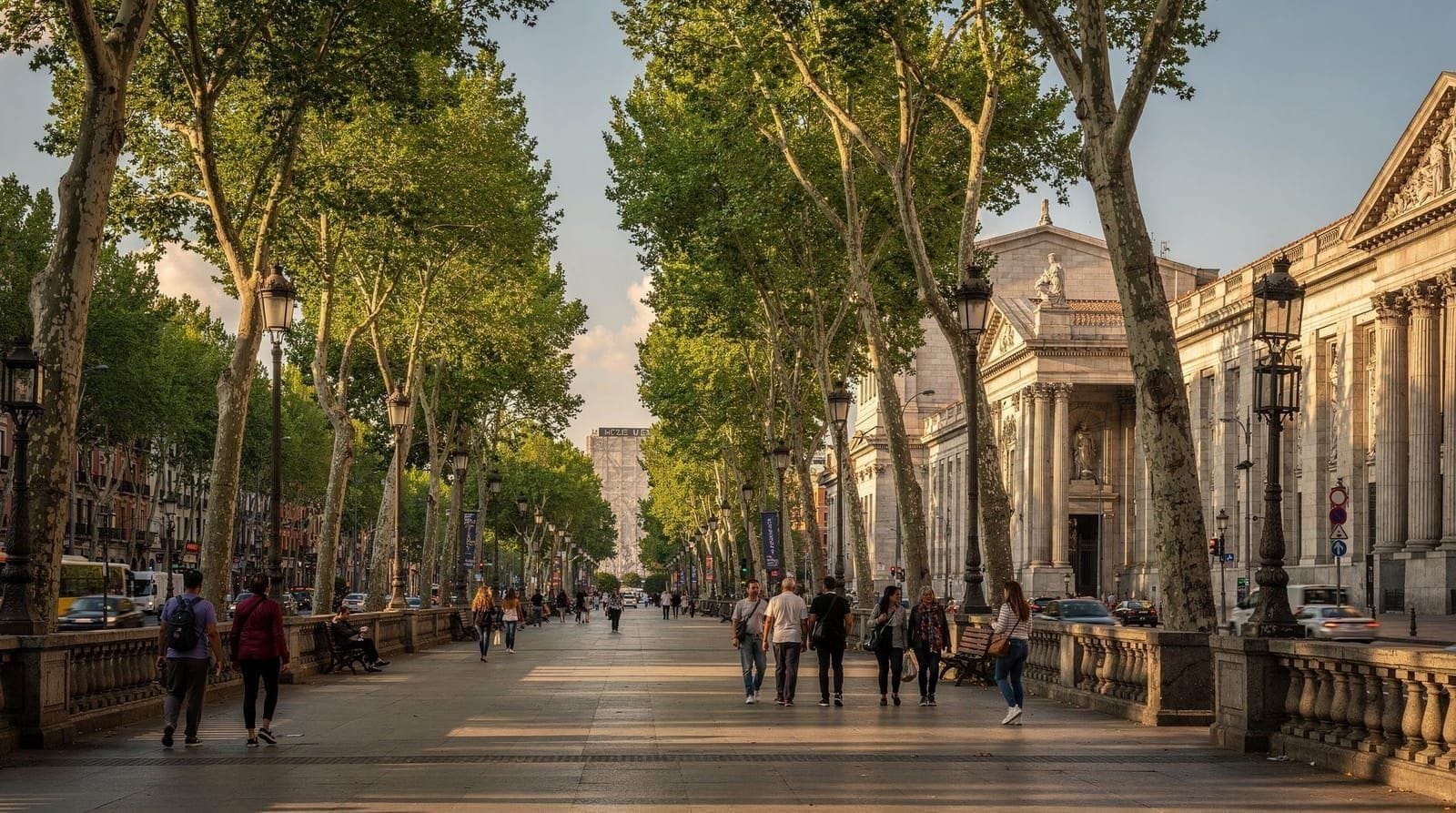
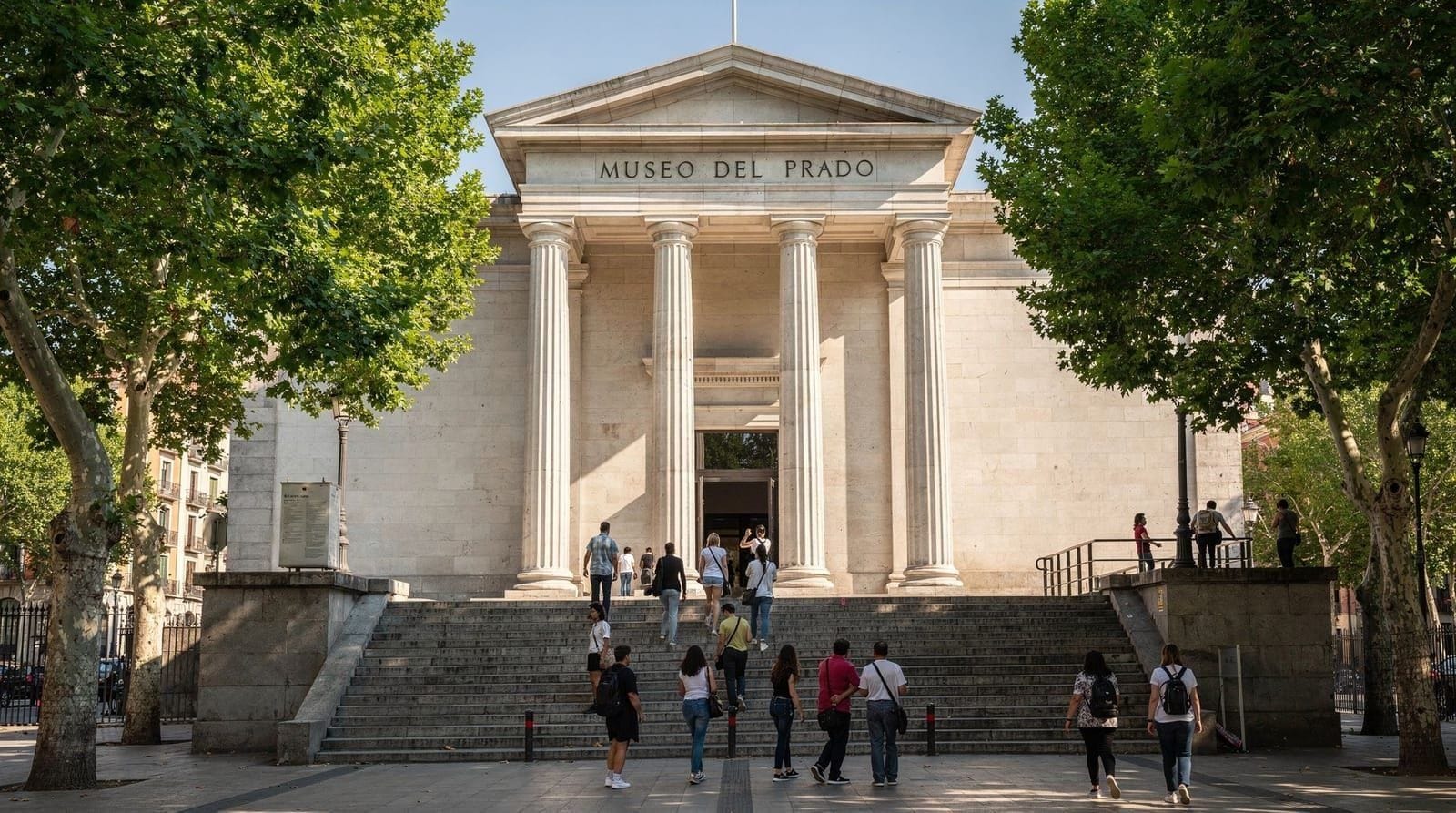
The neighbourhood’s position — immediately west of the Paseo del Prado, south of Puerta del Sol, north of Atocha station — makes it an excellent base for visiting the Golden Triangle museums.
From Plaza de Santa Ana:
- 10 minutes walk east to the Prado
- 15 minutes north to the Thyssen
- 15 minutes south to the Reina Sofía
For accommodation, the Barrio de las Letras has a range of boutique hotels and short-stay apartments that offer a more residential feel than the Sol-Gran Vía tourist core. See where to stay in Madrid for a neighbourhood comparison.
A literary quarter walking route
Duration: 1.5–2 hours, flat throughout
- Start at Plaza de Santa Ana — note the Teatro Español facade, the Hemingway bars, the Lorca statue
- Walk south on Calle del Príncipe — passing the site of the Corral del Príncipe (now the Teatro Español entry)
- Turn onto Calle de Cervantes — to number 11, the Casa Museo Lope de Vega. Visit if open (allow 45 minutes)
- Continue to Calle de Cervantes / Calle de León intersection — plaque marking Cervantes’ house site
- Walk north on Calle de Quevedo — another street named for a Golden Age writer
- Turn east to Calle Lope de Vega — to number 18, the Convento de las Trinitarias Descalzas (Cervantes’ burial site)
- Return west along Calle de las Huertas — reading the literary quote tiles in the pavement
- End at Plaza de Santa Ana — for a glass of wine at one of the historic bars
Connecting literary Madrid to the wider cultural picture
The Barrio de las Letras sits at the intersection of literary and visual arts in Golden Age Madrid. Velázquez painted at the court of Philip IV (whose patronage also sustained Lope de Vega and Quevedo). The Prado’s collection reflects the same moment of cultural abundance — the art and the literature were products of the same court culture, the same religious environment, the same economic and political tensions.
For a fuller picture of the Habsburg period that produced this concentration of talent, see Habsburg and Bourbon history. For the institutional legacy — the Prado as Bourbon museum housing Habsburg collections — see the golden triangle art walk.
The 3-day Madrid itinerary includes a half-day in the Barrio de las Letras as part of a culturally structured visit.
Practical information for a Barrio de las Letras visit
Metro: Antón Martín (Line 1) for the heart of the neighbourhood; Sol (Lines 1, 2, 3) for the northern edge.
Best times: The neighbourhood is busiest for eating and drinking from 13:00–16:00 (lunch) and 20:00–23:00 (dinner and pre-theatre). Morning visits (before 12:00) are ideal for the Casa Museo Lope de Vega and the street walk without crowds.
Free options: The street quote tiles on Calle de las Huertas are always accessible. The Convento de las Trinitarias exterior and plaque are always visible. The Casa Museo Lope de Vega is free (guided group visits, advance booking required).
Combined with: The Barrio de las Letras is on the natural route between the Prado and Puerta del Sol — it works as a between-museums break, a pre-museum morning, or an afternoon destination on its own.
For the broader neighbourhood context, see the Barrio de las Letras destination guide.
Rainy-day version
Madrid’s rain, when it comes, tends to be short and heavy rather than day-long, which suits the Barrio de las Letras well — the neighbourhood has more indoor options per block than most of central Madrid. The Casa Museo Lope de Vega is entirely indoors and takes 45 minutes to an hour; pair it with the covered galleries of the golden triangle museums for a rain-proof half-day. Wine bars such as El Lateral and La Venencia are functioning shelter as much as they are destinations — sitting out a downpour with a glass of sherry at La Venencia is, if anything, an improvement on the sunny-day version of the same visit. The street quote tiles on Calle de las Huertas are the one outdoor element that loses something in the rain; save that stretch for a dry morning if your schedule allows it.
For a full wet-weather plan across Madrid rather than just this neighbourhood, see the rainy day guide for kids if travelling with children, or plan around the free things to do guide for indoor free options nearby.
What the literary quarter tells you about Golden Age Spain
The concentration of literary talent in a few Madrid streets in the early 17th century was not accidental. It was a product of specific economic and institutional conditions:
The printing industry: Madrid had become Spain’s publishing centre after becoming the capital. Royal licenses for printing, which controlled what could legally be published, were issued from the court. Writers needed to be near the court for access to these licenses, to patrons, and to the corrales de comedias that provided income from theatrical performance.
Patronage economics: Writing in 17th-century Spain was not primarily self-supporting through book sales (printing runs were small, royalties minimal). It was supported through patronage — from noble families, from the church, from the royal court. The Barrio de las Letras’ proximity to the major noble households of Madrid was not coincidental.
The corrales de comedias: The theatrical venues in the neighbourhood created a daily demand for new dramatic content that is almost impossible to imagine today. Lope de Vega reportedly wrote over 1,500 full plays, and his rivals were similarly prolific. This production rate was possible because the financial incentives were significant: a successful play could run for weeks and earn substantial income for the playwright. The commercial theatrical circuit was the 17th-century equivalent of a major streaming platform in terms of its hunger for content.
Don Quijote: the book that defined the neighbourhood’s legacy
Don Quijote de la Mancha (1605, Part II 1615) was published while Cervantes lived in the Barrio de las Letras. The book’s influence on world literature is well documented; its relevance to understanding Spain specifically is in what it says about the Spain of its time: a society that had grown wealthy on imperial conquest and was beginning to decline, a culture that valorized an aristocratic ideal of honour and chivalry increasingly at odds with economic reality.
Don Quijote is a parody of the chivalric romances that Cervantes’ contemporaries were reading, but it is also a more complex meditation on illusion and reality, on the relationship between reading and living, on what it means to have a sense of purpose in a world that does not validate it. These questions remain contemporary; the novel has been translated into more languages than any other book except the Bible.
The character Don Quijote is from La Mancha — the Castilian plain south of Madrid, an area the book describes accurately enough to be geographically navigable today. The windmills at Consuegra (2.5 hours south of Madrid by bus) are the most visual connection to the novel; the literary quarter in Madrid is the place where the book was written and published.
Eating and drinking in the literary quarter
The Barrio de las Letras has become one of Madrid’s best eating and drinking neighbourhoods — a combination of its proximity to the Prado (providing a tourist base) and its historical literary cachet attracting a mix of Spanish and international visitors who come for the culture rather than just the food.
Casa Alberto (Calle Huertas 18): Operating since 1827, in a building associated with Cervantes. Traditional vermouth (vermut, the Madrid aperitif tradition) at the bar, traditional Castilian cooking in the dining room. The croquetas (jamón or bacalao) are consistently good. Open Tuesday–Sunday; lunch and dinner.
Cervecería Alemana (Plaza de Santa Ana 6): The historic bar favoured by Hemingway during his Madrid stays. German-influenced service (efficient, no nonsense), good beer selection, simple tapas. The interior has not changed significantly since the early 20th century. Expensive by Madrid standards but appropriate for the atmosphere.
El Lateral (Plaza de Santa Ana 12 and several other locations): Upscale wine bar format with an excellent by-the-glass selection. The pintxos (Basque-style small plates) are above average. Good for a mid-afternoon drink while deciding where to have dinner.
La Venencia (Calle de Echegaray 7): Sherry bar — one of the most atmospheric and unreconstructed bars in Madrid. Serves only sherry (fino, manzanilla, amontillado, oloroso, cream) and a small selection of traditional tapas. No music, no WiFi, hand-written receipts. Operating since 1922 and apparently determined to remain in 1922.
Dinner recommendation: The highest-value dinner area is the streets between Calle de las Huertas and Calle del Prado — several excellent small restaurants in the €20–35 per person range that are significantly better than the tourist-grade restaurants of Puerta del Sol.
If you would rather have someone choose the stops for you, a guided tapas and Spanish wine tasting evening is an easy way to taste the neighbourhood without queuing at the wrong counters. For the wider picture of how to eat well without falling into traps, the tapas guide, the best tapas bars and the tourist menu traps pages are good companions, and the vermouth guide explains the aperitif ritual you will see at Casa Alberto.
A day in the literary quarter: full itinerary
Morning (10:00–13:00):
- Casa Museo Lope de Vega (free, advance booking required, open from 10:00)
- Street quote tiles walk on Calle de las Huertas
- Convento de las Trinitarias (Cervantes’ burial site, exterior)
- Morning coffee at any of the neighbourhood’s traditional cafes
Lunch (14:00–16:00):
- Casa Alberto for traditional Castilian food at the bar (croquetas, tortilla, vermouth)
- Or one of the Plaza de Santa Ana terrace restaurants for the views at the cost of slightly higher prices
Afternoon (16:00–19:00):
- Real Jardín Botánico (5 minutes walk east, €5 entry)
- Or Retiro Park (10 minutes walk east, free)
- Or the golden triangle museums (Prado and/or Reina Sofía, 10–15 minutes walk)
Evening (19:00–23:00):
- Pre-dinner drink at La Venencia (sherry) or El Lateral (wine)
- Dinner at one of the neighbourhood’s restaurants
- Optional: Teatro Español (Plaza de Santa Ana) for an evening performance
Total budget: €0–25 for the morning (free options exist), €15–30 for lunch, €15–30 for dinner, €10–30 for a Teatro Español performance.
Guided or self-guided: which makes sense here
The self-guided route above works well for anyone comfortable following a map and reading the on-site plaques — the Casa Museo Lope de Vega has English-language information sheets, and the street quote tiles are self-explanatory once you know what they are. Where a guide adds real value is context: a good local guide connects the Corral del Príncipe’s commercial theatre economics, Cervantes’ complicated burial story, and the Golden Age patronage system into a single narrative that is hard to piece together from plaques alone.
Barrio de las Letras and old town walking tour with a local guideIf you would rather combine the literary quarter with the Prado on the same outing, the golden triangle art walk covers how the two connect logistically. Another way to join the two halves of the Golden Age story in one outing is a guided walk that pairs the old town with a skip-the-line Prado visit.
For a broader view of the choice, the guided versus self-guided comparison and the private guide page set out when paying for a guide is worthwhile, while the free walking tours guide covers the budget option.
Pairing the literary quarter with the rest of Madrid
The Barrio de las Letras rarely works as an isolated stop; it is at its best when it is woven into a longer visit. A few combinations that follow the logic of the neighbourhood:
- Literature and painting. The Prado museum guide shows the same court that employed these writers through the eyes of its painters, and the Thyssen and Reina Sofía guides cover the other two corners of the art triangle.
- Literature and royal Madrid. The writers worked in the shadow of the Habsburg court, so the Royal Palace guide and the Madrid royal sites itinerary give the setting for what you read on the plaques.
- Literature and the old centre. The Plaza Mayor guide and the Puerta del Sol guide cover the squares at the northern edge of the neighbourhood, a short walk from the first stop on the route above.
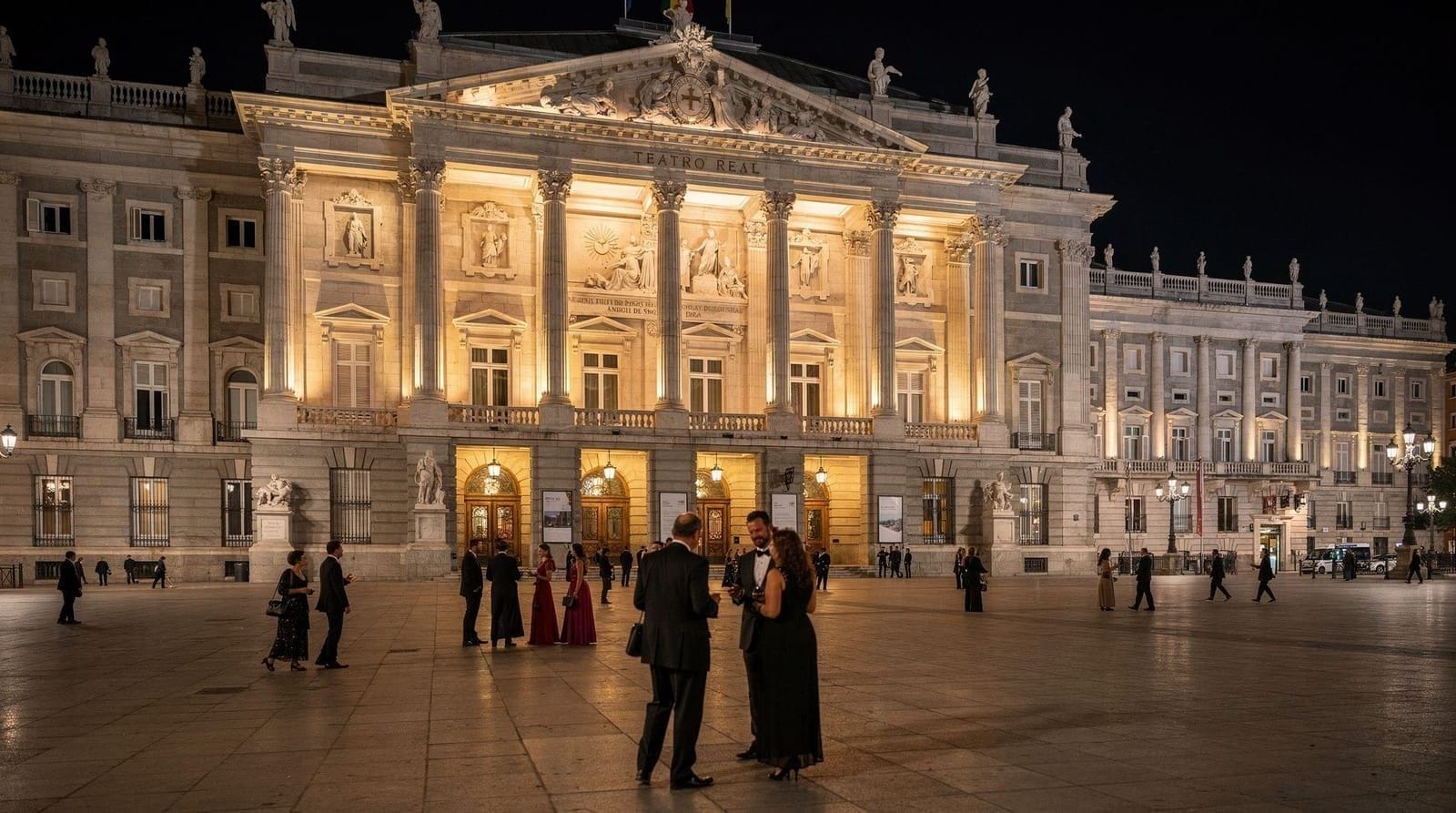
- Literature and the evening. The Teatro Real and zarzuela guide is the natural next step for anyone who enjoys the theatrical side of the quarter, and the Madrid at night guide suggests how to continue after dinner.
If you are building a full plan, the Madrid for art lovers itinerary and the one day in Madrid itinerary show where a morning in the Letras can sit without crowding out the big museums. The blog article on free art in Madrid is useful for anyone stretching a budget across several cultural stops.