Rainy day activities for kids in Madrid: the honest indoor guide
Madrid: Warner Park Entry Ticket
What can you do with children in Madrid when it rains?
Madrid gets very little rain (about 50 rainy days per year, mostly October–March). When it does rain: Zoo Aquarium (partly indoor), Faunia (many covered habitats), Natural Science Museum, Royal Palace interior, indoor play centres, and large shopping centres with food courts. The Aquarium section of the Zoo is the best pure indoor option for young children.
In brief: Madrid’s rainy days are infrequent (roughly 50 per year) and rarely last a full day — most showers pass in a few hours. But for the occasions when it matters, Madrid has good indoor family options beyond the standard museums.
| Where | Zoo Aquarium, Faunia, and central Madrid museums (all reachable by Metro) |
| Cost | Free (museums’ free windows) to around €22–28 (KidZania per child) |
| Time needed | 2–5 hours depending on venue |
| Best fully-indoor pick | Zoo Aquarium’s aquarium section, or the Natural Science Museum |
| Best time | Weekday mornings — rainy-day crowds concentrate on weekends |
First: understand Madrid’s rain calendar
Before planning around rain, it helps to know when it actually happens.
Madrid has a dry continental climate with genuinely low rainfall — about 400mm per year, concentrated in autumn (October–November) and spring (March–April). July and August have almost no rain (3–4 rainy days per month maximum). A prolonged day-long rain event in summer Madrid is unusual enough that it would be notable.
The rainy season reality:
- October–December: 5–8 rainy days per month, sometimes longer episodes
- March–May: 4–7 rainy days per month, usually shorter showers
- June–September: 1–4 rainy days per month, brief
The practical implication: if you are visiting in summer with children and rain is a concern, it is largely a non-issue. In spring and autumn, have a rainy-day fallback plan but do not over-plan around it.
The best fully indoor options for children
Zoo Aquarium (aquarium section)
The aquarium at the Madrid Zoo is fully air-conditioned and entirely indoors. The shark tunnel, tropical fish tanks, ray pools, and Mediterranean section are covered regardless of weather. The outdoor zoo sections (savanna, big cats, pandas) require rain management — but if rain is your concern, the aquarium alone justifies the entry fee for most children aged 3–12.
Combined admission includes both the outdoor zoo and the indoor aquarium, so you can move between covered and uncovered sections as the weather allows. See the Zoo Aquarium guide.
Faunia
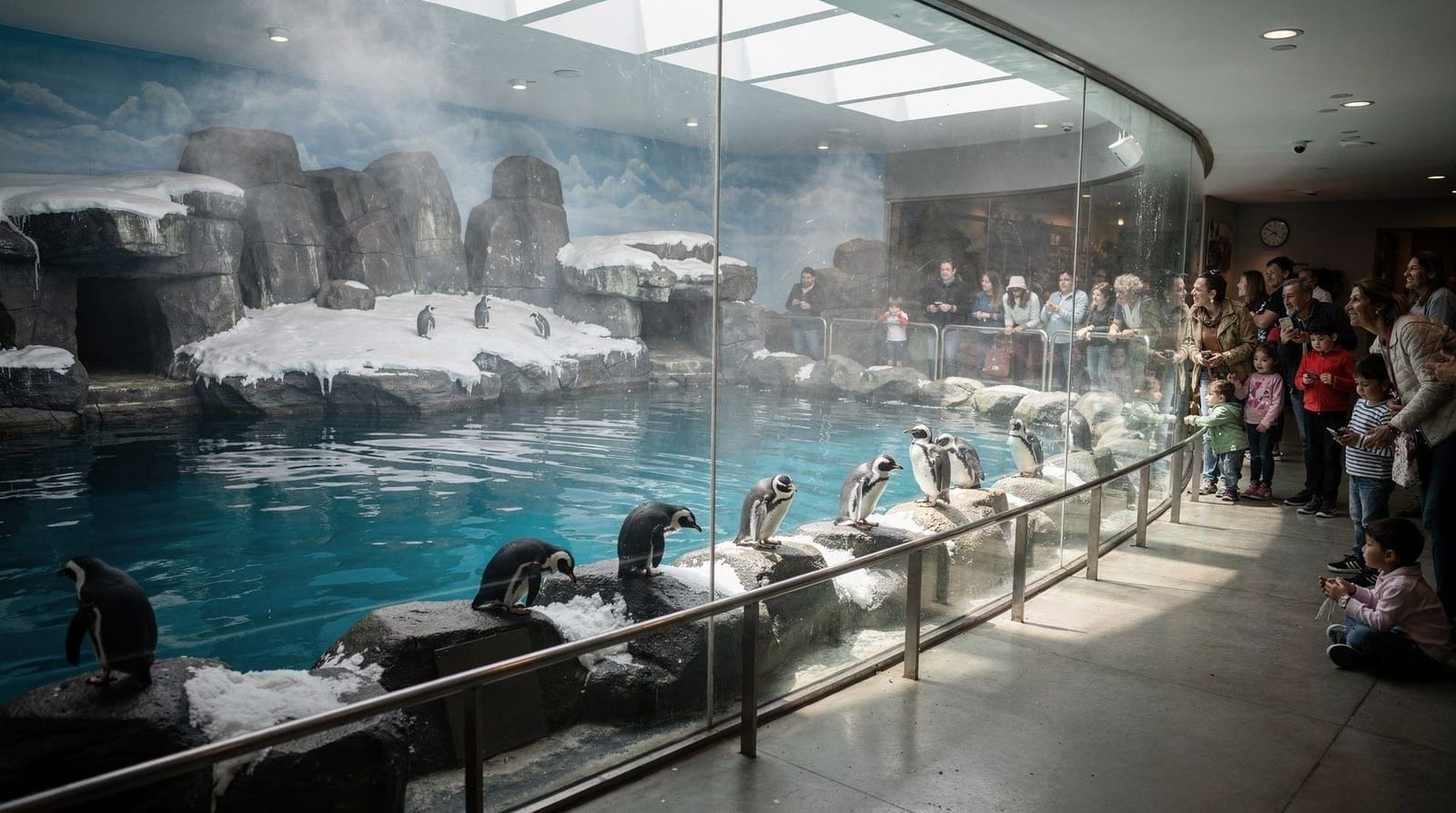
Several of Faunia’s habitats are fully covered — the Antarctic penguin exhibit, the tropical jungle (indoor, climate-controlled), and the nocturnal world. The wetlands outdoor section can be skipped in rain. Faunia is actually one of the more rain-resilient attractions in Madrid for families. See the Faunia guide.
Natural Science Museum (Museo Nacional de Ciencias Naturales)
Two buildings (opposite each other on Calle José Gutiérrez Abascal) containing natural history exhibits. The dinosaur fossil hall is the headline attraction — a well-displayed collection of large skeletons including long-necked sauropods. The zoology building has mounted animals and biodiversity exhibits.
Completely indoor. Good for ages 5–14. Admission approximately €7 adults, €3.50 children. Metro: Lines 6/10 to Nuevos Ministerios or Line 10 to Alvarado.
Royal Palace interior
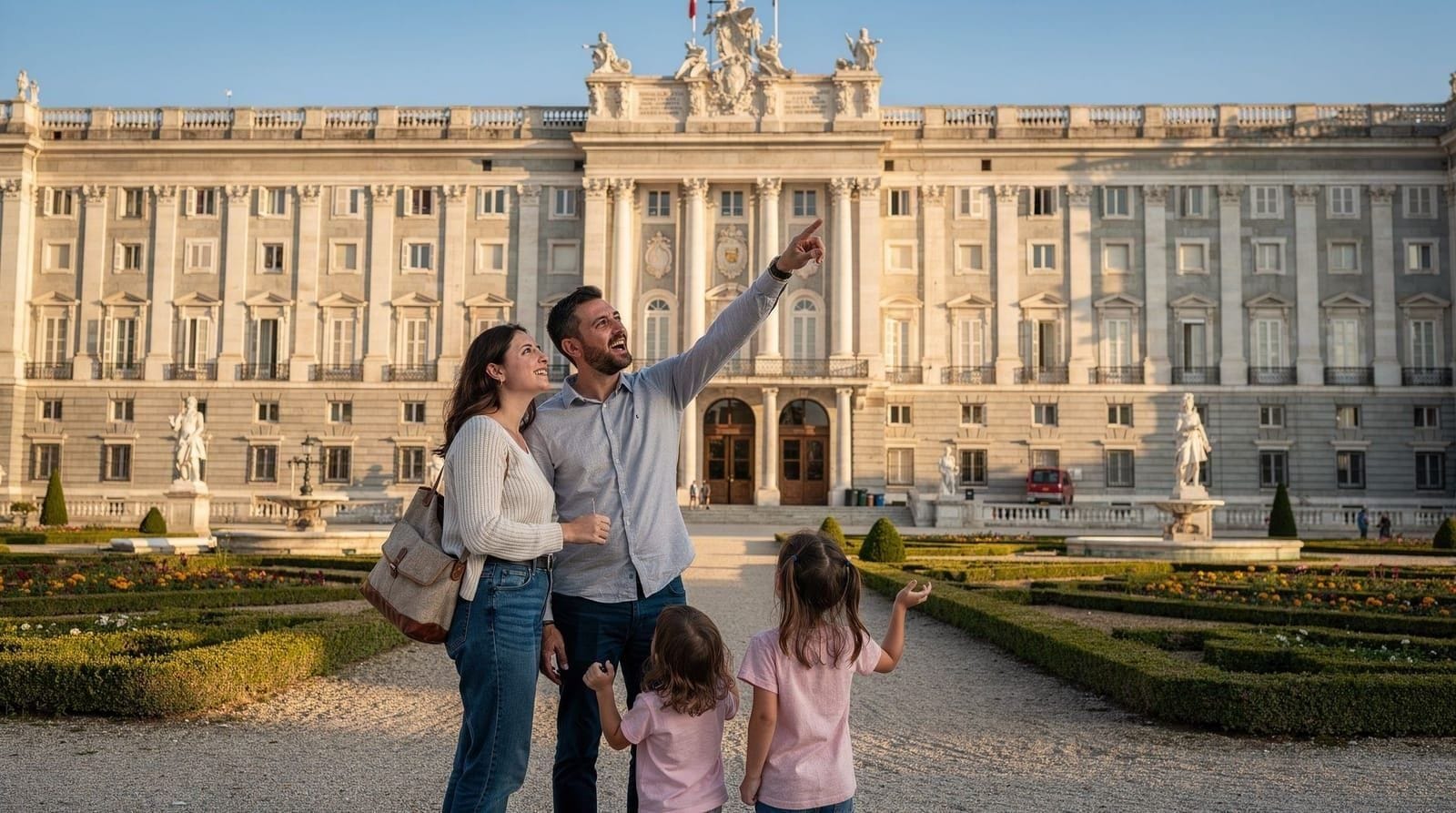
Rain actually improves a Royal Palace visit — fewer outdoor queue components, and the palace interior is entirely covered. The armour collection, throne rooms, and royal kitchen are all dry. See the royal palace guide.
Prado Museum
For art-interested children aged 10+, the Prado on a rainy day is excellent — the crowds are similar to good-weather days, but the motivation to stay longer is higher when there is nowhere to be outside. See the Prado museum guide.
If rain is forecast and you would rather not queue with restless children, a guided Prado visit with skip-the-line entry keeps the wet-weather wait short and gives the visit a clear thread to follow.
Reina Sofía
Guernica is genuinely impressive regardless of age or prior knowledge. The building itself (a former hospital converted to museum) is architecturally interesting. For children ages 8+. See the Reina Sofía guide.
Families who want both big art museums in one wet day can look at a guided visit covering the Prado and the Reina Sofía, which saves juggling two separate ticket lines under an umbrella.
Indoor play centres
Madrid has multiple purpose-built indoor children’s play centres (parques infantiles cubiertos). The largest and best-reviewed:
KidZania Madrid (La Vaguada Mall, Barrio del Pilar): A city-at-miniature format where children aged 2–14 take on adult roles — pilot, doctor, firefighter, chef, journalist — and earn “KidZos” (the park’s currency) to spend on activities. Extremely popular and busy on rainy days and school holidays. Book in advance (4–5 hours minimum for a satisfying visit). Admission approximately €22–28 per child, less for parents. Metro Line 9 to Herrera Oria.
Xanadú Indoor Ski Slope (Brunete, 35km from Madrid): The Xanadú shopping centre includes an indoor ski slope with beginner lessons. For families with children 6+ who want to try skiing. Requires transport (no direct metro). More a half-day activity.
City Kids (various locations): Smaller indoor soft-play centres spread across Madrid. Good for toddlers and children up to 8. Check current locations online.
Shopping centres with children’s facilities
On a serious rain day with children, a large shopping centre provides food, entertainment, and climate control in one location:
Centro Comercial La Vaguada (Barrio del Pilar): The oldest and largest mall in Madrid. Multiple food options, cinema, KidZania adjacent. Metro Line 9.
Intu Xanadú (Brunete): Outside the city but massive — cinema, bowling, indoor ski slope, multiple restaurants. Requires a car or taxi.
Madrid Río malls: The developments around the Madrid Río riverfront park have several indoor play facilities and food courts.
Cinemas
Standard multiplex cinemas are an obvious rainy-day option for older children. Note: most Madrid cinemas screen films in Spanish dubbing (dobladas), not the original language. Films in original version (versión original / VO) are available at specific screens — check listings specifically for VO screenings if English (or your language) matters.
The Yelmo Ciné Islazul and the Cinesa Proyecciones are reliable multiplexes with VO options. Check showtimes online.
Indoor cultural options for older children (10+)
Caixaforum Madrid (Paseo del Prado): A converted power station with temporary exhibitions, free to enter. The building itself (the hanging garden facade, the converted interior) is interesting for design-curious teenagers.
Naval Museum (Museo Naval): Near the Prado, focused on Spain’s maritime history — model ships, navigation instruments, maps. Unexpectedly good for children interested in history or engineering. Free admission. See the naval museum guide.
Thyssen-Bornemisza Museum: More accessible than the Prado for children — a coherent collection that progresses chronologically, with Impressionist work in the upper floors that children find more immediately engaging. See the Thyssen museum guide.
Practical logistics on rainy days
Dress: A light rain jacket is sufficient for Madrid’s showers. The city rarely has extended heavy downpours in the way that London or Amsterdam does.
Metro: The metro is fully underground and unaffected by rain. If outdoor walking is the issue, metro is the solution. See the tourist travel pass guide.
What closes: Outdoor attractions (Temple of Debod, rooftop terraces, walking tours) are reduced or cancelled in rain. Theme parks operate with some closures of outdoor rides.
Advance booking: Rainy days concentrate visitors into indoor attractions. If rain is forecast, book museum entry the previous day.
For the full family planning guide, see the Madrid with kids guide and the family itinerary.
Age-by-age rainy day planner
Ages 2–4
Outdoor exploration is off the table. The best options for toddlers and preschoolers:
- Zoo Aquarium (aquarium section only): The shark tunnel and the ray pool are indoor, calm, and visually stimulating for young children without being loud or overwhelming. 2–3 hours.
- KidZania: Specifically designed for this age group’s play mode. The “young child” roles (hospital patient, bakery helper) are accessible from age 2.
- Large shopping mall with soft-play area: Practical rather than memorable, but appropriate when all other options involve transport in rain.
- Swimming pool: Several Madrid public swimming centres have indoor pools with children’s shallow sections. Ask at your accommodation for the nearest.
- Children’s library (biblioteca infantil): Madrid’s network of public libraries has dedicated children’s sections with picture books in multiple languages and occasional storytelling sessions. Free. Often overlooked by visiting families.
Ages 5–8
More resilient and more able to engage with cultural content:
- Natural Science Museum: The full museum including dinosaurs and zoology — 3–4 hours. This is the primary recommendation for this age group.
- Faunia: The indoor sections (Antarctic, tropical jungle, nocturnal) work in rain. Allow 3 hours for the covered sections alone.
- KidZania: The sweet spot age range. Budget 4–5 hours.
- Reina Sofía Museum: The collection includes works that engage this age group — Guernica for its scale, Dalí for its strangeness, Miró for its colour. The museum has dedicated family activities on some days — check the website.
- Madrid Río aquatic centre (summer): If warm enough (unusual in rainy conditions, but Madrid’s summer rain often passes quickly), the indoor sections of the Aquatic Centre are accessible.
Ages 9–12
Beginning to engage with cultural content independently:
- Prado Museum (focused visit): 1.5–2 hours with a focus on the sections most likely to engage this age group — the Velázquez court portraits (Las Meninas is comprehensible to this age), Goya’s Black Paintings (darker and more dramatic), and the Bosch (El Bosco) triptych.
- Naval Museum: Genuinely interesting for engineering and history-minded pre-teens — model ships, navigational instruments, and maps of the first circumnavigation. Free.
- Escape rooms: A Madrid growth industry in recent years. Several quality escape rooms operate in the city centre. The format is excellent for children 9–14 who enjoy puzzle-solving. No Spanish required — English versions available at most venues.
- Caixaforum exhibition: The converted power station with temporary art and science exhibitions. Often has content designed for family engagement. Check the current exhibition before visiting.
Teenagers (13+)
- Escape rooms (same reasoning as 9–12)
- Reina Sofía — the 20th-century art collection is genuinely engaging for culturally curious teenagers
- Gaming cafes / board game cafes: Madrid has a developed board game café culture — venues where you pay a flat fee to access a library of hundreds of games with food and drinks. Appropriate for rainy afternoon/evening.
- Bowling/mini golf: Several entertainment complexes in the outer districts combine bowling, mini golf, and arcade games. Better for groups.
- Cinema in VO (original version): For teenagers, a film in English (or their language) with Spanish subtitles. Check listings for VO screenings.
Emergency options: what to do when nothing is pre-planned
If rain surprises you with no advance planning:
Step 1: Head to the nearest covered option — a large shopping centre, a museum, or a café. Do not try to navigate to a specific attraction in heavy rain with children.
Step 2: Reassess for 30 minutes. Madrid’s rain rarely lasts a full day. If the sky is improving, return to the original plan with appropriate gear.
Step 3: If the rain is persistent, book museum tickets on your phone for the next available timed entry (Prado and Reina Sofía both allow same-day online booking up to the hour before, subject to availability).
Step 4: If museum tickets are sold out, KidZania does not require advance booking (though queues can be 20–30 minutes on rainy days) and the Natural Science Museum rarely sells out.
What to keep in your bag for unexpected rain in Madrid
- Light rain jackets (1 per person): A packable jacket is sufficient for Madrid’s showers. No heavy waterproofs needed.
- Phone charger cable: Indoor waiting times eat battery.
- Snacks: If the plan changes to a museum visit, you control the food pace.
- Museum membership card (if applicable): Some visitors hold ICOM cards or similar that give free entry to state museums — useful for last-minute museum pivots.
An unexpected benefit of rainy days
Madrid’s rain is infrequent enough that it forces visitors into the museums they might otherwise have deferred. Many visitors report that the best single cultural experience of their Madrid trip (the Prado, the Reina Sofía, the Naval Museum) happened because rain pushed them indoors on a day they had planned to visit the parks.
The museums — particularly the Prado — are genuinely not overcrowded in Madrid the way the Louvre or the Uffizi are. A rainy day Prado visit with advance tickets feels calm and intimate in a way that is unusual for a world-class art museum.
For the broader context of visiting Madrid with children, see the Madrid with kids guide and the full family itinerary.
Madrid’s rainy-day culture: vermut and the indoor Sunday
For Spanish families, a rainy day is not a problem to solve — it is an invitation to the indoor social activities that are an integral part of Madrid culture.
The Sunday vermut session (from approximately 12:00 at any bar in La Latina, Malasaña, or Chamberí) is perfectly suited to rainy weather. Families gather, children run between tables, adults drink vermut and talk. This is an authentic Madrid activity that most tourists miss because they are trying to be outside visiting sights.
For visiting families on a rainy day, joining a vermut session in La Latina is genuinely more immersive than visiting another museum. You eat, the children are occupied (Spanish bar culture tolerates children completely), and you observe the actual rhythms of Madrid life.
The practical approach: find a bar on Calle Cava Baja with outdoor awnings and a good indoor section. Order vermut rojo (red vermouth with ice and an olive), a plate of patatas bravas, and a coca de atún. Stay for an hour. This costs approximately €8–12 per person and is a genuine cultural experience, not a tourist attraction.
Free museums and attractions on rainy days
Several Madrid museums are free on specific days or times — useful to know for families managing the cost of an unexpected indoor day:
Prado Museum: Free Monday–Saturday 18:00–20:00, Sunday 17:00–19:00. For families willing to visit in the last 2 hours, this is an excellent free option. Note: free time slots are popular and the museum can be crowded during free hours.
Reina Sofía: Free Monday and Wednesday–Saturday 19:00–21:00, Sunday 12:30–14:30. Same principle — excellent quality, zero cost during free windows.
Thyssen-Bornemisza: Free Monday (12:00–16:00). Typically less crowded than Prado and Reina Sofía on their free days.
Nacional de Ciencias Naturales (Natural Science Museum): Free last two hours of each opening day (approximately 16:30–18:30 on most days). Check current hours.
Sorolla Museum: The original house-museum of the Spanish Impressionist Joaquín Sorolla is closed for renovation (source: the museum’s official website, Ministry of Culture). Only the new building (calle Zurbano 68, opened 15 October 2026) is open, free of charge: Tuesday–Saturday 9:30–20:00, Sundays and public holidays 10:00–15:00, closed Mondays; last entry 45 minutes before closing. Check the museum’s official website for the reopening of the house.
Naval Museum: Always free (donation requested). See the Naval Museum guide.
National Archaeological Museum: Free Saturday afternoon and Sunday morning. Large collection covering pre-Roman Iberian culture through the Moorish period.
The Madrid Río aquatic facilities (summer rain only)
If a rainy day falls during summer (June–August) and the temperature is still warm (above 25°C — rain in Madrid summer is often a brief shower after a hot day), the indoor sections of Madrid Río’s aquatic facilities remain accessible.
The Parque Deportivo Madrid Río has an indoor pool section with lane swimming and recreational pools. Entry is minimal (approximately €5–7 adults, €3–4 children). Less exciting than an outdoor water park but comfortable and functional when outdoor options are reduced.
When the rain stops: quick-pivot outdoor options
Madrid’s showers rarely last the full day. When the rain clears, the following outdoor options are immediately accessible without planning:
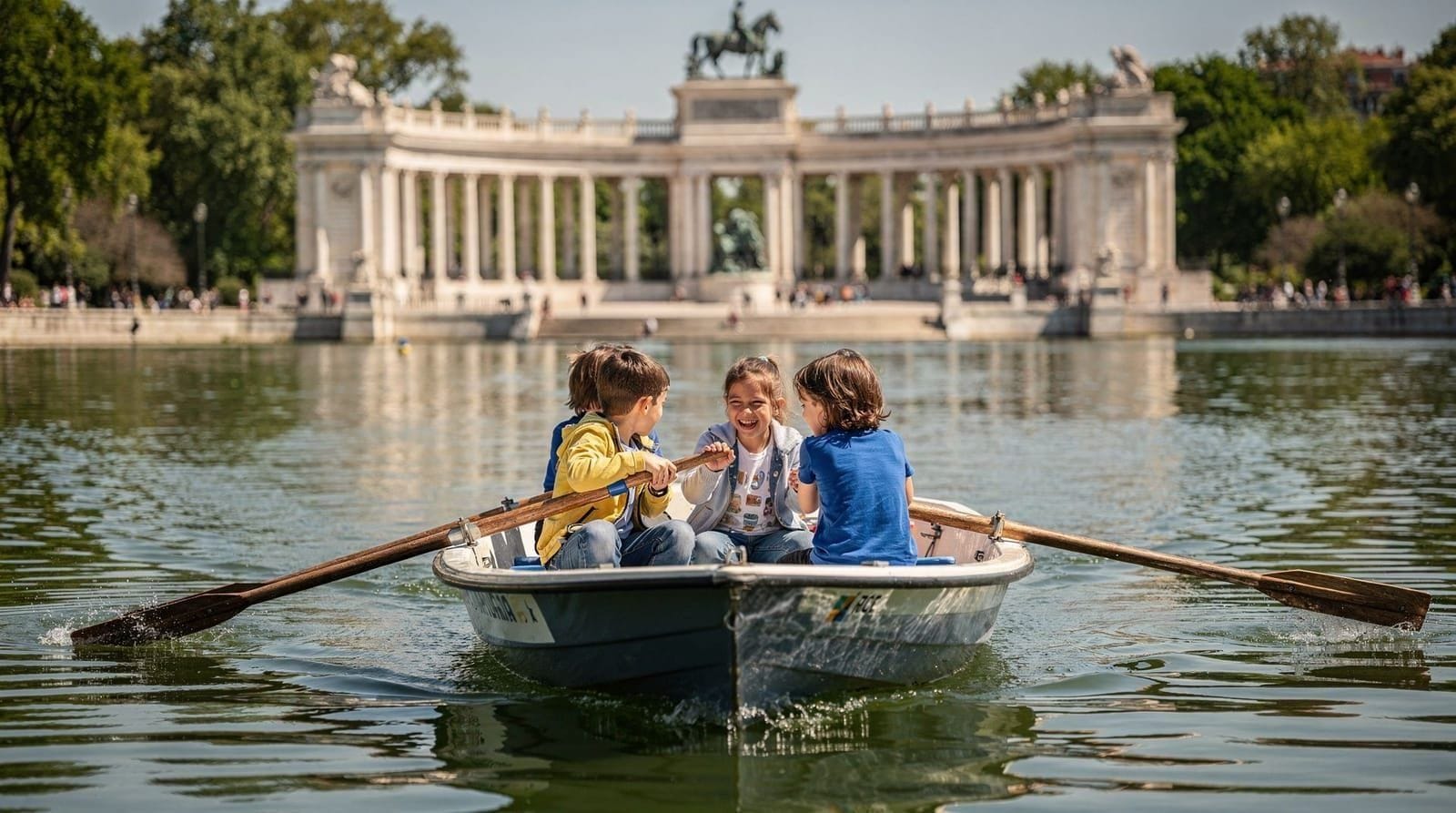
- Retiro Park: 15 minutes from most central hotels. The lake boat hire restarts as soon as conditions clear.
- La Latina terraces: The covered terraces on Cava Baja open as soon as the rain pauses.
- Parque del Oeste: Adjacent to the Teleférico station (the cable car is closed for refurbishment, reopening expected in the first quarter of 2027, EMT Madrid). The rose garden and the park itself are pleasant post-rain.
The quick-pivot strategy: have one indoor activity planned as a fallback, execute it in the morning if rain persists, and switch to outdoor options in the afternoon when the sky typically improves.
For the complete family planning context, see the Madrid with kids guide and the family itinerary.
Pairing a wet morning with a dry afternoon
A rainy day rarely has to be one single activity. The simplest approach is to treat the morning as the indoor slot and keep the afternoon flexible, then decide once you see the sky. A museum block in the morning, a long lunch, and a short outdoor stretch later keeps children from tiring of either.
Some combinations that work well together, using guides already on this site:
- Art in the morning, park later: start at the Thyssen museum or the golden triangle art walk, then head to the Retiro if the clouds lift.
- Palace and chocolate: a visit to the Royal Palace followed by churros con chocolate is a comfortable, dry half day that children tend to remember.
- Animals first, then the metro home: the zoo and aquarium or Faunia, with the Metro guide in hand so transfers stay simple.
- Food as the activity: a covered stop at the Mercado de San Miguel or one of the other Madrid markets turns lunch into part of the day rather than a break from it.
If your children are keen on rides rather than museums, the Parque Warner guide and the Parque de Atracciones guide explain how each park copes when the weather turns, and a day at the Warner theme park is worth considering only if the forecast looks settled.
For a longer stay, the Madrid with a family itinerary and the winter guide show where a flexible indoor day fits into the wider plan, and the blog post on rainy days with kids gives a second view of the same situation.
Rainy day vs sunny day: what actually changes
For families deciding how much to worry about rain in the forecast, it helps to see the practical difference side by side.
| Sunny day plan | Rainy day plan | |
|---|---|---|
| Morning | Retiro Park or Zoo outdoor sections | Natural Science Museum or aquarium section |
| Midday | Outdoor lunch on a terrace | Shopping centre food court or museum café |
| Afternoon | Casa de Campo or Teleférico (closed for refurbishment, reopening expected Q1 2027; check before planning) | KidZania or Reina Sofía |
| Transport | Walking between sights | Metro (fully underground, rain-proof) |
The core takeaway: Madrid’s indoor options for families are genuinely good, not just an emergency fallback — several visitors report the museum visit forced by rain became the trip highlight.
Top experiences
Bookable activities with verified prices and instant confirmation on GetYourGuide.