Real Fábrica de Tapices: Madrid's living royal tapestry workshop
Madrid: Prado Guided Skip the Line
What is the Real Fábrica de Tapices and can I visit it?
The Real Fábrica de Tapices (Royal Tapestry Factory) is a working artisan workshop established by Philip V in 1721, still producing handwoven tapestries and carpets using traditional methods. Guided tours (€6, €5 reduced, approximately 45 minutes) are available Monday to Friday. You visit the actual weaving rooms where craftspeople work at the looms — a living demonstration of a technique unchanged since the 18th century.
In brief: The Real Fábrica de Tapices is a still-functioning 18th-century royal workshop producing handwoven tapestries by traditional methods. Guided tours run Monday to Friday at €6 (€5 reduced). You watch craftspeople weaving at historic looms — an experience unlike anything else in Madrid’s museums.
| Where | Calle de Fuentearrabia 2, Retiro-Jerónimos neighbourhood |
| Cost | €6 per adult (€5 reduced), guided tour only |
| Time needed | 45 minutes |
| Getting there | Metro Atocha Renfe or Menéndez Pelayo (Line 1), 5–8 min walk |
| Best time | Weekday mornings; no tours at weekends |
Three centuries of continuous weaving
The Real Fábrica de Tapices (Royal Factory of Tapestries) was established by Philip V in 1721, modelled on the French manufactory system of Louis XIV. The goal was to produce tapestries for the royal palaces without depending on Flemish and French imports — a matter of both artistic prestige and economic nationalism.
The factory moved to its current location in the Retiro-Jerónimos neighborhood in 1889. It has been in continuous operation for over 300 years, surviving the Spanish Civil War, the transition to democracy, and the decline of European royal patronage by adapting to institutional and private commissions. The Spanish royal household still places orders here; so do foreign governments, museums, and private collectors.
What makes the Real Fábrica genuinely unique is that the techniques have not changed materially since the 18th century. The looms are traditional, the wool is dyed with the same colour ranges, and the weavers follow cartoons (scale designs) in the same way that the 18th-century workers who wove from Goya’s designs did. There is no mechanisation in the weaving process; what you see on a tour is indistinguishable in method from what you would have seen in 1780.
The Goya connection
Francisco Goya’s first professional success in Madrid was as a cartoon painter for the Real Fábrica de Tapices. Between 1775 and 1792, he produced 63 oil paintings (cartoons) depicting scenes of Madrid life — the Parasol, the Swing, the Blind Guitarist, the Crockery Vendor, the Straw Manikin — that the factory weavers translated into tapestries for the royal apartments.
The original cartoon paintings are in the Prado Museum (rooms 84–87 in the Prado, on the ground floor — often overlooked in favour of the more famous rooms). The tapestries woven from them hang in various royal palaces. The Real Fábrica tour explains this production process — how a Goya oil painting was scaled, gridded, and translated thread by thread into a textile — in a way that the Prado cannot, because the Prado shows only the paintings and not the manufacturing process.
Seeing the Goya cartoons at the Prado and then visiting the factory deepens both experiences considerably. The Madrid for art lovers itinerary includes this pairing specifically.
If you would rather have the cartoon rooms explained than wander through them alone, a guided Prado visit with priority entry gives you context on Goya’s early court work before you see how the weavers handled it.
What you see on the tour
The weaving rooms: The core of the visit. You enter the main hall where craftspeople (mostly women, trained in a multi-year apprenticeship) work at high-warp looms. High-warp weaving (vertical warp threads, weavers working from behind the tapestry and viewing the design via mirrors) is the traditional Brussels and Gobelin technique used since the 17th century. The weaving is entirely manual — each thread is placed by hand according to the colour cartoon.
A typical tapestry of 2 × 3 metres takes 2–5 months of work, depending on the complexity of the design and the number of weavers. A commissioned carpet of the same size takes a similar timeframe. The factory’s production rate is necessarily small, which is why the pieces cost what they do.
The design process: On tours, the guide explains how a cartoon (whether a 300-year-old Goya design or a contemporary commission) is scaled to the final tapestry dimensions and transferred to the weaving grid. The colour vocabulary available in wool is more limited than paint; translating painted colour into available dye lots is a significant part of the skill.
The restoration workshop: The factory also restores historic tapestries from Spanish royal collections and foreign institutions. If restoration work is in progress during your visit, you may see pieces from the 17th or 18th century on the restoration frames — an extraordinary close-up view of historic weaving.
The shop: The factory shop is genuine — pieces made on these premises. Small decorative weavings start at €300–500; medium carpets at €3,000–8,000; major tapestries at €15,000+. The quality justifies the price; these are not tourist souvenirs.
Practical logistics
Address: Calle de Fuentearrabia 2, 28014 Madrid. The factory is in the Retiro-Jerónimos neighbourhood, south of Atocha station and east of the Retiro park.
Getting there: Metro Atocha Renfe (Line 1) or Menéndez Pelayo (Line 1), then 5–8 minutes on foot. The factory is close to the Retiro park southern entrance. On foot from the Prado: 12–15 minutes.
Booking: Visits are guided only and must be booked in advance by email through the factory’s official website. Each tour needs a minimum of 5 visitors (8 for afternoon tours) and takes a maximum of 15.
Languages: Standard tours are in Spanish. Tours in English may be available on request for groups; for individuals, the factory staff often have enough English to provide commentary.
Summer: Afternoon tours are suspended from 1 July to 15 September; morning tours continue. If visiting in summer, confirm in advance.
Combining the Real Fábrica with the Retiro area
The factory’s location near the Retiro park and Atocha makes it a natural addition to a morning that also includes the southern Paseo del Prado museums. Possible combination:
- Morning: Prado Museum (10:00–12:30), specifically including the Goya cartoon rooms on the ground floor
- Lunch: Barrio de las Letras or around Atocha
- Early afternoon: Real Fábrica de Tapices guided tour (book the 11:00 or 12:00 slot if combining with Prado morning)
Alternatively, the factory pairs with a Retiro park walk — the southeast entrance to the park is 10 minutes from the factory on foot.
A third option is to follow the thread to its destination. The tapestries woven from Goya’s designs hang in royal residences, so a visit to the Royal Palace on another day completes the story. Booking a guided Royal Palace visit with skip-the-line entry is a practical way to do it without spending your time in the queue, and the guide can point out the textiles as you pass through the royal apartments.
What the Real Fábrica represents
The factory is a working institution, not a heritage display. The 30–40 people employed there are not performing a historical demonstration; they are craftspeople doing a job that takes years to learn and which produces objects of genuine quality. The workshop is maintained because institutions and collectors still want what it produces — not because Spanish heritage funding keeps it alive as a museum exhibit.
This distinction matters for how you experience the visit. You are a visitor in an active production environment, not an audience for a museum programme. The appropriate attitude is that of someone watching skilled work being done — attentive and respectful rather than consuming a packaged experience.
For visitors interested in traditional craft, material culture, or the history of Spanish decorative arts, the Real Fábrica is one of the most authentic experiences in Madrid. For visitors focused on the standard tourist circuit, it is an excellent optional addition to a third or fourth day — the Madrid 4–5 day itinerary includes it specifically.
The Goya cartoons in detail: what to see at the Prado first
Before visiting the Real Fábrica, seeing the Goya cartoon paintings at the Prado Museum transforms the factory visit. The cartoons are in Rooms 84–87 on the Prado’s ground floor — often walked through quickly on the way to the more famous upper-floor rooms, but worth a dedicated 30 minutes.
The cartoon paintings show Goya at his most accessible: scenes of everyday Madrid life in the 1770s–1790s, painted in oil with a freshness and directness that the monumental court portraits lack. The subjects include:
The Parasol (1777): A young woman shaded by a parasol held by a man, seated on a slope overlooking Madrid. The light is Velázquez-influenced; the figures are observed rather than idealised.
The Blind Guitarist (1778): A street musician surrounded by onlookers — social observation rather than sentimentality.
The Swing (1779): Two women and two men in a garden, one woman on a swing, the scene suggesting flirtation and social play without explicit content.
The Straw Manikin (1791–1792): Four women tossing a male figure in a blanket — an image that admits multiple interpretations (folk festival, reversal of gender power, simple entertainment) and one of Goya’s most discussed cartoons.
At the Real Fábrica, the guide will show you how these oil paintings were translated into woven thread — the grid system, the colour selection, the scale change from canvas to tapestry. The two experiences are designed to inform each other.
The tapestry as medium: technical differences from painting
Understanding what the Real Fábrica workers actually do clarifies why hand-woven tapestries are valued as they are.
A tapestry is not a woven reproduction of a painting. The weaver’s task is to translate a painted image into a textile using wool (and sometimes silk) threads of limited colour range. The challenges are:
Resolution: A tapestry cannot reproduce fine detail — a face that Goya painted with 20 brushstrokes may require 500 individual thread placements. The simplified, stylised quality that gives tapestries their distinctive look is partly aesthetic choice and partly the medium’s inherent limitation.
Colour range: The colour palette available in dyed wool is more limited than paint. The weaver must make substitutions and approximations; the skill is making substitutions that read correctly from viewing distance.
Time: A square metre of tapestry takes approximately 4–8 weeks of a skilled weaver’s time, depending on complexity. The Real Fábrica estimates 2–5 months for a typical 2×3 metre commission.
Reversibility: Unlike painting, tapestry cannot be easily corrected — an error in placement requires removing and re-weaving entire sections. This is why the preliminary colour study (a detailed painted guide for the weaver) is prepared before work begins.
What the factory produces today
The Real Fábrica’s current production is divided between:
Royal commissions: Replacement tapestries for the royal palaces (when originals are too fragile for display) and new commissions for state spaces. The factory maintains historical designs from its archive.
Institutional commissions: Foreign governments, embassies, museums, and corporations occasionally commission tapestries. The factory has produced pieces for the Spanish Parliament, foreign royal households, and several major hotels.
Private collectors: Custom tapestries for private homes and corporate collections. Minimum dimensions and prices are not advertised publicly; contact the factory directly for quotations.
Restorations: The factory accepts restoration commissions for historic tapestries from Spanish royal collections and foreign institutions. This work — removing old repairs, re-weaving damaged sections — requires the highest level of skill and is typically more time-consuming than new production.
The factory neighbourhood: Retiro-Jerónimos
The Real Fábrica de Tapices sits in the Retiro-Jerónimos neighborhood — one of Madrid’s most pleasant and least-crowded areas for walking. The zone between the Retiro park, the Prado, and the Atocha station contains several sights that make natural combinations with the factory visit:
Real Jardín Botánico de Madrid: The 18th-century royal botanical garden, adjacent to the Prado’s south side. Entrance €4; lovely in spring (April–May) and autumn. The Jardín Botánico guide covers seasonal highlights.
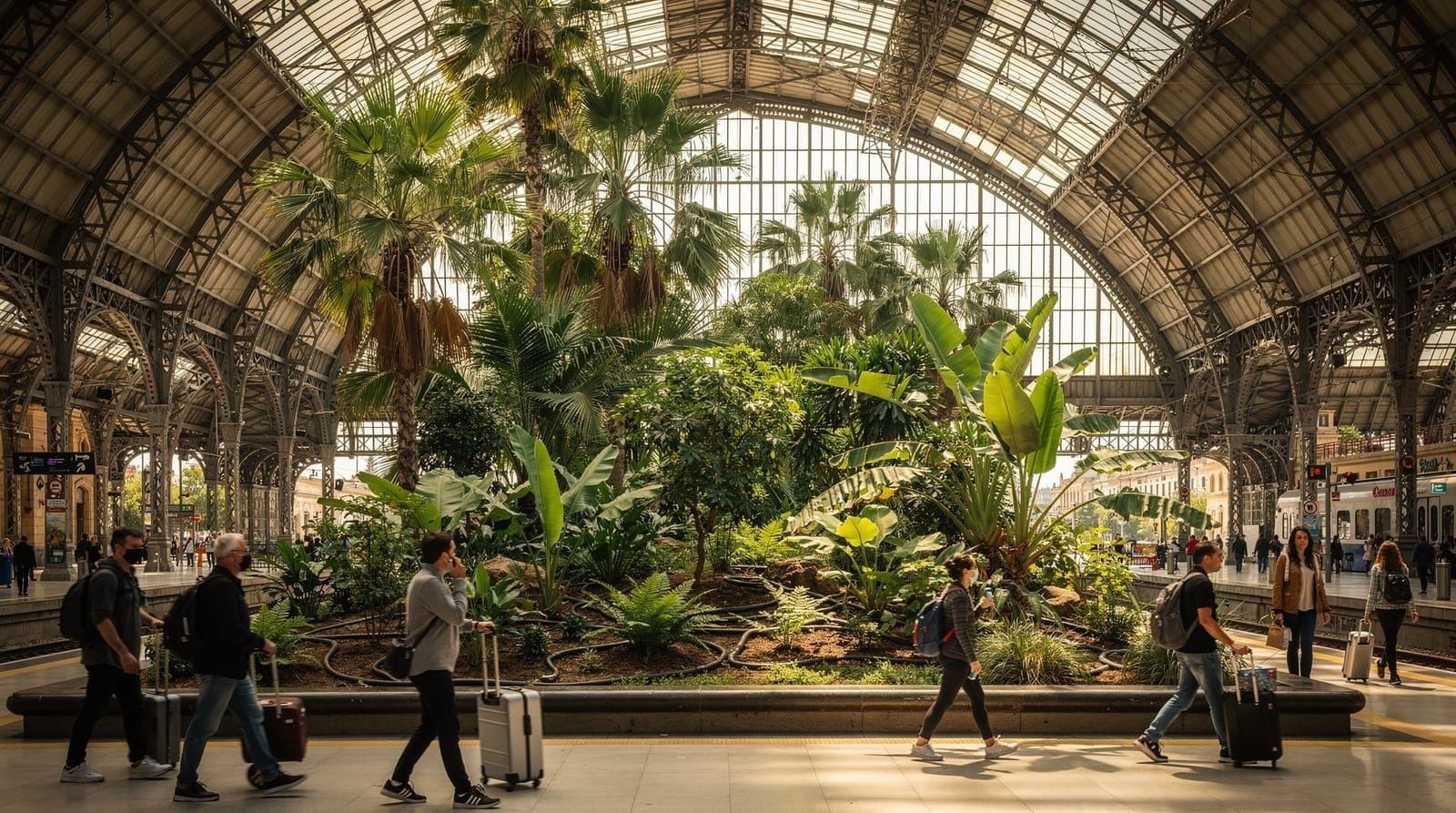
Estación de Atocha: The 1992 glass-and-iron transformation of the 1892 Atocha station by Rafael Moneo, with a tropical garden inside the old train shed. Free to enter through the hall; the garden is visible from the main concourse.
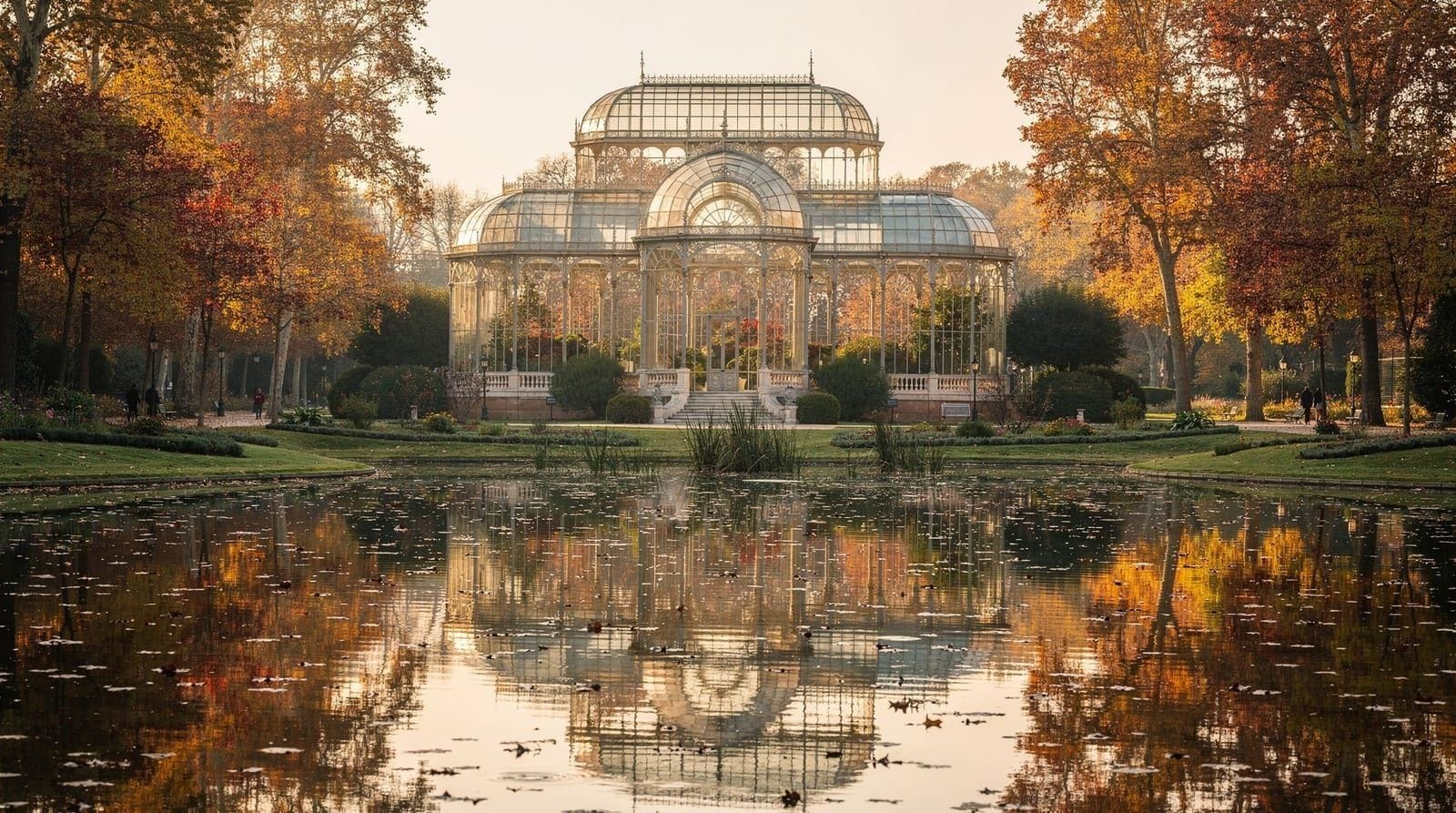
Retiro Park: The southeast park entrance is 10 minutes on foot from the factory. The Retiro’s Palacio de Cristal and Palacio de Velázquez (free) are the most architecturally significant elements, and the lake is the classic Madrid park experience.
A morning at the Real Fábrica (10:00–12:00, guided tour) + Jardín Botánico (12:30–14:00) + lunch in the area + afternoon in Retiro is a full Madrid day at modest cost.
The history of royal tapestry manufacture in Spain
Spain’s relationship with tapestry manufacture begins before the Real Fábrica. The Spanish crown’s Flemish tapestry collection — assembled between the late 14th century and the 17th century when Spain controlled the Low Countries — is one of the finest in existence, with major holdings in the Royal Palace, El Escorial, and the Patrimonio Nacional collections. The Flemish workshops of Brussels, Bruges, and Ghent produced the highest-quality tapestries in Europe; the Spanish monarchs were their best customers.
Philip V established the Real Fábrica de Tapices in 1721 precisely to break this dependency. Having a Spanish manufactory producing work of comparable quality was a matter of economic policy (keeping money in Spain rather than sending it to Flanders) and cultural prestige (Spain should produce its own luxury goods, not import them). The factory’s initial production director and master weavers were recruited from the Flemish manufactories — the knowledge transfer was deliberate and systematic.
Within a generation, the factory was producing work comparable to the best Flemish and French workshops. The commission to Goya for the cartoon paintings (1775–1792) elevated the factory’s artistic ambition to a level that competed with the most prestigious European producers.
Conservation work: the factory’s second function
Beyond new production, the Real Fábrica carries out conservation of historic tapestries — removing old repairs, cleaning, restabilising the textile structure, re-weaving damaged sections. This conservation work is technically demanding and time-consuming; a complete restoration of a large 17th-century tapestry can take several years.
The factory’s conservation expertise is recognised internationally: institutions including foreign royal households, major museums, and the Patrimonio Nacional itself send pieces here for treatment. On any given tour, you may see conservation work in progress alongside new production.
Understanding the conservation work adds a dimension to the tour: you see not only how tapestries are made new but how pieces that have survived three or four centuries are maintained for the next three or four centuries.
What “handmade in Madrid” means for the product
The pieces produced at the Real Fábrica carry a provenance that no other textile workshop can claim. A tapestry made here is made by craftspeople trained in a direct pedagogical lineage that runs from the factory’s founding in 1721 to the present — each generation of weavers trained the next, with the same techniques, the same loom types, and the same wool preparation methods.
This provenance has real value in the collector and institutional market. A carpet or tapestry from the Real Fábrica comes with documentation of its production, the weavers who made it, the cartoon it follows, and the materials used. For institutional buyers (embassies, government buildings, corporate headquarters), this documentation is part of the purchase.
For visitors to the factory shop, the prices reflect this reality. A hand-woven carpet starting at €3,000 for a modest size is not expensive by the standards of what it is — it is considerably less expensive than comparable pieces from the surviving European manufactories (Gobelins in Paris, Aubusson in France, Schloß Schallaburg in Austria). The Real Fábrica is among the most accessible of the major surviving European tapestry workshops.
After the tour: lunch options near the factory
The Retiro-Jerónimos neighborhood around the Real Fábrica has several good lunch options at different price points:
El Anciano Rey de los Vinos (Calle de Bailén 19, 20 minutes northwest): A historic wine bar near the Royal Palace, dating from 1909. Traditional Spanish wine culture in a beautiful tiled interior.
Restaurante Lateral (multiple locations, including Paseo de la Castellana): Modern Spanish tapas at consistent mid-range prices. Reliable quality.
La Cava Real (Calle del Doctor Cortezo): Traditional cocido madrileño (Madrid’s signature slow-cooked stew) and roasts. A proper sit-down lunch after a morning of cultural activity.
The Barrio de las Letras neighborhood is a 10-minute walk northwest with a higher density of options. The Madrid tapas guide covers specific recommendations across the Retiro-Letras-Huertas area.
Is it worth the detour?
The Real Fábrica is not on the standard tourist circuit, and that is exactly its appeal — a 45-minute tour costing €6 that takes you inside an actively working 18th-century craft institution rather than a museum display case. It rewards visitors with an interest in traditional craft, material culture, or the Goya connection specifically; it is a poor fit for anyone trying to cover Madrid’s headline sights in a tight one- or two-day visit, where the Royal Palace and Prado should take priority.
The strongest case for visiting: pairing it with the Goya cartoon rooms at the Prado on the same day, so the production chain — oil painting to woven thread — is visible from both ends.
Frequently asked questions about Real Fábrica de Tapices
What are the Real Fábrica de Tapices opening hours?
Guided tours run Monday–Friday at 10:00, 11:00, 12:00 and 13:00, plus 16:00 Monday–Thursday (afternoon tours are suspended from 1 July to 15 September). The 10:00 tour on Mondays is free, and tours in English run on Tuesdays and Thursdays at 09:00. There are no tours at weekends. Hours are subject to change — verify at the official website or by phone before visiting.How much does a Real Fábrica de Tapices tour cost?
€6 per adult for the guided tour, €5 reduced (unemployed, over-65s and pensioners, people with disabilities, students and under-18s). The Monday 10:00 tour is free. Visits must be booked in advance by email.What is the connection between the Real Fábrica and Goya?
Francisco Goya worked as a court painter from 1775 onward, and his first major commission was producing the preparatory cartoons (oil paintings) for tapestries woven at the Real Fábrica de Tapices. The Goya cartoons — depicting scenes of ordinary Madrid life, hunting, and leisure — are now in the Prado Museum, but the tapestries woven from them hang in the Royal Palace. The factory tour explains this production chain directly.Can I buy tapestries or carpets at the Real Fábrica?
Yes. The factory shop sells tapestries, hand-woven carpets, and smaller decorative woven pieces. Prices range from several hundred euros for small pieces to tens of thousands for large tapestries requiring months of work. Custom commissions are accepted. The factory supplies tapestries to the Royal Palace and foreign institutions.Is the tour suitable for children?
For children aged 10 and above who are genuinely curious about craft production. The visual spectacle of the looms and the weavers at work is engaging; the technical explanation may hold children's interest for 30–40 minutes. Younger children may find the 45-minute tour difficult.