Museum free hours in Madrid: the honest version with real queue times
Madrid: Reina Sofía Skip the Line Ticket
Are Madrid museum free windows actually worth it given the queues?
It depends on the season and which museum. Reina Sofía Sunday free window (12:30–14:30) is usually worth it if Sunday is your only option — 2 hours of free access, but it is a short window you need to plan around. Prado free window (18:00 weekdays, 17:00 Sundays) is worth it in autumn and winter (10–20 min queue), debatable in spring peak (40–50 min queue), and barely worth it in July–August (potentially 60+ min). Thyssen Monday free is the easiest — minimal queue. The editorial positions here are based on realistic queue times, not the optimistic 'just arrive a few minutes early' advice you find elsewhere.
| Best free window | Reina Sofía, Sunday 12:30–14:30 (2 hours) |
| Worst season to rely on free entry | April–May and July–August (Prado queues 35–60 min) |
| Easiest free window | Thyssen, Monday 12:00–16:00 |
| Booking | Free windows are not bookable — queue in person |
| Paid alternative | Prado €15 / Reina Sofía €12, timed entry, no queue |
What the official information doesn’t tell you
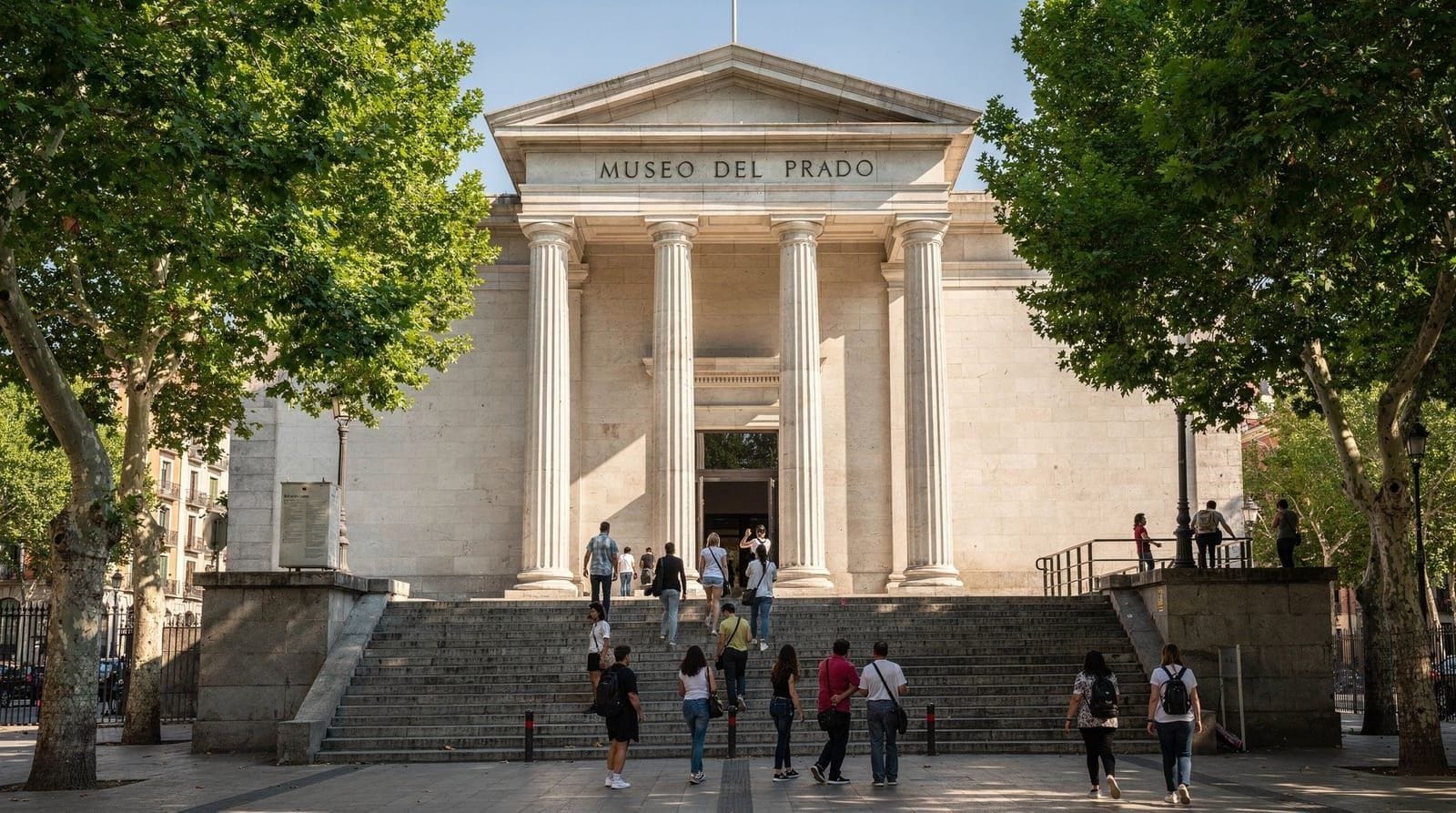
The official tourist guidance on Madrid museum free hours is technically accurate and practically misleading. It states the free windows correctly (Prado 18:00–20:00 weekdays, etc.) and suggests arriving “a few minutes before” the free window opens.
In peak season, “a few minutes before” gets you to the back of a 300-person queue. You will queue for 40+ minutes, have your free access reduced to under 90 minutes (the window is 2 hours but you enter 30+ minutes in), and feel a gap between the promise and the reality.
This guide gives you the actual queue times by season and month, along with an honest assessment of when the free window is the right choice and when paying for advance access makes more sense. For the plain schedule of every free window without the queue commentary, see the companion museum free hours guide; for the full list of what’s free, see free things to do in Madrid.
The real queue data: Prado by season
The following estimates are for arriving 15–20 minutes before the free window opens at the Puerta de Goya entrance (the faster queue). Arriving 40 minutes early reduces these times by 40–60% in peak season.
| Period | Weekday queue | Weekend/holiday queue |
|---|---|---|
| January–February | 5–15 min | 10–20 min |
| March | 10–20 min | 20–30 min |
| April | 20–30 min | 35–50 min |
| May (peak) | 25–35 min | 40–55 min |
| June | 20–30 min | 30–40 min |
| July–August | 25–40 min | 45–65 min |
| September | 20–30 min | 30–40 min |
| October | 15–25 min | 25–35 min |
| November–December | 10–20 min | 15–25 min |
The honest conclusion: In January–March and October–November, the Prado free window is excellent — queue under 20 minutes on most days, 2 hours of access. In April–May and July–August, the free window requires arriving 40+ minutes early to be practical, which means planning your entire late afternoon around a museum queue. In those seasons, the calculus of paid access (€15, no queue, unlimited time) becomes genuinely competitive. The Prado museum guide covers the paid-ticket booking process and how to structure a visit either way.
Reina Sofía: why Sunday morning is different
The Reina Sofía free windows are better than the Prado’s in a structural sense — the museum is smaller, has lower absolute attendance, and its free windows are easier to manage, though the Sunday window is short (12:30–14:30, the same 2 hours as the Prado).
Sunday free window (12:30–14:30) queue estimates:
- January–March: walk in directly or 5 minutes maximum
- April–May: 10–20 minutes; arrive a little before 12:30
- Summer: 15–25 minutes; the queue grows quickly as the window starts
- Autumn: 10–15 minutes; one of the best periods for this
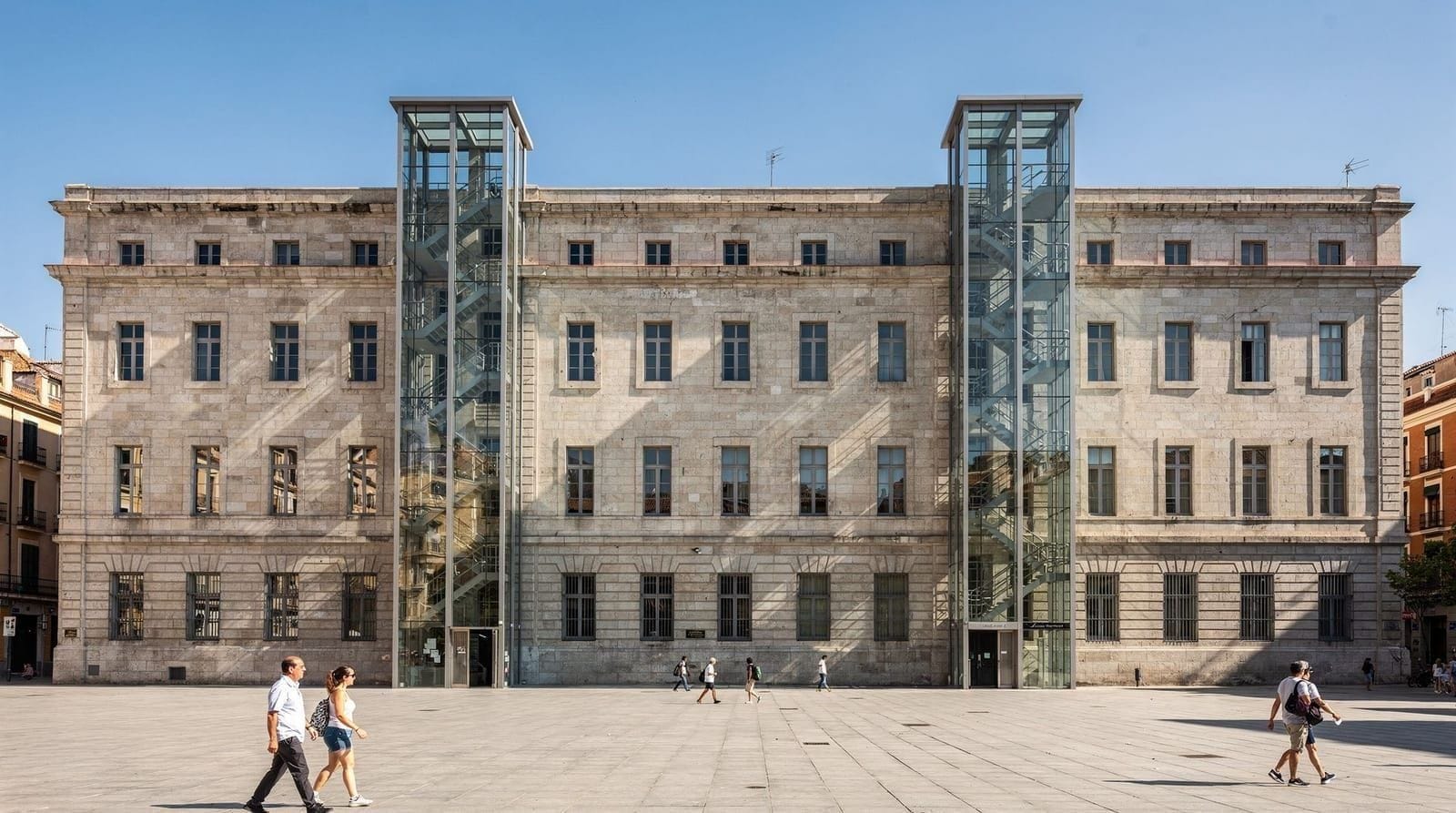
The strategic advice: The Sunday window is only 2 hours, so do not waste it: arrive a little before 12:30, go straight to Guernica while the room is still manageable, and then choose a few rooms rather than aiming for full coverage. If you want a longer, calmer visit, a paid ticket for another day is the better choice. See the Reina Sofía museum guide for what to prioritise once you’re inside beyond Guernica.
Evening free windows (Mon, Wed–Sat 19:00–21:00): Queue: 15–30 minutes in peak season, 5–15 minutes in off-peak. The 2-hour evening window is compressed but manageable. The advantage over the Prado evening window: Reina Sofía is smaller and more focused — 2 hours is adequate for the permanent collection’s highlights.
Thyssen: the honest picture
The Thyssen Monday free policy (12:00–16:00) has been in place for several years. The honest caution: this policy has been temporarily suspended on specific Mondays (bank holidays fall on Mondays; some special event Mondays may have adjusted terms). Always verify at thyssen.org the week before your visit.
Queue estimate on free Monday: Typically 10–15 minutes in peak season, often walk-in in off-peak months. The Thyssen is the most stress-free free museum access in Madrid precisely because it is often overlooked.
The hidden caveat about the Thyssen: The museum is technically two buildings — the main Palacio Villahermosa and the Carmen Thyssen-Bornemisza collection in an adjacent building. The Monday free window generally covers both for the permanent collections. Check thyssen.org for what is included in the current exhibitions.
Why the Thyssen queue stays short even in peak season: Unlike the Prado and Reina Sofía, the Thyssen does not appear on most first-time visitors’ must-see lists in the same automatic way, and its free window runs four hours on Monday (12:00–16:00) rather than a compressed evening slot — arrivals spread out naturally instead of clustering at a single opening moment. The practical result is that even during the busiest weeks of the year (Easter, August, Christmas), a Thyssen Monday visit rarely means more than a 15-minute wait, and often none at all if you avoid the first hour after opening (12:00–13:00) when tour groups tend to arrive.
The full-day free access special dates
Mark these in your calendar if your visit overlaps:
18 May — International Museum Day
The single most valuable free day of the year in Madrid. Most national museums offer free all-day access. In 2026 this includes, in principle, the Prado, Reina Sofía, and the smaller national museums. Queues will be significant from midday — plan to arrive at opening (10:00) if you want the main museums.
18 April
Reina Sofía free all day. A fixed date every year, so worth planning your museum day around if your visit overlaps.
12 October — Día de la Hispanidad
Reina Sofía free all day. Also the day of the national military parade on Castellana — two major free experiences on one day.
6 December — Constitution Day
Reina Sofía free all day. Lower tourist numbers in December make this a quieter free day than the others.
The honest verdict by visitor type
Budget-primary visitor (cost is the main constraint):
Use the free windows. Be willing to queue 30–40 minutes in peak season. Arrive at the Prado’s Puerta de Goya 40 minutes early in April–May. Use the Reina Sofía Sunday window (12:30–14:30). Use the Thyssen on Monday. In 3 days you can cover all three major museums for €0 with this approach. Add in the Sorolla museum’s new building (free) and the permanently free smaller museums. Madrid is genuinely generous with free access — a cost-optimised museum visit here is much better than the equivalent in Paris, London, or Rome.
Time-primary visitor (vacation time is limited, want to maximise what you see):
Buy paid tickets for the Prado and Reina Sofía for morning sessions. Online booking (prado.es, museoreinasofia.es) gives you timed entry without queue overhead. Spend the freed-up afternoon time in the city rather than queuing. The combined ticket cost (€15 + €12) represents one or two restaurant meals — for many visitors this is a reasonable trade.
Families with children:
Children under 18 are free at the Prado and Reina Sofía at all times (not just free windows). The family maths therefore favours the free windows less clearly — the savings are only on adult tickets. For a family of 2 adults + 2 children, the paid adult tickets at the Prado (€30) versus waiting 40 minutes for the free window: calculate whether €30 is worth 40 minutes of two restless children queuing in the sun.
Is a museum pass worth it instead?
For visitors weighing up free windows against paying for convenience, the Madrid City Card worth-it guide covers whether a bundled pass beats paying for individual timed tickets — the short version is that it depends heavily on how many museums beyond the golden triangle you plan to visit. If your priority is simply avoiding the Prado and Reina Sofía queues without paying for a card you might not fully use, buying the two individual timed tickets directly is usually the cleaner option. For a broader look at where else Madrid saves you money, see Madrid on a budget, and for how this fits into a short trip, the Madrid 3-day itinerary and the golden triangle art walk both structure a museum-heavy day around these free windows.
How to build a day around a free window
The most common mistake is treating the free window as a single event rather than as the centre of a day. A free slot at the end of the afternoon works best when everything before it is light: a slow lunch, a walk through the Retiro park and then a short stroll to the museum. You arrive rested, you queue in the shade of the trees rather than after a long morning on your feet, and you walk in with energy for the paintings rather than for the nearest chair.
Plan the evening that follows, too. A museum visit that ends at closing time leaves you in the middle of a city that eats late, so there is no rush to find dinner. Many visitors book a table for later and spend the gap in a bar nearby; the tapas guide and the advice on where locals eat help you avoid the overpriced places that cluster around the big museums.
Think about the order of your museums as well. Pairing a free evening window at one museum with a paid, timed morning at another is a sensible compromise: you spend money where the crowds are worst and save it where they are manageable. The golden triangle art walk shows how the three big collections sit close enough together that this kind of mix-and-match is easy on foot.
Seasonal adjustments that change the plan
The tables above give the raw numbers, but the season also changes how a queue feels. In spring the wait is long but pleasant, since the weather is mild and the street outside is part of the experience. In summer the same wait can be a real test, with little shade and strong sun; carry water and a hat, and read the summer in Madrid guide before planning anything outdoors. In autumn and winter the queues shrink, and the main discomfort is the cold, so a coat matters more than a place in line. The seasonal guides for spring and autumn show what else fits around a museum visit at those times of year.
If your dates are flexible, the cheapest improvement you can make is to shift the museum day, not the museum. Moving a visit by a few weeks into a quieter period does more for your experience than any queueing trick.
What to do when the queue is simply too long
Sometimes you arrive and the line is worse than expected. Do not stand in it out of stubbornness. You have three honest options:
- Switch museums. If the Prado line wraps around the building, the Thyssen or the Reina Sofía may be calmer at that moment. Madrid’s museums are close enough that changing plan costs you a short walk.
- Switch to a paid ticket. Booking on the spot is often possible, and for the Reina Sofía you can book a ticket that lets you skip the line, for example a skip-the-line ticket for the modern art museum. This costs money but gives you back the evening.
- Come back another day. If you have slack in the itinerary, treat the failed attempt as reconnaissance and return at a quieter hour.
For the Thyssen, a visit is easier to enjoy with some context. If you would rather not wander alone, a ticket combined with a guided visit of the collection is a calm alternative to the free Monday, particularly for visitors who care more about understanding the paintings than about saving money.
Beyond the big three
The queue conversation tends to focus on the Prado, Reina Sofía and Thyssen, yet some of the best free or low-stress visits are elsewhere. The Sorolla museum is free at its new building, open Tuesday to Sunday (the original house museum is closed for renovation; check the museum’s official website for its reopening), and the Royal Palace guide explains how a very different kind of collection fits into the same trip. The free art in Madrid article lists further ways to see art without paying, and the free walking tours guide covers the city’s other no-cost options when a museum queue defeats you.
If Guernica is the main reason you are going, read what to know about Guernica beforehand so you can spend your time in front of it rather than reading the wall text. And if you are short on time at the Prado, the two-hour Prado plan is written for exactly the constraint a free evening window creates.
Travelling with children
Families have a different calculation from other visitors. Children tolerate a queue far worse than adults, and a museum visit that begins with forty minutes of waiting rarely ends well. If you are travelling with young ones, favour the quieter windows, keep the visit short, and treat one or two rooms as a success rather than a failure to cover everything. The Madrid with kids guide has more ideas for pacing a day so that the museum is one pleasant part of it rather than the whole of it.
Frequently asked questions about Museum free hours in Madrid
What is the real queue time at the Prado free window?
Honest estimates by season: January–February: 5–15 minutes (shortest of the year). March: 10–20 minutes. April–May peak: 35–50 minutes at weekends, 20–30 minutes weekdays. June: 20–30 minutes. July–August: 30–60 minutes (worse on weekends). September–October: 20–35 minutes. November–December: 10–20 minutes. These are estimates for a midpoint arrival 15–20 minutes before opening. Arriving 40 minutes early in peak season reduces this substantially. The Puerta de Goya entrance is consistently faster than the main Velázquez entrance for the free queue.Does 2 hours at the Prado feel rushed?
Yes, for most visitors. The Prado's permanent collection is enormous — the building is one of the largest art museums in the world. The essential rooms (Velázquez: rooms 10–14; Goya: rooms 34–38, Black Paintings rooms 67–68; Bosch: room 56A) require approximately 90 minutes at a comfortable pace. With the remaining 30 minutes, you can add one more room of your choice. You cannot see the full Prado in 2 hours; you can see the highlights. If complete coverage matters to you, a paid morning ticket (10:00–13:00) gives you 3 hours in far emptier conditions — this is often a better choice in April–May when the queue eats into the free window time.Is the Reina Sofía Sunday free window the best free option in Madrid?
It is a good option, but not as generous as it is often described. The Sunday free window is only 12:30–14:30 (the museum itself closes at 14:30 on Sundays), so you get 2 hours, and you need a free ticket (bookable online). Arrive a little before 12:30 and head straight for Guernica, then pick a few key rooms of the permanent collection rather than trying to cover everything. The evening free windows (Monday, Wednesday–Saturday 19:00–21:00) are also 2 hours and are often easier to fit into a day. The museum is closed on Tuesdays.When should I just pay for a museum ticket instead of using the free window?
Buy a paid ticket if: you are visiting in April, May, or July–August (when the Prado free queue exceeds 40 minutes regularly); you want to spend 3+ hours in the museum; you want to visit a temporary exhibition (always paid regardless); you want to arrive at opening (10:00) for the minimum crowds; you value predictability over the possibility of a queue. The Prado paid ticket (€15 adult) buys you unlimited time, advance entry, and access to temporary exhibitions. In peak season, the time cost of the queue often makes the €15 worthwhile.Are there days when the museums are free all day (not just the standard window)?
Yes. National holidays trigger full-day free entry at some national museums: 18 April — Reina Sofía free all day; 18 May (International Museum Day) — most national museums free all day, including Prado and Reina Sofía; 12 October (Día de la Hispanidad) — Reina Sofía free all day; 6 December (Constitution Day) — Reina Sofía free all day. The 18 May International Museum Day is the single best free day of the year — potentially free access to Prado, Reina Sofía, Thyssen, and smaller museums simultaneously.What is the Thyssen Monday free window really like?
The easiest free window to use. The Thyssen free window on Monday (12:00–16:00) typically has minimal queues (10–15 minutes at most, often less outside peak season). The museum is smaller than the Prado or Reina Sofía and the Monday visitor volume is lower. However: verify at thyssen.org before visiting, as the Monday free policy has occasionally been suspended for specific periods or adjusted seasonally. The Monday free window runs 12:00–16:00 and covers the permanent collection and current exhibitions.Can I book a time slot for the Prado free window?
No. The free entry windows at the Prado are not ticketed or bookable — you queue in person. Only the paid entry has advance booking online (which is why it is faster). For the free window, the queue is the system. This is one of the genuine trade-offs of the free access: no advance reservation, no guaranteed entry time, variable queue depending on conditions.