
Where locals actually eat tapas in Madrid (not where tourists go)
The tourist tapas circuit in Madrid is easy to follow: walk along the streets near Sol, find a bar with photographs on the menu, eat something passable at twice the price a Madrileño would pay, and repeat. This circuit is convenient and largely disappointing. The local circuit exists in parallel, often within a few streets of the tourist one, and most visitors never find it simply because no one points them in the right direction.
| Where | La Latina, Malasaña, Barrio de las Letras |
| Cost | Around €1.50–€3 per drink+tapa in local bars |
| Time needed | 2–3 hours for a proper bar-hopping session |
| Getting there | Metro to La Latina, Tribunal, or Antón Martín |
| Best time | Sunday 12–2pm for the vermouth ritual |
This is that pointing.
Why the circuits barely overlap
The short answer: Madrileños eat tapas as part of a social ritual at places they know, at prices that make sense, at hours that suit the Spanish rhythm. Tourists want something fast, visible, and easy. Restaurant owners near Sol and Plaza Mayor have optimised for the tourist circuit so thoroughly that the two experiences have almost nothing in common beyond the word “tapas.”
The longer answer: a proper local tapas session in Madrid involves vermut at noon, a couple of standing bars, gradual movement from one neighbourhood spot to another, and a strong emphasis on value for the round (because usually someone is paying for everyone). None of this maps onto a tourist visiting three to five places over a two-hour window.
La Latina: the gold standard
La Latina is the neighbourhood that most Madrileños name first when asked about tapas. The main drag for bar-hopping is Cava Baja and its continuation Cava Alta — two parallel streets lined with traditional taverns, many of which have been here for decades.
What to look for on Cava Baja:
- Taberna Almendro 13: A classic, always packed on weekends, famous for its tostas and huevos rotos (broken eggs with jamón). Arrive early or wait.
- Casa Lucio (nearby on Cava Baja): One of Madrid’s most famous traditional restaurants — not cheap, not standing tapas — but the huevos estrellados here are in a different category from anything on the tourist circuit.
- El Bonanno: A good spot for a glass of vermouth with some olives before moving on.
- El Sur: Small, neighbourhood-facing, excellent cured meats and cheeses.
The ritual in La Latina, particularly on a Sunday morning from 12-2pm, is to move slowly between bars, sharing a vermut (vermouth) or a cold beer with a small tapa at each stop. Nobody eats a full meal. Nobody hurries. This is the tapas session as social event rather than as catering.
The Madrid tapas guide goes deeper on the culture and vocabulary.
Malasaña: the neighbourhood local
Malasaña doesn’t market itself as a tapas neighbourhood the way La Latina does, which is exactly why it works for locals. The bar scene here skews younger and more casual — it’s the neighbourhood for morning coffees, afternoon cañas (small draught beers), and the kind of bar where the tapa comes free with the drink without fanfare.
The traditional free-tapas-with-drinks culture has almost entirely disappeared from the tourist-facing parts of Madrid, but it persists in certain Malasaña bars and in local-facing places throughout the city. The rule: if you’re paying €1.50-2.50 for a caña and a small plate of something (olives, a slice of bread with tomato, a small pincho) arrives unbidden, you’ve found the right kind of bar.
Streets to explore in Malasaña: Calle del Espíritu Santo, Calle de la Palma, and the area around Plaza del Dos de Mayo. None of these streets have particular flagship restaurants — the point is the general atmosphere of neighbourhood bars doing what they’ve always done.
The vermouth hour — and why tourists miss it
Vermut (or vermú) is the Spanish aperitivo — vermouth, typically red, served with a splash of soda, a slice of orange, and an olive, at bars that open specifically for the pre-lunch window. In Madrid, vermouth hour runs from roughly 12pm to 2pm on Saturdays and Sundays. Some bars do it daily.
The best tapas bars in Madrid guide covers specific vermut bars by neighbourhood.
Most tourists eat lunch at 1pm, which is approximately when Madrileños are having their second vermouth. The result is that visitors almost entirely miss the vermouth ritual — one of the more pleasant food-adjacent experiences Madrid offers — because they’re following European eating schedules in a city that operates on a different clock.
If you’re going to eat lunch at 2pm or 2:30pm (which is what you should do), the vermut session before it makes perfect sense.
What to avoid: the tourist trap bars
The bars around Plaza Mayor are the canonical tourist trap. The problem isn’t that they’re terrible — it’s that they charge €8-12 for a caña and a small tapa, deliver average quality, and rely entirely on first-time visitors who won’t return. Locals don’t go there.
Similarly, the bars on the main pedestrian streets of Sol and Gran Vía are primarily catering to tourists. The menú del día near Sol runs €15-20 when an equivalent meal two streets away in any direction costs €12. The tourist density is pricing signal: the further you are from Sol, the better the value tends to be.
The tourist traps guide covers this in more detail and with specific examples.
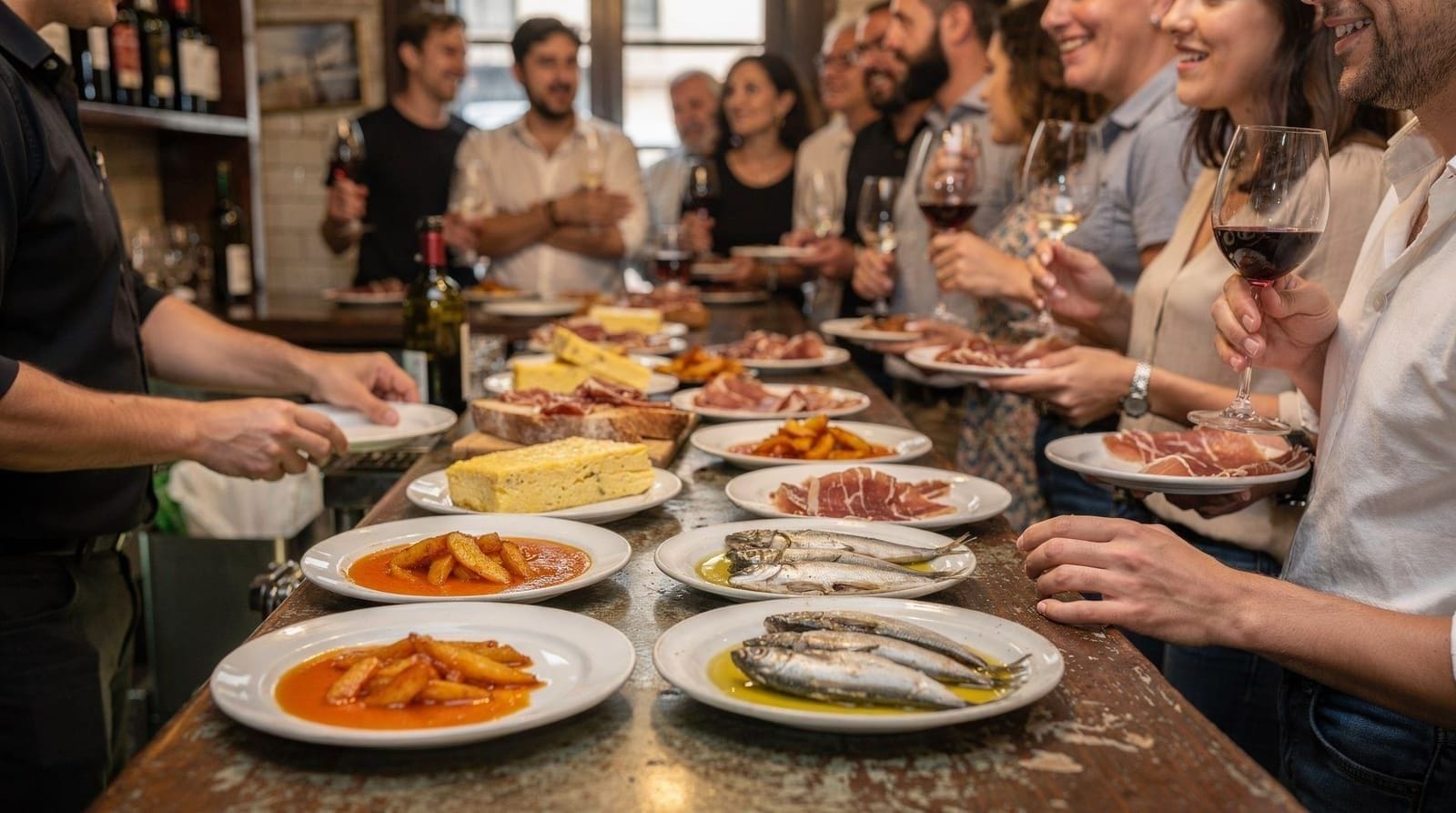 Non Touristy Tapas 10 Tapas 4 DrinksCheck availability
Barrio de las Letras: a middle option
If La Latina is purely neighbourhood and Sol is tourist-facing, Barrio de las Letras (the old literary quarter, south of Sol toward the Prado) is in between. It has good restaurants, a local clientele, reasonable prices, and enough character to be worth a dedicated tapas walk. The streets around Calle de las Huertas and Calle del León have a concentration of quality options.
This is also a useful neighbourhood if you’ve been to the Prado or the Reina Sofía in the afternoon and want a natural post-museum eating zone. The food tour guide covers whether a structured tour of this area makes sense versus independent exploration.
Guided tapas and wine tour with a local hostNeighbourhood at a glance:
| Neighbourhood | Vibe | Best for |
|---|---|---|
| La Latina | Traditional, weekend-busy | Cava Baja bar-hopping, Sunday vermouth |
| Malasaña | Younger, casual | Free tapas with drinks, low-key evenings |
| Barrio de las Letras | Mixed local/visitor | Post-museum meals, sit-down options |
| Sol / Plaza Mayor | Tourist-facing | Avoid for tapas — go for sights only |
If you’d rather not guess: signs of a good bar versus a bad one
A few quick tells work almost anywhere in the city, not just the neighbourhoods above. A menu with photographs of the food is a tourist-circuit signal, not a local one — proper local bars rarely bother. A blackboard in Spanish only, updated daily, usually means the kitchen is cooking what’s fresh rather than running a fixed laminated list. And a bar with a long zinc or wooden counter crowded with locals standing three deep, rather than empty tables with hosts outside trying to wave you in, is close to a guarantee of quality.
Going deeper once you have the basics
Once the rhythm makes sense, a few other pages help you build a session around it. The vermouth guide explains what to order and where the ritual is strongest, while the La Latina guide and the where to eat in La Latina page help you plan the Cava Baja stretch stop by stop. For the younger side of the city, Malasaña’s bars are a natural continuation, and the eat like a local guide covers the habits that carry across every neighbourhood.
If food is the main reason for your trip, the Madrid for foodies itinerary strings these neighbourhoods together, and the Mercado de San Miguel guide is worth reading before you decide whether a market is where you want to snack. Our tourist menu traps page is a good companion for the lunch side of things, and the wine bars guide suits an evening that ends more slowly than it began.
Practical tactics for the local tapas experience
Go at the right time: Pre-lunch (12-2pm) for vermouth. Proper lunch from 2-4pm. Tapas-and-drinks from 7-9pm. Dinner from 9pm onwards. Do not eat dinner at 7pm — many kitchens won’t even be open.
Order in Spanish, or at minimum try: Bars that see you’re making an effort often treat you differently from people pointing at laminated photos.
Stand at the bar: The bar counter (la barra) is cheaper than a table (terraza or sala) in many places. In some bars, prices are explicitly different at the bar vs a table.
Pay per round, not per person: In local bars, it’s common to pay for a whole round, then the next person pays the next round. This isn’t obligatory for tourists but it’s the natural rhythm.
Follow the density: Lunchtime, a bar with Madrileños eating at it is almost always better than one without. This sounds obvious and it works.
The overrated and underrated guide for Madrid has a broader look at which parts of the tourist experience are worth engaging with and which can safely be skipped.
Eating well in Madrid as a visitor isn’t about finding secret restaurants. It’s about reading the neighbourhood cues correctly — the presence of locals, the absence of photos on menus, the price of a caña, the hour of the day. Get those signals right and the city’s food culture opens up quickly.