Tourist menu traps in Madrid: how to spot them and what to eat instead
Madrid: Prado Guided Skip the Line
How do I identify a tourist menu trap in Madrid and what should I eat instead?
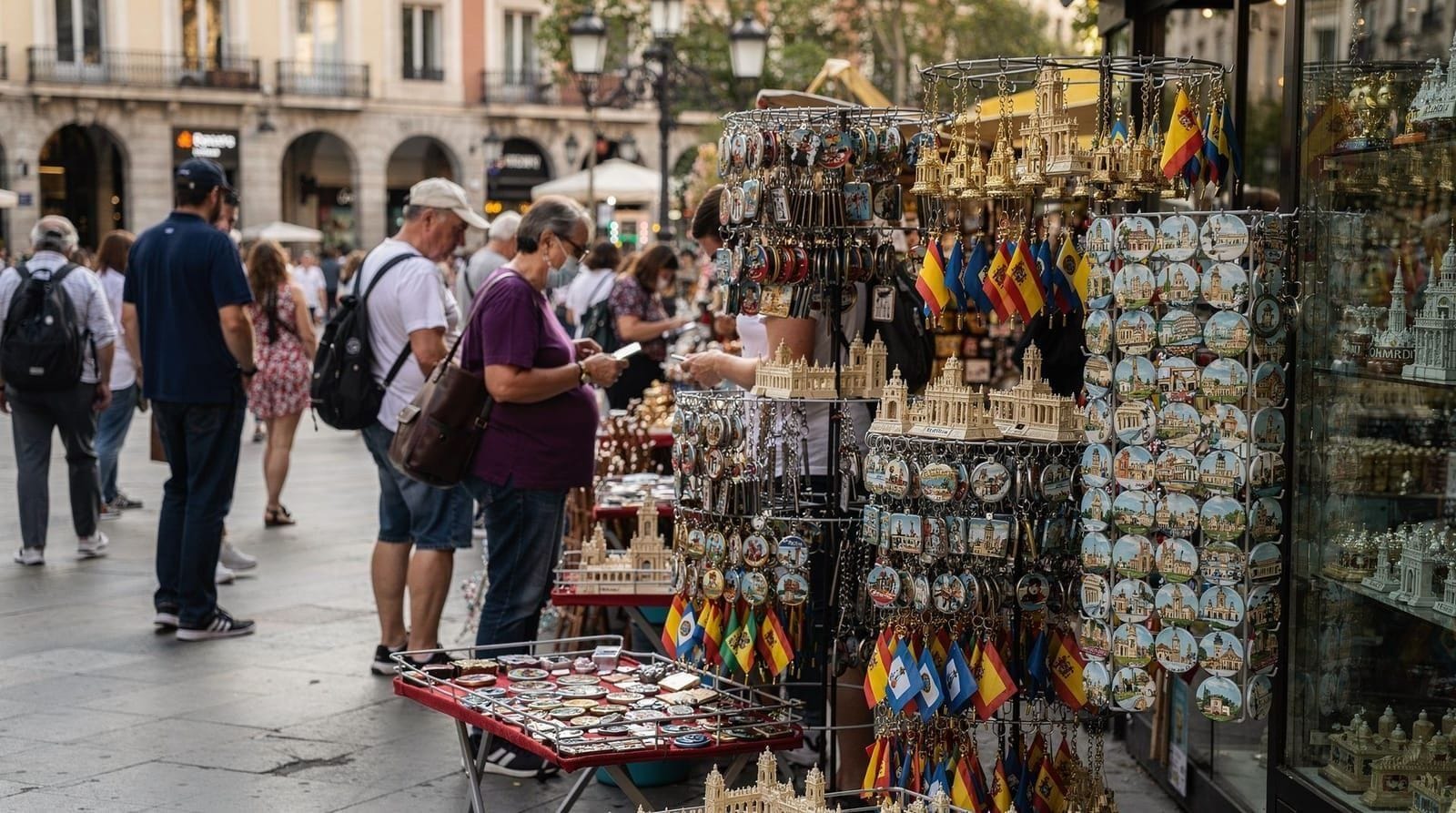
Tourist menu traps cluster around Sol, Gran Vía, Plaza Mayor, and the path between the Prado and the Royal Palace. Signs: menu displayed in 6+ languages with photos; staff soliciting passersby; 'paella' prominently featured; sangria pitchers in the window; the word 'típico' or 'traditional Spanish'. The real alternative: walk two streets off the tourist circuit to a bar or restaurant with a handwritten Spanish-only menu board, a table of Spaniards eating lunch, and a menú del día for €10–14. This is not hard to find — it is just not on the tourist footpath.
The tourist restaurant problem in Madrid
Madrid’s tourist-trap restaurants are not primarily an honesty problem — they don’t usually lie about what they offer. They are an information asymmetry problem. A first-time visitor standing on Calle Victoria near Sol at 14:00 with limited knowledge of the local restaurant landscape sees: multiple restaurants with menus in English, photos of the dishes, prices that look accessible (€12–15 per person), and staff who immediately speak English.
Two streets away in a residential direction, the same visitor could find: a three-course menú del día for €10–12, made fresh that morning, served to a table full of Madrileños, with wine included. The information gap between these two options — which might be 200 metres apart — is significant.
This guide is that information.
It also helps to understand why the pattern repeats. Restaurants in the busiest tourist zones pay for their position, not for their reputation. They do not need you to come back, so there is little pressure to improve the cooking. Neighbourhood places depend on the same regulars every week, and that dependence is the whole quality mechanism. Once you see the difference as an incentive problem rather than a question of luck, spotting it gets much easier. For the wider picture of how visitors get caught out across the city, the tourist traps in Madrid guide and the honest take on overrated and underrated sights are good companions to this page.
| Where the traps cluster | Sol, Gran Vía, Plaza Mayor, the Prado approach streets |
| Typical trap price | Around €15–22 for a “menú turístico” |
| Typical honest price | Around €10–14 for a menú del día |
| Best time to spot the difference | Lunch, 13:30–16:00, when locals actually eat |
| Rule of thumb | Walk two streets off the main tourist path |
How to read a restaurant from outside: the checklist
Signals that suggest a tourist-trap restaurant:
- Menu displayed in 6 or more languages (English, French, German, Italian, Chinese, Japanese is a common combo — the kitchen has decided it caters to everyone, which usually means it has mastered nothing)
- Laminated photos of the food in the menu or in a window lightbox
- Staff standing outside engaging passersby (“Hey! Good food here, very special today…”)
- “Paella” prominently featured (Madrid is not Valencia; proper paella requires specific techniques and ingredients not available at tourist-volume restaurants)
- Sangria pitchers prominently displayed
- “Traditional Spanish,” “Typical Madrid,” or “Authentic” in the signage — these words are marketing, not guarantees
- Location directly on the main tourist thoroughfare (Calle Victoria, Gran Vía central stretch, plaza-facing arcade positions)
- Menu price ends exactly at €12.90 or €15.90 — suspiciously round “value” pricing
Signals that suggest a legitimate neighbourhood restaurant:
- Menu board in Spanish only, or Spanish with one other language
- Handwritten or reprinted daily menu board listing specific dishes for today
- No one standing outside; possibly a small queue at the door at peak hours
- You can see the kitchen is active (steam, staff movement) through a window or open door
- The clientele visible inside is mixed or primarily Spanish
- Price €10–14 for a complete three-course lunch
None of these signals is a guarantee on its own. A good restaurant can have a photo menu, and a poor one can have a chalkboard. What matters is the combination: when three or four signals line up on the same side, trust the pattern. If you are unsure, stand for a minute across the street and watch who goes in. Office workers in lanyards, older couples who greet the waiter by name and groups of colleagues are the clearest sign that the kitchen is cooking for people who return. If the only people entering are visitors holding phones, keep walking.
It also pays to look at the time. A restaurant that is empty at 14:30 on a weekday, when the real lunch rush should be in full swing, is telling you something. The same is true of a place that serves a “menu of the day” at eight in the evening: the format belongs to the Spanish working lunch, and outside that window it is usually a marketing label. For a broader look at how residents eat and drink through the day, see the eat like a local guide.
The streets to avoid and the streets to seek
Streets with high tourist-trap concentration
Calle Victoria (running south from Sol toward Huertas): This street, and the parallel Calle del Príncipe for its most tourist-facing section, has one of the highest densities of tourist restaurants in Madrid. Most are in the ‘multilingual menu with photos’ category. Walk through to reach Barrio de las Letras; eat somewhere else.
Gran Vía central (between Callao and Red de San Luis): The highest-traffic section of the main boulevard. The restaurants here are mostly tourist-oriented chains and large-format tourist restaurants. The two exceptions are the authentic café-bars that predate the tourist transformation — these typically have long counters, standing customers, and no photos on the menu.
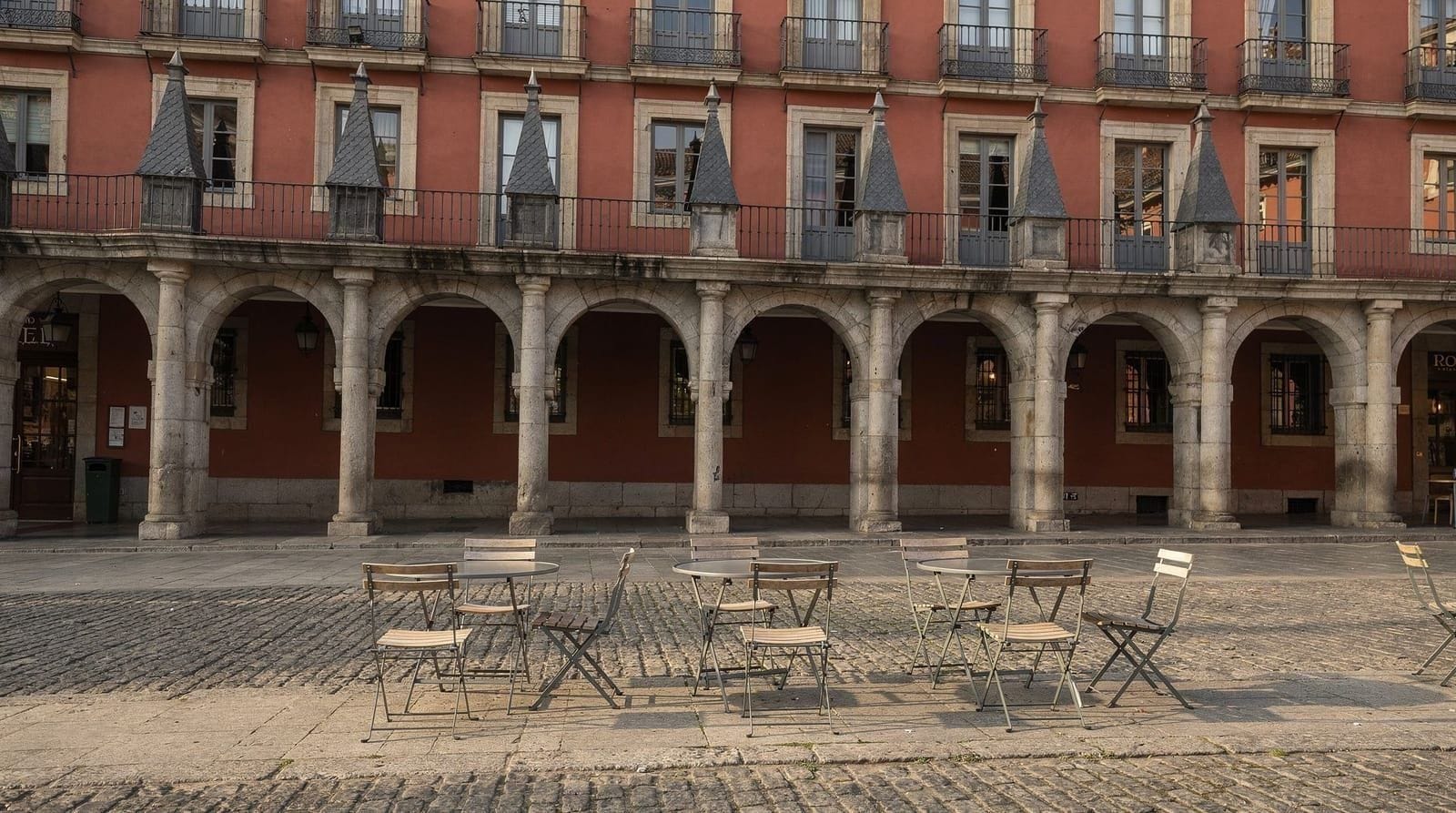
Plaza Mayor arcades and Calle Cuchilleros: Detailed in the Plaza Mayor overpriced guide. The rule applies: don’t eat here if value matters.
The Prado approach streets (Calle Felipe IV side): The restaurants immediately facing the Prado entrance on Calle Felipe IV and the adjacent streets are positioned to capture museum visitors. Quality and value are typically poor. Walk east into Barrio de las Letras (Calle del Prado, Calle de las Huertas) for significantly better options.
The same logic applies if you are spending a morning in the Golden Triangle. Museum fatigue makes the nearest terrace feel like the obvious choice, and that is exactly what those restaurants count on. A little planning solves it: decide where you will eat before you go in, and leave the museum already heading in that direction. If you would rather have the art handled for you, a guided Prado visit with skip-the-line entry keeps the morning compact, so you reach lunch with energy to walk the extra couple of streets. Our Prado Museum guide and the Golden Triangle art walk show how to build the day around a proper lunch stop.
Streets with good legitimate restaurants
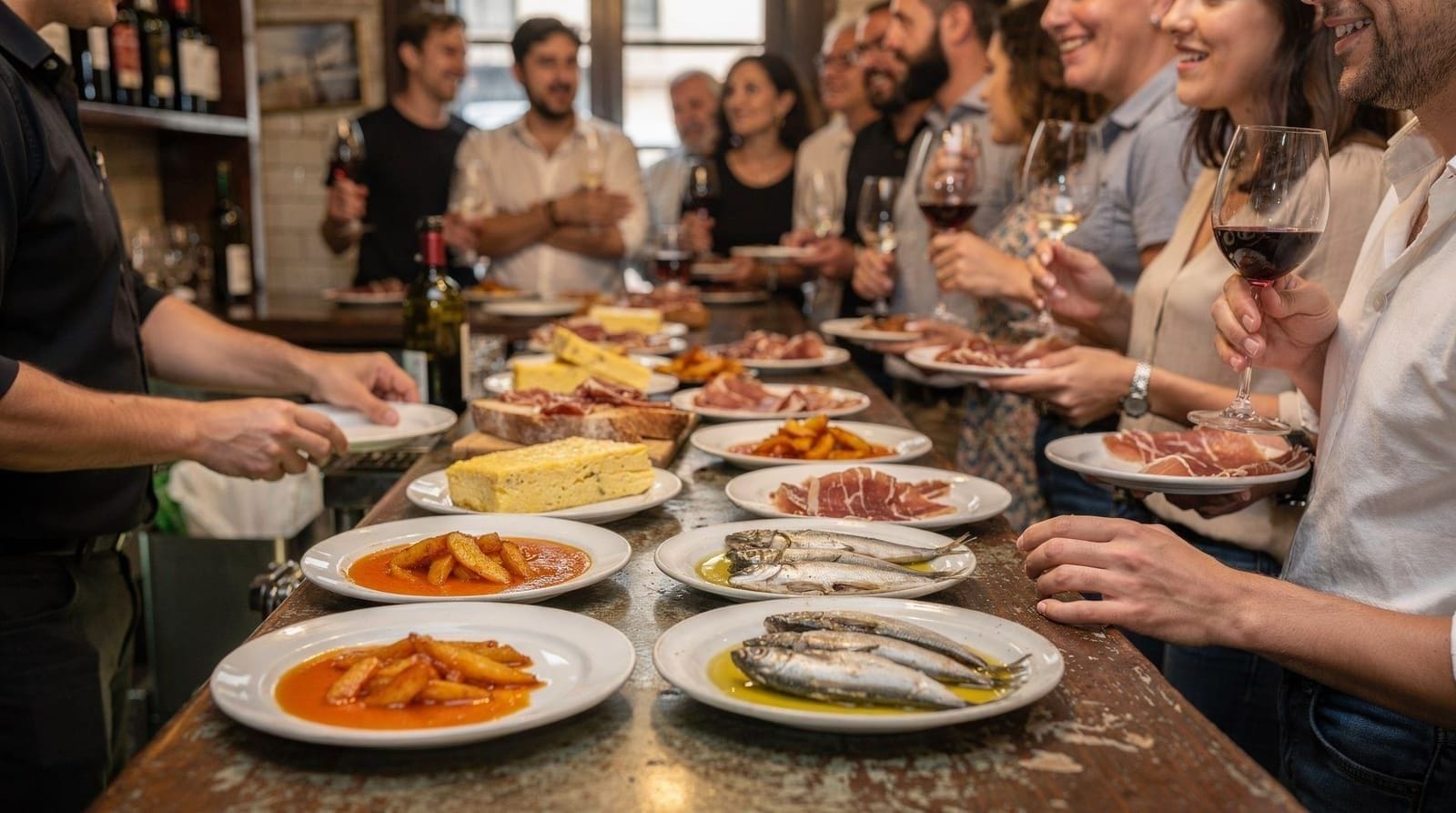
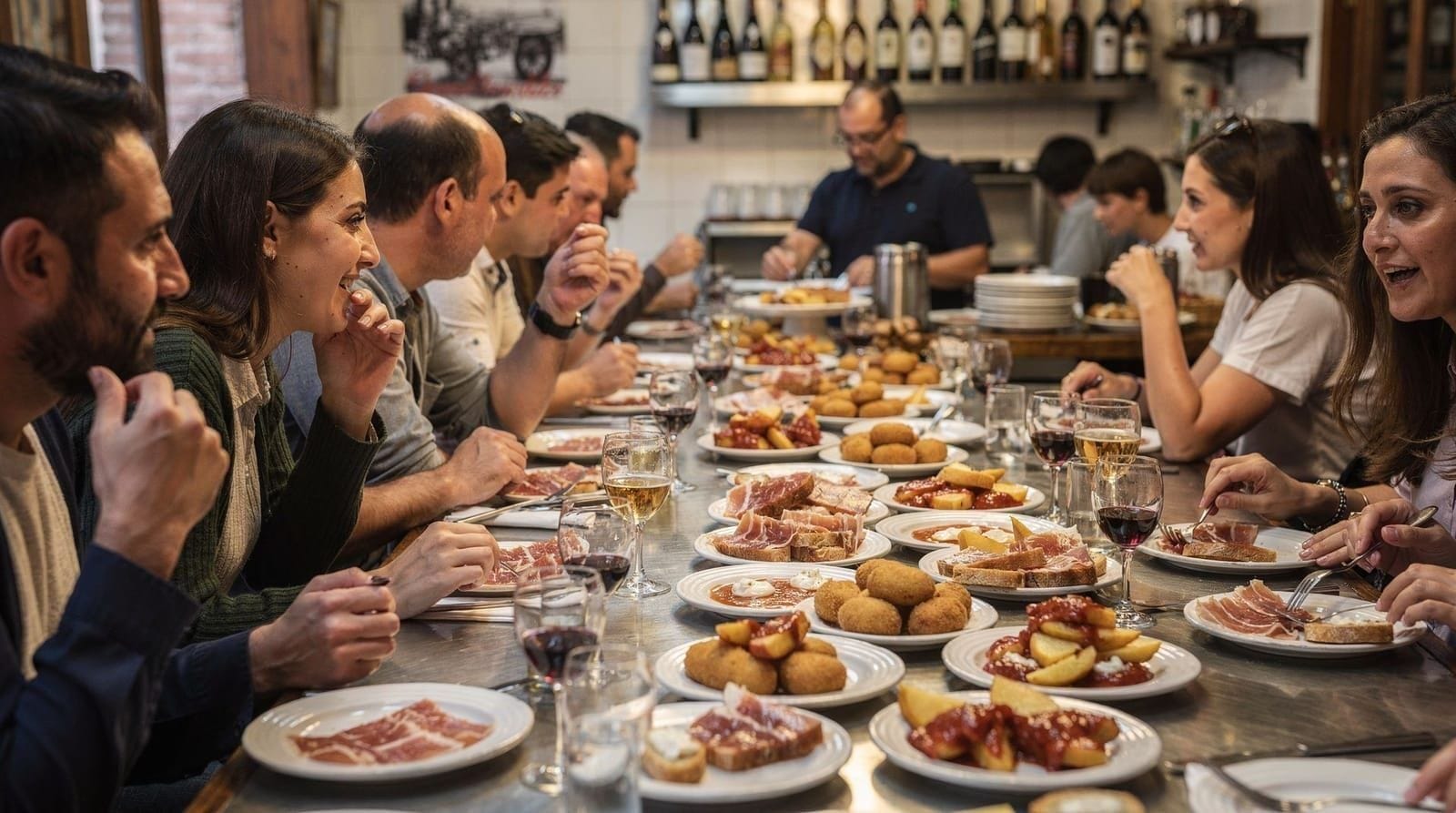
Calle del Almendro and Cava Baja (La Latina): The classic tapas circuit. Prices are not the cheapest in the city but represent genuine value — neighbourhood competition keeps quality honest. Walking from one bar to the next for tapas here is an excellent lunch or evening strategy.
Calle de las Huertas and Calle del Príncipe (eastern Barrio de las Letras): Slightly further east than the tourist-facing section, this stretch has several genuine neighbourhood restaurants with good menú del día. The restaurants catering to the local creative and arts community have quality incentives.
Calle de Fuencarral (Malasaña): The residential section above Gran Vía has consistent neighbourhood bars and small restaurants. Walk north of Gran Vía for 3–4 blocks and you are in a different price-quality world.
Chamberí (around Plaza de Chamberí, Calle de Alonso Cano): The best neighbourhood restaurant density in Madrid for a visitor willing to walk 15 minutes from the tourist circuit. The menú del día restaurants here serve the same residents every weekday — the quality incentive is completely different from the tourist-area model. The Chamberí neighbourhood page explains what the area is like beyond lunch.
Two more neighbourhoods are worth knowing. In Lavapiés, the mix of long-established bars and newer kitchens means plenty of honest, modest places; start with the Lavapiés guide. In Malasaña, the side streets away from the busiest squares reward a short walk, and the Malasaña guide covers where to begin. If you prefer standing at a counter with small plates instead of sitting down for three courses, the Madrid tapas guide and the Mercado de San Miguel guide help you judge which style suits you, and the food tour worth it guide weighs whether a guided option pays off.
What the real menú del día looks like in practice
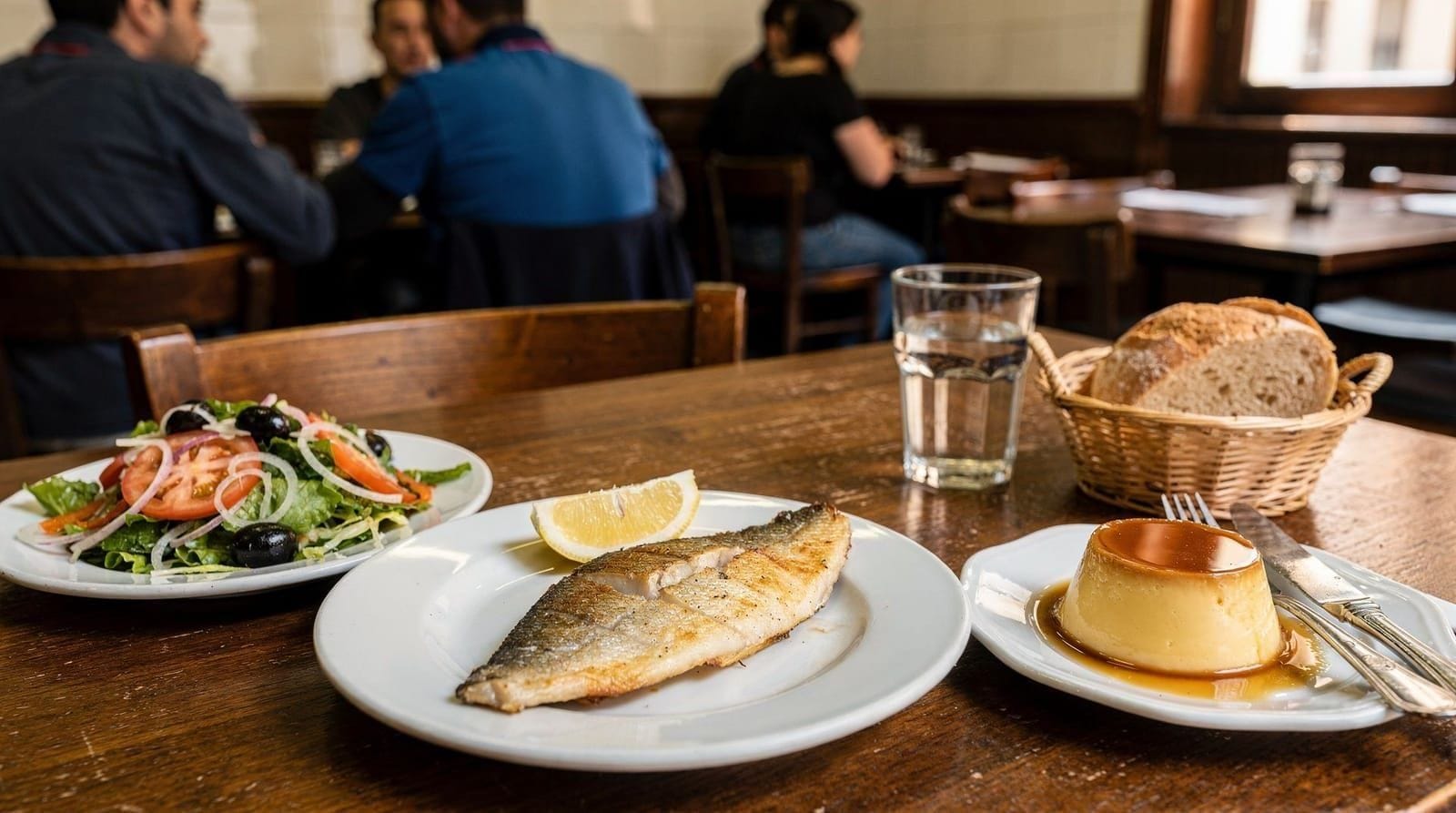
To make this concrete: a typical legitimate menú del día at a Chamberí neighbourhood restaurant on a Wednesday in May 2026 might look like:
First course (choose one):
- Ensalada mixta (mixed salad)
- Judías blancas estofadas (white bean stew)
- Crema de calabaza (cream of pumpkin soup)
Second course (choose one):
- Pollo al ajillo (garlic chicken)
- Bacalao a la vizcaína (salt cod in tomato-pepper sauce)
- Revuelto de setas (scrambled eggs with mushrooms)
Dessert:
- Flan casero (homemade crème caramel)
- Fruta del tiempo (seasonal fruit)
- Yogur
Included: bread, a glass of house wine or water (or soft drink).
Price: €12.
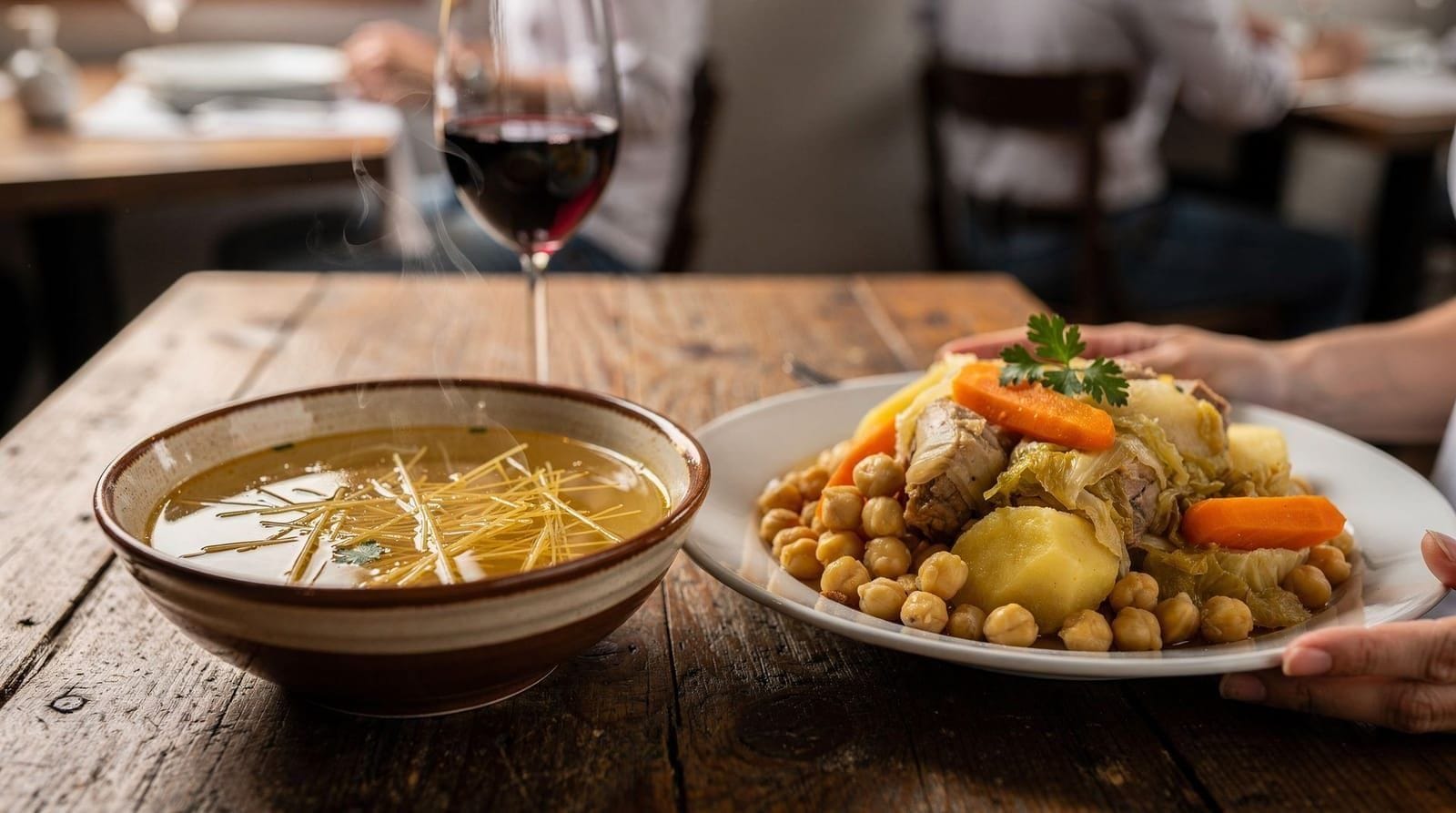
This is what Spanish workers and residents eat for weekday lunch. It is not exotic or thrilling; it is competent, fresh, filling, and honest. The contrast with a tourist-area menú turístico — often the same price or higher, with smaller portions of pre-prepared food — is stark once you’ve experienced both.
A few practical habits make the experience smoother. Order the way locals do: choose a first and a second course, and decide on dessert or coffee at the end. Do not be surprised if the waiter recites the options aloud instead of handing you a menu; that is normal in neighbourhood places and a good sign. Ask for the wine if you want it, and expect it to arrive without ceremony. Pace yourself, because this is a long, relaxed meal, not a quick refuel. On Sundays and in the quieter summer weeks, some small restaurants close or change their format, so check before you walk a long way. For a deeper dive into the dishes themselves, the cocido madrileño guide and the guide to callos a la madrileña describe the classics that often appear on a good daily menu, and the Madrid on a budget guide shows how a daily menu fits into a wider spending plan.
The sangria problem
No traditional Madrid restaurant or bar that serves Madrileños routinely offers sangria pitchers. Sangria (wine with fruit and sometimes spirits, a cold-weather improvisation) has become an international shorthand for “Spanish drink” but is not part of daily Madrid food culture.
What Madrileños drink at lunch:
- A glass of the house wine (vino de la casa, €2–3.50, usually Rioja or Manchuela)
- A caña (small draft beer, €1.80–2.20)
- Water
- Tinto de verano (wine mixed with lemon soda, a genuine summer refresher, €2–3)
What tourist-area restaurants charge for sangria:
- A pitcher for 2: €15–20
- Quality: variable, often pre-mixed
If a restaurant is advertising sangria by the pitcher in the window, it has made a deliberate decision to appeal to tourist expectations rather than local culture. This correlates reliably with the other tourist-trap indicators.
If you want a drink with real local character, try a vermouth before lunch, which is a genuine Madrid ritual; the vermut guide explains where and how. For wine, the wine bars guide is a better starting point than any pitcher in a window.
A local-guided tapas and wine tour introduces the authentic Madrid food culture — the actual bars and dishes that residents use — in a way that independently navigating the tourist-trap geography cannot replicate quickly.
The “paella” problem in Madrid restaurants
Repeated here from the tourist traps guide because it is worth specific emphasis:
Madrid does not have paella as part of its traditional cuisine. Paella is Valencian. The dish requires specific techniques (wood fire, specific Valencian rice varieties), specific ingredients (conejo/rabbit, ferraura green beans, garrofón beans), and a form of rice cookery that developed in the Valencia rice paddies over centuries. None of this is present in Madrid’s food history.
The “paella” on tourist-area menus in Madrid is almost uniformly:
- A seafood rice dish cooked in a shallow pan (not authentic paella)
- Frozen pre-cooked rice reheated in a pan
- A hybrid interpretation using Spanish rice and random seafood
This is not a minor quibble — it is a category error. If you want authentic paella, go to Valencia (2.5 hours by AVE from Madrid Atocha). In Madrid, the honest rice dishes are arroz con bogavante (lobster rice) and arroz caldoso (soupy shellfish rice) — genuinely prepared and genuinely Madrileño at restaurants that serve them. But neither appears on tourist-area menus because neither is what tourists expect.
If a restaurant on the tourist circuit is prominently advertising paella, it is one of the most reliable indicators that the kitchen is producing food to match tourist expectations rather than local quality standards.
A quick comparison: trap versus honest lunch
| Signal | Tourist menu trap | Genuine menú del día |
|---|---|---|
| Menu format | Laminated, photos, 6+ languages | Handwritten or reprinted, Spanish |
| Typical price | €15–22, often with a hidden cubierto | €10–14, bread and drink included |
| Clientele | Tourists, high turnover | Local workers, repeat customers |
| Ingredients | Often frozen or pre-prepared | Bought fresh that morning |
| Location | On the main sightseeing path | One or two streets off it |
If you only remember one thing from this table: the menu that changes daily is almost always the better one, because a kitchen that reinvents its dishes every day is cooking for people who will come back tomorrow.
Frequently asked questions about Tourist menu traps in Madrid
What does 'menú turístico' mean and is it always bad?
The 'menú turístico' is a catch-all marketing term, not a regulated category. In its honest form, it simply means a fixed-price set menu aimed at visitors who want a predictable choice. In its most common tourist-area form, it means a €15–20 fixed menu of pre-prepared or frozen food with limited variation, served at speed in a restaurant that has no repeat customer to satisfy. The distinction: a 'menú del día' (daily menu) at a neighbourhood restaurant changes every day based on what the kitchen has bought fresh that morning. A 'menú turístico' often doesn't change from Monday to Sunday, month to month, because the food isn't fresh anyway.What are the worst streets for tourist menu traps in Madrid?
The highest concentration of tourist-trap restaurants: Calle Victoria (between Sol and Huertas — the street heading south from Sol is almost entirely tourist-oriented restaurants); the arcades of Plaza Mayor and Calle Cuchilleros; Calle del Arenal (between Sol and Ópera); the streets immediately in front of the Prado Museum (Calle Felipe IV side); Gran Vía for most of its length (with a few genuine exceptions, mostly chains). The rule: the higher the tourist foot traffic, the worse the food-to-price ratio.Is a 'menú del día' the same as a tourist menu?
No — they are usually opposite ends of the quality spectrum. The menú del día is the traditional Spanish working lunch: a three-course meal including bread, a drink (wine or water), and sometimes coffee, for €10–14, served only at lunchtime (typically 13:30–16:00). This format exists in neighbourhood restaurants, workplace cafeterias, and local bars — places that serve the same customers every weekday and therefore maintain consistent quality and price. The tourist menu exists at restaurants designed for visitors who won't return. Visually, both may look similar (a fixed price for multiple courses) but the clientele, quality, and freshness are usually very different.Are photos on the menu always a bad sign?
In Madrid specifically, yes, as a correlating indicator. The restaurants with photos of the food laminated into the menu or displayed outside in lightboxes are almost uniformly in the tourist-trap category. This isn't because photos are inherently bad — Japanese restaurants worldwide use photos effectively — but because in Madrid's tourist restaurant ecosystem, the photos correlate strongly with restaurants that need to show tourists what 'tortilla española' looks like because their customers have no other frame of reference. A restaurant serving Spaniards who know Spanish food doesn't need to show them what tortilla looks like.What is the 'cover charge' trap in some Madrid restaurants?
Some tourist-area restaurants charge a 'cubierto' (cover charge) of €1.50–3.50 per person, supposedly for bread. This is legal if displayed on the menu, but many tourist-facing restaurants bury it in small print or add it to the bill without explicit mention. In authentic neighbourhood restaurants, bread is either included in the price of the meal or charged at €0.50–1 per basket, never as a per-person automatic charge. If you see a cover charge on your bill that was not mentioned, you can contest it — but the energy cost of doing so usually exceeds the amount. Prevention: check the menu or ask before ordering.What does a legitimate menú del día restaurant look like from outside?
The signals of a genuine, good-value menú del día restaurant: a small blackboard or printed paper (not laminated) with today's specific dishes; menu primarily or entirely in Spanish; you can see Spaniards eating inside when you look through the window; no one standing outside trying to get you to come in; the lunch rush is genuine (full between 14:00 and 15:30); prices €10–14 for three courses. These restaurants are common in Chamberí, Malasaña residential streets, the south side of Chueca, and the streets east of Barrio de las Letras — basically, anywhere the residents outnumber the tourists.