Taxi vs Uber in Madrid: which is better in 2026?
Madrid: Airport Private one-way Transfer
Should I use taxis or Uber in Madrid?
Taxis win in two situations: at the airport (flat fare €33, immediately available at the rank) and for spontaneous short city trips where hailing is faster than opening an app. Uber and Cabify make sense for pre-booked journeys, late-night bar districts where ranks are busy, and when you want a receipt without cash. Prices are comparable for mid-distance city trips.
Short version: Madrid taxis are honest, well-regulated, and metered — they are not the tourist trap that taxis are in some European cities. For the airport flat fare (€33), they are unbeatable. Uber/Cabify are slower to pick up in some areas but good for late-night use when you want app tracking. Neither is dramatically cheaper than the other for standard city trips.
| Airport flat fare | €33, fixed 24/7, taxi only |
| Typical city trip | €8–13 for ~6 km, either option |
| Booking | Not required for taxis; Uber/Cabify need the app |
| Best for taxis | Airport runs, spontaneous hails, late-night surge |
| Best for Uber/Cabify | Pre-booking, tracking, card-only payment |
How Madrid taxis work
Madrid’s licensed taxis are white with a red diagonal stripe and a city of Madrid coat of arms. All are required to use meters and follow the official tariff structure set by the Comunidad de Madrid.
Basic 2026 tariff structure:
- Per km: €1.40 (Tarifa 1, weekday daytime) or €1.60 (Tarifa 2, nights, weekends and holidays) — official 2026 rates; the flagfall and minimum fare are shown on the tariff card in the cab
- Airport flat fare (any terminal to/from anywhere inside M-30): €33 fixed, 24/7
- Supplements (for example at railway stations) are listed on the tariff card in the cab — check it before you ride
- Night rate (Tarifa 2, 21:00–07:00 weekdays; weekends and holidays all day): slightly higher per-km rate
No hidden charges for normal luggage (up to two large suitcases is standard), tolls (tolls are added if used, but most central routes avoid toll roads), or having more than one person. The €33 airport fare is genuinely all-inclusive.
How to get a taxi in Madrid
Street hail: The green “LIBRE” light on the roof indicates availability. Busy areas like Sol, Gran Vía, and the Prado museum area always have taxis passing. Hailing is the fastest option for spontaneous trips.
Taxi stands (paradas): Fixed taxi ranks exist throughout the city near major hotels, stations, and attractions. In areas like La Latina late at night, the nearest rank may have a queue but moves quickly.
Apps: Free Now (formerly MyTaxi) and Pidetaxi are the main apps for booking licensed Madrid taxis. You can track the taxi, pay by card, and receive a receipt. The fare is the same metered rate — no markup compared to street hail.
Calling: Radio-Taxi numbers (RadioTaxi 3aPicos, Radiotaxi, Tele-Taxi) connect you to a licensed dispatcher. Useful if apps aren’t working.
Uber, Cabify, and ride-hailing apps
Uber operates in Madrid under the Spanish VTC (Vehículo con Conductor de Turismo) licence, which is different from the taxi licence. This distinction matters for practical reasons:
Key differences from taxis:
- Uber and Cabify cannot be hailed in the street — you must book via the app
- They cannot use official taxi ranks
- At the airport, they have a separate pickup zone away from the main arrivals exit (adds 5–10 minutes compared to walking to the taxi rank)
- Pricing is dynamic and can surge during peak times and on weekends
Prices under normal conditions: Comparable to taxis for mid-distance trips. A ride from Sol to the Bernabéu (~6 km) costs approximately €8–€12 via Uber vs €9–€13 by taxi meter. The difference is not dramatic.
Surge pricing is the key variable. On Friday and Saturday nights in Malasaña, Chueca, and La Latina from 23:00–04:00, Uber and Cabify prices can double or triple. A taxi to the same destination will cost the same as always. Late at night in party districts, taxis often win on price — particularly during peak festival periods like Orgullo (Pride) and San Isidro.
Cabify vs Uber
Both operate similarly in Madrid. Cabify (Spanish-founded, strong in Spain and Latin America) has a slightly larger presence in Madrid and sometimes has better surge pricing behaviour. Uber has wider international recognition. Both accept all major payment methods. In practice, check both apps and take the cheaper estimate for your specific journey.
Airport: taxis win
At Barajas Airport, taxis have a decisive advantage:
- Available immediately at the rank outside each terminal’s arrivals exit
- The €33 flat fare is price-locked regardless of traffic or time of day
- No surge pricing exists on the flat-fare route
Uber/Cabify pick up from a dedicated VTC zone at the airport — this is a separate area from the taxi ranks, sometimes a 5–10 minute walk (T4 is large). And they do not offer the €33 flat fare — the metered price from T4 to central Madrid can be €30–€50 depending on surge.
For most arrivals and departures, the taxi is both simpler and cheaper at the airport. See the full airport to city guide.
A third option: pre-booked private transfer. If you’d rather not deal with ranks, apps, or surge pricing on arrival — particularly with luggage, jet lag, or a late-night landing — a pre-booked private transfer locks in the price before you land and has a driver waiting with your name at arrivals. Private one-way airport transfer to central Madrid is a straightforward alternative to figuring out taxi ranks or VTC pickup zones on your first minutes in the city.
If you already know you will want the same convenience on the way back to the airport, a private airport transfer booked for both directions saves you from planning the departure morning separately, which is when early flights and heavy bags make a driver waiting at the door most welcome. For other ways to reach the city from the terminals, the airport to city guide and the Cercanías guide lay out the options side by side.
Late night and nightlife areas
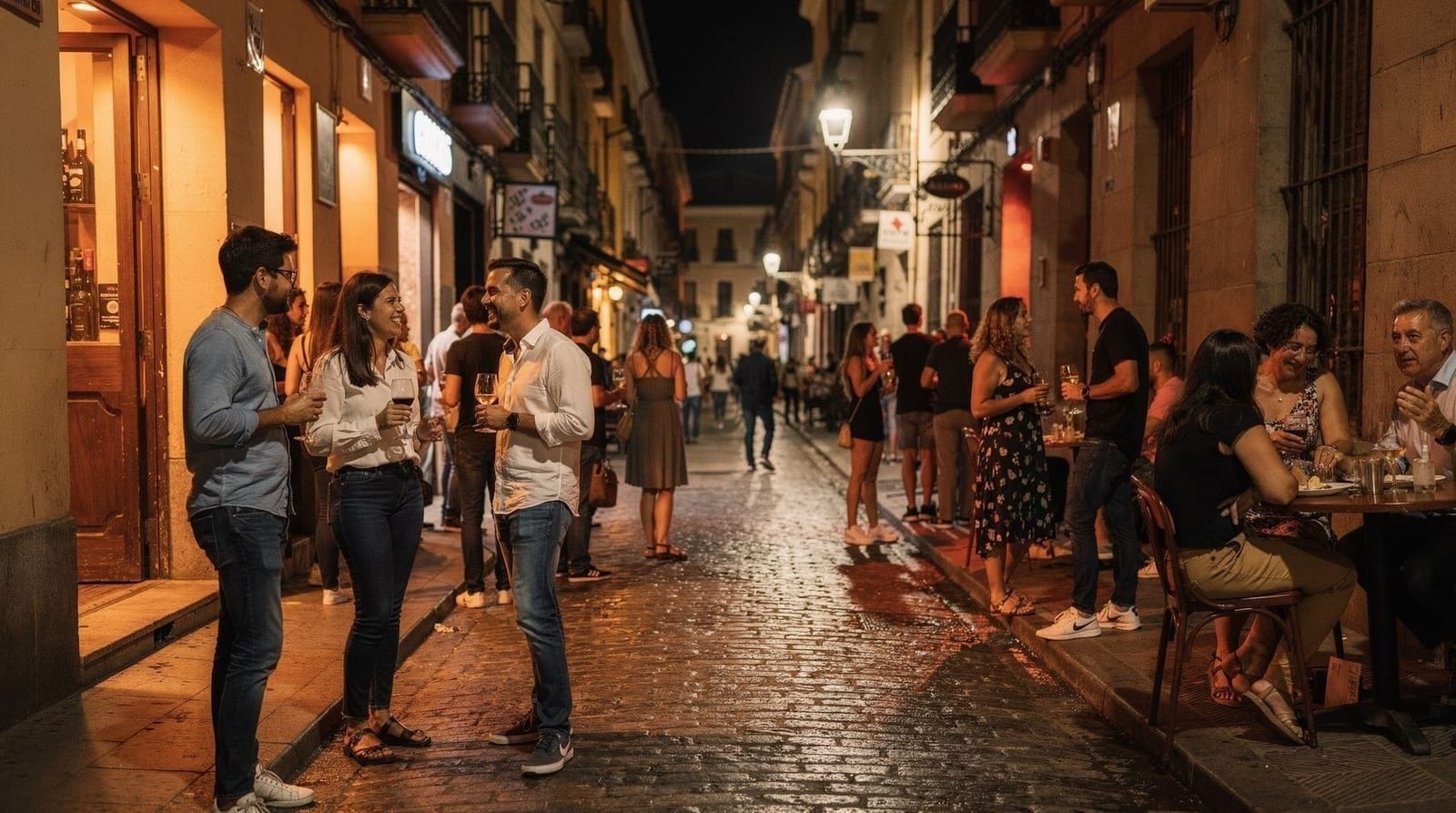
Advantage: Uber/Cabify for booking ahead. If you’re in a busy nightlife area (Malasaña at 03:00, Chueca on Saturday, La Latina after El Rastro on Sunday), app-based booking means you can order a car before you leave the venue and see a live ETA. This beats standing at a potentially busy taxi rank.
But watch the surge. The same late-night Friday scenario where Uber is convenient is exactly when surge pricing activates. Check the price estimate in the app before confirming. If the surge is more than 1.8x, street-hailing a taxi is almost certainly cheaper.
Practical approach: Open both the Uber/Cabify app and the Free Now (licensed taxi) app. Compare estimates. Take the cheaper option for your specific situation.
Which is safer?
Both licensed taxis and VTC drivers (Uber/Cabify) are regulated and vetted in Madrid. The unlicensed drivers occasionally operating around Barajas or outside major clubs late at night are the only category to avoid — never accept a ride from someone approaching you outside an airport or club. Licensed taxis have ID visible to passengers; Uber/Cabify show driver rating and registration in-app.
Madrid’s overall safety record for transport is good. Serious incidents involving licensed taxis or platforms are rare and reported to regulators. This is not a city where you need to approach taxis with suspicion — they are generally honest operators following official tariffs.
Practical comparison table
| Factor | Licensed taxi | Uber/Cabify |
|---|---|---|
| Airport flat fare (€33) | Yes | No |
| Street hail | Yes | No |
| App booking | Free Now, Pidetaxi | Native apps |
| Surge pricing | None (fixed tariff) | Yes (peak hours/weekends) |
| Night supplement | Yes (Tarifa 2, not dramatic) | Dynamic — can be high |
| Card payment | Most accept cards; some prefer cash | Always card |
| Receipt | On request or via app | Automatic |
| Station pick-up supplement | Possible — see the tariff card in the cab | None, but surge possible |
| Accessibility vehicles | Available (book via radio-taxi) | Some accessible vehicles in fleet |
When to use each
Use a taxi when:
- Arriving or departing from Barajas airport
- Hailing is faster than booking (short spontaneous trip, taxi visibly available)
- It’s Friday/Saturday after midnight and surge pricing makes apps expensive
- You prefer the certainty of a fixed tariff structure
Use Uber/Cabify when:
- You want to book ahead and track arrival time
- Going to/from a venue where taxi ranks are distant or crowded
- You need a guaranteed card-only payment with automatic receipt
- Travelling with a larger group where the per-person calculation favours a pre-booked car
Booking taxis for specific purposes
Hotel pick-up: If you ask your hotel concierge to call a taxi for early-morning departure, they typically use a radio-taxi service. The taxi arrives at the hotel entrance, the meter starts when you enter, and no airport supplement applies until you reach Line 8. For airport runs, the €33 flat fare kicks in as soon as you direct the driver to the airport.
Train station pick-up: Getting a taxi from Atocha or Chamartín after a day trip (returning from Toledo or Segovia) can involve a brief queue at peak times. The Atocha taxi rank is outside the main entrance on Paseo del Infante Isabel. At Chamartín, the taxi rank is at the main station exit on Calle Agustín de Foxá. Both are clearly signposted.
Day trip pick-up at destination: If visiting Toledo or Segovia independently, you’ll need transport within those cities. Toledo has taxis at the bus/train station; Segovia’s taxi rank is in the centre of town near the aqueduct. Uber/Cabify do not operate in smaller Castilian cities — licensed local taxis are the only ride-hailing option outside Madrid.
Stadium runs: Getting to and from the Santiago Bernabéu (Real Madrid stadium) on a match day is best done by Metro (Line 10, Santiago Bernabéu station) rather than taxi — traffic around the stadium before and after matches is extreme. After the match, the Metro is packed but moves; taxis and Uber can sit in traffic for 45–60 minutes. See the Bernabéu stadium tour guide for full match-day logistics.
A fixed ride for early Madrid departures
A dawn flight from a Madrid hotel is the one trip where a street taxi can feel uncertain. The concierge will call a radio-taxi, and the airport flat fare applies once you name the airport, but you still depend on a car turning up at the right minute. Say the terminal clearly when you get in, and keep the hotel entrance as your meeting point.
If your group has several suitcases, or you land late and do not want to look for a rank after a long flight, a driver arranged in advance removes the guesswork. Check that the confirmation shows your flight number, the pick-up point and the drop-off address, and leave a margin for morning traffic. For the airport leg, you can pre-book an airport transfer with Kiwitaxi in Madrid.
Group and family logistics
Larger groups: A standard taxi or Uber/Cabify fits up to 4 passengers comfortably (legally up to 4 in the back plus front seat in some vehicles, but 4 total is the practical norm with luggage). For groups of 5 or more, request an XL vehicle in advance — both taxi radio-dispatch and Uber/Cabify offer larger vehicle categories, though availability is more limited and worth booking ahead for airport arrivals with a full group.
If your group is too big for one car, a pre-booked larger-capacity airport minivan transfer keeps everyone and the luggage together instead of splitting across two taxis at the rank. It is also the easiest way to avoid hunting for an XL vehicle at the moment you land.
Traveling with young children: Neither taxis nor standard Uber/Cabify vehicles are required to carry child seats in Spain for hired transport, which surprises many visitors from countries with stricter rules. If a child seat is non-negotiable for your family, book a private transfer or radio-taxi in advance and specify the requirement explicitly — do not assume a street-hailed taxi will have one.
Luggage-heavy airport runs: Both taxis and Uber/Cabify handle two large suitcases per passenger without additional charge under normal circumstances. For a family of four with a full set of check-in luggage, mention the volume when booking a private transfer so an appropriately sized vehicle is sent.
Understanding taxi meter tariffs
Spanish taxi meters have multiple tariff modes. Understanding them prevents the impression of being overcharged:
Tarifa 1 (T1) — Standard weekday daytime:
- Per km: €1.40 (official 2026 rate)
- In use: Monday–Friday 07:00–21:00
Tarifa 2 (T2) — Night, weekend, and holiday rate:
- Per km: €1.60 (official 2026 rate)
- In use: every day 21:00–07:00; Saturday, Sunday, and public holidays 07:00–21:00
Airport flat fare: The €33 fixed price overrides the meter entirely for airport-to-M30 journeys. The driver will switch the display to show “33€” or the flat-fare mode. This applies 24/7, regardless of which tariff is technically active.
Supplements: Some pick-ups (railway stations, for example) carry a fixed supplement on top of the meter. The tariff card inside the cab lists them; check it rather than relying on a figure from a guide.
What to do if the tariff looks wrong: Ask the driver to confirm “¿cuánto es la tarifa?” (what is the tariff?). Licensed drivers are required to display the tariff card inside the vehicle. If you believe you’ve been overcharged, note the taxi’s licence number (on the door or the meter) and the receipt number.
Tipping
Tipping taxi drivers in Madrid is not obligatory. Rounding up to the nearest euro for short trips (e.g. paying €10 for a €8.70 meter) is common and appreciated. For longer trips, €1–€2 on top is generous. No expectation of a percentage tip as in the US. For Uber/Cabify, in-app tips are available but rarely expected by Spanish drivers.
Accessibility
Licensed Madrid taxis include accessible vehicles (Eurotaxi) for wheelchair users — these must be booked via radio-taxi numbers with advance notice. The Free Now app also has an accessible vehicle option in Madrid. Uber has a limited Uber Assist option in Madrid but coverage varies. For full accessible transport options, see the accessible Madrid guide.
Getting taxis in specific Madrid situations
Outside nightlife venues (Malasaña, Chueca): On Friday and Saturday nights, the most practical approach is to walk one or two blocks away from the immediate club or bar entrance. Taxis cruise the main streets (Fuencarral, San Bernardo, Hortaleza) rather than the narrow backstreets. If there’s a taxi rank nearby, use it — the queue moves.
From El Rastro (Sunday market): The Sunday market in La Latina/Embajadores ends around 15:00. Getting a taxi home directly from the market area is difficult — hundreds of people leaving simultaneously. Walk 10–15 minutes toward Sol or Atocha, or take Metro Line 3 (Embajadores station) which is quieter than hailing in the market area.
After a Bernabéu match: Do not try to get a taxi outside the stadium after a Real Madrid match. Traffic is completely gridlocked. Take Metro Line 10 (Santiago Bernabéu station, straight into the city) or walk 15–20 minutes to Nuevos Ministerios before looking for a taxi. Uber/Cabify are equally stuck in the stadium traffic.
From museums: The Prado, Thyssen, and Reina Sofía all have taxi ranks outside or nearby. The Prado rank on Paseo del Prado is visible from the main entrance. Good waiting times at these locations during the day.
Late night from airport: Taxis are 24-hour at all terminals. After the Metro closes (01:30), the taxi rank at T4 and T1/T2/T3 arrivals maintains a queue. Expect brief waits only. The €33 flat fare applies regardless of the hour — the one constant in Madrid late-night transport.
The Free Now app: booking licensed taxis with tracking
Free Now (formerly MyTaxi) is the main app for booking licensed Madrid taxis with app-like convenience:
- Books a white licensed taxi (same as street hail, same meter fare, no markup)
- Shows driver location on map with real-time ETA
- In-app payment option (card charged after ride)
- Accessible vehicle option available
- Receipt sent by email automatically
Free Now is essentially taxis + the app-experience benefits without the surge pricing. The key advantage over Uber/Cabify for regular Madrid use: no surge pricing, ever. The driver is a licensed taxi operator using the official meter.
Download before you travel. Create an account in advance so you can book immediately on arrival without entering card details on a slow airport Wi-Fi connection.
What to do if you have a problem with a taxi
Licensed taxis in Madrid are regulated. If you have a complaint:
- Note the taxi’s licence number (on the rear door, usually “SP-XXXXX” format) and the driver’s ID visible on the dashboard
- Ask for a receipt (factura o recibo) — drivers are required to provide one
- File a complaint online with the Ayuntamiento de Madrid’s taxi service, or in person at any police station (comisaría)
In practice, disputes are rare. The most common issues are: driver claims to not have change (have small bills), route disputes (check on Maps if the route seems unreasonably long), and occasional card payment refusals. All are manageable with straightforward communication.
Frequently asked questions about taxis and Uber in Madrid
Is Lyft available in Madrid?
No. Lyft does not operate in Spain. The relevant platforms are Uber and Cabify.
Can I pay cash in a Madrid taxi?
Yes — cash is accepted by virtually all Madrid taxis. Some older taxis prefer cash; newer ones have card terminals. If paying cash, have small denomination bills (€10–€20) as drivers sometimes claim not to have change for €50 notes late at night.
Do Madrid taxis have child seats?
Taxi drivers are not required to carry child seats under Spanish law for hired vehicles. If you need a child seat, request one explicitly when booking via radio-taxi in advance, or bring your own portable booster. This is one case where a pre-booked private transfer (specifying child seat requirement) is more reliable.
Are there water taxis or river transport in Madrid?
No. Madrid has no navigable river in the city centre — the Manzanares at Madrid Río is shallow and has no passenger water transport.
Is it safe to use fake taxis or “unofficial” drivers at the airport?
Avoid completely. Only use white licensed taxis from the official rank, or app-booked VTC services at the designated pickup area. People approaching you in arrivals offering rides are unlicensed and typically charge multiple times the correct rate.
Which is better for getting around Madrid overall — taxis, Uber, or public transport?
For most of a Madrid visit, the Metro is faster and cheaper than either taxi or ride-hailing for point-to-point travel within the city, especially at rush hour when road traffic slows both options equally. Taxis and Uber earn their place for airport transfers, late-night trips after the Metro closes (01:30), luggage-heavy journeys, and accessibility needs. A Tourist Travel Pass covering unlimited Metro and bus travel is the most economical base layer for most visitors, with taxis or Uber layered on top for the specific situations covered in this guide.
How taxis and Uber fit into your wider Madrid trip
Getting the transport mix right matters more over a multi-day stay than any single ride. A typical pattern for visitors combines the Metro or a Tourist Travel Pass for daytime sightseeing, a taxi or private transfer for the airport legs at the start and end of the trip, and Uber/Cabify or a taxi rank for the return home after a night out in Malasaña, Chueca, or La Latina. Day trips by Cercanías regional train to Toledo, Segovia, or Aranjuez are a separate category entirely — neither taxis nor Uber operate economically over those distances, and the train network is both faster and dramatically cheaper.
For visitors planning how many days to spend in Madrid, the transport budget is worth sketching early: a week combining Metro passes, two or three taxi/Uber rides, and one or two Cercanías day trips typically comes in well under what a car rental and parking would cost, with none of the parking stress in the historic centre.