
How to visit the Prado Museum in two hours (and see what actually matters)
Two hours in the Prado sounds like a contradiction. The museum holds more than 20,000 works, its permanent collection spans five centuries, and even a selective visit can stretch into a full day if you let it. But a focused two-hour visit — one built around a clear route and deliberate choices about what to skip — is not only possible, it’s often more satisfying than an exhausted four-hour marathon where everything blurs together.
This guide gives you two concrete options: a tight two-hour route that prioritises the absolute essentials, and a relaxed two-hour route for people who want to linger rather than tick boxes. It also covers the practicalities — entry prices, the free hours schedule, how to get in fast, and room numbers for the key works so you’re not wandering.
| Where | Paseo del Prado, Banco de España / Atocha metro (Line 1) |
| Cost | Around €15 standard adult ticket; free evening windows |
| Time needed | Two focused hours, or three if relaxed |
| Getting there | Jerónimos entrance for prebooked tickets, Velázquez entrance for free hours |
| Best time | Weekday free evening window, arrive early to queue |
Entry, prices and the free hours
The standard adult ticket costs €15. There are no hidden charges once inside. Children under 18 enter free.
The Prado runs free admission windows that many visitors don’t use effectively. Monday to Saturday from 18:00 to 20:00, entry is free. On Sundays and public holidays, free entry runs from 17:00 to 19:00. These are the last two hours before closing, so you won’t have the full day — but two hours in the Prado free is exactly the subject of this guide.
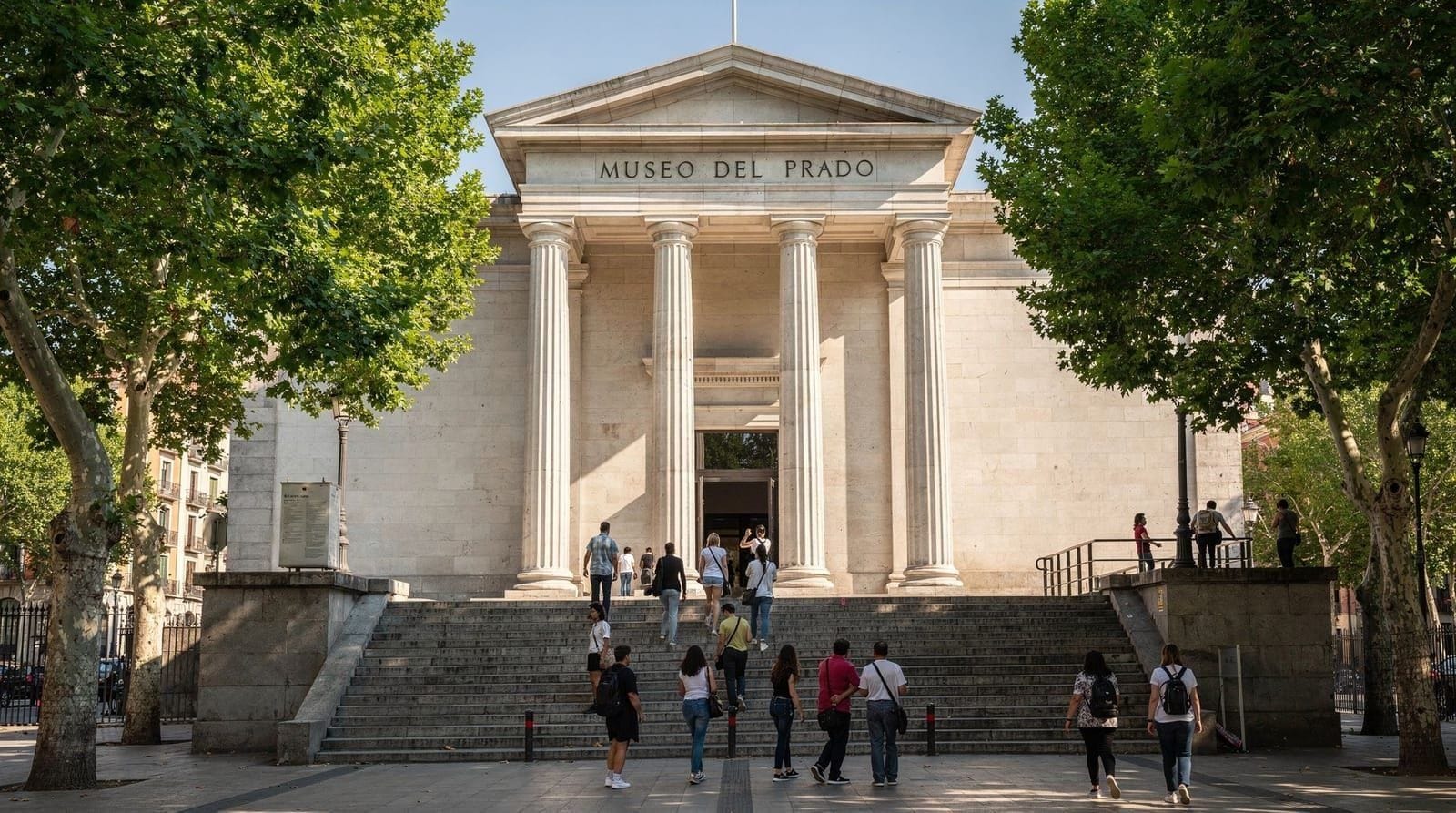
The catch is that queues form early. On summer evenings, particularly in July and August, people start lining up outside the Velázquez entrance (the main entrance on Paseo del Prado) around 30 to 40 minutes before the free window opens. If you want to start at 18:00, you need to be in line by 17:20 at the latest. In spring and autumn the wait is shorter — around 15 to 20 minutes.
Prebooking a timed ticket online bypasses the queue entirely. If you’re paying full price, this is worth it almost every time. The ticket booking system on the Prado’s website allows you to select a 30-minute entry window. Arrive in that window, go directly to the ticket scanners at the Jerónimos entrance (the newer glass building on the right side), and you’re inside in minutes.
For the free evening windows, prebooking isn’t available — those slots are walk-up only.
The full Prado museum guide covers ticketing, the permanent collection layout, and the Casón del Buen Retiro annex in more detail.
What to prioritise in two hours
The Prado’s essential works cluster in three areas: the Velázquez rooms, the Goya rooms, and the Flemish and Italian masters on the ground floor. If you’re short on time, these three areas account for most of the museum’s internationally recognised masterpieces.
Velázquez (Rooms 12 and 14-15, first floor): Las Meninas is in Room 12 and is the undisputed centrepiece of the Prado. It’s a large, strange, endlessly discussed painting — a royal portrait that also contains a self-portrait of the painter, reflections, servants, a dog, and a figure in a doorway. Allow at least five minutes just to stand with it. Room 14 holds the equestrian portraits; Room 15 has the mythological paintings including Los Borrachos.
Goya (Rooms 64-67, first floor, and Room 89): Goya’s presence in the Prado is vast. The Black Paintings — the Saturn Devouring His Son, The Witches’ Sabbath, the Dog — are in Rooms 67 and 66. The two Majas (clothed and nude) are in Room 65. The Disasters of War series, one of the most powerful graphic works ever made, is displayed in Room 89 in a dedicated exhibition space. Don’t mistake Goya for a minor detour.
El Greco (Rooms 8b-11, ground floor): The Nobleman with his Hand on his Chest is the most reproduced, but the Adoration of the Shepherds and the Trinity are arguably finer. These rooms are often quieter than the Velázquez and Goya sections.
Bosch (Room 56a, ground floor): The Garden of Earthly Delights is on the ground floor in the centre of the building. It’s a triptych — hell, earth, and heaven — that rewards slow looking. King Philip II collected it, which is why it’s here rather than in Amsterdam or Vienna.
The tight two-hour route
This route is for people with exactly two hours and no room for detours. Start at the Jerónimos entrance (right side building), collect or scan your ticket, and head immediately to the first floor.
First 20 minutes — Velázquez: Take the escalator to the first floor and walk directly to Room 12. Spend 8-10 minutes with Las Meninas, then walk through to Rooms 14 and 15 for the equestrian portraits. Don’t stop at anything else on this floor yet.
Next 35 minutes — Goya: From the Velázquez rooms, continue to the Goya section. Go to Room 65 first for the Majas, then Room 66 and 67 for the Black Paintings. Allow at least 10 minutes in the Black Paintings rooms — these are unlike anything else in European painting and they tend to stop people in their tracks. End at Room 89 for the Disasters of War.
Next 25 minutes — Ground floor highlights: Take the stairs down to the ground floor and go directly to Room 56a for Bosch’s Garden of Earthly Delights. Then walk to the El Greco rooms (8b-11) for the Nobleman with his Hand on his Chest.
Final 20 minutes — buffer or Flemish masters: If you’re ahead of schedule, Room 29 holds Rogier van der Weyden’s Descent from the Cross, one of the finest Northern European paintings in any museum. Rooms 26-28 cover the Italian Renaissance including Raphael and Titian. If you’re out of time, head to the museum shop or exit — you’ve already seen the core.
The relaxed two-hour route
This version is for people who want to absorb fewer things more fully, rather than ticking every major work.
Choose two of the three main areas — Velázquez, Goya, or Bosch and the Flemish masters — and spend a full hour on each. Skip the other. This is counterintuitive but it works: a Goya-focused two hours where you sit in front of the Black Paintings for ten minutes each, read the context panels, and look at the Disasters of War carefully, is more valuable than a rushed sprint through everything.
The Retiro park is directly behind the museum and makes a natural place to decompress afterwards — the gardens, the pond, and the Palacio de Cristal are all within a five-minute walk from the Jerónimos exit. Read more in the Retiro and Jerónimos neighbourhood guide.
Which route fits you:
| Route | Best for | What you’ll cover |
|---|---|---|
| Tight route | First-timers, tour groups, tight schedules | Velázquez, Goya, Bosch, El Greco — the four pillars |
| Relaxed route | Repeat visitors, art enthusiasts | Two of the four areas in real depth |
What to skip if time is short
The Dauphin’s treasure: A decorative arts collection on the ground floor. Beautiful, but not what you came for.
The temporary exhibitions: The Prado runs excellent temporary shows, but they require separate tickets and take significant time. Save these for a return visit.
The Casón del Buen Retiro annex: Reached via a short walk, it houses 19th-century Spanish painting. Skip it on a two-hour visit.
The top floor: The top floor contains smaller format works and drawings that reward a longer visit. On two hours, stay on the first and ground floors.
Should you take a guided tour?
A guide changes the experience significantly. Instead of identifying which painting is important from a wall label, you get the sequence, the stories, the political context behind Las Meninas, why Goya’s late style is so different from his early work, what’s actually happening in the Garden of Earthly Delights. Two hours with a knowledgeable guide covering 20 works is more rewarding than two solo hours covering 40.
 Prado Guided Skip the LineCheck availability
If you’d rather explore solo, the Prado’s audio guide (available on the museum app or rented at the entrance) covers the main works and is significantly better than most museum audio guides.
If the Prado is only one stop in a bigger art day, a combined visit such as a guided visit that pairs the Prado with the Reina Sofía saves you from sorting out two sets of entry arrangements, and the guide handles the sequencing for you. Our guide to choosing between a guided and a self-guided visit helps you decide which suits your style, and the private guide in Madrid page covers the more personalised options.
Combining the Prado with the rest of the Golden Triangle
The Prado sits at one corner of what locals call the Golden Triangle of Art — three major museums within 15 minutes walk of each other. The other two are the Reina Sofía (home of Guernica) and the Thyssen-Bornemisza. Doing all three in one day is ambitious. Doing two properly is realistic.
A common combination: Prado in the morning (full price, prebooked timed entry), Reina Sofía in the free evening window from 19:00. Or: Thyssen on a Monday (free from 12:00 to 16:00), Prado in the paid afternoon. The Golden Triangle art walk guide covers how to sequence all three.
For the full breakdown of which free hours windows work best for which museums, and which are worth paying for, read the museum free hours guide and the more detailed honest assessment of the free hours.
A note on the Goya frescoes
The Prado holds Goya frescoes detached from the San Antonio de la Florida hermitage — small but significant works. These are separate from the Black Paintings and require navigating to a specific section of the collection. For a pure two-hour visit, these are optional. If Goya is your primary reason for visiting Madrid, the Royal Palace guide also covers the Goya tapestry cartoons held in the palace collection, which are underappreciated.
Getting there
The museum is at Paseo del Prado, closest to the Banco de España or Atocha metro stops (both Line 1). The Jerónimos entrance (right side) is best for prebooked tickets. The Velázquez entrance (main door on Paseo del Prado) is best for free-hours queue.
Opening hours: Monday to Saturday 10:00-20:00, Sunday and public holidays 10:00-19:00. Closed on 1 January, 1 May, and 25 December.
Etiquette and photography
Photography without flash is generally permitted in the permanent collection, but flash and tripods are not, and a few rooms — usually those with temporary loans — post their own restrictions at the entrance. Respect the barrier distance around paintings; guards will ask you to step back, and repeated close encroachment can get a group asked to move on. Bags larger than a small daypack should go in the free lockers near the entrance rather than being carried through the galleries, which also makes moving quickly between rooms easier on a tight schedule.
Fitting the Prado into your wider Madrid plan
A two-hour Prado visit slots easily into a longer stay. If you are building a short trip, the Madrid in one day itinerary and the three-day itinerary both leave room for a focused museum stop, while the Madrid for art lovers itinerary is the one to follow if paintings are the main point of your trip. Not sure how long to stay overall? The how many days in Madrid guide and the blog’s take on whether three days in Madrid is enough will help you decide.
Other posts pair well with this one: the honest take on Guernica if you continue to the Reina Sofía, the list of free art in Madrid, and the rainy day ideas for families if the weather decides your plans. After the galleries, the Retiro park guide is a gentle way to wind down.
Two hours is enough to leave the Prado with something real. It just requires knowing in advance what you’re going to see, rather than deciding when you’re inside.