
Why El Escorial is Madrid's most underrated day trip
Most visitors to Madrid make a list of day trips, put Toledo at the top, add Segovia, and consider themselves well-informed. Very few add El Escorial. This is a mistake — not a catastrophic one, but the kind that means missing something genuinely exceptional that is both easy to reach and consistently uncrowded.
| Where | San Lorenzo de El Escorial, ~50km northwest of Madrid |
| Getting there | Cercanías C-8 from Atocha or Chamartín, ~55-65 min |
| Cost | Train: see Renfe; monastery entry separate |
| Time needed | Half a day comfortably, a full day if unhurried |
| Crowds | Consistently quieter than Toledo or Segovia |
The Real Monasterio de San Lorenzo de El Escorial is one of the largest and most architecturally imposing buildings in the world. It was built between 1563 and 1584 on the orders of Philip II, king of Spain at the height of the empire, and it served simultaneously as a monastery, a royal palace, a basilica, a library, and a mausoleum for the Spanish royal family. It has been a UNESCO World Heritage Site since 1984.
And almost nobody on a first trip to Madrid visits it.
What El Escorial actually is
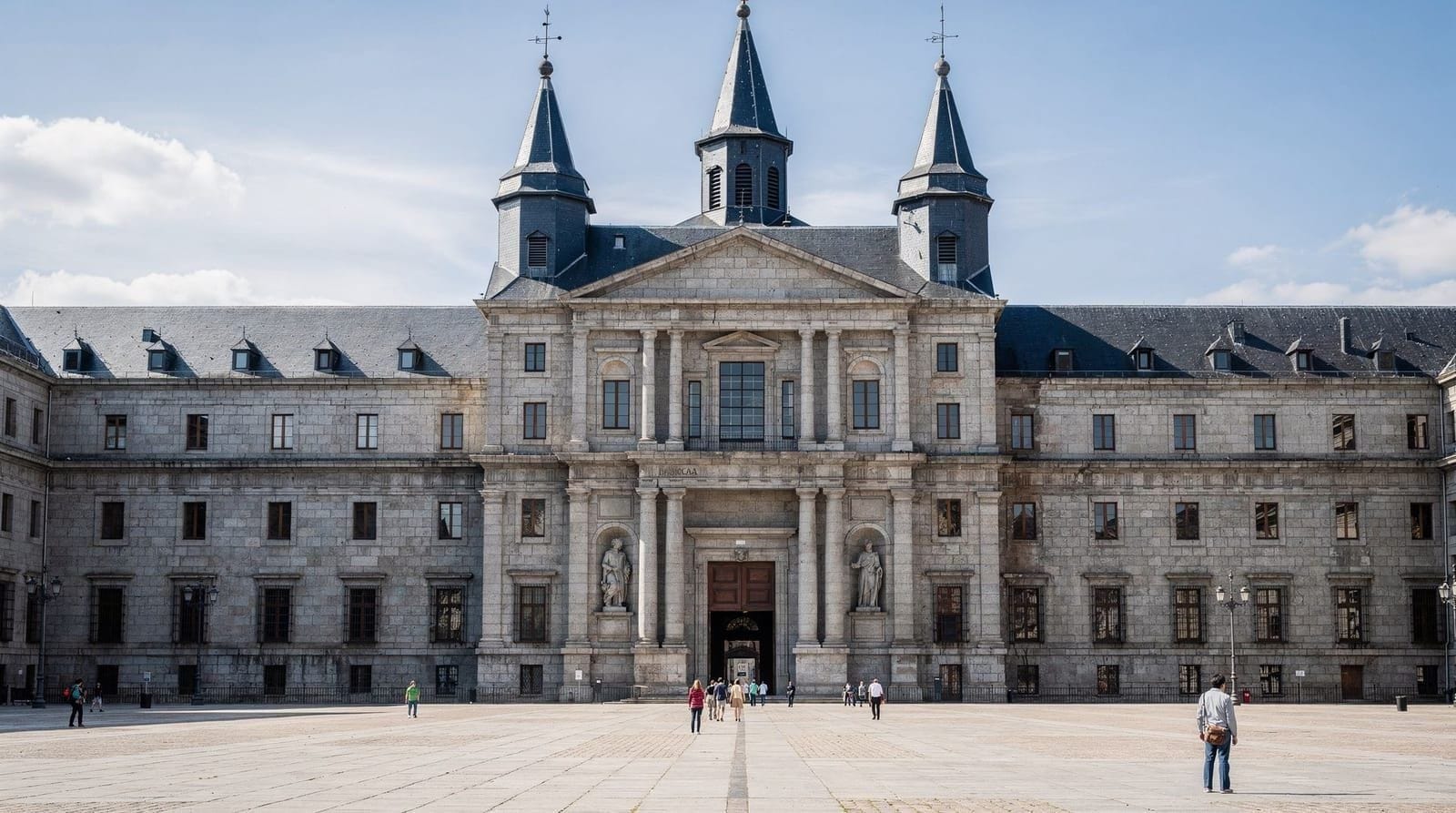
The building is enormous — roughly 207 by 161 metres, containing around 1,200 doors, 2,600 windows, 15 cloisters, 86 staircases, and 9 towers. That scale is part of the point. Philip II intended it as a monument to Spanish power and Catholic faith, built in the austere Renaissance style (Herreran architecture) that he personally favoured. The result is simultaneously severe and overwhelming.
It’s worth being clear about what you’re visiting: not a castle, not just a palace, not just a monastery. It’s all of these at once, built to a single unified plan and executed to a very high standard. The cold granite exterior doesn’t immediately charm, which is probably why fewer tourists make the journey. But the interior is extraordinary.
What to see inside
The Basilica occupies the centre of the complex and is one of the finest Renaissance churches in Spain. The main altarpiece was designed with input from Philip II himself and contains an unusual feature: bronze sculptures of the royal family in prayer, positioned so that the king could watch Mass from his apartments directly above through a grille in the wall. It’s an architectural expression of how Philip understood his relationship to God and power.
The Panteon de Reyes (Royal Pantheon) is the building’s most memorable space and the one most people remember. Located directly beneath the basilica’s main altar, it is an octagonal baroque chamber containing the remains of almost every Spanish monarch since Charles I. The tombs are identical in size — all equal in death, regardless of the power they held in life. The atmosphere is genuinely eerie and strangely moving.
The Library is exceptional and undervisited even by those who make it to El Escorial. Philip II was a passionate bibliophile and assembled one of the finest collections in 16th-century Europe. The hall itself has ceiling frescoes by Pellegrino Tibaldi depicting the liberal arts. Uniquely among major European libraries, the books are shelved with their spines facing inward — an intentional aesthetic choice. The collection includes rare Arabic manuscripts, illuminated medieval texts, and scientific instruments.
The Royal Apartments offer a stark contrast between the austere rooms Philip II used (he reportedly died in a small, simply furnished bedroom near the basilica, able to see the altar from his bed) and the more ornate apartments added by later monarchs. The juxtaposition says more about the evolution of Spanish royal taste than any history book.
The Pinacoteca (painting collection) holds works by El Greco, Titian, Veronese, Ribera, and others. Some of these are directly commissioned for the building; others are accumulated royal acquisitions. The quality is high.
The full El Escorial from Madrid guide has opening times, current ticket prices, and which sections require separate tickets.
 Escorial Valley Basilica Day TripCheck availability
Why people skip it
The honest answer is that El Escorial doesn’t photograph particularly well. The exterior is grey granite, deliberately severe, without the dramatic silhouette of Toledo’s Alcázar or Segovia’s castle. On Instagram, it looks like a large, square building. Nothing in the image hints at the Pantheon beneath it or the library above it.
Toledo and Segovia have been on “best day trips from Madrid” lists for decades. El Escorial hasn’t been marketed the same way. Many organised tour operators focus on the more obviously picturesque pair, and travellers following recommendations tend to follow the same path.
There’s also a mild practical deterrent: El Escorial is served by Cercanías, not the faster AVE, so the journey takes closer to an hour rather than 30 minutes. It’s not hard, but it requires slightly more planning than the Toledo or Segovia trains.
Getting there
El Escorial is on the Cercanías C-8 line from Madrid Atocha. The journey takes approximately 55-65 minutes depending on service. From Chamartín, trains also run on the same line. Tickets are inexpensive — see the Renfe website for current fares — and no advance reservation is needed.
From the El Escorial train station, it’s a 15-20 minute walk uphill to the monastery, or a short taxi or local bus ride. The walk is manageable in mild weather and gives you a good sense of the town.
The day trips by train from Madrid guide compares El Escorial’s logistics with other destinations if you want to plan multiple trips.
Combining with Valle de los Caídos
For many years, El Escorial was paired on day trip itineraries with the Valle de los Caídos — the vast basilica carved into a mountain nearby, built under Franco’s dictatorship using forced Republican labour. In 2019, Franco’s remains were exhumed and relocated, and the monument has been in a process of transformation toward a site focused on memory and reconciliation, now officially renamed the Valle de Cuelgamuros.
Access and what you can visit has changed significantly in recent years. Check current availability before planning your visit — the monastery’s visitor information has up-to-date guidance.
How El Escorial compares to Toledo and Segovia
Toledo and Segovia are richer destinations in terms of sheer variety — more streets, more individual monuments, more neighbourhoods to wander. Toledo alone can fill a full day with no repetition. Segovia has better food and a more compact, relaxed energy.
El Escorial is a single building that contains an extraordinary amount. The best day trips from Madrid overview puts all three in context. The comparison between Toledo and Segovia at Toledo vs Segovia is a useful benchmark for how El Escorial fits into a broader day trip plan — it’s more specialised than either, but for visitors interested in art history, architecture, or the Habsburg period specifically, it may be the most rewarding of the three.
If you have done Toledo and Segovia and are looking for a third day trip that is different in character — quieter, more focused, more unusual — El Escorial is the answer. The day trip without a car is entirely straightforward on the Cercanías network, and the building itself is something that many visitors describe as one of the most memorable things they saw in Spain.
How the three compare
| El Escorial | Toledo | Segovia | |
|---|---|---|---|
| Journey time | ~55-65 min | 33 min | 28-30 min |
| Character | Single monumental building | Sprawling medieval city | Compact walkable old town |
| Crowds | Consistently light | Heavy, especially midday | Moderate to heavy weekends |
| Best for | Art, architecture, Habsburg history | Full-day immersion, variety | Food, aqueduct, easy pace |
| Minimum time | Half day | Full day (5-6h) | Half to full day |
The historical thread worth knowing
Understanding El Escorial properly means understanding Philip II’s broader project of consolidating Habsburg power and Counter-Reformation Catholicism in a single generation. The Habsburg and Bourbon history guide puts the monastery in the context of the dynasty that built it, which makes the Panteón de Reyes considerably more resonant than approaching it as an isolated sight. For the town itself beyond the monastery walls, the El Escorial destination page covers where to eat lunch and how the town feels outside the main complex.
If you want the fuller loop
Visitors with a full day and an interest in 20th-century Spanish history sometimes combine El Escorial with the nearby Valle de Cuelgamuros — formerly Valle de los Caídos — though as noted above, access has changed significantly and should be checked in advance. The Valle de los Caídos page has current context on what the site represents today.
For those who would rather not manage the Cercanías timetable themselves, a guided day trip covering the monastery in more depth is a reasonable alternative:
El Escorial monastery guided site tour from MadridThat almost nobody goes is their misfortune and your opportunity.