Campo de Criptana
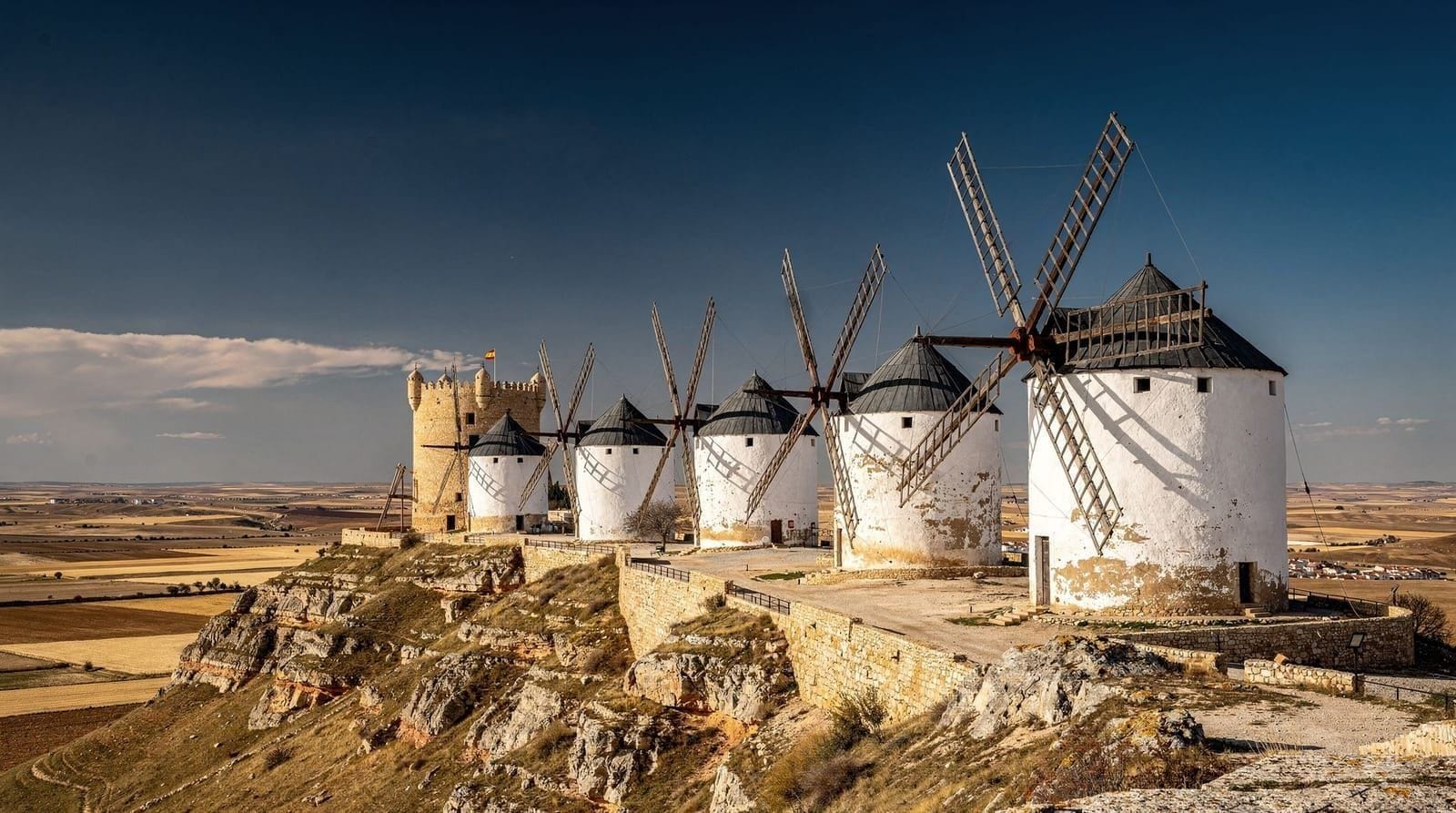
Campo de Criptana: 10 La Mancha windmills above a white village. Three are 16th-century National Monuments — the strongest Don Quixote windmill-country
Consuegra: Toledo la Mancha Windmills Private
Quick facts
- Distance from Madrid
- ~155 km southeast (1 h 30 min by car)
- Train from Madrid (Atocha)
- ~1 h 50 min (regional, Cercanías C-4 + Altaria)
- Population
- ~13,000
- Windmills
- 10 surviving on the Altozano ridge
- Three are UNESCO protected
- Declared National Monuments
- Don Quixote claim
- Strongest geographical candidate for the windmill chapter
Campo de Criptana has the most windmills. Of all the La Mancha villages that claim the setting of Cervantes’ windmill episode, this one preserves the largest surviving group — 10 towers on the Altozano ridge above a whitewashed village, the largest concentration in the region. Three are declared National Monuments and have not been substantially altered since the 16th–17th centuries. The visual from below, looking up at the white cylinders with their octagonal wooden frames and faded sails against the blue sky, is the quintessential La Mancha image.
The village itself is more interesting than Consuegra’s town centre — a network of steep whitewashed streets climbing the hill to the windmill ridge, cave houses (bodegas and homes dug into the hill’s soft rock) integrated into the neighbourhood, and a quiet provincial character that feels less adapted to day-tripper traffic than some of the more visited sites. A Tuesday morning in Campo de Criptana in May: practically deserted, the windmills yours alone, the plain extending south for 60 km in flat, wheat-and-vine geometry.
| Where | ~155 km southeast of Madrid, La Mancha |
| Getting there | Car ~1 h 30; train + taxi via Alcázar de San Juan ~1 h 50 |
| Windmill entry | Varies — ask the tourist office (3–4 usually open) |
| Time needed | Half day (2–3 hours); full day combined with Consuegra |
| Best time | April–June, September–October |
Getting to Campo de Criptana from Madrid
By train: a regional train from Atocha (the Altaria service towards Alicante or a regional connection) reaches Alcázar de San Juan station in approximately 1 hour 30–50 minutes, from where Campo de Criptana is 8 km (taxi €8–€10 or local bus). This is workable but requires scheduling attention.
By car: the A-3 motorway southeast from Madrid reaches Campo de Criptana in approximately 1 hour 30 minutes. Parking below the windmill ridge is free. This is by far the most practical approach for a day trip.
Combining with Consuegra: both are in the same geographical arc southeast/south of Madrid. With a car, a combined day is feasible: Campo de Criptana in the morning (2 hours), then drive 60 km west to Consuegra for lunch and the afternoon. Return to Madrid via Toledo (50 km north on the N-401) for a late evening. This is a long day (250+ km) but covers the core La Mancha landscape comprehensively.
Private day trip from Madrid: Toledo and La Mancha windmill countryIf you would rather not drive at all, the day trips without a car guide explains what is realistic from Madrid, and day trips by train covers the rail-based options. Atocha, where the regional service starts, is compared with the other main station in Atocha vs Chamartín, which is worth reading before you buy a ticket.
The windmills of the Altozano
The Altozano ridge carries 10 surviving windmills from an original group that numbered 34 in the early 17th century (Cervantes’ era). The three National Monument mills — Burleta, Infante, and Sardinero — have the original 16th-century stone construction and have not been substantially altered. The other seven were rebuilt in the 19th and early 20th centuries. All are structurally intact; three or four are usually open to visitors with the internal mechanism accessible.
The mill interiors show the complete grain-processing installation: the vertical drive shaft from the horizontal sail shaft above, the wooden gear train (lantern pinion and crown wheel), the millstones (upper and lower, 700–900 kg each), and the grain hopper. The scale of the installation, built in stone without metal fasteners for the primary structure, is a convincing demonstration of pre-industrial engineering capability.
The best photo position: from the approach road at the south side of the ridge, in the morning, looking up at the mills against the sky with the village below. The light is at its best before 10:00 in spring and autumn.
Take your time inside the mills rather than treating them as a quick photo stop. The mechanism rewards a slow look, and the ridge is a pleasant place to simply sit and watch the plain. If the windmill theme appeals to you, the Consuegra windmills guide describes the second great ridge of the region and helps you decide how to split your time between the two.
The village and cave houses
Campo de Criptana’s lower town has an interesting concentration of bodegas — cave cellars dug horizontally into the soft sandstone hillside, used for wine storage (the Manchegan wine industry has deep roots here) and occasionally adapted as houses or restaurants. The barrio de las Cuevas (cave neighbourhood) on the eastern slope of the Altozano is the most complete example; several cave bodegas are open for visits and tastings (arrange at the tourist office on the main square).
The village has the whitewashed aesthetic typical of this part of La Mancha — lime-washed walls, painted doors, flower pots on the wall — and has benefited from the tourism infrastructure around the windmills without being overwhelmed by it. The streets are genuine residential streets, not tourist lanes.
Iglesia de Nuestra Señora de la Asunción (16th century, at the base of the windmill ridge): the parish church has Gothic vaulting and a 16th-century Plateresque portal. The tower serves as a visual anchor for the approach to the windmill ridge. Usually open for morning mass and tourist visits.
The Don Quixote claim
The geographical argument for Campo de Criptana as the setting of Chapter VIII of Don Quixote rests on proximity: the village is close to the route that Quixote would plausibly have taken from his putative home village (El Toboso, the village of Dulcinea, is 20 km east), and the windmills would have been visible from the road. Scholars have noted that the novel’s vague topography (“those fields”) is consistent with this area.
The competing claim belongs to Consuegra (which has the castle) and to Alcázar de San Juan (where baptismal records have been used to argue Cervantes was actually born, rather than Alcalá de Henares — a minority position). None of the claims is definitively established; Cervantes never identified the exact location.
What Campo de Criptana offers that the other claimants do not is the largest surviving windmill group (10 vs Consuegra’s 12, but the three National Monument mills here are older and more authentic) and the most convincingly intact 16th-century examples. If Cervantes saw working La Mancha windmills and based his description on them, these three mills are the type he would have known.
Cervantes is also tied to Madrid itself, and the literary quarter around Cervantes is a good way to pair this countryside with the city streets where he lived and worked. His birthplace is traditionally placed in Alcalá de Henares, which makes a natural companion trip for anyone following the author. Reading a few pages of the novel before you go, or on the train, makes the ridge much more vivid.
Where to eat in Campo de Criptana
Bar Restaurante El Hidalgo (Calle Doctor Torres Guardiola 5): the standard local choice for a Castilian lunch. Pisto manchego, Manchego cheese, migas (fried bread crumbs with chorizo and eggs — a shepherd’s dish), lamb chops. Mains €12–€18.
Cave Bodega La Perdiz (Barrio de las Cuevas): wines from the local La Mancha DO, small tapas selection (cheese, cured meats), served in the cave cellar. More of a tasting experience than a meal; good for understanding local wine culture. Advance booking recommended.
Manchegan food staples to seek: pisto manchego (the vegetable stew), tiznao (salt cod with peppers and garlic, a Lenten dish), morteruelo (the pork-and-game pâté shared with Cuenca), migas a la pastor (shepherd’s fried bread dish). This is inland peasant cooking — rich, simple, using preserved meats and vegetables.
For more on the wider Spanish table, the Madrid tapas guide and the Cocido madrileño page show how the same inland, preserved-ingredient cooking appears in the capital, so you can compare the village version with the city one when you return.
La Mancha wine country
Campo de Criptana sits in the heart of the La Mancha DO — the largest wine appellation in Spain by surface area (more than 7,000 square kilometres of vineyard). The region’s primary grape is Airén for white wines (the world’s most planted grape variety, though rarely found elsewhere), and Tempranillo (locally called Cencibel) for reds. The wine is not internationally fashionable but the value is extraordinary: serious Cencibel with four years of oak ageing for €6 in the local cooperatives.
The Cueva Bodega experience (see above) provides an introduction to the local wine culture. For more depth, the cooperative Vinícola de Campo de Criptana offers tours and tastings (arranged through the tourist office).
Practical information
Without a car: Campo de Criptana is significantly harder to reach by public transport than Consuegra or Toledo. The train option requires a connection at Alcázar de San Juan and a taxi for the final 8 km. For day-trippers without a car, an organised tour combining Campo de Criptana with other La Mancha sites is the practical option.
Summer heat: the La Mancha plain in July–August regularly exceeds 38°C with no shade on the windmill ridge. Visit before 09:00 or after 18:00, or plan for spring and autumn.
Combining with Toledo: Toledo is 90 km northwest via the N-301. A car-based day combining Campo de Criptana (morning) with Toledo (afternoon) is a natural La Mancha to UNESCO-walled-city transition. For the Toledo details, see Toledo.
How it fits into a Madrid trip: Campo de Criptana is for the visitor who has covered Madrid’s main attractions and wants to understand the landscape around the capital — the Don Quixote country, the wheat and vine plains, the windmill technology of the 17th century. For a Madrid week with day trips, day 6 or 7. See best day trips from Madrid for how it compares to other options.
Don Quixote windmills and Toledo day trip from MadridOther day trips worth weighing against this one include Chinchón, a small town with its own strong character, and Cuenca, which shares some of the Manchegan cooking. The Toledo versus Segovia comparison helps if you are choosing between La Mancha and the walled cities for your single free day, and the Madrid and Toledo itinerary shows how to build the UNESCO-city side of the trip.
Campo de Criptana versus Consuegra
Both villages claim the Don Quixote windmill setting, and travellers deciding between them (or wondering whether to visit both) should know the real differences:
| Campo de Criptana | Consuegra | |
|---|---|---|
| Windmill count | 10 surviving (3 National Monuments) | 12, plus a hilltop castle |
| Character | Whitewashed village, cave houses | Larger town, more visited |
| Public transport | Difficult — train + taxi | Easier — more direct bus options |
| Best single reason to visit | Oldest, most authentic mills | Castle + windmill combination |
Neither claim is definitively “correct” — Cervantes never named the location — but Campo de Criptana has the stronger case on mill authenticity, while Consuegra offers a more complete sightseeing package with its castle. A car-based day covering both, as described above, resolves the dilemma entirely.
Frequently asked questions about Campo de Criptana
Is Campo de Criptana worth visiting without a car?
It’s difficult but possible — the train connection via Alcázar de San Juan requires a taxi for the final 8 km, which adds cost and complexity. For travellers without a car, an organised tour combining Campo de Criptana with Consuegra or Toledo is the more practical option, since it removes the connection risk entirely.
How does Campo de Criptana compare to Consuegra for photos?
Campo de Criptana’s windmills sit directly above a whitewashed village, giving a stronger foreground for photographs than Consuegra’s more exposed hilltop ridge. Consuegra’s castle adds a different, more dramatic silhouette. Photographers who can only choose one often prefer Campo de Criptana for the village-and-mills composition.
Can I visit the inside of the windmills?
Yes — three or four of the ten mills are usually open to visitors, with the internal milling mechanism visible. Opening rotates, so not every mill is accessible on a given day; ask at the tourist office on the main square for which are currently open.