Consuegra
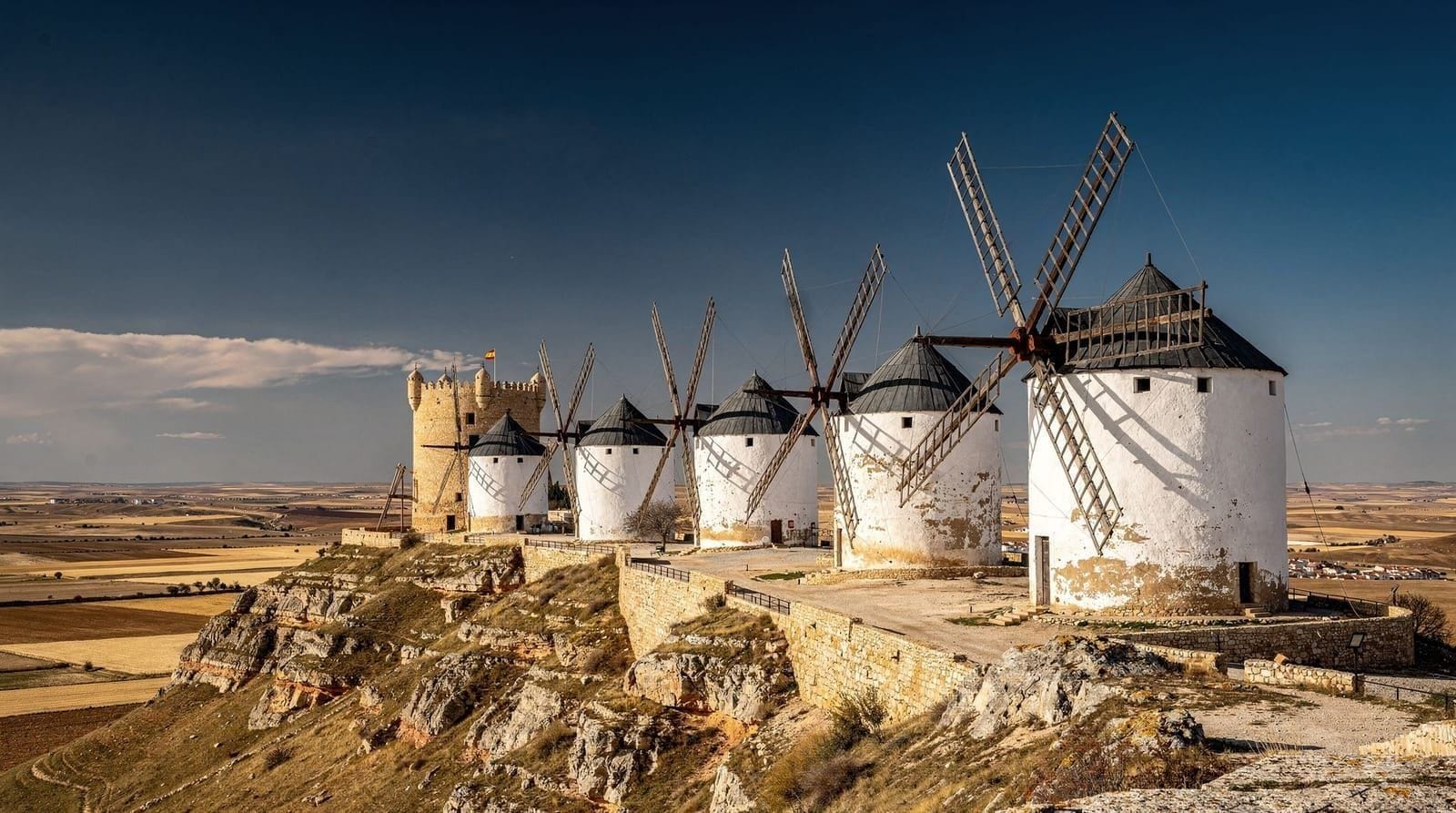
Consuegra has 12 white windmills on a ridge above a Moorish castle — the most iconic La Mancha landscape from Don Quixote. 2 h 20 min by bus from Madrid.
Consuegra: Consuegra Windmills Tour
Quick facts
- Bus from Madrid (Estación Sur)
- ~2 h 20 min (InterBus)
- Bus fare
- varies (check the carrier's website)
- Population
- ~10,000
- Windmills
- 12 surviving, on a ridge above the Moorish castle
- Saffron
- La Mancha saffron (DOP) harvested here in October
- Don Quixote connection
- The windmill-tilting episode is set in La Mancha
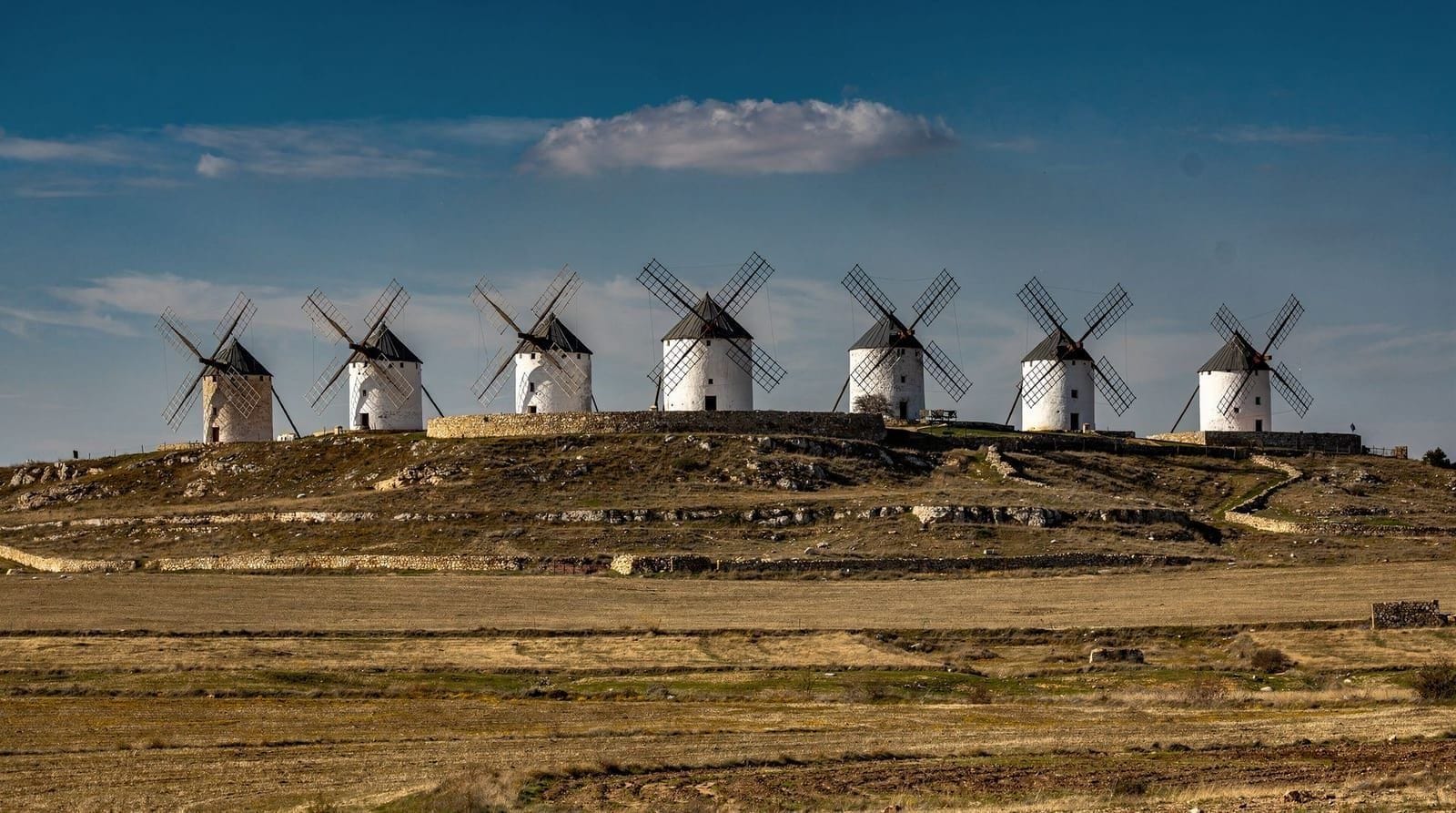
Consuegra’s windmill ridge is the image most people picture when they picture La Mancha — a line of white cylindrical towers with conical caps and sails, sitting on a hill above the flat plain, the Moorish castle at the end of the row. This is the landscape that Cervantes placed in Don Quixote when Alonso Quixano tilted at windmills he mistook for giants: not a specific identified village, but the generic La Mancha landscape of which Consuegra is the most photogenic surviving example.
The windmills are real and working in the sense of being structurally intact; several have been restored and can be entered, with the internal grinding mechanism preserved. The castle is Moorish, dating from the 10th century under Abd-ar-Rahman III’s expansion into central Castile, rebuilt by the Order of St John of Jerusalem (Hospitallers) after the Christian reconquest of Toledo in 1085, and used intermittently until the early modern period. Together, the windmills and the castle on the ridge represent a landscape that is genuinely historic rather than merely picturesque — the mills ground grain from La Mancha’s wheat fields for centuries, and the castle controlled the road between Toledo and the south.
The honest caveat: Consuegra is further from Madrid than the other major day trips (2 hours 20 minutes by bus, or similar by car on the A-4 motorway south), and the site itself is best experienced in two hours. The logical combination is Consuegra in the morning and Toledo for the afternoon — both are in the same geographical direction from Madrid.
| Where | La Mancha plain, 60 km south of Toledo, ~115 km from Madrid |
| Cost | Bus fare varies (check the carrier’s website); castle and mill admission varies |
| Time needed | Half day (2–3 hours at the site) |
| Getting there | InterBus from Estación Sur, ~2h20; or A-4/N-401 by car |
| Best time | Late October (saffron harvest); spring/autumn for mild heat |
Getting to Consuegra from Madrid
By bus: InterBus operates services from Estación Sur (Méndez Álvaro metro, lines 6 and Cercanías) to Consuegra, taking approximately 2 hours 20 minutes. The bus drops passengers in the town centre, about 1.5 km from the windmill ridge.
By car: the A-4 motorway south to Toledo, then the N-401 south to Consuegra, approximately 1 hour 30 minutes to 1 hour 45 minutes from Madrid depending on traffic. Parking at the base of the windmill ridge is free and plentiful.
Organised tour: day trips from Madrid combining Consuegra’s windmills with Toledo are available and make efficient use of the travel time — the tour picks up in central Madrid, goes to the windmills, then continues to Toledo for the afternoon. This is generally the most efficient option for visitors without a car.
Day trip from Madrid to Consuegra windmillsIf you want the practical detail on the ridge itself before you commit, the dedicated Consuegra windmills guide goes deeper on the mills and the walk up. For the Toledo half of the circuit, Toledo from Madrid covers how that city works as a day trip, and the Madrid and Toledo itinerary shows how to slot it into a longer stay.
The windmills
Consuegra’s ridge (the Calderico) carries 12 of the original mills, named individually (Rucio, Sancho, Barataria, Mambrino, Bolero…) in reference to the Quixote characters and mythology. They were built in the 16th–17th centuries and used for wheat milling until the early 20th century. The windmill type is the standard La Mancha cylindrical tower mill: a permanent cylindrical stone base (the atalaya) with a conical rotating cap (the caperuza) that can be oriented into the wind, carrying four sails on a horizontal shaft connected to the grinding mechanism inside.
Several mills are open to visitors and have been restored to working condition with the original millstones, hoisting systems, and gear mechanisms in place. The restoration is honest rather than theme-park — the mechanisms are real, the guides explain the milling process accurately, and the scale of the machinery (millstones weighing 500–800 kg) communicates what grain processing meant before mechanisation.Entry to the open mills is charged separately; check the official Consuegra tourism website for current prices.
The photographic position is from the approach road or the saddle between the castle and the first mill — this gives the classic ridge silhouette with the plains extending in every direction below. Arrive before 10:00 for the light and before the day-trip coaches (from Toledo, which brings visitors to Consuegra for an hour mid-morning before continuing to Toledo).
The Castle of La Muela
The castle at the eastern end of the ridge is the Castillo de la Muela — the Moorish name (La Muela means “the grinding wheel,” referring to the hill’s flat-topped profile, not the literal milling reference). Founded in the 10th century, it passed to the Hospitallers after the Reconquista, served as an administrative headquarters for the Order’s territory, and was partially destroyed in the 19th century. The current restoration project (ongoing) has stabilised the walls and opened the interior courtyard and towers to visitors. Tickets and opening times: see the official Consuegra tourism website; the keep provides the best elevated view of the full windmill line.
The castle’s archaeological layer is older than the Moorish foundation — Ibero-Roman remains from the 1st–2nd centuries BCE have been found in excavations on the hilltop, and traces of Visigothic occupation exist. The hill’s strategic position (visible across the flat plain for 20+ km in every direction) attracted settlement long before the windmills arrived.
La Mancha saffron
The province of Toledo — and specifically the area around Consuegra — produces La Mancha saffron (Azafrán de la Mancha, DOP), the most expensive spice in the world by weight and a product of extraordinary quality when produced correctly.
The saffron crocus (Crocus sativus) blooms for a few days in late October. The purple flowers open at dawn and must be picked by hand within hours — each flower has three red stigmas, which are the saffron threads. It takes approximately 150,000 flowers to produce 1 kg of dried saffron, all hand-picked in a window of a few weeks.
Consuegra’s Día de la Rosa del Azafrán (usually the last Sunday of October) is the annual saffron festival: demonstrations of the harvest and the desbrín (stigma-removal) process, a competition for fastest desbrín, local food, and the coronation of the festival queen. The atmosphere is genuine local festival rather than tourist performance — Consuegra’s saffron industry is a real economic activity, not a heritage recreation.
If you visit in late October, you may see saffron crocus fields in bloom on the plain below the ridge — low-growing purple flowers covering flat fields, an unusual spectacle. La Mancha saffron can be purchased in Consuegra’s shops at prices lower than Madrid’s spice markets and with guaranteed local origin.
Where to eat in Consuegra
Consuegra is a small town with limited restaurant options; the best approach is lunch after the windmill visit.
Restaurante Bar La Torre (near the castle road): the standard option for locals and day-trippers, Castilian cooking with a good pisto manchego (the La Mancha ratatouille — roasted tomatoes, peppers, onion, courgette with egg) and local lamb. Mains €12–€18.
Bar Los Molinos (in the town centre): cheaper, fills with locals at lunch. The menú del día (€10–€12) is typically the best value option.
What to buy: La Mancha saffron (DOP), Manchego cheese (DO), and queso de cabra (local goat cheese) are the main food souvenirs. The saffron available at the windmill-area souvenir stalls is usually genuine; check the DOP seal if you are concerned about provenance.
Full La Mancha circuit from Madrid: Don Quixote windmills, Toledo, and AlcaláThe Don Quixote connection
Cervantes never specifies the exact village in the windmill-tilting episode of Don Quixote (Part I, Chapter VIII, 1605). He places it “en esto, descubrieron treinta o cuarenta molinos de viento que hay en aquel campo” — in those fields, thirty or forty windmills. La Mancha windmills were ubiquitous across the region in Cervantes’ time; the specific debate about which village he meant (Consuegra and Campo de Criptana are the main claimants) is unresolvable, and both have credible claims.
What Consuegra has over Campo de Criptana is the castle — the combination of windmills and a castle on the same ridge is unique to Consuegra and arguably makes for a more complete visual experience of the Quixotic landscape. Campo de Criptana has the largest surviving mill grouping (see Campo de Criptana).
Consuegra vs Campo de Criptana
| Consuegra | Campo de Criptana | |
|---|---|---|
| Mills | 12, plus a Moorish castle on the ridge | 10, the largest surviving grouping, no castle |
| Distance from Madrid | ~2h20 by bus, ~1h30 by car | Further east, best reached by car or tour |
| Best for | Combining with Toledo; the castle-plus-windmills view | Purists wanting the largest mill cluster |
| Festival | Saffron rose festival, late October | Quieter, fewer organised events |
Both are valid choices; if time only allows one and Toledo is also on the itinerary, Consuegra’s geography makes it the more efficient pairing.
Nearby villages worth a detour
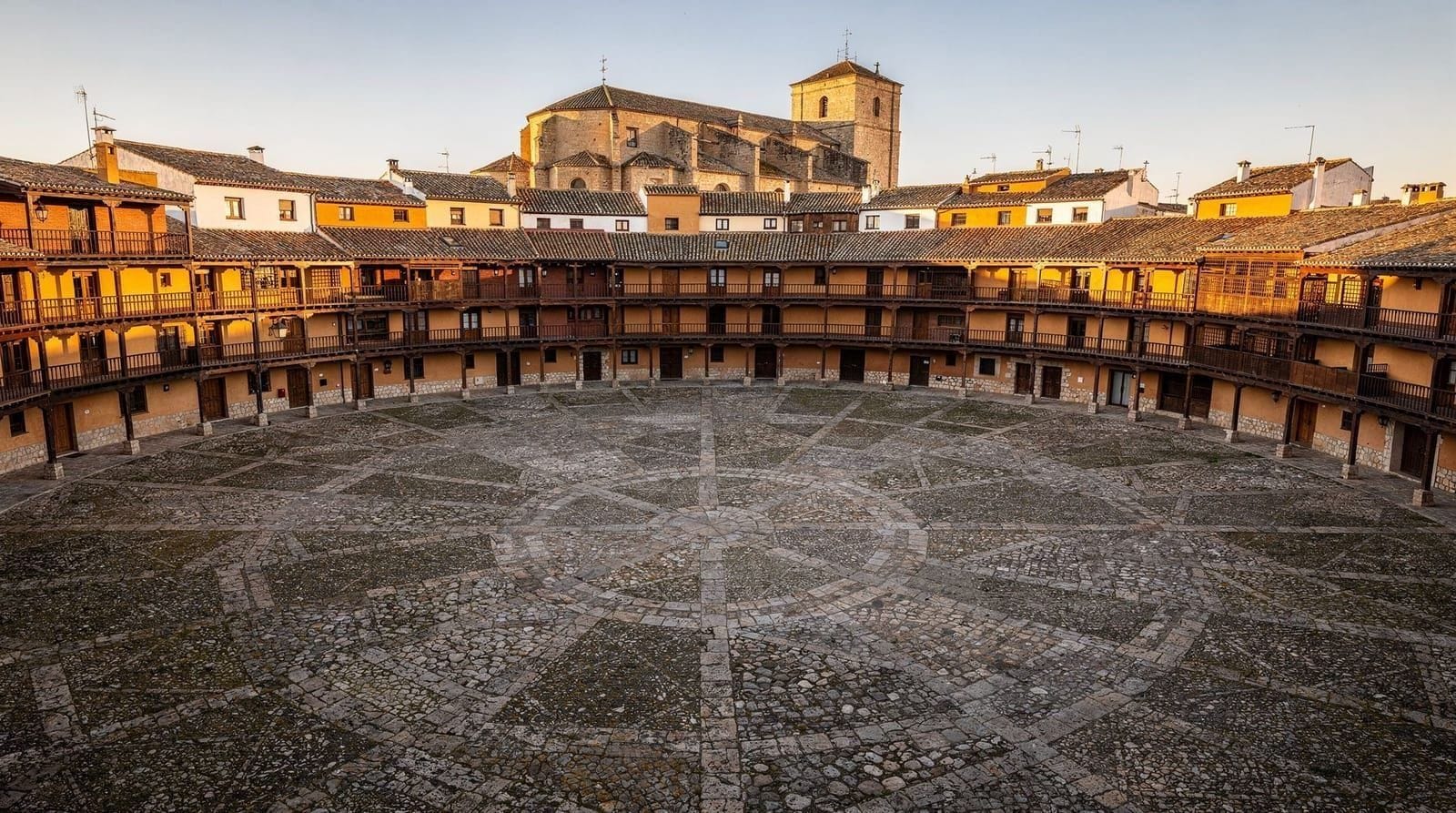
Chinchón, roughly an hour northeast by car, has one of Castile’s most photogenic arcaded plazas and is easy to fold into a longer La Mancha loop — see the Chinchón guide for the square, the anís distilleries and the parador. Travellers building a fuller circuit sometimes also add Alcalá de Henares, Cervantes’ birthplace, which pairs naturally with a Don Quixote-themed day — see Alcalá de Henares. Neither is walkable from Consuegra itself; both require a car or a separate tour leg.
Practical information
Summer warning: Consuegra sits in the heart of the La Mancha plain at 704 m altitude. Summer temperatures regularly reach 38–40°C. The windmill ridge is fully exposed with no shade. Visit before 10:00 or after 17:00 in July–August, or plan the trip for spring or autumn.
Combining with Toledo: Toledo is 65 km north of Consuegra on the N-401. Combining a morning at Consuegra’s windmills with an afternoon in Toledo is the standard circuit — 2 hours at the windmills, 30-minute drive north, afternoon in Toledo, return to Madrid. With a car this works smoothly; by bus it requires the organised tour option.
How to fit Consuegra into a Madrid trip: for most first-time visitors to Madrid, Consuegra is a supplementary day trip (day 4 or 5) best combined with Toledo. For visitors specifically interested in Cervantes, La Mancha, or Spanish agricultural history, it is worth the additional travel distance. For other options in the same window of time, see the best day trips from Madrid overview.
If you would rather skip the driving, the day trips without a car guide lays out what is realistic by public transport, and the week in Madrid with day trips itinerary shows where a La Mancha day can sit among the capital’s other sights. A trip that leans on Cervantes also pairs well with the literary quarter back in Madrid, which makes a good bookend before or after the windmills. For another Castilian outing built around a single historic town, Chinchón from Madrid is the natural comparison.
Frequently asked questions about Consuegra
Is Consuegra worth visiting without a car?
Yes, by InterBus from Estación Sur, though the standalone bus trip means roughly 4.5 hours of travel for 2–3 hours on-site. Most visitors without a car do better on an organised day trip that combines Consuegra with Toledo, which removes the logistics and uses the travel time more efficiently.
How does Consuegra compare to Campo de Criptana for windmill photos?
Consuegra’s advantage is the Moorish castle at the end of the ridge, which gives a more layered, dramatic photo than windmills alone. Campo de Criptana has more surviving mills clustered together but no castle. If you can only visit one and are also going to Toledo, Consuegra’s location makes it the easier addition.
Top experiences
Bookable activities with verified prices and instant confirmation on GetYourGuide.