Spanish cooking class in Madrid — honest review 2026
Madrid: Cooking Paella Tortilla Sangria
What a cooking class gives you that a restaurant cannot
There is an argument for eating at a good Madrid restaurant over taking a cooking class: the food is more precisely executed, the service is more attentive, and the range of dishes you encounter is wider. That argument is correct in a narrow sense and misses the point of what a cooking class actually provides.
A cooking class gives you the ability to reproduce Spanish dishes at home — or at least to understand why the restaurant version tastes as it does. The difference between a good and mediocre paella is comprehensible once you have made one yourself: the sofrito base (tomato, garlic, and paprika cooked to a deep concentration), the quality and temperature of the stock, the proportion of rice to liquid, and the final stage where the heat is increased to create the socarrat (the slightly caramelised rice crust at the bottom of the pan). Once you have done this, ordering paella in a restaurant involves a different kind of attention.
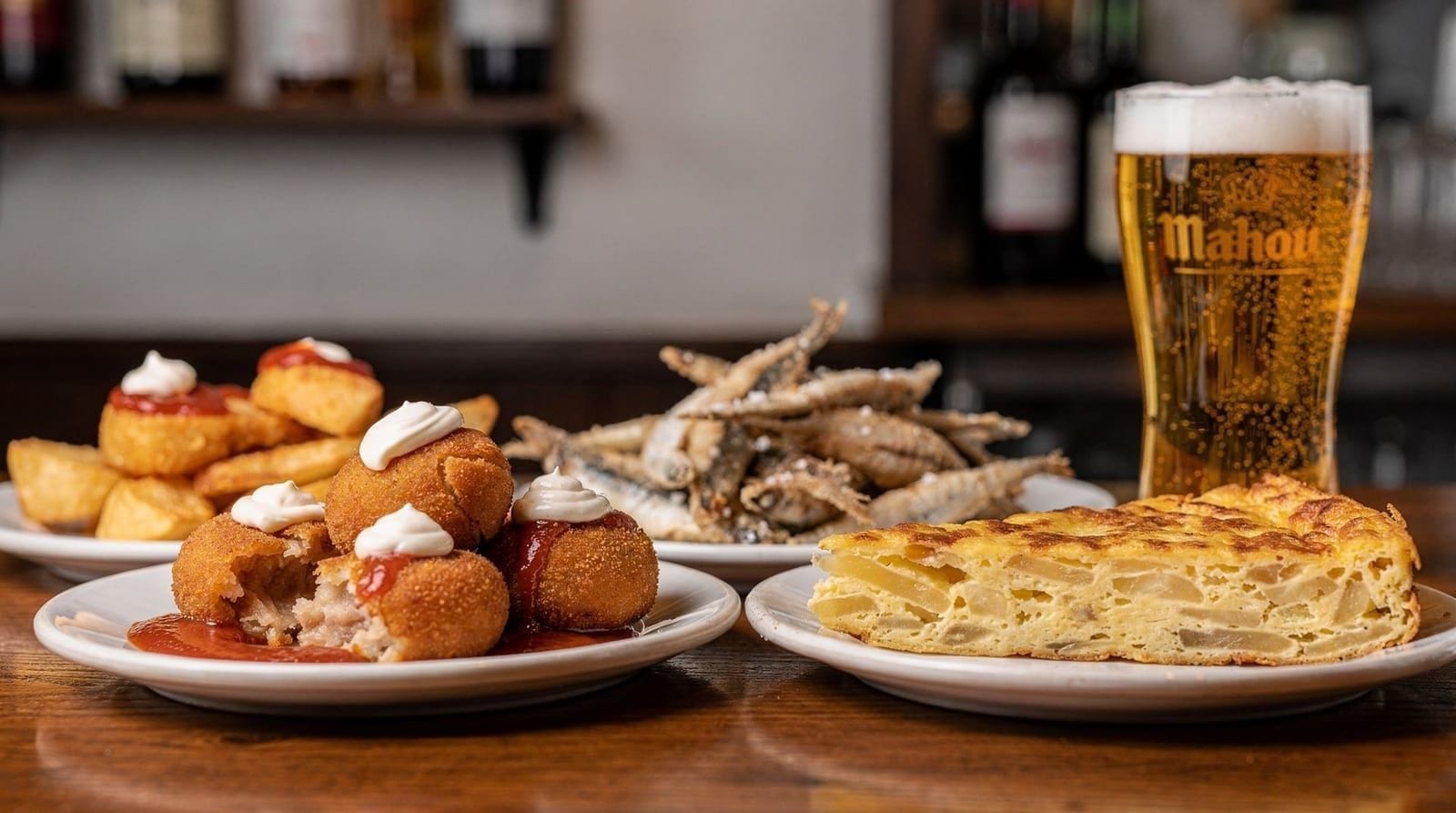
The same applies to tortilla española. A well-made tortilla — creamy in the centre, barely set, served at room temperature — is the result of precise temperature control and timing. A poorly made one is overcooked, rubbery, and dry. You can now judge which you are eating.
The Madrid cooking class: paella, tortilla, and sangria is one of the most complete standard-format classes available: three recipes, hands-on instruction throughout, and you eat the full meal at the end with wine.
The market visit: worth including?
Classes that include a visit to a Madrid food market add a component that the kitchen-only format lacks: the raw-ingredient context. Seeing the fish market section at a proper neighbourhood market (Mercado de Vallehermoso in Chamberí, or the covered market in Malasaña) before cooking shows you what fresh versus mediocre ingredients look like — the colour difference between bright orange paella prawns and pale frozen ones, the difference between fresh and day-old fish, the range of saffron qualities available.
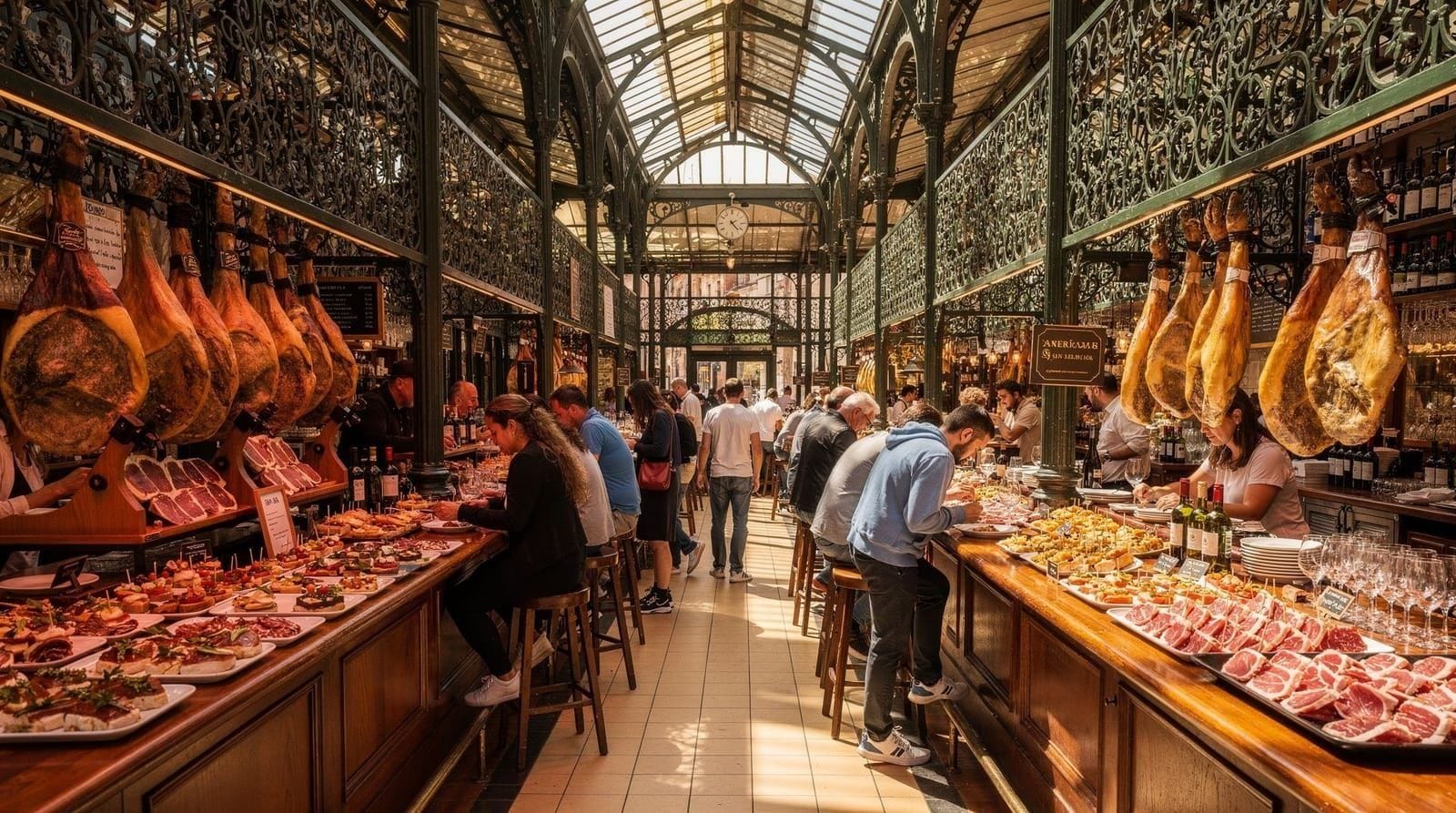
The Mercado de San Miguel (near the Royal Palace) is the most commonly used tourist market for cooking class visits and is a legitimate food market with good ingredients, though it is more expensive and more tourist-facing than the neighbourhood markets. For market-visit classes departing from the centre, it is a reasonable choice.
The Madrid paella and tapas cooking class with market visit includes a structured 45-minute market visit with the chef before moving to the kitchen — the format that provides the most educational food context.
What you will cook: the three dishes
Paella: The standard format is a seafood-and-chicken paella, made in a proper paella pan (typically 40–50 cm diameter for a class group of 6–8, with each participant taking a turn at specific stages). The class teaches sofrito preparation, the addition of paprika (the stage where it burns most easily), the correct ratio of stock to rice (typically 3:1 for bomba rice), the initial high heat and subsequent reduction, and the socarrat development. The class instructor manages the timeline — paella cannot be interrupted once started — so your hands-on involvement varies by class size. In smaller groups (4–6 people) you cook substantially; in larger groups (10–12) you cook symbolically.
Tortilla española: The deceptively simple technique involves cooking sliced or diced potatoes slowly in generous olive oil until soft but not coloured (this takes 15–20 minutes of patience), combining with beaten eggs, and cooking the tortilla in a frying pan with the critical flip — using a plate to invert the half-set tortilla back into the pan. The flip is where most first attempts fail and where the class instruction earns its keep.
Sangria: Wine, citrus fruits, brandy (or triple sec), and sweetener — the proportions vary by preference and the class allows customisation. The educational content here is minimal but the preparation is social and the result is consumed immediately alongside lunch.
Prices and what you actually get
Budget format (€35–€55): 2 hours, 1–2 recipes, pre-prepped ingredients, group of up to 14, eat what you cook. Includes the meal but not always wine.
Standard format (€55–€80): 3 hours, 2–3 recipes, group of 6–10, hands-on throughout, wine included. This is the correct price bracket for a satisfying experience.
Premium format with market (€80–€110): 3.5–4 hours including market visit, 3 dishes, group of 4–8, chef-led instruction with genuine culinary background. Best for visitors with a real interest in cooking technique.
The Madrid half-day Spanish cooking class sits in the premium bracket — small groups, genuine chef instruction, market component, full meal with wine — and is the option to book if you want the most educational and least tourist-scripted experience.
Honest comparison: class vs restaurant
For the experience itself — the social cooking, the learning, the sense of having produced something — a cooking class is a distinct and valuable Madrid activity. For the pure food quality, a meal at a good mid-range Madrid restaurant for the same per-person cost (€55–€80 typically buys an excellent three-course meal with wine) will almost certainly produce better food than you cooked in your class.
That is not a criticism of cooking classes — it is an accurate statement about the purpose of the two experiences. Book the class if you want to cook and learn; book a table at Lakasa, El Paraguas, or any of the better Malasaña restaurants if you want the best possible meal for the money. Both are valid choices; they are not the same choice.
See /guides/food-tour-worth-it/ for a comparison of Madrid food experiences (tours, classes, markets, restaurants) and /guides/madrid-tapas-guide/ for the independent tapas circuit that most visitors end up finding more useful for daily eating.
Verdict
A Spanish cooking class in Madrid is a worthwhile investment for visitors with a genuine interest in cooking Spanish food at home, for groups (couples, families, friends) who want an interactive activity, and for anyone who wants to understand why Spanish food tastes as it does beyond the experience of eating it. The market-visit format is the most educational. The 3-hour standard class gives you a satisfying morning or afternoon and a full meal; the 4-hour format with market extends this productively. Choose based on group size and budget: a small-group premium class is substantially more educational than a large-format budget one.
Compare top tours
Frequently asked questions about Madrid
What do you cook on a typical Spanish cooking class in Madrid?
Most Madrid cooking classes focus on two or three recipes from the Spanish canon: paella valenciana (the definitive rice dish, made in a large flat paella pan over high heat), tortilla española (potato and egg omelette, deceptively technical), and sangria. Some classes add a starter such as gazpacho, salmorejo, or pan con tomate, and occasionally a dessert like churros or crema catalana. The paella-centric format is the most common and the most requested. Classes that include a market visit (Mercado de San Miguel, Mercado de Vallehermoso, or a local neighbourhood market) add a food-shopping component that contextualises the ingredients.How long does a cooking class in Madrid take?
Classes range from 2 hours (rapid format, typically paella only, no market) to 4 hours (half-day format including market visit, multiple dishes, and full sit-down meal). The most common format is 3 hours: 30 minutes at a market or ingredient briefing, 1.5 hours cooking, 45–60 minutes eating what you made with wine included. Half-day classes that include a market visit and three dishes take approximately 3.5–4 hours total.What is the honest difference between cheap and expensive cooking classes?
Budget classes (€35–€55 per person) typically cook in a commercial kitchen with pre-prepped ingredients, teach 1–2 recipes, and serve what you cooked without table service. Premium classes (€75–€110 per person) are smaller (maximum 6–8 people), may include a market visit, cook 3–4 dishes, and are led by a chef with genuine culinary background rather than a tour guide who also cooks. The practical difference: in a premium class you learn transferable technique (how to build sofrito correctly, why the socarrat bottom crust matters in paella, the three critical variables in tortilla); in a budget class you follow instructions and eat the result. Both are enjoyable; the premium format is more educational.Is paella from Valencia or is it a Madrid dish?
Paella originates from Valencia — specifically from the rice-farming flatlands south of the city of Valencia. The original paella valenciana is made with rabbit, chicken, green beans (bajoqueta), and white beans (garrofó), cooked over a wood fire in the wide, flat two-handled pan that gives the dish its name. The seafood paella that dominates tourist menus across Spain (including in Madrid) is a later, widely adopted variation that Valencians do not consider traditional paella. Most Madrid cooking classes teach a version combining chicken and/or seafood. You will learn to make a good paella; you will not be cooking the strict Valencian original.Can vegetarians or vegans do a cooking class in Madrid?
Yes. Most operators offer vegetarian and vegan variants: a vegetable paella (with artichokes, peppers, tomatoes, and green beans), tortilla española (naturally egg-based, not vegan, but vegetarian), and gazpacho (fully vegan). Vegan participants typically substitute the sangria-making component with a non-alcoholic drink option. Check with the specific operator when booking — the better classes accommodate dietary requirements without significantly changing the curriculum.Do you need cooking experience to join a class?
No prior experience is needed or expected. Classes are designed for tourists who may never have cooked Spanish food and the recipes chosen (paella, tortilla) are accessible to beginners while still teaching something genuine. The instruction is hands-on: you chop, you sauté the sofrito, you add the stock and the rice, you watch the paella develop the socarrat. Experienced home cooks will pick up specific technique details (the proportion of stock to rice, the resting time, the heat management) that are genuinely useful even if the recipes themselves are familiar.