El Escorial and Valle de los Caídos day trip — honest review 2026
El Escorial: Escorial Valley Fast Track Entry
El Escorial: the monastery that ran an empire
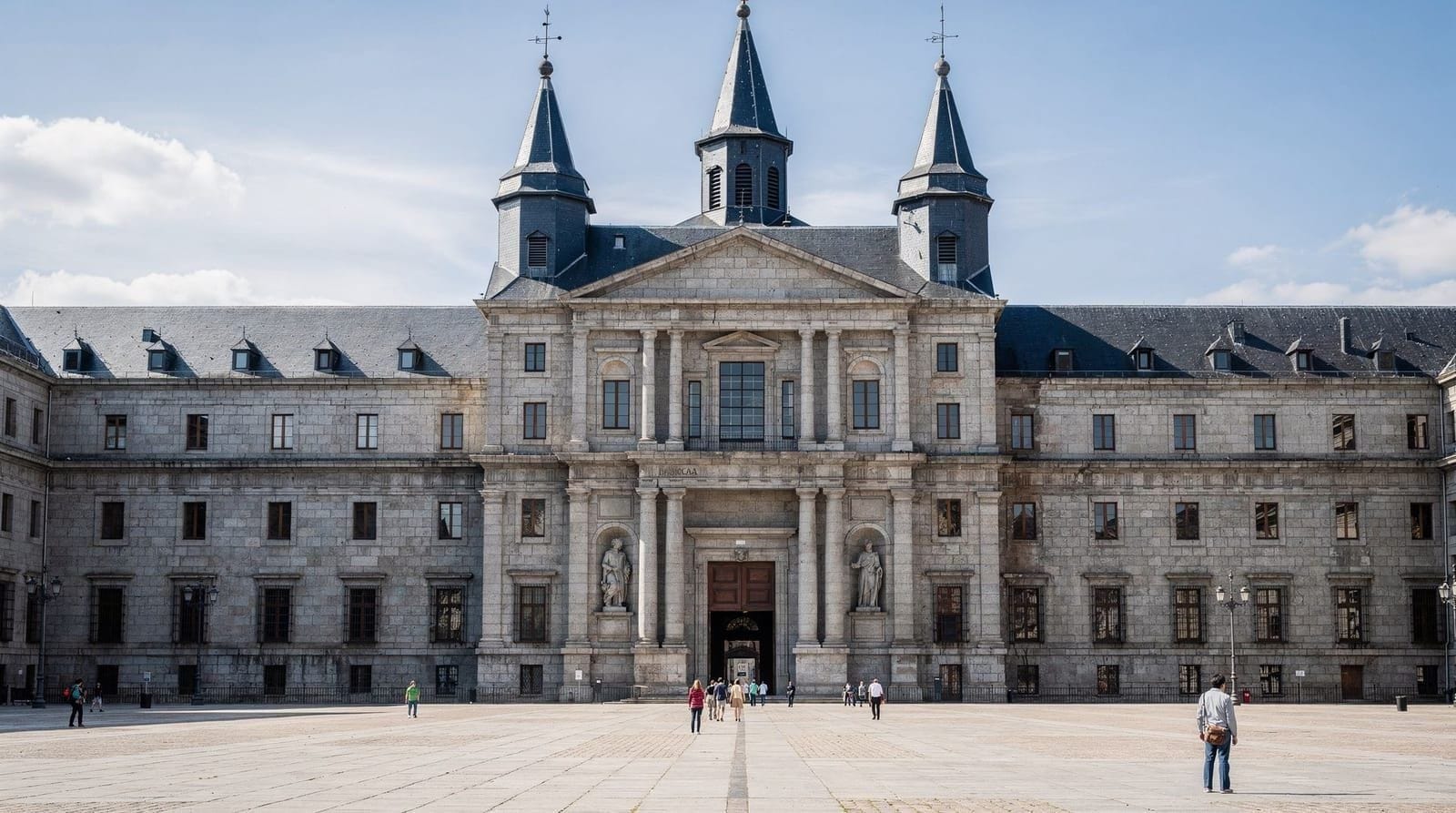
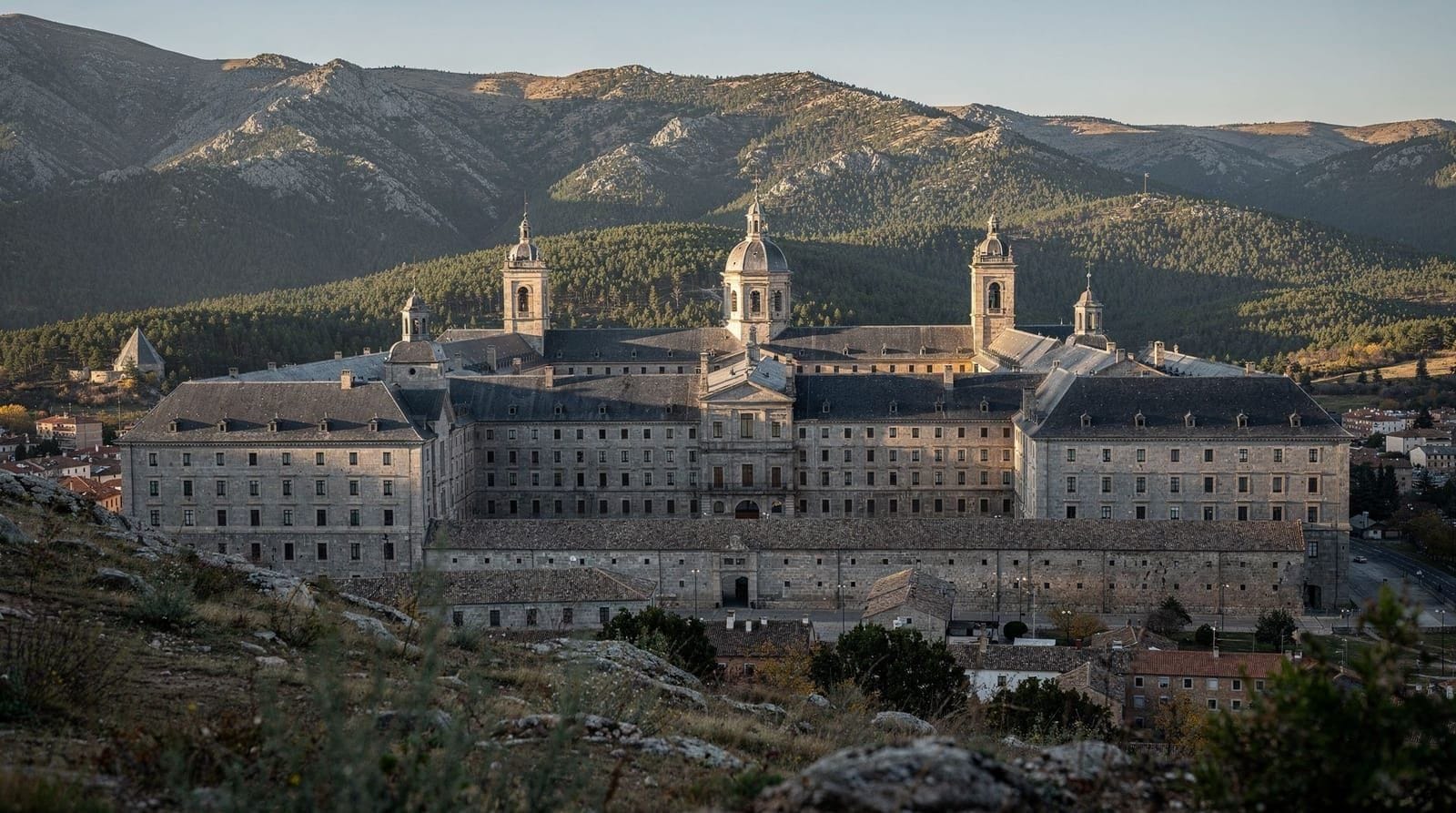
The Real Sitio de San Lorenzo de El Escorial sits in the foothills of the Sierra de Guadarrama, 50 km northwest of Madrid, and it is unlike any other building in Spain. Philip II conceived it as simultaneously a royal palace, a monastery, a cathedral, a royal mausoleum, and a library — the administrative and spiritual capital of the world’s largest empire at its 16th-century peak.
The building took 21 years to complete (1563–1584). Its architect, Juan de Herrera, developed a style so restrained and geometrically severe that it became a named aesthetic: the Herreran style, or El Escorial style — grey granite, flat surfaces, minimal ornament, mathematical proportions. Standing in the main courtyard (the Patio de los Reyes, with the six Old Testament kings above the basilica entrance) the effect is imposing and slightly inhuman in scale. This was deliberate: Philip II intended to express the authority of God and the Spanish crown simultaneously.
The El Escorial fast-track entry ticket provides priority access through the dedicated pre-booked visitor lane, avoiding the box office queue that can run 30–45 minutes on summer weekends.
What’s inside: the five essential spaces
The Basilica is the building’s spiritual centrepiece, situated at the intersection of the monastery and palace wings. The interior is austere Herreran: barrel-vaulted nave in grey granite, no decorative excess, paintings by Titian and El Greco in the altarpieces. The choir stalls above the entrance are carved walnut. The main altarpiece — 30 metres high, designed by Herrera — holds paintings from Pellegrino Tibaldi, Luca Cambiaso, and Federico Zuccaro. Philip II’s private oratory (where he observed mass through a grille from his royal apartments) opens directly into the basilica’s north transept.
The Royal Pantheon of the Kings (Panteón de los Reyes) is the burial chamber directly below the high altar. You descend a dramatic 19th-century baroque stair into a circular room of black and red marble, gold, and bronze. The sarcophagi of 26 Spanish monarchs (from Charles I to Alfonso XIII) are arranged in four tiers on the circular walls. The chamber was completed in 1654, more than 60 years after Philip II died waiting for it. It is one of the most architecturally complete royal mausoleums in the world.
The Pantheon of the Infantes is larger, lighter, and more architecturally elaborate than the kings’ pantheon — and considerably more affecting. The room holds 60 princes and princesses who died without reigning, in multiple sarcophagi of varying sizes. The centrepiece is the “tarta” (the cake) — a circular 19th-century sarcophagus with 60 niches holding the remains of children. Queen Mercedes (first wife of Alfonso XII, dead at 18 after five months of marriage) is also here. Historians find the room fascinating; emotionally sensitive visitors may find it difficult.
The Royal Library is one of the finest surviving Renaissance libraries in the world. The gallery ceiling, frescoed by Pellegrino Tibaldi with allegorical figures of the Seven Liberal Arts, runs 55 metres above the display cases. The collection of 40,000 volumes includes Arabic manuscripts, a Book of Hours made for Philip II, and the Codex Aureus from the 7th century. The books are shelved spine-inward — a preservation technique — which gives the room a distinctive visual appearance unlike any other library.
The New Museums occupy the palace’s lower floors and hold Flemish and Italian paintings from the royal collection: Roger van der Weyden’s Calvary Triptych (one of the greatest Flemish paintings in Spain), Bosch’s Seven Deadly Sins (the same Bosch who painted The Garden of Earthly Delights now in the Prado), El Greco’s early works from before his Toledo period, and paintings by Titian, Rubens, and Ribera.
The guide question: when does commentary add value?
El Escorial is the category of historic site where a guide makes the most pronounced difference. Without context, the procession of severe granite rooms, the Pantheon tiers, and the Renaissance painting collection are impressive but inert. With context — Philip II’s Counter-Reformation motivation, the dynastic logic of the Pantheon, the political significance of the library’s collection — the building coheres into one of the most complete historical statements made in architecture.
The El Escorial monastery site guided tour is the full in-depth guided format — appropriate for visitors with a serious interest in Habsburg history, architecture, or the Counter-Reformation. The 3-hour guided visit covers all five main spaces with detailed commentary.
For visitors who prefer self-guided flexibility, the audio guide (included in the standard ticket) covers the main rooms adequately for a first visit.
The Valle de los Caídos: the contested component
Most guided day trips from Madrid that include El Escorial also offer the Valle de los Caídos (now officially Cuelgamuros) as a combined visit, 10 km northeast. The site is Spain’s most politically contested monument and requires a brief explanation before you decide whether to include it.
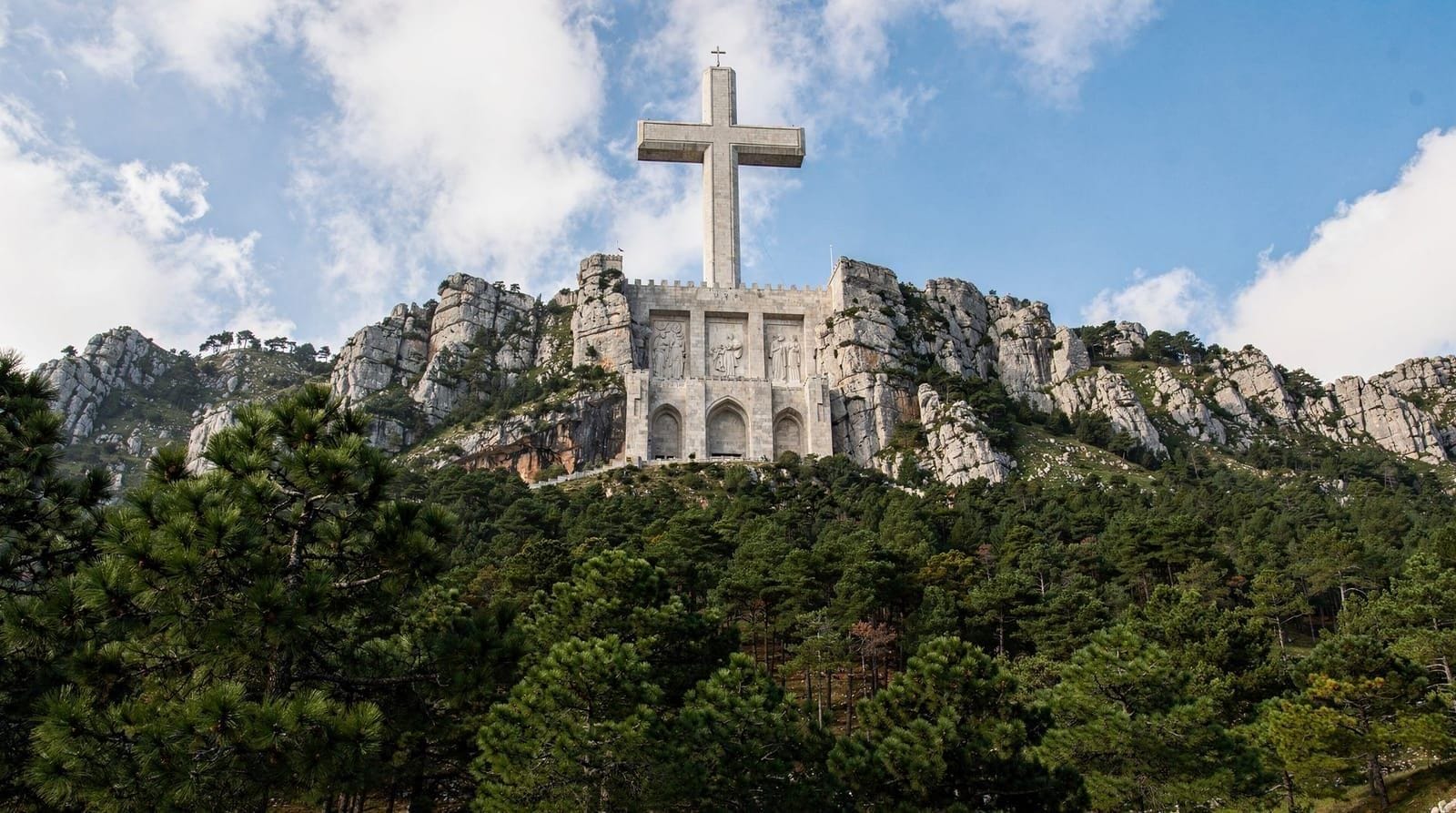
The complex was built between 1940 and 1959 under Franco’s orders, using forced labour from Republican prisoners. It includes a 150-metre granite cross visible for 40 km, a basilica carved into the granite mountain, and a Benedictine monastery. Franco was buried here in 1975; his remains were exhumed in 2019 following legislation by the Sánchez government. Since 2023 the complex has been subject to ongoing Democratic Memory Law reforms and renaming as Cuelgamuros.
The cross and exterior terrace are accessible. The basilica interior has been subject to changing access restrictions through 2024–2026 as the site undergoes renovation and government-managed historical recontextualisation. Before booking any tour that includes interior basilica access at Cuelgamuros, verify current status with the operator — access policies have changed multiple times in recent years and some tour descriptions may be outdated.
The El Escorial and Valley of the Fallen day trip includes both sites; confirm current Cuelgamuros access when booking.
Combining with Segovia: the extended day trip
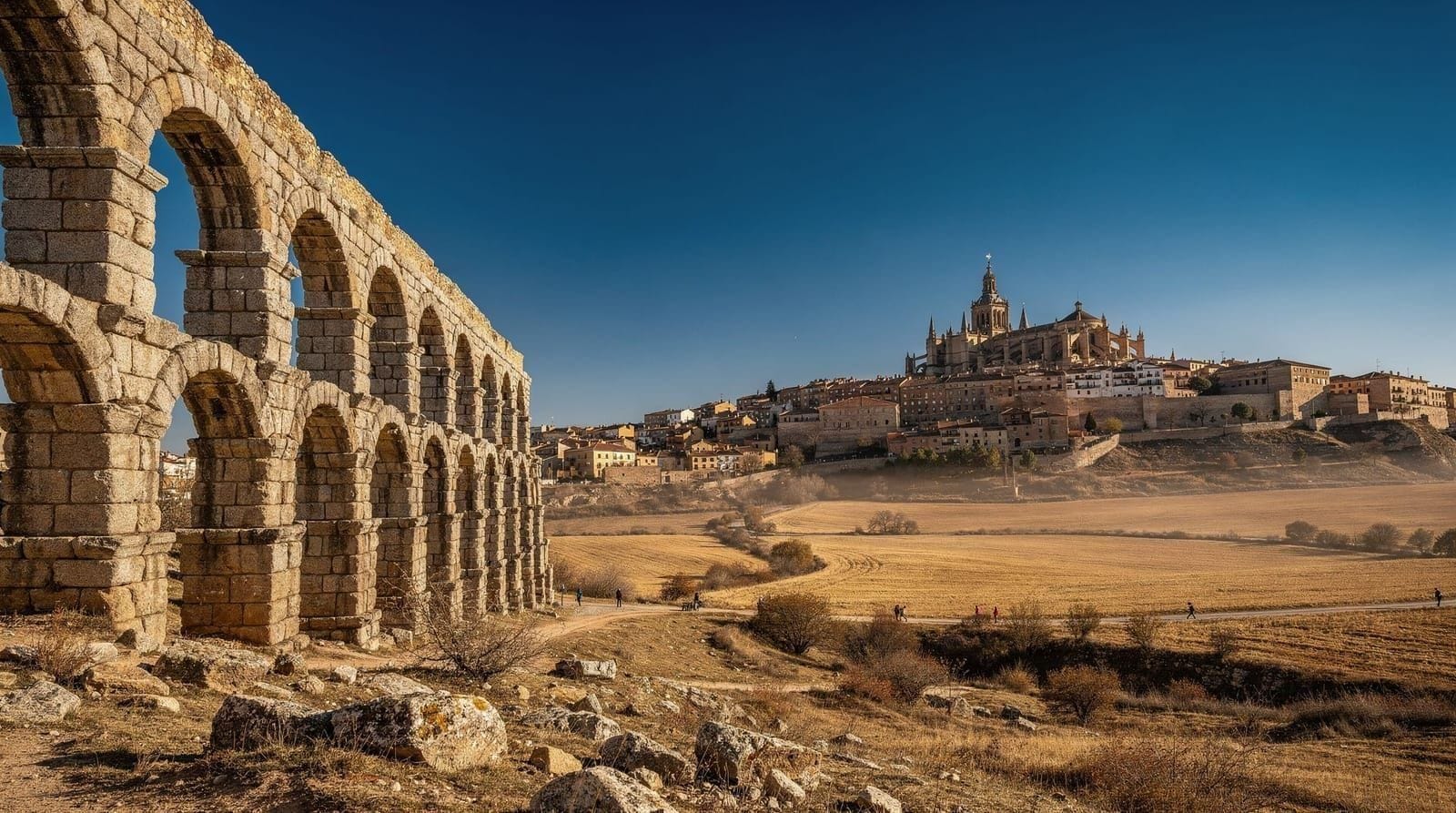
The El Escorial to Segovia distance is approximately 55 km north via the Puerto de la Cruz Verde mountain pass. Several operators offer a three-site day trip combining El Escorial, a brief mountain pass crossing, and Segovia. This is a long day (typically 11–13 hours) but gives you the Sierra de Guadarrama landscape as a connecting element — the mountain pass views are among the finest in central Spain.
The El Escorial, Valley of the Fallen, and Segovia day trip is the most comprehensive format: three UNESCO-adjacent sites in a structured full-day tour with a licensed guide throughout.
Practical details
Entry ticket price: see the official Patrimonio Nacional ticket site for current prices for the full royal site complex (Basilica, Pantheons, Library, New Museums).
Pre-booked skip-the-line: €18–€22 depending on operator.
Opening hours: Tuesday–Sunday 10:00–19:00 (April–September), 10:00–18:00 (October–March). Closed Monday.
Getting there independently: Cercanías Line C-8 from Atocha (1 hour) or Chamartín (50 minutes); the fare depends on your zone (see the CRTM fare finder). Taxi from El Escorial station: €6–€8. The monastery is not walkable from the train station in summer heat — take the taxi.
Nearest food: The village of San Lorenzo de El Escorial has a main street (Calle del Rey) with several restaurants serving cocido, grilled meats, and set menús at €12–€18. Quality varies; avoid the restaurants on the monastery’s immediately facing square (tourist pricing) and walk one block into the village.
See /guides/el-escorial-from-madrid/ for a detailed independent visit guide and /destinations/el-escorial/ for the wider royal sites region.
Verdict
El Escorial is the most architecturally and historically significant site in the Madrid region — more substantial than Toledo for architecture enthusiasts, more historically concentrated than Segovia. The building rewards serious attention and benefits significantly from a guide who can explain the Habsburg dynastic context and the Counter-Reformation symbolism. The Cuelgamuros component is separately notable as Spain’s most contested monument; its current status should be verified at booking. A dedicated half-day to El Escorial alone is better than a rushed combined day; the El Escorial-plus-Segovia combination is compelling if you have the full 11–13 hours.
Compare top tours
Frequently asked questions about El Escorial
What is El Escorial and why is it significant?
The Real Sitio de San Lorenzo de El Escorial is a 16th-century royal monastery-palace-mausoleum complex built between 1563 and 1584 by Philip II of Spain. It is one of the largest Renaissance buildings in the world — 33,000 square metres of floor space, 86 staircases, 2,673 windows, 1,200 doors, 16 courtyards, 15 cloisters, 9 towers, and 88 fountains — and was the administrative and symbolic centre of the Spanish empire at the height of its power. UNESCO listed it as a World Heritage Site in 1984. Inside: the Royal Library (with 40,000 volumes and manuscripts illuminated with ceiling frescoes by Pellegrino Tibaldi), the Royal Pantheon (where 26 Spanish monarchs and their spouses are interred in bronze and marble sarcophagi), and the Basilica with its Herrera-style austerity and Titian altarpieces.What is the Valle de los Caídos (Valley of the Fallen) and is it open?
The Valle de los Caídos is a monumental complex 10 km northeast of El Escorial, built by Franco's regime between 1940 and 1959 largely by Republican prisoners. It consists of a massive granite cross (150 metres high), a basilica carved into the mountain, and a Benedictine monastery. Francisco Franco was buried here from 1975 until 2019, when his remains were exhumed and reinterred at the El Pardo cemetery following legislation by the Spanish government. The site was renamed Cuelgamuros in 2023 as part of ongoing Democratic Memory Law reforms. The cross and exterior remain visitable; the basilica's accessibility is subject to ongoing renovation and policy changes — check current status before booking any tour that includes interior access, as this has changed repeatedly in 2024–2026.How far is El Escorial from Madrid and how do I get there?
El Escorial village is approximately 50 km northwest of Madrid. By Cercanías commuter train (Line C-8 from Atocha or Chamartín), the journey takes 55–65 minutes; the fare depends on your zone (see the CRTM fare finder). The monastery is a 2.5 km walk or short taxi (€6–€8) from El Escorial station. By guided day-trip coach from central Madrid, departure is typically 09:00 and travel time is 50–60 minutes. By car (A-6 motorway northwest, then M-600): approximately 45 minutes.How long do you need at El Escorial?
A complete visit to the monastery complex — Basilica, Royal Pantheon, Royal Library, New Museums (holding Flemish and Renaissance paintings transferred from the royal collection), El Greco gallery, and the Palace of the Habsburgs — takes 2.5–3.5 hours. A focused visit covering the Pantheon, Library, and Basilica only takes 1.5–2 hours. Most guided day trips allocate 2.5–3 hours in El Escorial plus travel time. The surrounding village and gardens can be explored in an additional 45–60 minutes.Is the El Escorial visit morbid or unpleasant?
The Royal Pantheon of the Kings is unusual in its directness: the sarcophagi of 26 kings and queens of Spain are arranged in a circular chamber in neat tiers of marble and bronze, lit by a single baroque lamp. It is solemn rather than morbid — the effect is more architectural than ghoulish, and visiting it with historical context (understanding which monarchs are here, from Charles I through Alfonso XII with a notable gap for the Bourbons who died in exile) makes it one of the most historically resonant spaces in Spain. The Pantheon of the Infantes (princes and princesses who died without reigning) has a darker character, with the famous 'tarta' sarcophagus holding the remains of 60 children in a single circular tomb. Visitors who find mausoleums distressing should know the Pantheon is included on the standard tour route.