Salamanca
Salamanca: Spain's oldest university (1218), golden sandstone Plaza Mayor, Plateresque facades, 30,000 students. 1h40–2h45 from Madrid by train.
Salamanca: Salamanca Private Day Trip
Quick facts
- Train from Madrid (Chamartín)
- 1h40–2h45 (Alvia/regional)
- Train fare
- Varies; see Renfe
- UNESCO status
- Old city since 1988
- Population
- ~144,000 (30,000+ students)
- University founded
- 1218 — one of the oldest in the world
- Stone type
- Villamayor sandstone — glows gold in afternoon light
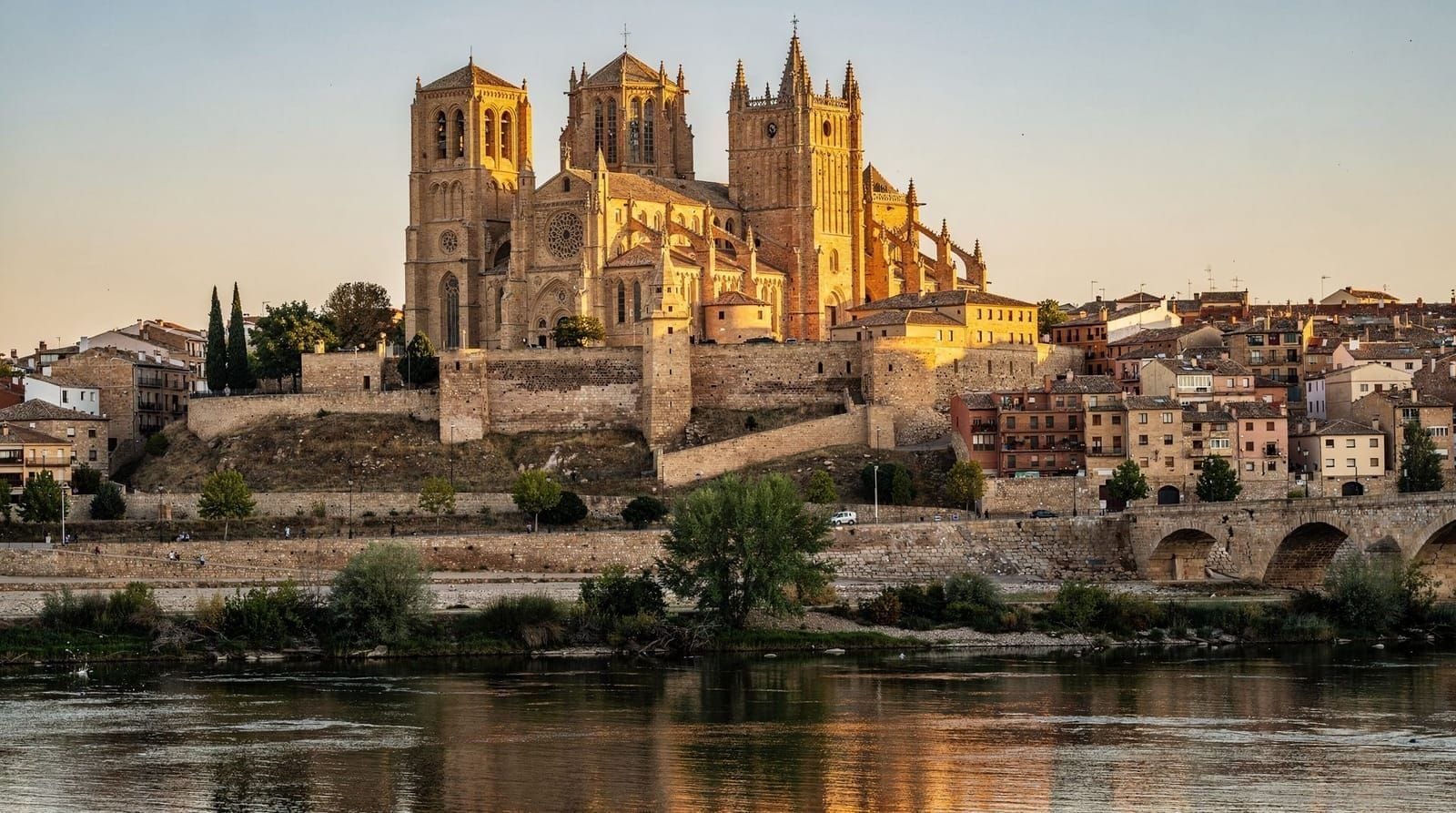
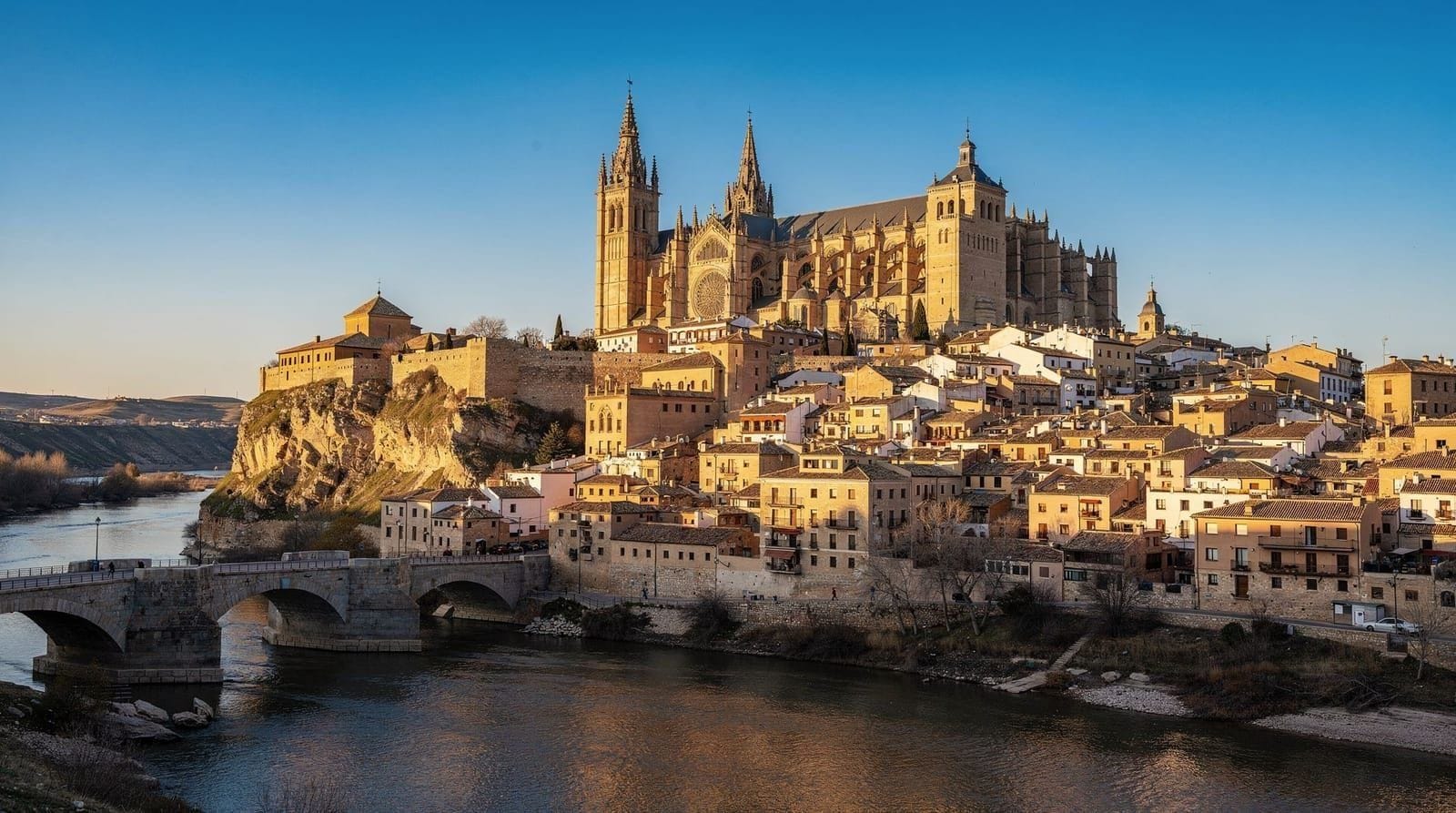
Salamanca glows. The Villamayor sandstone used to build most of its historic centre oxidises to a warm amber-gold in the afternoon light — a quality unique to this particular stone from the quarry 30 km to the northwest — and the effect on the cathedral facades, the university’s Plateresque front, and the Plaza Mayor arcades is one of the most photographically compelling urban experiences in Spain. This is not a coincidence or atmospheric accident; it is a structural property of the material that medieval and Renaissance builders chose precisely because they understood it.
The golden city is also a working university city — one of the oldest universities in the world (founded 1218, ranked alongside Oxford, Bologna, and Paris), continuously functioning for 800 years, and still drawing 30,000 students to a city of 144,000. The Plaza Mayor is not just a tourist attraction but the civic and social heart of a city that actually uses it: morning coffee, afternoon paseo, evening gatherings. Salamanca is not frozen in time the way Toledo is; it is a small city that has maintained continuous cultural life while its architectural fabric remained intact.
The honest caveat for day-trippers: Salamanca is 1h40–2h45 from Madrid by train — further than Toledo (33 minutes), Segovia (28 minutes), or Cuenca (55 minutes). A day trip is possible but leaves limited time in the city. An overnight stay is strongly preferable; Salamanca at night, when the Plaza Mayor is illuminated and the student bars are active, is a different experience from the daytime tourist circuit.
| Where | 210 km northwest of Madrid, Castile and León |
| Cost | Train fare varies (see Renfe); combined cathedral ticket €10; university €10 |
| Time needed | Full day (8–9 hours), overnight strongly preferable |
| Getting there | Alvia from Chamartín, 1h40–2h45, or ALSA bus (journey times on the Alsa website) |
| Best time | April–June or September–October |
Getting to Salamanca from Madrid
The Alvia or long-distance Renfe train from Chamartín takes 1h40–2h45. Check Renfe’s website; prices vary significantly with booking window.
By bus: ALSA operates buses from Estación Sur (Madrid) to Salamanca (journey times on the Alsa website). Frequency is good (roughly every 30–60 minutes during the day). The bus may be cheaper and competitive on journey time.
Organised day trips: guided day trips from Madrid by bus, sometimes combining Salamanca with Ávila, are available for €50–€90 per person with entries included. These compress the journey and make the most of a long-haul day trip. The added value of narrated transport and entrance logistics is genuine for a city this far from Madrid.
Day trip from Madrid to Ávila and Salamanca with entries includedThe Plaza Mayor
Salamanca’s Plaza Mayor was built between 1729 and 1755 under the direction of Alberto de Churriguera (from the dynasty of architects whose Baroque excess gives us the word “Churrigueresque”) and completed by his brother Manuel. The debate about whether it is the most beautiful plaza mayor in Spain is a traditional one — Toledo’s and Valladolid’s have their advocates — but the Salamanca version has a specific quality: perfect Baroque proportions, four equal sides of arcaded colonnades, and Churriguera’s restrained ornamentation (relative to what the family were capable of), all in the warm Villamayor sandstone.
The 88 arches of the lower arcade shelter cafés, bars, and shops. The upper two floors carry medallion portraits of Spanish monarchs and historical figures — including El Cid, Columbus, and some disputed identifications. The portrait of the dictator Franco was chiselled off in 1990; the medallion is still blank.
This is not a traffic-free tourist square. It is Salamanca’s main public space, used all day for every purpose: morning coffee at the bars, afternoon sun on the benches, evening aperitivo, Saturday markets. The best time to experience it as a Salamantino experience rather than a tourist experience is a weekday morning before 10:00 or a quiet Sunday evening.
The University
The University of Salamanca’s main building (Escuelas Mayores) opens onto a Renaissance courtyard and presents to the street the most famous Plateresque facade in Spain. Plateresque is a Spanish architectural style of the early 16th century that applies Gothic structural forms with Renaissance surface decoration so intricate it resembles silverwork (platero = silversmith). The Salamanca university facade (completed 1529) carries layers of interlocking medallions, coats of arms, grotesque heads, and foliage all carved from a single cream-coloured sandstone surface. Somewhere in the carving is a hidden frog sitting on a skull — finding it is a student tradition; if you find it before entering, legend promises academic success. (It is in the left panel of the facade, third pillar from the left, roughly two-thirds up — but better to search yourself.)
The university interior includes the Classroom of Fray Luis de León, a 15th-century lecture hall preserved as it was when the Augustinian theologian returned to his chair in 1576 after five years’ imprisonment by the Inquisition and opened his first lecture with the words “As we were saying yesterday…” (Decíamos ayer…). The phrase became a Spanish idiom for resuming interrupted conversation. The library, with 66,000 historic volumes on its open shelves, is accessible on guided tours. Combined museum/classroom entry €10; student card holders €5.
The Cathedrals
Salamanca has two cathedrals sharing a wall — the Old (Romanesque, 12th century) and the New (Gothic/Baroque, 16th–17th century) — accessible on a combined ticket (€10).
The Old Cathedral (Catedral Vieja) is the more architecturally pure: Romanesque nave, 12th-century Byzantine-influenced tower Torre del Gallo (visible from much of the city), and a remarkable 15th-century altarpiece by Nicolás Florentino with 53 painted panels depicting the Virgin and the Last Judgment.
The New Cathedral (Catedral Nueva) was begun in 1513 and not completed until 1733, absorbing late Gothic, Renaissance, and Baroque styles in the process. The carved west portal (Puerta de Ramos, 1513) is Plateresque work of exceptional quality — look for the astronaut carved into the doorway moulding in 1992 during restoration (another of Salamanca’s hidden figures, modern this time). The interior choir stalls are Churrigueresque woodwork.
The Dominican and Dominican convents: San Esteban and Las Dueñas
Two convents a few streets from the cathedrals are consistently underrated by day-trippers focused on the Plaza Mayor and university circuit. The Convento de San Esteban (Dominican, 16th century) has a monumental Plateresque facade comparable in ambition to the university’s, fronting a church with an extraordinary gilded Churrigueresque altarpiece by José de Churriguera — the same dynasty responsible for the Plaza Mayor. Historically significant too: it was here in 1486 that a commission of theologians, including friars from this convent, debated Christopher Columbus’s proposed westward route to Asia before his voyage.
The Convento de las Dueñas (Dominican nuns, 15th–16th century), a short walk away, has a two-storey Renaissance cloister considered one of the most unusual in Spain — the upper gallery’s capitals are carved with a bizarre and inventive array of grotesque figures, skulls, and fantastical creatures, quite unlike the restrained Plateresque decoration seen elsewhere in the city. The convent is still an active community of cloistered nuns, who sell traditional pastries (yemas, almond sweets) through a revolving turnstile at the entrance — a small but genuine piece of living tradition alongside the architecture. Entry €2.
Casa de las Conchas
The 15th-century Palace of the Shells — a nobleman’s palace whose sandstone exterior is decorated with 300 carved scallop shells (a symbol of the Santiago pilgrimage, suggesting the owner’s devotion or completion of the Camino) — is one of the most distinctive pieces of domestic architecture in Spain. Now a public library; the courtyard is freely accessible during library hours and the façade is best photographed from the street opposite in morning light.
Where to eat in Salamanca
Salamanca’s food scene benefits from the student population — enough customers to support variety at every price point, including serious restaurants using local products alongside cheap pintxos bars.
El Corral de Leal (Calle Tentenecio 3): one of the best restaurant experiences in the city. Well-sourced Castilian produce, good wine list focused on regional appellations (Ribera del Duero, Rueda), mains €18–€30. Book ahead.
Mesón El Labrador (Calle San Pablo 5): classic Castilian kitchen with the local specialty of farinato (a pork-fat and paprika sausage of Salamanca, fried and served as a tapa or with eggs). Mains €14–€20.
Tapas bars on Calle Van Dyck and Calle Prior: the most concentrated bar strip in the city for pintxos and tapas. Prices are genuine student-economy — €1.50–€2.50 per pintxo. These are not polished places but they are where locals eat at 13:00 and 20:00.
Hornazo: the local pastry — a stuffed bread filled with chorizo, jamón, and eggs, traditionally eaten at the April Lunes de Aguas festival when students return from a week outside the city walls (a tradition dating from the era when prostitutes were expelled from the city during Holy Week). Available year-round in bakeries; €3–€5 for a portion.
Convent sweets: beyond Las Dueñas’ yemas, several of Salamanca’s convents sell traditional pastries through the turnstile tradition — a genuinely old form of commerce that predates the modern bakery and is worth seeking out specifically for the experience, not just the sweets themselves.
Guided visit from Madrid to Ávila and Salamanca with cathedral ticketsSalamanca after dark
The student population of 30,000 in a city of 144,000 means Salamanca has a nightlife disproportionate to its size. The Plaza Mayor is the evening gathering point from about 20:00 onwards. Bar crawls run along Calle Prior and into the Gran Vía area. Clubs open late and close at 06:00; the local tradition is to eat late (dinner at 22:00), drink at bars until 02:00, then go to a club.
This is not relevant to a day trip but is a strong argument for the overnight visit: arriving by afternoon train, exploring the city in the evening light, and spending the night makes Salamanca a genuinely different experience from the compressed day-trip version.
The Salamanca sandstone: Villamayor and the golden city
The specific geological material that makes Salamanca’s architecture distinctive is Piedra de Villamayor — a Miocene-period sandstone quarried from the village of Villamayor de la Armuña, 8 km north of Salamanca. The stone is easily worked when freshly quarried (soft enough to carve the intricate Plateresque decorations of the university facade) but hardens on exposure to air, forming a weathering rind that oxidises progressively from pale cream to the deep amber-gold that gives Salamanca its evening glow. The oxidation process accelerates over decades; buildings completed in the 19th century have not yet reached the same depth of colour as 15th-century structures, creating subtle tonal differences across the old city that a careful observer notices.
The stone’s porosity is also its vulnerability. Air pollution, particularly sulphur dioxide from vehicle emissions and historic industrial sources, accelerates deterioration. Restoration work on the major facades — Cathedral, university, Casa de las Conchas — has been ongoing since the 1990s, involving cleaning, consolidation, and in some cases replacement of severely degraded stones with new Villamayor quarried to match. The quarry is still active; the current generation of masons uses the same material as the 16th-century builders.
Best light for photography: because the stone’s colour depends so directly on the angle and quality of light, timing matters more in Salamanca than in most Spanish cities. Late afternoon, roughly two hours before sunset, is when the amber-gold effect is most pronounced on the Plaza Mayor and the university facade; midday light flattens the effect considerably. Photographers who can manage an overnight stay specifically for this reason will find it worth the extra cost.
Fray Luis de León and the Inquisition
Salamanca’s most famous historical episode — at least for literary historians — is the imprisonment and trial of Fray Luis de León (1527–1591). An Augustinian theologian and poet of exceptional quality (his poems are among the finest lyric verse in 16th-century Castile), he was denounced to the Inquisition in 1571 on charges of questioning the authority of the Vulgate Bible (Latin translation) and favouring direct translation from the original Hebrew. He had made a private translation of the Song of Songs into Castilian — a book considered too erotic for lay reading — and this was used against him.
He spent five years in the Valladolid cells of the Inquisition before being acquitted in 1576. The following day he returned to his chair at the University of Salamanca and reportedly opened his lecture with the words “As we were saying yesterday…” — Decíamos ayer — as if the five-year interruption had not occurred. The phrase became one of the most celebrated in Spanish cultural history: a statement of intellectual continuity in the face of institutional violence. The lecture hall (Aula de Fray Luis de León) preserves his chair and the 15th-century wooden benches as they were in his time.
Planning Salamanca alongside the rest of your trip
Salamanca works best when you decide early where it fits. If this is your first visit to the capital, start with the best day trips from Madrid to see how the city compares with the closer options, then read the dedicated Salamanca from Madrid guide for the practical side of the journey. Travellers who prefer rail to coaches will find the wider picture in day trips by train, and those without a car can lean on day trips without a car.
Many visitors pair this city with its neighbour. The Ávila from Madrid guide explains why the walled city makes a natural companion, and if you are still weighing the closer options, Toledo vs Segovia helps you choose between the two easiest excursions before committing a long day to Salamanca.
Salamanca also rewards the kind of slow, unhurried travel that suits a longer stay. The Madrid in 4–5 days itinerary leaves room for a trip like this, and the Habsburg and Bourbon history guide gives useful background on the Spain that built the monuments you will be walking past. Whichever way you arrange it, keep the evening free for the Plaza Mayor.
Practical information
Timing: Salamanca’s distance from Madrid makes timing critical. Take the first morning train (around 07:00–08:00), arriving by 10:00–10:30. Leave on the 19:00–20:00 return. This gives 8–9 hours in the city, enough for the main sights, lunch, and a walk.
Overnight option: mid-range hotels in the historic centre cost €60–€110 for a double. The extra €60–€100 for a night transforms the experience — evening in the Plaza Mayor, cathedral floodlit at night, morning without tourists. Booking directly on the Plaza Mayor is atmospheric but noisier; a room one or two streets back gives a quieter night’s sleep without losing the walkable convenience.
For a Madrid and Segovia or Madrid week with day trips: Salamanca is the right choice for day 6 or 7 if you have that many days, or the right choice for a dedicated short break (2 nights, train from Madrid).
Frequently asked questions about Salamanca
How far is Salamanca from Madrid, and how should I plan the journey?
Approximately 1h40–2h45 by train service (Alvia from Chamartín). Bus journey times from Estación Sur are on the Alsa website. The distance is 210 km. This genuinely makes Salamanca the most time-intensive of all the standard day-trip options from Madrid — more distant than Toledo (33 min), Segovia (28 min), or Cuenca (55 min) — plan accordingly.
What is Salamanca’s university and why is it significant?
The University of Salamanca was founded in 1218 by Alfonso IX of León, making it one of the four oldest continuously operating universities in the world (with Oxford, Bologna, and Paris). At its peak in the 16th century, it had 10,000 students and was a leading centre of theology, canon law, and humanism. Christopher Columbus petitioned the university’s cosmographers in 1486 before his Atlantic voyage; Fray Luis de León taught theology here before his Inquisition imprisonment. The current student body is around 30,000.
What is the hidden frog on the University of Salamanca facade?
The Plateresque facade of the Escuelas Mayores university building (1529) contains a small carved frog sitting on a skull among the decorative stonework. Finding it is a student tradition linked to promises of exam success or good luck. It is in the left-hand panel of the facade, roughly two-thirds up, near a pillar. The symbol’s original meaning is debated; plausible interpretations include a memento mori (the skull) with a symbol of fertility/luck (the frog).
What should I eat in Salamanca?
The local specialties are farinato (a pork-fat and paprika sausage, typically fried and served with eggs or as a tapa), hornazo (a stuffed pastry bread with chorizo and jamón), and the general Castilian repertoire of roast lamb and suckling pig. The student economy keeps tapas prices low; the bar strip along Calle Van Dyck and Calle Prior is the best value.
Is Salamanca better as a day trip or overnight stay?
Overnight is significantly better. The 1h40–2h45 train means a day trip leaves only 8–9 hours in the city — enough for the main sights but rushed. An overnight stay adds the evening and morning atmosphere: the Plaza Mayor at night under floodlights, the cathedral bells at dawn, the city before the day-trip coaches arrive. If you are already planning 5+ days in Madrid, adding Salamanca as a 1-night excursion is the right call.
Are the convents in Salamanca worth visiting alongside the cathedrals?
Yes, and they’re less crowded. San Esteban’s Plateresque facade and Churrigueresque altarpiece rival the university and cathedral in craftsmanship, while Las Dueñas’ bizarre carved cloister is unlike anything else in the city. Both are a short walk from the Plaza Mayor and rarely see the queues that build at the more famous sights.
What is the Casa de las Conchas?
The Palace of the Shells (Palacio de las Conchas, built c.1493–1517) is a nobleman’s residence decorated with 300 carved limestone scallop shells across its exterior facade — one of the most photographed buildings in Salamanca. The shells are associated with the Camino de Santiago pilgrimage. The building now functions as a public library; the Gothic courtyard is accessible during opening hours and entry is free.
Top experiences
Bookable activities with verified prices and instant confirmation on GetYourGuide.